

Most people assume toxic gaming communities are caused by competitive players being bad people.
I spent years thinking the same thing. Then I started paying attention to which competitive games actually turn hostile (and which ones don’t) and realized the conventional explanation misses the point.
Toxicity isn’t a people problem. It’s a design problem. And the variable that matters most is one almost nobody talks about.
⚡ Speed Run Notes
- Toxicity is downstream of design, not character. League of Legends and Brawl Stars attract similarly competitive players, yet one breeds constant rage and the other doesn’t. The difference is entirely structural: match length, blame attribution, and loss framing. Players behave exactly the way the system trains them to behave.
- Time-per-cycle is the hidden variable. A 40-minute League match where you know you’re losing at minute 10 creates 30 minutes of compounded frustration. A 3-minute Brawl Stars round? Bad teammate costs you 3 minutes. Queue again. Toxicity scales with time sunk, not competitive stakes alone.
- Recognition and blame are the same mechanism. Systems that make individual performance visible (like League’s individual leveling) create both accomplishment for strong players AND precise blame targets. Systems that hide individual contribution (like Heroes of the Storm’s shared leveling) reduce toxicity but frustrate high performers. There is no free lunch.
- Vote on character in toxic communities, vote on skill in healthy ones. League’s Honor system asks “Were you a good person?” because that’s what the community needs. Heroes of the Storm votes on “Who played well?” because its community can afford to. The voting system’s purpose should match the community’s actual health level.
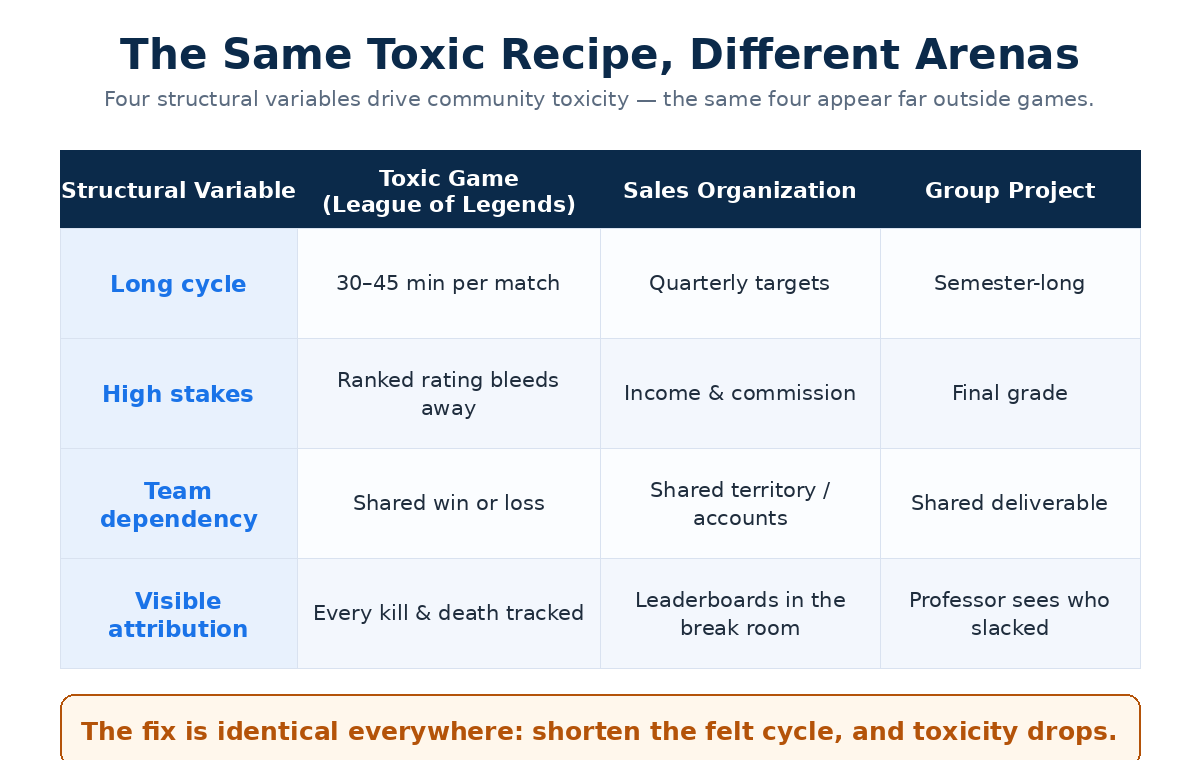
- This applies far beyond games. Any system with long cycles, team dependency, visible attribution, and high stakes will produce the same toxicity pattern. Think quarterly sales teams, open-plan offices, academic group projects. Shorten the feedback loop, add recognition for citizenship, and watch the hostility drop.
Table of Contents
- About the Creator of the Octalysis Framework
- The Obvious Variables Everyone Blames
- The Hidden Variable: Time Per Cycle
- The Recognition-Toxicity Duality
- How League of Legends Fights Its Own Design
- The Voting System Principle
- Beyond Games: Where This Shows Up in Real Life
- Frequently Asked Questions
- Related Reading
About the Creator of the Octalysis Framework

Yu-kai Chou created the Octalysis Framework after studying gamification since 2003 — years before the term entered mainstream vocabulary. As a Human-Systems Architect & Behavioral Designer, his framework has been applied by LEGO, Microsoft, Porsche, Coca-Cola, Salesforce, and MrBeast, impacting over 1.5 Billion Users.
Chou has taught the Octalysis methodology at Harvard, Stanford, Yale, Tesla, Google, BCG, and IDEO.
His work has been cited by Harvard, Stanford, MIT, Forbes, Wall Street Journal, Wired, US Department of Energy, NIST, NSF, NCBI, US Department of Education, ClinicalTrials.gov, and 3,700+ more academic publications. Explore his books here.
The Obvious Variables Everyone Blames
When people try to explain why a game community is toxic, they usually point to the same handful of suspects.
Competitiveness. Ranked systems with visible ratings create higher emotional stakes. When your rating is on the line, every mistake feels more costly.
Steep skill curves. Games where the gap between a good player and a mediocre one is enormous make that gap painful. You can feel when your teammate doesn’t belong at your level, and that feeling breeds resentment fast.
Team dependency. This one matters more than most people realize. When your personal performance is gated by your teammates’ competence, frustration becomes structural. You might have worked for 60 hours that month to squeeze out 3 more wins than losses. Then one session playing with weaker teammates wipes all of that out.
Rating volatility. Yo-yoing between ranks despite playing consistently triggers what I call Core Drive 8: Loss & Avoidance. You didn’t get worse overnight. The system just punished you anyway. That kind of perceived injustice is fuel for rage.
These are all real factors. But none of them explain the full picture.
Because here’s the thing — Brawl Stars has ranked mode, team dependency, and real competitive stakes. Yet its community is surprisingly chill compared to League of Legends.
Same type of player. Same competitive drive. Wildly different social outcomes.
Something else is going on.
The Hidden Variable: Time Per Cycle
The single most important variable that determines community toxicity is one almost nobody talks about: how long each cycle takes.
Think about it this way.
In League of Legends, a single match runs 30 to 45 minutes. If you get matched with a teammate who feeds kills to the enemy in the first 5 minutes, you know you’re going to lose. But you can’t leave. Leaving triggers penalties. So you sit there for 25 to 35 more minutes, grinding through a match that’s already over, watching your rating bleed away.
That’s not just frustration. That’s Core Drive 6: Scarcity & Impatience compounded by Core Drive 8: Loss & Avoidance. Your time is being stolen, and the loss is being forced on you in slow motion. The emotional investment scales with every passing minute.
Now compare that to Brawl Stars.
A round lasts a few minutes. Bad teammate? You lost 3 minutes. Queue again. The emotional price of failure is so low that rage doesn’t have runway to build.
Heroes of the Storm sits in between at 20 to 25 minutes per game. Less toxic than League, more toxic than Brawl Stars. The pattern holds perfectly. (Blizzard moved Heroes of the Storm into long-term sustainment in 2022, but the design choice we’re studying — shared team leveling — has survived nowhere else in the genre, so this remains the cleanest illustration.)
Even within Overwatch 2, you can see this play out. Casual unranked modes with shorter matches? Relatively chill. Ranked competitive mode where results stick, matches run longer, and individual hero stats are visible at the post-match screen? Toxicity spikes.
The formula looks something like this:
Toxicity = Results Matter × Time Per Cycle × Team Dependency
| Game | Typical cycle | Blame clarity | Toxicity pressure |
|---|---|---|---|
| League of Legends | 30 to 45 minutes | Very high, one feeder can feel obvious | High |
| Heroes of the Storm (in long-term sustainment, but still the cleanest design counter-example) | 20 to 25 minutes | Lower, shared leveling muddies blame | Medium |
| Brawl Stars | 2 to 3 minutes | Visible, but the damage ends fast | Low |
When you waste 45 minutes in a game you knew was lost at minute 10, that’s not just a bad gaming session. That’s a betrayal — at least that’s how your brain processes it. And betrayal makes people mean.
Research backs this up. A 2023 study in the European Journal on Criminal Policy and Research reviewed 328 League of Legends matches and found that 70% contained some form of toxic behavior, with only 10.9% consisting exclusively of more clearly harmful conduct. In other words, most of the toxicity was not random hate. It was disruptive, teammate-focused blame inside a system where people felt their time slipping away.
The Recognition-Toxicity Duality
Here’s where it gets really interesting, and where most game design analysis stops too early.
There’s a structural design tradeoff hiding inside the toxicity problem, and it’s one of those things that seems obvious once you see it but almost nobody designs for it deliberately.
The tradeoff: Systems that make individual performance visible create both recognition AND blame. You cannot have one without the other.
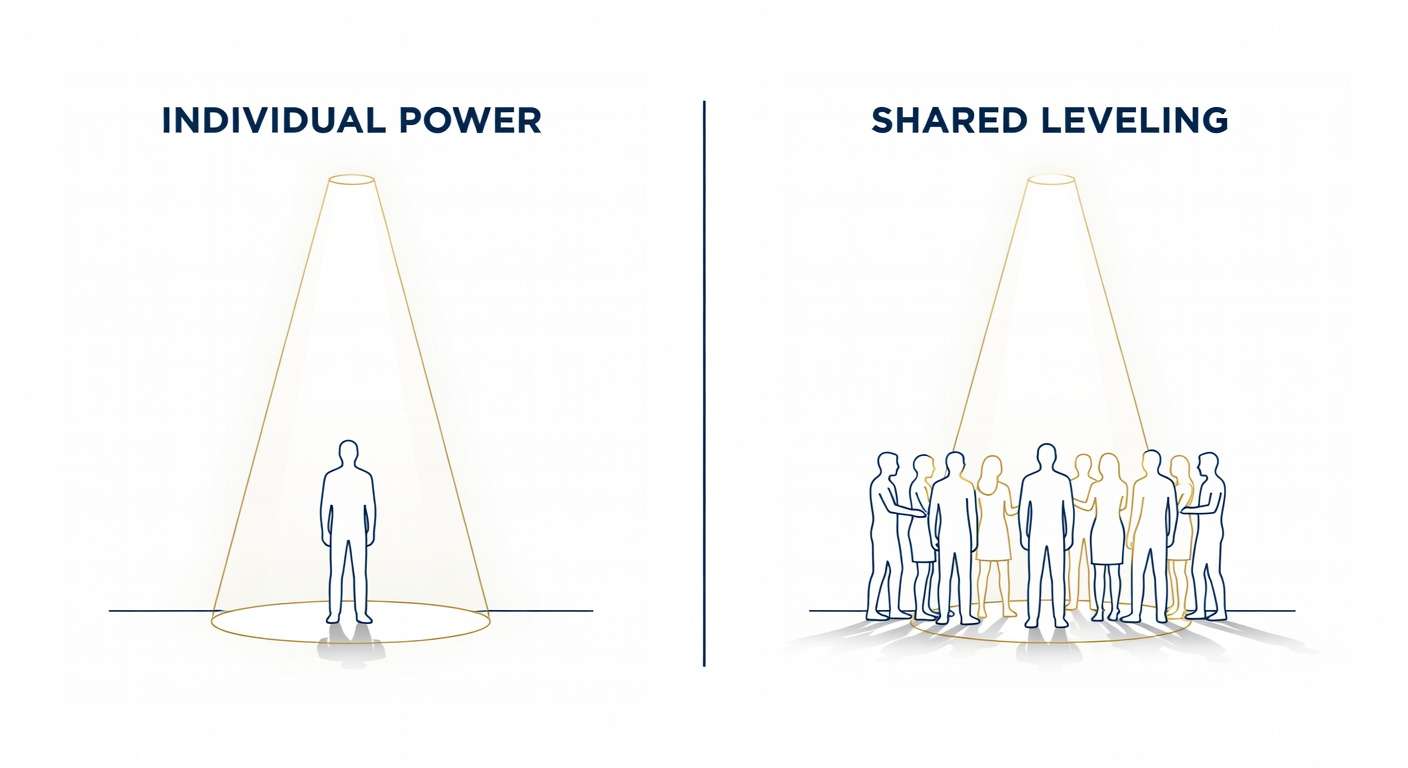
Let me show you what I mean with two games that solved this problem in opposite directions.
League of Legends chose individual power.
Each player levels independently. If you’re great, you become “super powerful,” able to carry your entire team through sheer individual skill. Your kills, your deaths, your farm, your item build: all of it tracked and individually attributable.
Strong players love this. Ownership. Agency. The ability to shine.
But that same attribution system means that when someone plays badly, everyone knows exactly who it is. The spotlight that creates accomplishment for top performers creates a blame target for everyone else.
Heroes of the Storm chose shared leveling.
The entire team shares one level. One person’s excellence lifts everyone slightly. One person’s failure drags everyone slightly. Individual performance is smoothed out, harder to attribute.
Result? Less toxic. Nobody can point at a specific player and say “you cost us the game” because the system deliberately obscures that information.
But there’s a cost. Strong players feel frustrated because they can’t carry. They can’t be the hero. Their superior skill doesn’t translate into a visibly superior impact. Core Drive 2: Development & Accomplishment, the drive that makes people feel good about getting better, gets muted.
That’s a different kind of dissatisfaction. Less toxic, yes. But it’s the dissatisfaction that slowly makes your best players leave.
This is the design paradox that almost nobody discusses honestly: you can reduce blame by hiding individual contribution, but you pay for it with reduced recognition for excellence. There is no free lunch in community design.
I’d give this pattern a name: The Spotlight Tax. Any system that hands you a spotlight for individual excellence is also shining that spotlight on every individual failure. You don’t get to keep the recognition mechanism and turn off the blame mechanism — they’re the same mechanism. Every game designer, every manager, every classroom teacher building a “performance leaderboard” is paying the Spotlight Tax whether they realize it or not. The only real choice is how to price it: surrender votes, character-based recognition, citizenship status, alternative achievement axes.
Most game design articles present toxicity reduction as pure upside. “Just make your game less toxic!” But they ignore the fact that every mechanism you use to reduce blame also reduces the clarity of achievement. That’s not a reason to ignore toxicity. It’s a reason to be thoughtful about which tradeoffs you’re making.
How League of Legends Fights Its Own Design
Riot Games didn’t choose to redesign League’s core attribution system. That would change the game at its core. Instead, they built mitigation systems around the edges. Three of them matter most.
1. The Surrender Vote
After a certain point in a losing match, the team can vote to end it early. This is brilliant because it attacks the hidden variable directly: it shrinks the demoralized-time-cycle.
Remember: much of the rage in League doesn’t come from losing. It comes from being forced to sit in a loss you can’t escape. Surrender gives players an exit valve before frustration compounds into hostility.
It doesn’t fix the design flaw. It puts a pressure-release valve on it.
2. The Honor System
At the end of each match, players vote on teammates. But here’s the key: they vote on character traits, not performance. The three Honor categories are: “You were chill” (stayed calm under pressure), “Great shot-caller” (good leadership), and “GG” (good friend/teammate).
Notice what’s missing? “Best player.” “Most kills.” “Carried the team.”
That’s intentional. In a community where the problem is hostility, you don’t want to reinforce the performance hierarchy that’s causing the hostility. You want to create an alternative status pathway: one that rewards being a good human, not just a skilled player.
In Octalysis terms, this is strengthening Core Drive 2 through a healthier channel. Your identity as a player isn’t solely defined by your win rate. There’s another axis of recognition where being kind and communicative is the achievement.
3. Cumulative Reputation Scoring
Honor votes accumulate into a visible reputation. Over time, consistently positive behavior builds a meta-status, recognition for who you are rather than how well you play. This taps into Core Drive 5: Social Influence & Relatedness in a constructive direction.
Riot also spent years tightening moderation around the edges. In its 2022 player-dynamics update, Riot said fewer than 10% of penalized players received another penalty within the same calendar year. In its 2023 behavioral systems update, Riot said automatic muting plus its GATES text-evaluation models let it act on over 15 times more disruptive text than before and opened the door to more real-time in-game reporting. By 2026, it had escalated severe abusive chat from comms penalties to gameplay bans. That is smart symptom control, but it still sits on top of the same structural pressure cooker.
The Voting System Principle
Here’s an insight that extends far beyond gaming, and it’s one I haven’t seen articulated anywhere else.
The purpose of your community’s voting system should match your community’s current health level.
League of Legends has a toxic community. So its end-of-game voting rewards character: being calm, being a good teammate, being friendly. The system is medicine for what ails it.
Heroes of the Storm has a healthier community (partly because of the shared leveling). So its end-of-game voting rewards performance: who played well, who had the best game.
This isn’t accidental. It’s a design principle:
Toxic communities should vote on character. Healthy communities can afford to vote on skill.
If you flip this. Ask a toxic community to vote on who played best? You just gave the mob another weapon. “Vote for me because I carried your sorry team.” That reinforces the attribution-blame cycle.
If you do it the other way (asking a healthy community to vote on character) you’re solving a problem that doesn’t exist while ignoring the recognition that top performers actually want.
This is the kind of nuance that separates thoughtful community design from surface-level gamification. You can’t just copy mechanics. You have to diagnose what your community actually needs and choose the mechanism that addresses that specific deficiency.
Beyond Games: Where This Shows Up in Real Life
Every variable I’ve described shows up in non-game contexts. The pattern is the same. Only the names change.
Sales organizations are the most obvious parallel. Quarterly sales targets with team quotas, visible performance dashboards, and individual attribution? That’s the exact same recipe. Long cycle (quarterly), high stakes (income dependent), team dependency (shared territory or accounts), and visible attribution (leaderboards in the break room).
Is it any surprise that toxic sales cultures are infamous? They’re structurally identical to a 40-minute League match where one underperformer drags everyone down.
The fix is similar too. Shorten feedback cycles, for instance weekly check-ins instead of quarterly reveals. Add recognition for citizenship behaviors, like “helped a colleague close a deal” alongside “highest revenue.” Reduce the cost of a bad week by decoupling compensation from single-period performance.
When you genuinely can’t shorten the macro cycle — quarterly earnings cycles, semester-long student groups, multi-year R&D projects — the move is to insert mid-cycle reset checkpoints. Each checkpoint is its own “round” with its own outcome and recognition. Sprint reviews inside a six-month launch. Mid-semester peer evaluations. Monthly variable-comp adjustments inside a quarterly target. The macro stake stays high, but the felt cycle drops to something the brain can metabolize without compounding rage. The frustration of being “stuck in a losing match” gets replaced by “we lost that round, here’s the next one.”
Academic group projects follow the same pattern. Long cycle (semester), high stakes (grade), team dependency (shared deliverable), visible attribution (the professor knows who didn’t contribute). Students who’ve been burned by freeloading teammates carry that resentment the same way a League player carries tilt from a feeding teammate.
Even open-plan offices can produce soft versions of this toxicity pattern. When performance is visible, cycles are long, and people depend on each other, the conditions for blame escalation exist. The office version just looks different. Passive aggression instead of all-chat flame wars, email complaints instead of surrender votes.
What I call the Do-Your-Job Game Trap is the workplace version of this problem. When the only recognition a system provides is for doing your job (performance), and there’s no recognition for being a good colleague (character), you get a culture that tolerates brilliance without kindness. That’s a toxicity time bomb.
The design lesson translates perfectly: before diagnosing a hostile community as “bad people,” check the structural variables. How long is a cycle? Can people exit bad situations early? Is individual attribution creating precise blame targets? Are you recognizing the behavior your community actually needs more of?
Toxicity is almost always a design outcome. Change the variables, and you change the behavior.
Frequently Asked Questions
Why is League of Legends so much more toxic than Brawl Stars if both are competitive?
Because toxicity scales with time-per-cycle, not competitiveness alone. A bad League match wastes 40+ minutes of your life. A bad Brawl Stars round wastes 3 minutes. The emotional cost of each failure is wildly different, and rage needs runway to build — short matches deny it that runway.
Does making individual performance visible always create toxicity?
Not always, but it creates the conditions for it. Performance visibility is a double-edged sword — it enables recognition for excellence and precise blame for failure. The key is whether the system provides enough positive outlets and escape valves to keep blame from becoming the dominant social dynamic.
Can these design principles prevent workplace toxicity?
They can significantly reduce it. Any workplace with long performance cycles, team dependency, and visible individual attribution is structurally similar to a toxic game. Shortening feedback loops, adding recognition for citizenship alongside output, and giving people escape valves from doomed projects all attack the same structural variables.
What is the most effective single change to reduce community toxicity?
Shorten the cycle length. When the cost of a bad interaction drops from 40 minutes to 3 minutes, the emotional stakes of every mistake plummet. Rage needs time to compound — remove the time, and you remove most of the rage.
Why does League’s Honor system focus on character instead of skill?
Because the community’s problem is hostility, not lack of skill recognition. Voting on character creates an alternative status pathway that rewards pro-social behavior. Healthy communities like Heroes of the Storm can afford to vote on performance because blame isn’t their dominant social pattern.
If you build communities — in games, in workplaces, in classrooms — the structural variables in this post will keep showing up until you start designing for them deliberately. My books on gamification go deeper, and the Community Design piece is the most-related companion to this one.
Related Reading
- What is Gamification?
- White Hat vs Black Hat Gamification
- Community Design: Building Tribes, Not User Bases
- The Do Your Job Game Trap
- Leaderboard Design: The Definitive Guide
- Status Design: Why Status Drives Behavior More Than Money
- Core Drive 2: Development & Accomplishment
- Core Drive 5: Social Influence & Relatedness
- Core Drive 6: Scarcity & Impatience
- Core Drive 8: Loss & Avoidance
- Octalysis: Complete Gamification Framework
- Books by Yu-kai Chou