

Every brand collab in mobile gaming follows the same script, where the two companies swap some skins, run a trailer, and cash the check. The Brawl Stars Duolingo collab did something I rarely see a studio try. It swapped the habit loops underneath the mascots.
Duolingo’s owl Duo showed up inside Brawl Stars as a 20-player boss who fires quiz questions at you mid-fight. Brawl Stars’ cactus Spike showed up inside Duolingo as the prize at the end of a seven-day streak quest.
Supercell’s own press release says the quiet part out loud: “It comes down to two green mascots fighting for the same thing: players’ time.” That sentence is the whole design brief. Two daily-habit apps competing for the same fifteen minutes decided to trade engines instead of fighting over the driveway.
I have been keeping a Duolingo streak for my Spanish, so I felt this one from both sides. Below is what the campaign actually did, mapped onto the 8 Core Drives, plus the two places the design fell flat and what I would have changed.
Speed Run Notes
- Most brand collabs stop at trading skins, while this one traded the behavior loops underneath: Brawl Stars borrowed Duolingo’s quiz and classroom, and Duolingo borrowed Brawl’s limited quest and Legendary unlock.
- The rivalry works because the mascots run on opposite fuel: Duo makes you fear losing a streak (Core Drive 8, Loss & Avoidance), while Spike is wanted because few own him (Core Drive 6, Scarcity & Impatience).
- Weeks of comment-section beef, trash-can installations, and an airplane banner did the awareness work a paid campaign would normally do, before a single in-app event had loaded.
- Ten million players tapped a shop tile labeled in Japanese to unlock a skin for everyone, and that is the strongest public proof the campaign moved people, because it is an action Supercell’s servers counted.
- The loot table is the weak point, because a free Legendary that most veterans already own is a reward aimed at the players least likely to want it, so the social layer ended up carrying the campaign.
In This Article
- Two Green Mascots Competing for the Same Fifteen Minutes
- How the Feud Did the Work of a Media Buy
- Inside the Duo Boss Fight: How the 20-Player Mode Actually Plays
- Classroom and Detention: The Community Ladder
- Spike in Duolingo: A Seven-Day Quest That Installs a Streak
- The 3.141592 Million Gem Giveaway
- The Octalysis Scorecard
- Where the Reward Design Fell Flat
- What Nobody Has Published Yet
- What to Steal for Your Own Product
- Frequently Asked Questions
Author Credibility: Yu-kai Chou

Yu-kai Chou created the Octalysis Framework after studying gamification since 2003 — years before the term entered mainstream vocabulary. As a Human-Systems Architect & Behavioral Designer, his framework has been applied by LEGO, Microsoft, Porsche, Coca-Cola, Salesforce, and MrBeast, impacting over 1.5 Billion Users.
Chou has taught the Octalysis methodology at Harvard, Stanford, Yale, Tesla, Google, BCG, and IDEO.
His work has been cited by Harvard, Stanford, MIT, Forbes, Wall Street Journal, Wired, US Department of Energy, NIST, NSF, NCBI, US Department of Education, ClinicalTrials.gov, and Google Scholar — with 3,700+ more academic publications. Explore his books here.

Two Green Mascots Competing for the Same Fifteen Minutes
The collab only makes sense once you look at what each mascot actually does for its product.
Duo is probably the most famous guilt trip in software, because the owl exists to make you feel the streak you are about to lose, and that feeling is Core Drive 8 (CD8): Loss & Avoidance in its purest consumer form. Duolingo built a club of more than 10 million users with 365-day streaks on that feeling, and the company reported 56.5 million daily active users in its first-quarter 2026 results.
Spike runs on the opposite fuel, because he is a Legendary Brawler, one of the rarest characters in the game, and his whole appeal is that most people do not have him, which makes him a walking example of Core Drive 6 (CD6): Scarcity & Impatience.
So when Supercell and Duolingo staged a rivalry between the two, they were staging a fight between loss and scarcity. Both apps live or die on the same fifteen minutes of your day.
I ranked Duolingo years ago in my breakdown of the best gamified education apps, and I have written about what makes Brawl Stars competitive in ways other shooters are not. I did not expect the two to trade their core loops.
Brawl Stars took Duolingo’s quiz, its classroom, and its streak buff. Duolingo took Brawl’s limited-time quest, its loot drops, and a Legendary unlock. ContentGrip put it best in their coverage: “The brands are effectively swapping their strongest behavior loops.”
That exchange is the part worth studying, because anyone can put a rival’s logo on a skin, and very few teams are willing to hand over the mechanic that keeps their own users coming back.
How the Feud Did the Work of a Media Buy
The in-app event went live on September 19, 2026, but the campaign had already been running since August 26.
For three and a half weeks before anyone could play anything, the two official accounts ran a slow-burn feud in each other’s comment sections, with Duolingo posting lines like “so forward! at least buy me dinner first” under Spike.
Then it moved into the physical world. Duolingo posted a short titled “someone vandalized hq this morning,” showing Duo’s face defaced, and Brawl Stars commented in character: “i feel for you little green thing, oh wait maybe i dont.” Brawl Stars then installed Duo in trash cans and posted “Put @duolingo in his natural habitat.” Duolingo answered with a plane trailing a banner: “when they go low i buy a plane @BrawlStars.”
None of this was fan chaos. The vandalism short, the trash cans, and the plane all came from the two official accounts, on a schedule, with the collab reveal sitting in the middle of it, which tells you the office defacing and the airplane banner were the campaign.
Before a single reward existed, that sequence was running on Core Drive 7 (CD7): Unpredictability & Curiosity, because every post left people wondering what the owl would do next and whether the cactus had really defaced an office. Each beat was a cliffhanger that cost almost nothing to produce and pulled millions of views on its own.
It also sets up Core Drive 5 (CD5): Social Influence & Relatedness. A rivalry with two sides invites you to pick one. Brawl players rallied behind Spike, Duolingo’s audience rallied behind Duo, and the eventual in-game showdown became a way to settle a beef you had already joined.
The numbers on the official side: the August 29 Brawl Talk reveal sits at 9.5 million YouTube views, the September 19 event explainer at 7.7 million, and the 40-second trailer at 4.8 million. That is roughly 22 million views on three videos before you count shorts, TikTok, Reels, or creator coverage.
Compare that to what a paid user-acquisition campaign would cost to reach the same eyeballs, and you see the design decision. The event only had to convert attention the feud had already earned.

Inside the Duo Boss Fight: How the 20-Player Mode Actually Plays
This is the first 20-player Boss Fight Brawl Stars has ever shipped, and I suspect the collab was partly an excuse to build it, because the mode is the durable asset Supercell keeps after Duo goes home.
The map is Duo’s classroom, and every match runs in two phases.
In the question phase, Duo asks three to five questions, some about languages and some about Brawl Stars itself. You get seven seconds to walk your Brawler into one of three answer zones. Answer right and you build a streak plus a 20% additive buff to health and damage. Answer wrong and your streak resets and you eat 6,500 damage.
Then Duo’s eyes go bloodshot and the battling phase begins. The questions stop, he attacks, and you spend the buffs you earned to burn through his health before the five-minute timer runs out. At Normal difficulty he has one million HP. At Impossible he has two million and God Mode.
Supercell’s blog adds the detail I love most: “Duo won’t remain patient forever.” A perfect quiz run does not save you.
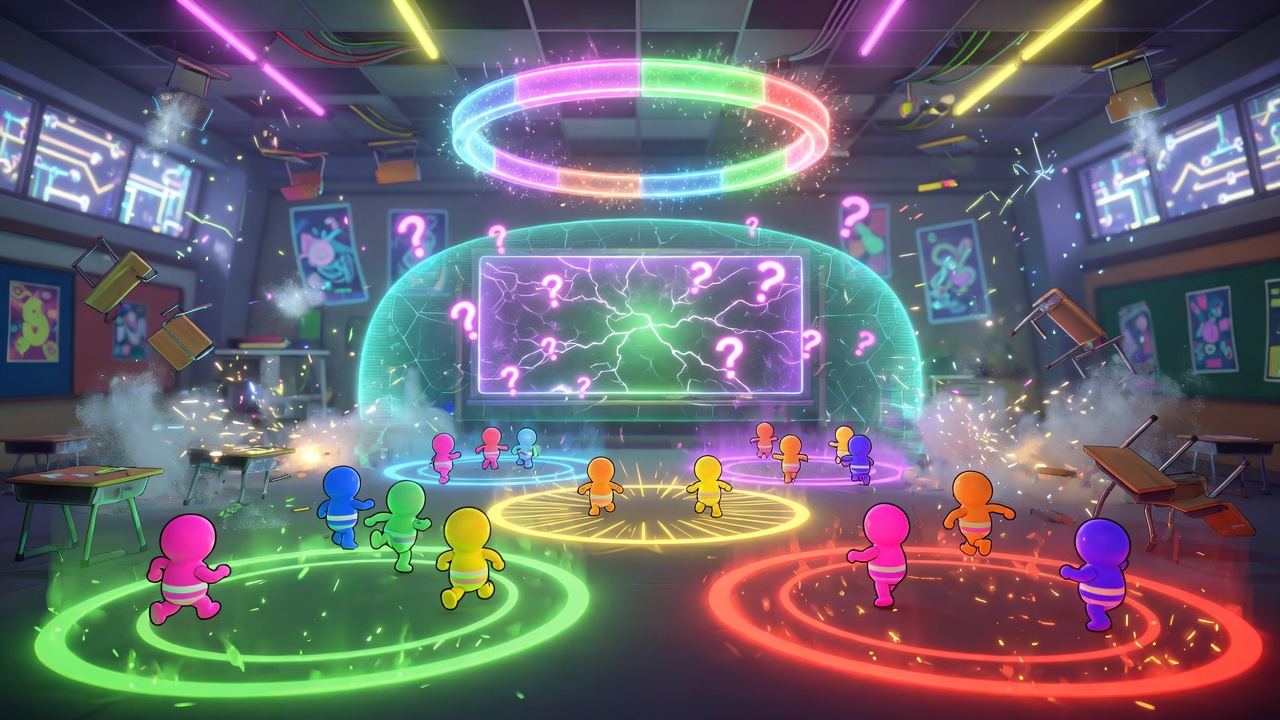
Map the psychology and you get a tight stack. The streak buff is Core Drive 2 (CD2): Development & Accomplishment, made visible as a growing number that everyone in the lobby can feel. The 6,500-damage penalty and the streak reset are CD8, imported straight from the streak-loss anxiety Duolingo already trained into 56 million people. Duo’s random questions and his unpredictable snap into rage are CD7.
The 20-player version adds a rule that most co-op modes skip, which is Elimination: defeated players do not respawn, so if you die at minute two you lose the match even if the other nineteen players kill Duo at minute four.
That single rule is why the mode feels like a classroom. Your mistake costs you, and it costs the group a body. CD5 cuts both ways: shared victory feels great, and a shared loss caused by a stranger feels terrible.

Classroom and Detention: The Community Ladder
If the boss fight is the part of the collab you play, the community event is the part you belong to, and it is where most of the social energy lived.
Supercell framed the whole thing as school. In the Classroom phase, the entire player base works toward a shared gameplay goal while Duo tries to teach. When players keep “playing Brawl during class,” the whole community gets sent to Detention, and escaping Detention requires what the official blog calls “specially stupid tasks.”
The ladder alternated Class and Detention twelve steps deep. The Class steps were volume goals: 40 million wins in the Duo mode, 5 trillion damage dealt, 40 million Brawl Ball wins, 8 million Duo Boss Fight quests, 10 million 20-player matches.
The Detention steps were the genius part, because they were tasks that no reward-optimizing designer would ever propose in a meeting.
- Email or comment a chicken recipe at a Brawl Stars creator until at least one of them cooks it on camera, which several creators did, and the recap short pulled 138,000 views.
- Get 3% of the entire player base to switch their in-game language to Italian. Players did, then flooded the comments asking how to switch back. The official follow-up: “Now you need to learn italian.”
- Drop 100,000 comments under one official video teaching Brawl Stars a word in your language.
- Get 10 million players to pick the “right” shop offer, where two identical free 10-coin offers sat side by side and one was labeled in Japanese.
That last one unlocked the Trash Goblin Darryl skin for the whole community by September 27, and Brawl Stars celebrated with “Proof that you can be literal trash and still win!” That post drew 7,437 likes, the strongest of the late campaign.
Ten million logged in-app actions is the single most concrete public number in this entire collab, because YouTube views only tell you that people watched, while a shop tap is an action Supercell’s own servers counted.
Seen through the framework, every Class step is a Group Quest: a goal no individual can hit, unlocked by aggregate effort, with a reward everyone shares. That is Core Drive 1 (CD1): Epic Meaning & Calling stacked on CD5. Your one Brawl Ball win is a drop in a 40-million bucket, and that is exactly why it feels like it counts.
The Detention steps run on a different fuel. Switching your language to Italian has zero gameplay value, and that is the point: it is a small, slightly annoying sacrifice you make in public, alongside millions of other people, for a joke. Behavioral scientists would call that a costly signal, and in a community it works like glue, because the people who did it now share something the people who skipped it do not.
Every one of those silly tasks is a shared inside joke with a price tag attached, and shared inside jokes are the strongest relatedness engine in CD5. The chicken recipe, the Italian client, the Japanese shop tile: none of them are about Duolingo’s product. All of them are about being the kind of player who was there when it happened, which is a stronger bond than any skin.
Spike in Duolingo: A Seven-Day Quest That Installs a Streak
Flip to the other app. Inside Duolingo, Spike replaced Duo as the temporary lesson mascot, and a Brawl Stars widget offered a Quest: complete any course lesson each day for seven days.
The reward track climbed from Chaos Drops on day one through Duolingo gems, chests, and a Duo-themed cosmetic bundle, to Spike himself on day seven. If you already owned Spike, you got 3,000 coins instead. The quest opened September 19, you had to start it by September 30, and the track stays open through October 1. Eleven calendar days to finish seven lesson-days, so a missed day did not kill the run.
Seven days of daily lessons is the exact length Duolingo needs to install the habit its entire business runs on, so Spike is really the bait that gets a Brawl player to open the app, and the streak he builds along the way is the thing Duolingo actually wanted.
This is Appointment Dynamics from Octalysis, a mechanic that asks you to return at a set time to collect something, which is CD6 and CD8 working together. The daily lesson also builds an endowed-progress loop. Once you are three days in, the four remaining days belong to you in a way that day one never did, and that is Core Drive 4 (CD4): Ownership & Possession. The goal-gradient effect takes over from there, and people who would have quit on day two start sprinting on day five.
Even the launch video added a CD2 taunt: “legend says only 6.8% of Brawl players are smart enough to complete this quest.” Supercell’s blog phrased it as “prove the green chicken wrong.” That is trash talk used as a status challenge. The number is a joke, and the joke works, because nobody wants to be in the 93.2%.
Here is where the asymmetry shows up, though. Brawl players were pushed out of their game and into language lessons. Duolingo learners were pushed out of their lessons and toward a shooter many of them had never opened.
Each side used the other as a reward layer, and reward layers only work when the reward matches what the person already wants. A Brawl player wants Spike, but a forty-year-old Duolingo Super subscriber learning French for a trip does not want Chaos Drops, and a thread on r/duolingo titled “Is anyone else grossed out by the Brawl Stars crossover?” is what that mismatch looks like in public.
Duolingo did include an opt-out, and parents in the same thread reported their kids loved it. But the lesson holds: a partner brand’s reward only motivates the slice of your audience that already values the partner. For everyone else it reads as an ad, and extrinsic rewards that miss can push people away.
The 3.141592 Million Gem Giveaway
The third layer was social. Brawl Stars called it “The Smartest Giveaway Ever”: 3.141592 million gems, pi on theme, split across ten winners. To enter, you answered surprise quiz posts on the official accounts with the hashtags #BrawlStars and #Duolingo, and the more correct replies you posted, the better your odds.
The September 21 “Math Surprise Test” pulled 11,524 replies. Spot-the-difference on September 25 pulled 3,805, and the final test on September 27 pulled 3,848. Roughly 19,000 replies across three posts, on a mechanic that costs the studio nothing but the prize pool.
This is a straight lottery, which is CD7, wrapped in a public participation loop, which is CD5. Replies are also a stronger signal than views, because someone has to decide to type a reply while a view can happen by accident while scrolling, and a quiz post that turns 417,000 views into 11,000 typed answers is converting at a rate most brand accounts would kill for.
One design note: a lottery where more replies means better odds rewards spam over thought. A cap per person would have kept all of the excitement and cleaned up the behavior at the same time.
The Octalysis Scorecard
Put the whole campaign on the Octalysis Framework and the shape is unusual. Most cross-promotions live entirely in Core Drives 4 and 6, which is the “here is a limited skin, go get it” model, while this one touched all eight in one way or another.

How each Core Drive shows up on each side of the collab
Core Drive 1 (CD1): Epic Meaning & Calling
Inside Brawl Stars: Community Group Quests: 40M wins, 8M boss quests, 10M shop taps unlock rewards for everyone
Inside Duolingo: Barely present, since the quest is personal and the “learn a language” meaning belongs to Duolingo’s base product rather than to the collab
Core Drive 2 (CD2): Development & Accomplishment
Inside Brawl Stars: Answer streak buffs, six difficulty tiers up to Impossible, the 6.8% taunt
Inside Duolingo: Seven-day reward track with a visible next reward every day
Core Drive 3 (CD3): Empowerment of Creativity & Feedback
Inside Brawl Stars: Thin, because choosing which answer zone to stand in is selection rather than creation, and the chicken-recipe task is the only real creative prompt
Inside Duolingo: None beyond the base product
Core Drive 4 (CD4): Ownership & Possession
Inside Brawl Stars: Trash Goblin Darryl skin, Duo pin, spray, and profile icon
Inside Duolingo: Spike unlock, endowed progress across the seven days
Core Drive 5 (CD5): Social Influence & Relatedness
Inside Brawl Stars: 20-player co-op, the mascot rivalry, Detention tasks done in public, giveaway replies
Inside Duolingo: Mostly absent inside the app; the social layer lived on Brawl Stars’ channels
Core Drive 6 (CD6): Scarcity & Impatience
Inside Brawl Stars: Twelve-day window, rotating boss lineups, the Legendary framing of Spike
Inside Duolingo: Start-by-September-30 deadline, one lesson per day gating
Core Drive 7 (CD7): Unpredictability & Curiosity
Inside Brawl Stars: Random quiz questions, Duo snapping into rage, surprise Detention tasks, the gem lottery, the whole IRL feud
Inside Duolingo: Chests and Chaos Drops on the reward track
Core Drive 8 (CD8): Loss & Avoidance
Inside Brawl Stars: Wrong answer costs 6,500 damage and your streak; Elimination means no respawn
Inside Duolingo: The streak itself, which is Duolingo’s native engine, now with Spike riding on it
Two things jump out of that table, and both of them matter for anyone planning a similar partnership.
First, the Brawl Stars side is heavy on the Right Brain drives (CD5, CD7) and the Duolingo side is heavy on the Left Brain drives (CD2, CD4, CD6). Right Brain drives are intrinsic and outlast the reward; Left Brain drives are extrinsic and fade once the prize is claimed. That imbalance predicts something: Brawl players are likely to remember the campaign itself, while Duolingo learners are more likely to remember only the loot they collected.

The Right Brain side is the intrinsic half of the octagon, and it is where most of the Brawl Stars campaign lived, from the mascot feud to the 20-player lobbies to the surprise Detention tasks.

Second, look at the White Hat and Black Hat balance. The boss fight itself leans Black Hat, with CD8 penalties, a CD6 timer, and CD7 randomness pressing on you inside a five-minute match. The community ladder around it leans White Hat, with CD1 shared goals, CD2 milestones, and CD5 belonging. Putting the Black Hat pressure inside the match and the White Hat meaning around it is the right way to use the dark drives, because the pressure ends when the match ends and the good feeling stays.

The Black Hat drives at the bottom of the octagon are the ones the boss fight leans on, and they are effective precisely because a five-minute match gives them a hard stop.

If you want the full walkthrough of all eight drives before you reuse this scorecard, here is my lesson on the 8 Core Drives from the Octalysis Masterclass.

Where the Reward Design Fell Flat
The loot table is where I would have pushed back in the design room.
The capstone reward on the Duolingo side is Spike. A Legendary sounds like a big prize, until you remember that Brawl Stars has been live since 2018 with over a billion lifetime downloads. The players most likely to grind seven days of lessons for a Brawler are the most engaged players, and the most engaged players already own Spike.
For them the reward collapses into 3,000 coins, and the r/Brawlstars threads said exactly what you would expect: a Legendary’s fallback should be worth more than a week of grinding, and 3,000 coins is not it.
The Brawl Stars community reward has the same problem from a different angle. Trash Goblin Darryl is a fun skin, but it is a Darryl skin with trash-can theming, when the thing the community asked for was a Duo skin. Fans named their wish list in the threads, asking for a Duo skin on Spike, Crow, El Primo, or Mr. P, and Supercell shipped none of them.
In Octalysis terms, both rewards are CD4 pinches aimed at the wrong segment. The endgame player wants something exclusive, which is CD6, or something that expresses identity, which is CD4 at its strongest. A cosmetic that ties the two mascots together would have done both of those jobs, while a Legendary they already have does neither.
Here is what I would have changed, in order of cost.
Make the day-seven reward a Duo-themed Spike skin, available only through the Duolingo quest, never in the shop. That is a true CD6 exclusive with built-in CD4 identity, and it is worth a week of lessons to a veteran in a way that 3,000 coins never will be.
Turn the Duo pin, spray, and profile icon into a real Collection Set that completes only when you have done at least one thing on each side of the collab: a boss-fight win, a Detention task, and a finished Duolingo lesson. The pull of the missing piece would have pushed more Brawl players across the bridge, and it would have given veterans who already own Spike a reason to care.
What Nobody Has Published Yet
The temptation with a campaign this loud is to declare it a success. As of this writing, two days before the event closes, neither company has released an install number, a daily-active number, a revenue figure, or a quest completion rate.
The “6.8% of Brawl players” line is a joke in a launch video, and it should never be quoted as data. The 8-million-quest target was published and later rewards went live, so it was very likely hit, but Supercell never posted the final count.
What we can say with receipts: three official videos passed 22 million combined views, one quiz post drew over 11,000 typed replies, 3% of an active player base switched their client to Italian, 100,000 comments landed under one video, and 10 million players tapped a Japanese shop tile. Those are participation numbers, and they are big.
What we cannot say is whether Duolingo gained learners who stayed, or whether Brawl Stars gained sessions that turned into revenue. Both companies used tracked install links in their video descriptions, so they have those numbers, and they have simply chosen not to share them yet.
The earliest realistic window for real results is Duolingo’s next earnings call or a Supercell community recap. I will update this post when either of them lands, and until then the honest verdict is “mobilized at scale, return unknown.”
What to Steal for Your Own Product
The design moves transfer well beyond shooters and language apps.
Trade behavior loops, and treat the logos as a bonus. Before you sign a partnership, name the single behavior loop each side is best at. Then ask what it would look like to run their loop inside your product with your content. A quiz inside a fight and a quest inside a lesson are more interesting than a co-branded banner.
Build the story before you build the feature. Three and a half weeks of a feud that cost a plane rental and some trash cans out-performed most paid launches, because people will follow a narrative with two sides long before they will follow a feature list.
Make the community goal something your servers can log. Ten million shop taps is worth more than ten million views, because it proves people did the thing inside your product rather than watching someone else talk about it.
Give the crowd a stupid, shared sacrifice. The Italian language switch is the most quietly brilliant mechanic in the campaign, because it cost nothing to build, it was mildly annoying to do, everyone did it in public, and the people who did it will remember it. A small shared inconvenience builds more belonging than a big private reward.
Check the capstone against your most engaged users. Before you ship a prize, ask what percentage of the people who will actually finish already have it. If the answer is “most of them,” you have designed a reward for the people who will not show up.
Two green mascots spent a month fighting for your time, and the fight itself turned out to be the most valuable thing either company shipped. Attention is hard to win and habits are even harder to install, and the studios that understand the loops underneath their mascots are the ones that will keep winning both.
Frequently Asked Questions
When does the Brawl Stars Duolingo collab end?
The in-game event in Brawl Stars runs from September 19 through September 30, 2026. The Duolingo quest had to be started by September 30 and stays open through October 1, and the ten winners of the 3.141592 million gem giveaway are contacted after October 1.
How do you get Spike for free in the Duolingo quest?
Open the Brawl Stars quest inside the Duolingo app and complete any course lesson on seven separate days within the eleven-day window. Day seven awards Spike, and if you already own him, the game gives you 3,000 coins instead.
What is the Duo Boss Fight in Brawl Stars?
A cooperative boss mode set in Duo’s classroom, available in 3-, 5-, and 20-player versions. Duo asks quiz questions, correct answers build a streak that buffs your health and damage, wrong answers deal 6,500 damage and reset the streak, and once Duo loses patience he attacks. In the 20-player Elimination version, defeated players do not respawn.
Which Core Drives does the collab use most?
Core Drive 5 (Social Influence & Relatedness) and Core Drive 7 (Unpredictability & Curiosity) carry the Brawl Stars side through the mascot feud, the 20-player co-op, and the surprise Detention tasks. Both the streak penalty in the boss fight and the streak itself in Duolingo run on Core Drive 8 (Loss & Avoidance). Behind the Spike unlock and the limited window sit Core Drive 4 (Ownership & Possession) and Core Drive 6 (Scarcity & Impatience).
Was the Brawl Stars Duolingo collab a success?
It mobilized in-game actions at a scale few collabs reach: 10 million players tapped a Japanese-labeled shop offer, 3% of the player base switched languages, and three official videos passed 22 million combined views. Neither company has published installs, daily actives, or revenue, so any claim about business results is still a guess.
Go Deeper on the Loops Behind the Mascots
If the scorecard above made you want to run the same analysis on your own product, the full method is in my books. Actionable Gamification walks through all 8 Core Drives with the case studies behind them, and 10,000 Hours of Play applies the same thinking to your own life. Start with the books here, and read the Core Drive chapters first if you want the scorecard to make sense on your own product.
Related Reading
- The 10 Best Gamified Education Apps, Duolingo Included
- Why Games Turn Toxic: The Hidden Variable in Game Design
- 10 Best Mobile Games Mastering Gamification Design
- FOMO: An S-Tier Behavioral Designer’s Guide
- The Zeigarnik Effect and Why Unfinished Streaks Nag at You
- White Hat vs Black Hat Gamification