
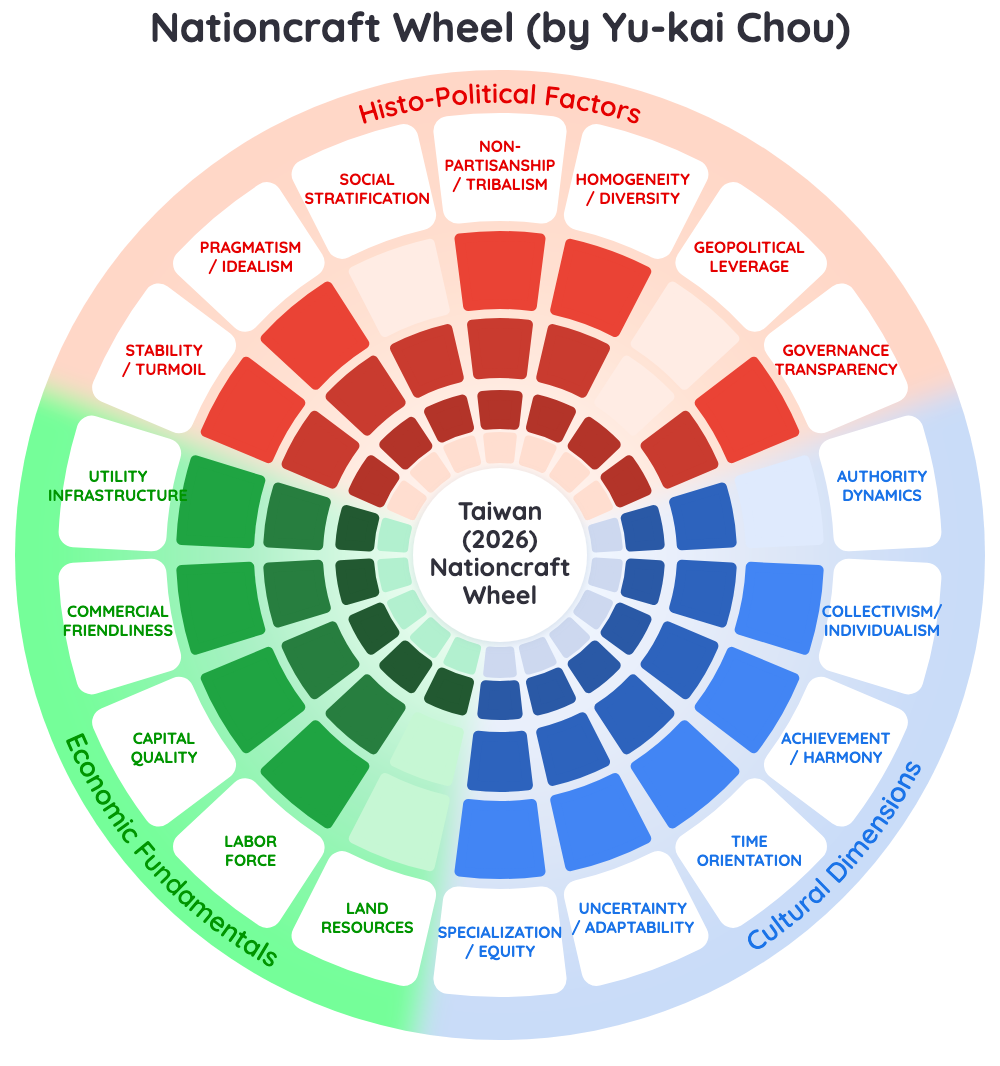

Taiwan should not be able to look like this. The map says small island, twenty-three million people, no oil, no domestic auto industry, no UN seat, no formal diplomatic recognition from any major power. The Nationcraft profile says something else. On sixteen of the eighteen Nation Variables, Taiwan scores at or near the top of the scale: long time horizon, high labor force quality, elite capital quality, world-class utility infrastructure, dense commercial friendliness, a stable democracy that has survived three peaceful transfers of power. By every internal measure the Nationcraft Framework tracks, Taipei built a near-optimal state on a piece of land that was producing US$100 per capita in 1950.
The two variables Taiwan does not dominate are the two it cannot legislate around. V12 Geopolitical Leverage sits at 3/10. V14 Land Resources sits at 2/10. And those two scores are exactly where the rest of the world has decided to apply force in 2026. Beijing has spent the eighteen months since President Lai Ching-te’s inauguration ramping People’s Liberation Army (PLA) aircraft and naval activity around the island. The opposition Kuomintang–Taiwan People’s Party (KMT-TPP) majority in the Legislative Yuan has frozen the NT$1.25 trillion special defense budget that Lai proposed in November 2025 to take spending to 3.3% of GDP. The Trump administration’s 100% chip tariff threat has rewritten the calculus around TSMC’s Arizona expansion, now reported as a potential US$465 billion footprint. Lai’s approval rating is in the low thirties. The Constitutional Court, paralyzed by the opposition’s December 2024 Procedure Act amendment, cannot rule.
This is the paradox the Nationcraft Framework is built to surface. A nation that mastered sixteen of its eighteen variables can still be unraveled by the two it does not control, and the variables it does control can become the very target the antagonist wants to hold. That is the Silicon Shield Paradox. The same V15 Labor Force Quality and V16 Capital Quality that built TSMC is what makes Taiwan strategically irreplaceable to global supply chains, which is what makes it the most contested real estate on earth, which is what stresses V7 Stability and V12 Geopolitical Leverage in 2026. The shield deflects fire and draws fire at the same time.
This analysis runs Taiwan through the full 18-variable Nationcraft profile, names the paradox, walks the V-vector variable by variable, identifies the Success Packets that actually fit the configuration, and rejects the imported playbooks that would not survive contact with V1 Authority Dynamics under a split executive-legislature regime. It is written for the policy maker who has read the Lee Kuan Yew and Park Chung-hee case studies and wants to know which parts transplant and which do not. Quality of the diagnosis matters more than enthusiasm of the prescription. Taiwan does not need cheerleading. It needs a frame.
⚡ Speed Run Notes
- The paradox. Taiwan scores elite (7-9/10) on sixteen of eighteen Nation Variables, but V12 Geopolitical Leverage sits at 3/10 and V14 Land Resources at 2/10 — the two scores it cannot legislate around.
- The shield is also the target. V16 Capital Quality and V15 Labor Force Quality built TSMC, which deters attack by making global supply chains depend on Taiwan — and simultaneously makes the island the single most strategically valuable territory on earth.
- Internal gridlock, not turmoil. V7 Stability is 8/10; V1 Authority Dynamics is 6/10. The Democratic Progressive Party (DPP) holds the executive, the KMT-TPP coalition holds the legislature. The NT$1.25 trillion special defense budget proposed November 2025 has been stuck since.
- Constitutional Court paralysis. The KMT-TPP Constitutional Court Procedure Act amendment of December 2024 raised the quorum for rulings, effectively freezing V13 Governance Transparency enforcement at a moment when it is most needed.
- The native packet still fits. SP-009 KMT Economic Miracle Packet (1949-1990) — Taiwan’s own — remains the operative template. SP-002 Lee Kuan Yew Industrialization and SP-008 Park Chung-hee Industrialization share the Tiger pattern but assume V1 Authority Dynamics of 8-9, which Taiwan no longer has.
- Sequencing matters. Protect V13 before reforming V1. Harden V12 before deepening V18. Anchor TSMC overseas without hollowing the home cluster — V16 is the load-bearing variable for the entire shield.
Table of Contents
- Understanding Taiwan’s Governance Landscape Through Nationcraft
- What is the Nationcraft Framework?
- Why This Taiwan Variables Analysis Matters Right Now
- The 18 Taiwan Nation Variables
- The Silicon Shield Paradox
- Detailed Justifications: Reading the Vector Variable by Variable
- Strategic Implications of Taiwan’s V-Vector
- Best-Match Historical Packets for Taiwan
- Governance Strategy Recommendations
- Comparative Context: Taiwan vs South Korea, Singapore, Ukraine
- The Nationcraft Framework in Practice
- Explore More Nationcraft Analyses
- Related Reading
- Frequently Asked Questions
- Footnotes
About Yu-kai Chou

Yu-kai Chou is a Human-Systems Architect & Behavioral Designer and the creator of the Nationcraft Framework — an 18-variable diagnostic for matching a country’s structural profile to the reform packets that have historically worked under similar conditions. He has consulted for governments in eight nations, including Ukraine, the United Kingdom, the Kingdom of Bahrain, Singapore, Taiwan, the Netherlands, Kazakhstan, and South Korea, and has worked directly with President Zelenskyy’s team on post-war reconstruction priorities for Ukraine.
Chou’s prior framework — the Octalysis Framework — has been applied by LEGO, Microsoft, Porsche, Coca-Cola, Salesforce, and MrBeast, impacting over 1.5 Billion Users. He has taught the methodology at Harvard, Stanford, Yale, Tesla, Google, BCG, and IDEO.
His work has been cited by Harvard, Stanford, MIT, Forbes, Wall Street Journal, Wired, US Department of Energy, NIST, NSF, NCBI, US Department of Education, ClinicalTrials.gov, and Google Scholar — with 3,700+ more academic publications. Explore his books here.
This Taiwan analysis builds on Chou’s first-hand work with Taiwanese officials, eighteen years of family roots in Taipei and Hsinchu, and direct engagement with the semiconductor cluster that anchors the island’s geopolitical leverage. The Nationcraft Framework is applied here to one of the most internally optimized small states in modern history — and to the single externality, geopolitical leverage, that the Taipei system cannot legislate around.
Understanding Taiwan’s Governance Landscape Through Nationcraft
The reason most published analyses of Taiwan miss the actual reform question is that they pick the wrong frame. National Security analysts read Taiwan through the Beijing lens and produce a war-or-no-war binary. Economic columnists read it through the TSMC lens and produce a tariff-and-supply-chain narrative. Democracy scholars read it through the post-2024 election lens and produce a legislative-gridlock story. All three are true. None of the three captures the underlying structural fact: Taiwan is a near-fully-optimized small state operating with two unfixable external variables. Until the analytical frame holds all eighteen variables at once, the recommendations that come out will overweight whichever lens the analyst happened to use.
The Nationcraft Framework is the diagnostic the rest of this post will use. It scores every country on the same 18 Nation Variables — from V1 Authority Dynamics through V18 Utility Infrastructure — and matches the resulting profile against the historical Success Packets and Failure Packets that have either worked or failed under similar V-vector preconditions. The framework’s central claim is that reform packets are not portable in the abstract. Singapore’s Lee Kuan Yew Industrialization Packet worked because Singapore had specific V1, V2, V8, and V12 values that fit the template. Trying to run the same packet against Venezuela’s V-vector, as the recent Venezuela analysis showed, breaks against V7 Stability and V13 Governance Transparency long before the policy details matter.
Taiwan in 2026 is a stress test for the framework. The country has run a Tiger pattern, ET-003 in the Historical Patterns catalog, for more than half a century. It also sits in the Buffer State Squeeze pattern ED-002, which describes small or medium states caught between a peer-superpower neighbor and a distant security guarantor. The Tiger and Buffer overlay is exactly what makes Taiwan such a useful Nationcraft case: it isolates the variables a country can build (V15, V16, V17, V18) from the variables a country cannot manufacture (V12, V14). Taipei has won the first set decisively. The second set is what 2026 is testing.
What is the Nationcraft Framework?
The Nationcraft Framework is an 18-variable diagnostic that scores a country’s structural profile on a 1-10 scale across the categories that historically determine which reform packets survive contact with reality and which collapse. The full framework is documented on the Nationcraft hub page, but the short version is this: every country has a V-vector, every Success Packet has a V-vector precondition, and you cannot prescribe a packet whose preconditions the target country fails to meet. Most reform failures across the post-1945 record are not failures of policy detail. They are precondition mismatches.
The 18 variables are organized into structural and resource clusters. Variables V1 through V11 are the political-cultural-social configuration: how authority moves, how collective the society is, how it relates to time, uncertainty, and stratification. Variables V12 through V18 are the geopolitical-material configuration: leverage, transparency, land, labor, capital, commercial environment, infrastructure. The Nationcraft method does not average these scores; configuration is strategy. A V1=8 V12=3 country is a fundamentally different reform target from a V1=3 V12=8 country, even if the simple average is identical.
The framework is paired with a Success Packets catalog, currently at 118 documented reform packets, indexed by which V-vector preconditions each packet required to function. SP-002 Lee Kuan Yew Industrialization needed V1 ≥ 8, V8 ≥ 7, V12 manageable. SP-008 Park Chung-hee Industrialization needed similar V1 and V8 plus a different V11 Homogeneity score. SP-003 Deng Xiaoping Open Reform needed a controlled-authoritarian V1 and an unusually high V8 Pragmatism. The catalog turns the question “what should this country do?” into the question “which packets had preconditions this country meets, and what did sequencing look like for those packets?”
For broader context on the philosophy behind the framework, the Nationcraft and Octalysis meta-piece traces how the same behavioral-design discipline that produced the Octalysis Framework for product design carries over to national reform, where the unit of analysis becomes the population-level motivation profile rather than the individual user.
Why This Taiwan Variables Analysis Matters Right Now
Three time-sensitive shifts in the past twelve months put Taiwan’s V-vector under sustained pressure, and none of them is going away on the current cron schedule.
The legislative-executive gridlock has solidified. The Bluebird movement’s mass recall campaign against 31 KMT legislators in July and August 2025 ended with zero successful recalls. That is the structural fact that defines V1 Authority Dynamics for the rest of Lai’s term. The DPP cannot legislate around the KMT-TPP majority, and the voters who turned out for the recalls were not enough to flip the balance. Every defense, constitutional, and budgetary lever now requires opposition cooperation. The October 2024 Constitutional Court ruling that struck down most of the KMT-TPP “Contempt of the Legislature” Act bought the executive some procedural breathing room, but the December 2024 Constitutional Court Procedure Act amendment — raising the quorum for rulings to ten justices and requiring nine to declare unconstitutionality — has effectively frozen V13 Governance Transparency enforcement at the very moment the system needs it.
Cross-strait military pressure is now a permanent operating condition. The PLA’s December 2025 blockade-style drills, the April 2026 Chinese carrier transit, and the daily Ministry of National Defense (MND) bulletins reporting 30-60+ PLA aircraft sorties on peak days have moved Taiwan from “occasional crisis” to “continuous Buffer State Squeeze.” V12 Geopolitical Leverage at 3/10 is not stale — it is the operating reality. Lai’s November 2025 announcement of a 3.3% GDP defense target for 2026, with a path to 5% by 2030, is a V12 hardening play. The NT$1.25 trillion special defense budget is the instrument. The opposition is the friction.
The shield is being globalized — by Taipei’s choice and by Washington’s pressure. TSMC’s Arizona footprint, currently US$165 billion committed and reportedly headed toward US$465 billion under a proposed US-Taiwan trade arrangement that would cap tariffs at 15%, is the V16 Capital Quality move that defines the next decade. The second Arizona fab moves equipment in October 2026 with volume production targeted for Q4 2027, ahead of the original 2028 schedule. The Nationcraft question is not whether TSMC should diversify. It is whether the diversification preserves enough Hsinchu-cluster gravity to keep the Silicon Shield deterrent intact, or whether the diversification gradually rebalances V16 toward Arizona in a way that lowers the cost of a future hostile move against the island.
The 18 Taiwan Nation Variables
The table below is Taiwan’s 2026 Nation Variables vector as scored against the canonical Nationcraft scale. Scores are 1-10 where 1 is the structural minimum and 10 is the structural maximum for that variable. Justifications are condensed; the per-variable section below works each one out in full.
| Variable | Score | Behavioral observation |
|---|---|---|
| V1 Authority Dynamics | 6/10 | Constitutionally strong presidency under Lai, but executive authority is structurally constrained by a KMT-TPP majority in the Legislative Yuan and a paralyzed Constitutional Court. Authority is legitimate but not consolidated. |
| V2 Collectivism vs Individualism | 8/10 | Confucian-derived in-group prioritization, dense family and clan networks, civic mobilization patterns (the Sunflower Movement, the Bluebird Movement) that read as collective rather than atomized political action. |
| V3 Achievement vs Harmony | 8/10 | Education-driven achievement culture, intense credentialism, family pressure on academic and professional advancement — the cultural substrate that fed the engineering pipeline TSMC consumes. |
| V4 Time Orientation | 9/10 | Decades-long industrial planning horizons. The Ten Major Construction Projects of 1974, the Hsinchu Science Park of 1980, TSMC of 1987 — all consequences of a system that thinks in twenty-year arcs. |
| V5 Uncertainty & Adaptability | 7/10 | High formal rule-following, but pragmatic adjustment under existential pressure. The 1996 missile crisis, the 2008 financial crisis, and the 2020 pandemic each produced rapid policy pivots without regime instability. |
| V6 Specialization vs Equity | 7/10 | Strong specialization in semiconductors, electronics, ICT — with relatively compressed income inequality compared to peer Tigers. The SME-led growth model of SP-009 produced a wider distribution of ownership than the chaebol model of SP-008. |
| V7 Stability vs Turmoil | 8/10 | Three peaceful presidential transfers since 2000. The institutional gridlock of 2024-2026 is procedural friction, not political violence. Civil order remains high. |
| V8 Pragmatism vs Idealism | 8/10 | The DPP’s “maintain the status quo” posture and the KMT’s “no surrender, no provocation” posture both reflect deeply pragmatic positioning. Cross-strait policy is calibrated, not ideological. |
| V9 Social Stratification | 5/10 | Class mobility through education remains real but credentialism and housing-cost pressure in Taipei have flattened the curve in the last decade. |
| V10 Non-Partisanship vs Tribalism | 7/10 | Strong issue-based political competition rather than identity-based fragmentation, though the Green-Blue divide remains structural. The 2025 recall failures showed how stable the partisan equilibrium has become. |
| V11 Homogeneity vs Diversity | 7/10 | Han-Chinese majority with a meaningful indigenous Austronesian minority, post-1949 mainlander/Hoklo/Hakka divisions now substantially blurred by intergenerational integration. |
| V12 Geopolitical Leverage | 3/10 | The defining external constraint. No UN seat, formal recognition from only thirteen states, security relationship with the US governed by strategic ambiguity. The Silicon Shield is the only leverage instrument that scales — and it is a deterrent, not a recognition substitute. |
| V13 Governance Transparency | 7/10 | Free press, independent judiciary in principle, robust civil society. Score is depressed from a higher reading by the Constitutional Court Procedure Act paralysis and the legislative reform crisis, but underlying institutional capacity is intact. |
| V14 Land Resources | 2/10 | Small island, limited arable land, no domestic fossil fuels, geographic vulnerability to typhoons and earthquakes. Concentration of strategic infrastructure on a single landmass is itself a vulnerability. |
| V15 Labor Force Quality | 8/10 | Top-tier engineering talent pipeline, high tertiary education attainment, language-bridge advantage with both English-language R&D and Chinese-language operations. The reason TSMC’s Hsinchu side remains irreplaceable. |
| V16 Capital Quality | 8/10 | Mature equity markets, US$1.7+ trillion TSMC market cap as of 2026, sophisticated venture and growth capital ecosystem, deep export-credit and trade-finance institutions. |
| V17 Commercial Friendliness | 8/10 | Top-quartile World Bank Ease of Doing Business positioning, strong intellectual property enforcement, predictable corporate law regime, dense supplier networks. |
| V18 Utility Infrastructure | 8/10 | Reliable electricity (though stressed by chip-fab demand), world-class telecommunications and broadband, integrated transport and port infrastructure, robust water and sanitation despite limited freshwater. |
Read the table once for the shape, not the individual scores. Sixteen variables sit in the 7-9 band. Two — V12 and V14 — sit at 3 and 2. That is not noise. That is the signature of a country whose Nationcraft profile is solved on every variable that internal policy can move, and unfinished on every variable that external geography and recognition determine. The Silicon Shield Paradox is the name for what this configuration produces in 2026.
The Silicon Shield Paradox
The Silicon Shield is the name the policy community has given to Taiwan’s dependency-induced deterrent. The argument runs: the global semiconductor supply chain depends on TSMC; TSMC depends on Hsinchu, Tainan, and Taichung; therefore an attack on Taiwan would destroy the production capacity the attacker also needs. The shield deters because rational adversaries do not destroy assets they want to capture intact.
The Nationcraft Framework lets us state precisely why this is also a paradox. The shield is built out of V15 Labor Force Quality, V16 Capital Quality, V17 Commercial Friendliness, and V18 Utility Infrastructure — four variables Taipei spent fifty years optimizing. The optimization succeeded. But the more successful the optimization, the more concentrated the value, and the more concentrated the value, the more strategically attractive the territory becomes to any peer competitor that can plausibly project force into the Western Pacific. V15 and V16 produced the shield. The shield, by its own existence, raises the value of V12 control. V12 — Geopolitical Leverage — is precisely the variable Taiwan cannot legislate. The shield deflects fire and draws fire at the same time.
The Park Chung-hee Industrialization Packet (SP-008) did not have this problem. South Korea had a peer-superpower neighbor in North Korea but a distant security guarantor that recognized Seoul as the legitimate Korean state. The Lee Kuan Yew Industrialization Packet (SP-002) did not have this problem either. Singapore had ambiguous regional geopolitics but no rival claiming sovereignty over the same territory. The KMT Economic Miracle Packet (SP-009), Taiwan’s own foundational packet, was operated under the umbrella of the 1954 US-Taiwan Mutual Defense Treaty and US recognition through 1979. The current Taiwan profile is the first time a Tiger configuration has been run with V12 = 3 and the antagonist explicitly claiming the territory as its own.
Three downstream consequences flow from the paradox. First, the Nationcraft sequencing logic for SP-009 — agriculture stabilization in the 1950s, import substitution in the 1960s, export promotion through the 1970s, technology cluster build-out through the 1980s — cannot be reversed. The cluster exists. The leverage problem is downstream of the cluster, not upstream. Second, the marginal investment that hardens V12 — asymmetric defense, civil defense, fuel and food stockpiles, the special defense budget — is exactly the investment the opposition has frozen. The variable that needs the most policy oxygen has the least political consensus. Third, the cluster’s globalization, via TSMC Arizona, redistributes V16 across two sovereign jurisdictions in a way that may erode the deterrent the Hsinchu-only configuration produced. The paradox is recursive.
This is why Taiwan’s reform debate cannot be settled inside any single ministry. V12 hardening is a defense ministry problem. V13 protection is a justice ministry problem. V16 anchoring is an economic affairs problem. V18 resilience is an infrastructure problem. The Nationcraft Framework is the cross-ministry diagnostic because no single policy lever moves more than two of the four shield-supporting variables. The work has to be sequenced, and the sequencing logic depends on which variable is failing fastest.
Detailed Justifications: Reading the Vector Variable by Variable
The V-vector summary table gives the headline score. The reform question requires the depth. Each variable below carries the specific 2024-2026 behavioral evidence that produced the score, the directionality (rising, stable, declining), and the policy lever that moves it.
V1 Authority Dynamics — 6/10
Taiwan’s presidency is constitutionally strong but politically constrained. President Lai Ching-te won 40.05% of the 2024 presidential vote, which is a mandate but not a majority. The KMT-TPP coalition holds 60 of 113 Legislative Yuan seats. The May 2024 “Contempt of Legislature” Act and related expansions of legislative oversight were the opposition’s attempt to harden their veto over the executive; the Constitutional Court annulled most of the package on 25 October 2024. The December 2024 Constitutional Court Procedure Act amendment is the opposition’s response — raising the quorum to ten justices and requiring nine for unconstitutionality rulings, which effectively prevents the Court from blocking future opposition legislation while several justice seats remain unfilled. V1 reads as 6 because executive authority is procedurally legitimate but operationally fenced. Compare with SP-008 South Korea under Park, where V1 ran at 8-9 under emergency powers; or SP-002 Singapore under Lee Kuan Yew, where V1 ran at 8 under a dominant-party legislature. Tiger-pattern reforms are normally executed in V1 ≥ 8 environments. Taiwan does not have that latitude in 2026.
V2 Collectivism / V3 Achievement — 8/10 and 8/10
Taiwan’s V2 reflects the Confucian-derived in-group orientation that family, lineage, and civic association still organize. The Bluebird Movement of 2024-2025, which mobilized civic groups to attempt recall of 31 KMT legislators, was a collective-action play that would have been unimaginable in a high-V2-low high-individualism culture. The fact that the recalls failed — every single one — does not lower the V2 reading; it shows that the opposite collective bloc is equally mobilized. V3 reads as 8 because Taiwan’s education-driven achievement culture remains the substrate that feeds the V15 Labor Force pipeline. The credentialism that drives household savings into education is the same credentialism that produces engineers for the Hsinchu fabs.
V4 Time Orientation — 9/10
This is Taiwan’s structural superpower. The Hsinchu Science Park was approved in 1976 and operational in 1980. TSMC was founded in 1987, a decade before semiconductors were a globally dominant industry. The Ten Major Construction Projects of 1974 — highways, ports, steel, petrochemicals — were planned for a country whose GDP per capita was still under US$1,000. A society that builds infrastructure for an economy that does not yet exist is operating at V4 = 9. The Nationcraft Framework reads this kind of long-horizon planning as the single most durable accumulator of compound advantage, and it is the variable Taipei did not have to fight for.
V5 Uncertainty & Adaptability / V6 Specialization vs Equity — 7/10 and 7/10
V5 captures the system’s capacity to adapt under pressure without losing institutional form. The 1996 Third Taiwan Strait Crisis, the 2008 financial crisis, and the 2020-2022 pandemic each produced rapid policy pivots — defense procurement reorientation, fiscal stimulus, and mask-export coordination respectively — without regime instability. V6 captures the trade-off between productive specialization and distributional equity. Taiwan’s specialization in semiconductors is intense, but the SME-led growth pattern in SP-009 produced a wider distribution of ownership than the chaebol concentration in SP-008. The Gini coefficient remains lower than South Korea’s, even with comparable median incomes.
V7 Stability vs Turmoil — 8/10
Three peaceful presidential transfers since 2000 — KMT to DPP in 2000, DPP to KMT in 2008, KMT to DPP in 2016 — and the 2024 transition from Tsai Ing-wen to Lai within the DPP. The 2024-2026 legislative gridlock and Constitutional Court paralysis are procedural turmoil, not political violence. There is no extra-constitutional faction trying to overthrow the system from inside or outside the institutions. V7 reads as 8 because the friction is real but bounded. The directionality bears watching — sustained gridlock can erode V7 if it produces unsolvable budget impasses, which is the live risk around the NT$1.25 trillion special defense budget.
V8 Pragmatism vs Idealism — 8/10
The DPP’s official position on cross-strait relations is to maintain the status quo — neither declare independence nor accept unification under the One China framework. That is a pragmatic posture by design. The KMT’s official position is to oppose both Taiwan independence and forced unification. Also pragmatic. Even the Bluebird Movement’s recall campaign, framed in idealistic civic terms, was operationally a pragmatic attempt to shift Legislative Yuan seat math. Ideologically pure positions exist on both fringes but do not control policy. V8 = 8 because the political center polices pragmatism on both sides of the Green-Blue line.
V9 Social Stratification / V10 Non-Partisanship / V11 Homogeneity — 5/10, 7/10, 7/10
V9 sits at 5 because intergenerational mobility through education remains real but housing cost pressure in Taipei and Taichung has flattened the curve in the last decade. V10 reads 7 because issue-based political competition still dominates identity-based fragmentation, though the structural Green-Blue divide is the operative frame for legislative arithmetic. V11 reads 7 because the post-1949 mainlander/Hoklo/Hakka divisions have substantially blurred over three generations, even as the indigenous Austronesian minority remains a meaningful and constitutionally recognized population. Compare Taiwan’s V11 with Ukraine’s V11, which the Ukraine Nation Variables analysis documents as compressed by war and population displacement.
V12 Geopolitical Leverage — 3/10
The structural constraint. Taiwan has formal diplomatic recognition from only thirteen states as of May 2026, no UN membership, and a US security relationship governed by strategic ambiguity rather than treaty guarantee. The 1979 Taiwan Relations Act commits the US to provide Taiwan with arms of a defensive character but stops short of an explicit defense commitment. The PLA’s December 2025 blockade-style drills, the April 2026 carrier transit through the Taiwan Strait, and the daily Ministry of National Defense reporting of 30-60+ PLA aircraft sorties on peak days are the operative pressure. V12 at 3 means Taipei cannot raise the issue inside the WHO, the ICAO, or the IMF without procedural objection from Beijing. The Silicon Shield is the only V12 leverage instrument the country has built that scales — and it is a deterrent against military action, not a substitute for recognition. Compare Israel’s SP-027 Nation-Building Packet, which solved V12 through the diaspora-and-recognition combination Israel had at independence; Taiwan does not have that lever.
V13 Governance Transparency — 7/10
Free press, an independent judiciary in principle, robust civil society and competitive elections. Taiwan ranks at or near the top of Asia on press freedom and corruption perception indices. The 7 score reflects two stresses on the underlying capacity. First, the Constitutional Court Procedure Act amendment of December 2024 has effectively halted Court rulings since the unfilled seats prevent the new ten-justice quorum from being met. Second, the cross-strait disinformation environment is a continuous load on V13. Underlying institutional integrity remains intact — what is at risk is enforcement, not values. The historical precedent for V13 enforcement gaps producing slow erosion of democratic quality is documented across the post-communist bifurcation pattern PT-004; Taiwan is nowhere near that trajectory but the watch matters.
V14 Land Resources — 2/10
The other structural constraint. Taiwan is 36,197 square kilometers — roughly the size of the Netherlands — with mountainous terrain limiting arable land to about a quarter of the total. No domestic fossil fuels of significance. Imports cover roughly 97% of energy needs. Limited freshwater. High seismic risk and a typhoon season that disrupts agriculture and infrastructure annually. The concentration of strategic infrastructure on a single 400-kilometer-long island is itself a vulnerability — the Hsinchu cluster, the Taichung cluster, and the Tainan cluster are all on the same coastal corridor. V14 at 2 is geographic destiny. The reform lever that moves it is not “find more land” but “manage concentration risk,” which is a V18 Utility Infrastructure problem in disguise.
V15 Labor Force Quality — 8/10
This is the variable that built the shield. Taiwan’s tertiary education attainment is among the highest in the OECD-comparable cohort. The engineering pipeline that feeds TSMC, MediaTek, Foxconn, and the supplier network is the densest concentration of process-engineering talent outside Silicon Valley itself. Mandarin and English bilingualism gives Taiwanese engineers a structural advantage in the US-Asia semiconductor R&D bridge. The labor force is also aging — Taiwan’s fertility rate is among the lowest in the world at roughly 0.85 in 2024 — which is a V15 pressure that does not yet move the current score but will move it within the next fifteen years if uncompensated by immigration policy.
V16 Capital Quality — 8/10
TSMC’s US$1.7+ trillion market capitalization is the headline indicator, but V16 is broader: mature equity markets, deep growth-stage venture capital, sophisticated export-credit institutions, and an Asian Development Bank credit standing among the highest in the region. The semiconductor cluster also produces a self-reinforcing capital-allocation pattern — Taiwanese household savings flow disproportionately into TSMC and adjacent equities, which deepens the domestic capital base, which funds the next generation of cluster investment. V16 is the load-bearing variable for the entire shield, which is why TSMC Arizona is a strategic question and not just a corporate-finance question. Anchoring V16 in Hsinchu while expanding it to Phoenix is the Nationcraft equivalent of Taiwan’s 1951 tax-receipt lottery program — solving a hard policy problem with a counterintuitive mechanism design.
V17 Commercial Friendliness — 8/10
Top-quartile World Bank Ease of Doing Business performance in the years the index was published, strong IP enforcement, predictable corporate law, dense supplier networks that can prototype to volume in a fraction of the time of competing clusters. The exception is foreign labor mobility — Taiwan’s work-visa regime is conservative compared to Singapore’s, which capped V17 at 8 rather than 9. The 2024-2026 trade environment with the US introduces new friction: the 20% tariff applied in August 2025 was the public symbol of a deeper trade negotiation that is still in progress. V17 reads 8 because the domestic environment remains excellent; external trade friction is captured by V12, not V17.
V18 Utility Infrastructure — 8/10
Reliable electricity supply, despite continuous load growth driven by chip-fab demand and the political tension around the nuclear phase-out timeline. World-class telecommunications and broadband. Integrated port and rail infrastructure. Water management is the soft spot — drought in 2021 stressed semiconductor water demand and produced rationing of agricultural water. The 8 reading is generous; the directionality is sideways with risk to the downside if electricity supply does not keep pace with fab expansion and AI-driven demand growth. V18 hardening is a politically uncomfortable conversation because it forces the nuclear question into the open.
Strategic Implications of Taiwan’s V-Vector
Five strategic implications follow from this V-vector, and each has a specific Nationcraft sequencing logic attached.
First, V12 is the dominant constraint. Every other reform conversation in Taipei is downstream of V12. Defense budget arithmetic, TSMC location strategy, energy-supply security, food and fuel stockpiling, civil defense — all of these are V12 hardening plays in different policy clothes. The Nationcraft Framework reads V12 = 3 as the single highest-leverage variable for the next decade, not because it is fixable to 8, but because every marginal point of V12 protection compounds with the strong V15-V16-V17-V18 cluster. A V12 = 5 Taiwan with the current V15-V18 vector is meaningfully harder to coerce than V12 = 3.
Second, V1 reform is the wrong fight to pick first. The 2024 legislative reform crisis showed what happens when the executive tries to recalibrate V1 against a hostile legislative majority. The reforms passed, the Court struck down most of them, the legislature retaliated against the Court itself, and the net result was paralysis of the very institution the executive needed working in 2026. A V1 reform conversation only succeeds inside a V13 enforcement architecture that can adjudicate the new boundaries. Until the Court is functional, V1 reform is a trap.
Third, V16 globalization has a critical mass problem. TSMC Arizona at US$165 billion does not yet rebalance V16 away from Hsinchu. TSMC Arizona at US$465 billion plausibly does, depending on which technology nodes get domiciled where. The Nationcraft sequencing question is whether the home cluster retains the most advanced process node — currently 2nm — for long enough that Hsinchu remains the destination Beijing wants intact. Anchoring 2nm and below in Taiwan while moving older nodes to Arizona, Japan, and Germany is the V16 strategy that preserves the shield. Moving leading-edge nodes overseas hollows it.
Fourth, V13 protection is the cheapest high-impact reform available. Filling the Constitutional Court vacancies and rolling back the December 2024 Procedure Act amendment costs nothing fiscally and would restore the institution that adjudicates every other reform fight. The political price is the willingness to make Court appointments a negotiated rather than imposed conversation, which requires the DPP to accept opposition input. The alternative — leaving the Court paralyzed — quietly erodes V13 across every subsequent reform cycle.
Fifth, V15’s demographic clock is the unstated emergency. Taiwan’s fertility rate of 0.85 is structurally below replacement, and the engineering-talent pipeline that feeds V16 has a fifteen-to-twenty-year lead time. Reform packets that ignore V15 demographics will look fine in 2026 and broken in 2040. Singapore’s SP-002 dealt with this through aggressive skilled-migration policy. Taiwan has not yet made that move. Compare the South Korea case in the South Korea Post-Martial Trap analysis, where V15 demographics produced parallel pressure that the Park-era packet could not anticipate.
Best-Match Historical Packets for Taiwan
The Nationcraft Success Packets catalog contains 118 documented reform packets indexed by V-vector precondition. The packet-fit analysis below identifies the three that actually fit Taiwan’s 2026 configuration and the five that get cited in the policy discourse but break against the current V-vector.
| Packet | V-vector preconditions | Fit verdict | What transplants / what does not |
|---|---|---|---|
| SP-009 KMT Economic Miracle Packet (Taiwan, 1949-1990) | V1≥6, V4≥8, V15≥6, V17≥6, US security umbrella | NATIVE FIT | Still the operative template. The sequencing — agriculture stabilization, import substitution, export promotion, technology cluster build-out — is complete. The 2026 question is how to operate the post-completion phase, not how to run the packet from scratch. |
| SP-002 Lee Kuan Yew Industrialization Packet (Singapore, 1965-1990) | V1≥8, V2≥7, V8≥7, V12 manageable | PARTIAL FIT | The skilled-migration and sovereign-wealth-fund mechanics transplant cleanly. The dominant-party V1 = 8 precondition does not — Taiwan has V1 = 6 with a split legislature. Use SP-002 for V15 demographic hardening, not for V1 reform. |
| SP-008 Park Chung-hee Industrialization Packet (South Korea, 1961-1979) | V1≥8 under emergency powers, V11≥8, V12 with US treaty alliance | HISTORICAL REFERENCE ONLY | The chaebol-led heavy-industry buildout does not match Taiwan’s SME-led path. V1 precondition unmet. Useful for understanding why Taiwan’s SME pattern produced wider distribution than Korea’s, not as a template for Taiwan today. |
| SP-027 Israel Nation-Building Packet (Israel, 1948-1990) | V12 secured through diaspora and recognition, V11 strong, V15 high | BREAKS ON V12 | The Israel packet assumed diplomatic recognition at independence and a diaspora that drove early state-building. Taiwan has neither structural condition. The defense-tech ecosystem development is studyable; the V12 architecture is not transferable. |
| SP-001 Meiji Open Reform Packet (Japan, 1868-1912) | V1≥8 imperial concentration, V4≥8, latecomer industrialization stance | STAGE MISMATCH | Meiji was a from-scratch industrialization run. Taiwan finished that run in 1990. The Meiji packet would be regressive in 2026 — it solves problems Taiwan no longer has. |
| SP-016 Celtic Tiger Packet (Ireland, 1987-2007) | V12 via EU membership, V17≥7, English-language advantage, low corporate tax | BREAKS ON V12 | The Irish solution to V12 was European integration with hard sovereignty guarantees. Taiwan cannot replicate the EU membership lever. The low-tax FDI-magnet mechanics transplant, but they already work in Taiwan. |
| SP-003 Deng Xiaoping Open Reform Packet (China, 1978-1992) | Controlled-authoritarian V1, V8≥8, latecomer status | ANTAGONIST PACKET — REFERENCE | Studyable as the operating system of the principal external adversary, not as a Taiwan template. Useful for predicting Beijing’s reform trajectory, not for prescribing Taipei’s. |
| SP-018 Đổi Mới Reform Packet (Vietnam, 1986-2000) | Transition from socialist plan, V8≥7, factory-floor capital deepening | STAGE MISMATCH | Vietnam was running a different transition — out of central planning into market economics. Taiwan ran market economics from 1949. Useful for understanding regional supply-chain pressure, not as a packet for Taiwan. |
The verdict reads simply. Taiwan’s native packet (SP-009) is still the operative one. Singapore’s SP-002 supplies useful sub-mechanics — skilled migration, sovereign-wealth allocation — but its V1 precondition cannot be replicated under a split legislature. Israel’s SP-027 supplies useful defense-tech-ecosystem signal but cannot supply the V12 architecture that made it work. The other five packets in common policy discourse — Park, Meiji, Celtic Tiger, Deng, Đổi Mới — break on either V1, V12, or stage mismatch. The reform conversation in Taipei should stop importing them.
Compare this verdict with the Venezuela analysis where the rejected count was eight and the fit count was three. Taiwan’s rejected count is six packets and the fit count is one native packet plus one partial. The asymmetry is informative: Taiwan does not need a new packet, it needs to operate the completed packet in the post-completion phase. Venezuela needed a packet because the V-vector had collapsed. Taiwan has the inverse problem — a completed packet looking for the next sequencing move under V12 pressure.
Governance Strategy Recommendations
The recommendations below are sequenced. Step ordering matters more than step content. The Nationcraft Framework’s central operational claim is that reform packets fail more often from sequencing errors than from policy-detail errors, and Taiwan’s 2024 legislative-reform crisis is the textbook case for what happens when the sequence is wrong.
| # | Action | Responsible body | Variables touched | Timing |
|---|---|---|---|---|
| 1 | Restore Constitutional Court operability — fill vacancies through negotiated bipartisan appointments; if not achievable, propose statutory reform of the December 2024 Procedure Act quorum requirement | Presidential Office + Legislative Yuan | V13, V7, downstream V1 | 0-6 months |
| 2 | Pass the NT$1.25 trillion special defense budget in modified form — accept opposition input on procurement transparency in exchange for the budget envelope | Executive Yuan + Legislative Yuan | V12, V18, V7 | 0-12 months |
| 3 | Lock the 2nm and sub-2nm process nodes to Hsinchu through industrial-policy commitment; treat Arizona expansion as additive capacity rather than replacement capacity | Ministry of Economic Affairs + TSMC | V12, V16, V17 | 0-24 months |
| 4 | Open a skilled-migration corridor for engineering talent — borrow Singapore SP-002 mechanics, target STEM PhDs and senior process engineers from Southeast Asia and the diaspora | National Development Council + Ministry of Labor | V15, V11, V17 | 6-36 months |
| 5 | Civil defense and resilience build-out — 90-day food and fuel stockpiles, decentralized power generation, hardened comms | Ministry of National Defense + local government | V12, V14, V18 | 12-48 months |
| 6 | Energy security pivot — resolve the nuclear timeline question with a multi-decade industrial-power supply plan that does not assume LNG availability under blockade conditions | Ministry of Economic Affairs + Atomic Energy Council | V18, V12, V14 | 12-60 months |
| 7 | Long-cycle V15 demographic strategy — fertility-supportive social policy combined with the skilled-migration corridor; aim for net additions in the prime working-age cohort by 2035 | National Development Council + Ministry of Health | V15, V9, V11 | 24-120 months |
| 8 | V10 cross-aisle institutional repair — formal legislative-executive communication channels modeled on the Westminster shadow-cabinet mechanism, adapted to the semi-presidential structure | Presidential Office + opposition leadership | V10, V1, V13 | 12-36 months |
Read the table for the sequencing logic, not the line items. The first action is V13 protection, because every subsequent reform depends on having a functional Constitutional Court to adjudicate disputes. The second is V12 hardening, because external pressure does not pause while the domestic legislative arithmetic gets resolved. The third is V16 anchoring, because the Silicon Shield is the load-bearing deterrent. The fourth through eighth actions extend the time horizon, with the V15 demographic move and the V10 cross-aisle repair operating over multi-decade arcs. Skipping the V13 step and going straight to V12 produces the 2024 outcome — reform passes, gets struck down, retaliation paralyzes the institution. Skipping the V12 step and going straight to V16 produces a hollowed-out shield. Sequence matters.
Comparative Context: Taiwan vs South Korea, Singapore, Ukraine
The Nationcraft Framework gains analytical power from comparison. Taiwan does not exist as an isolated case study; it sits in a cluster of small-to-medium states that share parts of the V-vector but diverge on the critical variables. The comparative table below contrasts Taiwan’s 2026 vector with the three peers whose published Nation Variables analyses are most relevant: South Korea, Singapore, and Ukraine.
| Variable | Taiwan 2026 | South Korea 2026 | Singapore | Ukraine 2026 | Reading |
|---|---|---|---|---|---|
| V1 Authority Dynamics | 6 | 7 | 8 | 7 (wartime) | Taiwan’s split executive-legislature is the weakest of the four on V1. Singapore’s dominant-party model produces the strongest reading. |
| V4 Time Orientation | 9 | 8 | 9 | 7 | The Tiger cluster (Taiwan + Singapore) shares elite V4. Ukraine’s score is depressed by war-induced short-cycle planning. |
| V7 Stability vs Turmoil | 8 | 6 | 9 | 3 (active war) | Singapore’s V7 is the regional anchor. South Korea’s post-martial trap depressed V7 below Taiwan’s. Ukraine is in active conflict. |
| V12 Geopolitical Leverage | 3 | 6 | 7 | 4 (NATO partnership but no membership) | The defining divergence. Taiwan’s V12 is the lowest in the comparison set. Singapore’s regional non-alignment combined with broad recognition gives it the highest reading. |
| V14 Land Resources | 2 | 3 | 1 | 8 | Ukraine’s V14 is the outlier — agricultural-and-mineral resource depth that the others structurally lack. |
| V15 Labor Force Quality | 8 | 8 | 8 | 7 | The Tiger cluster is tightly bunched on V15. Ukraine’s pre-war reading was higher; war has compressed it. |
| V16 Capital Quality | 8 | 8 | 9 | 4 | Singapore’s financial-center mechanics put it ahead of Taiwan on V16. Ukraine’s V16 is the lowest in the set. |
| V18 Utility Infrastructure | 8 | 8 | 9 | 5 (war damage) | Singapore’s infrastructure-as-design discipline shows up here. Ukraine’s V18 reflects active reconstruction. |
Three comparative insights matter for the Taiwan reform conversation. First, V12 is the divergence variable — the other three peer states all sit higher on geopolitical leverage, and the lever they used to get there is not available to Taiwan. Singapore got there through regional non-alignment and broad recognition. South Korea got there through a US treaty alliance and OECD membership. Ukraine got there through European partnership and conditional NATO security cooperation. Taiwan’s V12 lever is the Silicon Shield itself, which is sui generis and recursive in the way the paradox describes.
Second, Taiwan’s V1 reading is the weakest of the four, which is counterintuitive given Taiwan’s democratic credentials. The reason is the framework’s distinction between democratic legitimacy and authority consolidation: a strong democracy with a split legislature reads lower on V1 than a strong democracy with a dominant party (Singapore) or a centralized executive in crisis mode (Ukraine). The reform implication is that Taiwan’s V1 cannot be moved by importing dominant-party mechanics; it can only be moved by negotiated cross-aisle reforms, which is the V10 conversation in Table 3.
Third, the V15-V16-V18 cluster — the productive substrate of the Tiger model — is tightly bunched across Taiwan, South Korea, and Singapore. This is not a coincidence. The three states ran variants of the same export-led industrialization pattern in the same era. The Nationcraft Framework reads this as confirmation that ET-003 Tiger Pattern is a robust packet for V-vectors with V4 ≥ 8 and V15 ≥ 7 in a stable geopolitical environment. The unresolved question is what to call the variant Taiwan is running in 2026 — Tiger plus Buffer State Squeeze produces a sub-pattern that does not yet have a clean catalog identifier.
The Nationcraft Framework in Practice
What this Taiwan analysis demonstrates about the Nationcraft Framework is the central operating principle: configuration is strategy. The V-vector does not summarize Taiwan to a single score. It carries the shape of the country’s structural reality, and the shape is what determines which reform packets fit. A V12 = 3 V16 = 8 country is a structurally different reform target from a V12 = 8 V16 = 3 country. Singapore is a V12 = 7 V16 = 9 country. South Korea is V12 = 6 V16 = 8. Ukraine is V12 = 4 V16 = 4. None of them prescribe the same packet, even though all three share parts of Taiwan’s vector.
The framework’s diagnostic value is in surfacing the variables that bound the reform space. Taiwan’s reform space is bounded by V1 = 6 (which sets a ceiling on dominant-party mechanics), V12 = 3 (which sets a floor on the geopolitical-leverage problem), V14 = 2 (which sets a floor on the resource constraint), and V15 = 8 with V16 = 8 (which sets a floor on the productive capacity that any successful packet must protect). Inside that bounded space, the reform conversation is finite: protect V13, harden V12, anchor V16, fix V15 demographics, repair V10. Outside that bounded space — fixing V1 to 8, or V12 to 7 — is wishful policy.
The same logic operates across the other published Nation Variables analyses. The United States Nation Variables analysis shows a different bounded space: V1 = 4 with high V11 diversity stress, V12 = 9 hegemonic leverage. The Thailand Nation Variables analysis shows V1 oscillation between civilian and military authority centers with V13 enforcement gaps. The Ukraine analysis shows V7 collapse under wartime conditions and V14 underutilization despite resource depth. Each profile generates a different bounded space, and the framework’s job is to surface that space cleanly enough that reform conversations can happen inside it rather than across the imaginary terrain of generic best practice.
Explore More Nationcraft Analyses
The Nationcraft library at yukaichou.com/nationcraft-country-analyses hosts the full set of published Nation Variables analyses, including the deep-dive country pages for the United States, Ukraine, Thailand, the United Kingdom, South Korea, Venezuela, and now Taiwan. Each analysis runs the same 18-variable diagnostic and produces a country-specific reform sequencing logic. For the meta-conversation about how the framework was built and how it relates to the Octalysis Framework that preceded it, the Nationcraft and Octalysis nation-building piece is the canonical reference.
For comparison cases that share part of Taiwan’s V-vector, the most useful adjacent reads are the South Korea Post-Martial Trap analysis for the East Asian Tiger cohort, the Ukraine 2026 analysis for the Buffer State Squeeze pattern under active conflict, and the Venezuela Reform Playbooks analysis for the methodology of running rejected-and-fit packet comparisons.
Related Reading
- The Nationcraft Framework: 18 Variables, 8 Goals, 100+ Proven Reform Packets — the canonical hub explaining the diagnostic Taiwan was run through.
- Nationcraft Nation Variables Library — every published country analysis, indexed by region.
- Nation Variable Analysis: Ukraine 2026 — the Buffer State Squeeze pattern under active war.
- Nationcraft Analysis: South Korea Post-Martial 2026 — the East Asian peer with the closest V15-V16-V18 cluster to Taiwan.
- Nationcraft Analysis: Venezuela Reform Playbooks 2026 — the canonical rejected-and-fit packet methodology.
- The Taiwanese Government Gamified Tax Collection Since 1951 — a SP-009-era policy mechanism worth re-reading after this V-vector analysis.
Frequently Asked Questions
What is the Silicon Shield Paradox in Taiwan’s Nationcraft profile?
Taiwan scores at or near the top of the 18-variable Nationcraft scale on sixteen variables, but sits at 3/10 on V12 Geopolitical Leverage and 2/10 on V14 Land Resources. The semiconductor concentration that gives Taiwan its shield is precisely what makes it the most strategically valuable real estate on earth — and therefore the most contested. The shield both deters attack and draws fire.
Which historical Success Packet fits Taiwan’s 2026 V-vector best?
SP-009, the KMT Economic Miracle Packet (1949-1990), is Taiwan’s own native packet and remains the operative template. SP-002 Lee Kuan Yew Industrialization in Singapore and SP-008 Park Chung-hee Industrialization in South Korea share the export-led Tiger pattern but require recalibration around V1 Authority Dynamics and V12 Geopolitical Leverage. The other commonly cited templates — Meiji, Celtic Tiger, Deng, Israel Nation-Building — break on either V1 or V12 preconditions.
Why doesn’t the Park Chung-hee or LKY playbook map cleanly onto Taiwan?
Both packets ran on V1 Authority Dynamics scores of 8-9 — concentrated executive authority in environments where the leadership controlled the legislature. Taiwan in 2026 sits at V1 = 6 with a KMT-TPP opposition majority blocking the executive’s defense budget. The Tiger sequencing logic survives only with legislative alignment, which Taipei does not currently have.
Is Taiwan’s democracy backsliding?
The Constitutional Court Procedure Act amendment of December 2024 raised the threshold for Court rulings, which independent analyses including Taiwan Insight have characterized as a smoking gun of democratic backsliding. The failure of all 31 recall attempts in July-August 2025 confirmed the KMT-TPP coalition’s structural hold on the legislature. V12 and V7 are under pressure, but the underlying V13 Governance Transparency score of 7/10 remains intact. The risk is enforcement erosion rather than regime collapse.
What should reformers prioritize given this V-vector?
The Nationcraft sequencing reads: protect V13 by restoring Constitutional Court operability; harden V12 through asymmetric defense procurement and the NT$1.25 trillion special budget; anchor V16 by keeping TSMC’s leading-edge nodes in Hsinchu while expanding the overseas footprint; only then revisit V1 reforms. Trying to fix V1 first repeats the legislative-reform crisis of 2024.
How does Taiwan compare with Ukraine or South Korea in the Nationcraft system?
Taiwan, South Korea, and Ukraine all sit in the Buffer State Squeeze pattern ED-002, but Taiwan has the strongest V15/V16/V18 cluster of the three. Ukraine’s V7 Stability is depressed by active war; South Korea’s V1 is more concentrated. Taiwan’s specific challenge is that its strength on V4 Time Orientation and V16 Capital Quality is the very thing the antagonist wants to control.
Footnotes
- Taiwan Public Opinion Foundation, May 8-11 2025 poll, reported by Taiwan News, 2025-05-20: taiwannews.com.tw/news/6114777.
- The Straits Times, “Taiwan President Lai’s approval ratings at lowest after setbacks,” 2025-08-19: straitstimes.com.
- Global Taiwan Institute, “Lai Ching-te’s Fragile Presidency,” 2025-10-09: globaltaiwan.org.
- Global Taiwan Institute, “Results of the July 26 Recall Elections,” 2025-08: globaltaiwan.org.
- The Diplomat, “Taiwan’s Great Recall Movement Is Officially Over,” 2025-08: thediplomat.com.
- The Diplomat, “Taiwan’s Constitutional Court Strikes Down Much of Legislature’s Controversial New Powers,” 2024-11: thediplomat.com.
- Taiwan Insight, “The Smoking Gun of Democratic Backsliding? The 2024 Amendment to the Constitutional Court Procedure Act in Taiwan,” 2025-01-15: taiwaninsight.org.
- Brookings, “Defense in a democracy: Political competition and Taiwan’s special defense budget,” 2026: brookings.edu.
- Global Taiwan Institute, “The Contents and Controversies of Taiwan’s Special Defense Budget,” 2026-03: globaltaiwan.org.
- Taiwan Ministry of National Defense, daily PLA activity bulletins: mnd.gov.tw.
- TSMC SEC Form 6-K filings on US expansion, FY2025 and FY2026: sec.gov.
- EE News Europe, “TSMC Arizona expansion plan jumps to $465bn under proposed US-Taiwan tariff deal,” 2025: eenewseurope.com.
- TrendForce, “TSMC Reportedly Fast-Tracks 2nd AZ Fab in U.S. Push: Tool Move-In by Oct 2026, Targets 4Q27 Production,” 2025-08-07: trendforce.com.
- Wikipedia, “2025 Taiwanese recall votes,” compiled record of recall outcomes: en.wikipedia.org.
- Stimson Center, “Tariffs, Economic Nationalism, and the Future of US Semiconductor Manufacturing,” 2025: stimson.org.