
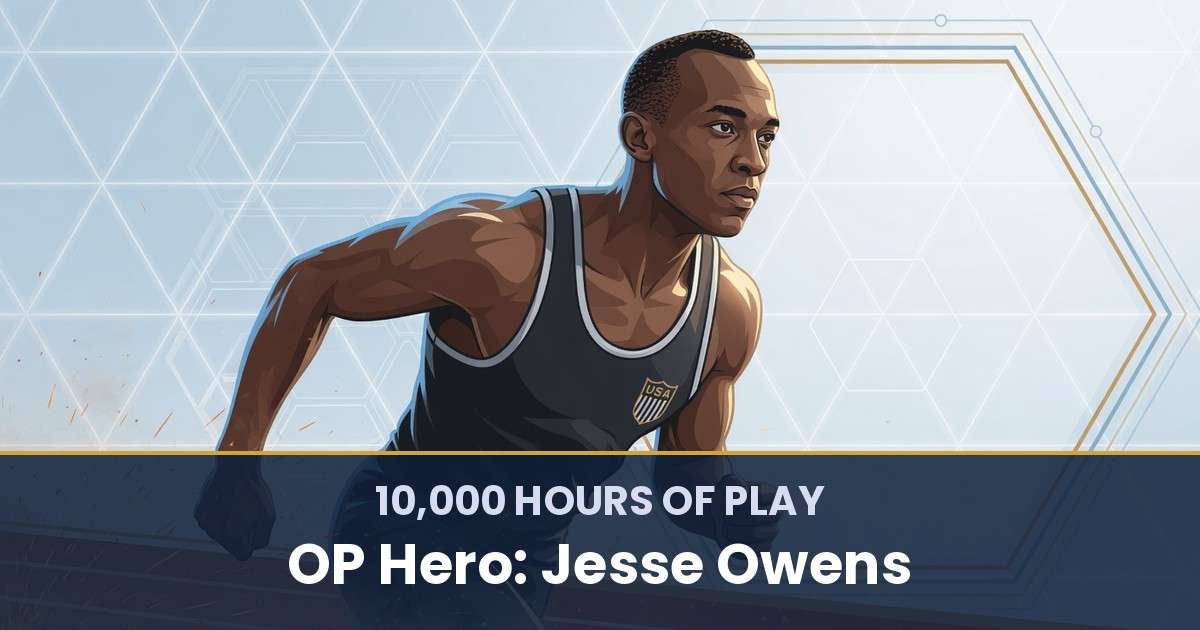


On the afternoon of May 25, 1935, a twenty-one-year-old with a sore back walked onto a cinder track in Ann Arbor and rewrote the record book four times in roughly forty-five minutes. He tied the world mark in the 100-yard dash, then broke the world records in the long jump, the 220-yard dash, and the 220-yard low hurdles, one after another, barely sitting down between events.
His name was Jesse Owens, and the long jump he posted that day, 26 feet 8¼ inches, would stand as a world record for the next quarter century.
The grandson of enslaved people and the son of an Alabama sharecropper had no athletic scholarship and was working part-time jobs to stay in school. Fifteen months later he would stand on a podium in Berlin, in front of Adolf Hitler, with four Olympic gold medals around his neck. Run his life through the six-step framework I use to study how legendary builds actually get made, and the pattern that produced those forty-five minutes is the same one that produced everything after.
⚡ Speed Run Notes
- Owens’ real game was never just speed. It was earning undeniable recognition in a society built to deny it, and turning that recognition into dignity and a living.
- On May 25, 1935, hurting from a back injury, he set three world records and tied a fourth in about 45 minutes, a stretch many historians still call the greatest 45 minutes in sports.
- At the 1936 Berlin Olympics he won four golds (100m, 200m, long jump, 4×100m relay), becoming the first American track athlete to take four at a single Games.
- After fouling twice in the long jump, he took tactical advice from German rival Luz Long, fixed his run-up on the spot, and won gold.
- The setback the medals hide: a U.S. amateur ban ended his career within weeks, and he was soon racing against horses for cash. He rebuilt himself into a speaker and goodwill ambassador.
- The lesson to steal: composure and coachability are skills, not gifts. He out-trained pressure, and he let a competitor coach him when it mattered most.
Table of Contents
- Step 1: The Game Jesse Owens Was Playing
- Step 2: Attributes (The Innate Stats)
- Step 3: Roles (The Character Class Across Chapters)
- Step 4: Skills He Mastered
- Step 5: Allies Who Multiplied Him
- Step 6: Quests That Shaped the Saga
- What You Can Steal From Jesse Owens’ Build
- Where this framework comes from
About Yu-kai Chou

Yu-kai Chou is the author of 10,000 Hours of Play — the book that treats your life as the most important game you’ll ever build a character in, and gives you the 6-Step framework (Game · Attributes · Role · Skills · Allies · Quests) to play it on purpose. He has spent two decades developing the system through which this post analyzes its OP Hero, and applies it to his own life and to the lives of the people he advises around the world.
Chou’s other framework, the Octalysis Framework, has been applied by LEGO, Microsoft, Porsche, Coca-Cola, Salesforce, and MrBeast, impacting over 1.5 Billion Users. He has taught the methodology at Harvard, Stanford, Yale, Tesla, Google, BCG, and IDEO, and has advised governments in eight nations including Ukraine, the United Kingdom, the Kingdom of Bahrain, Singapore, Taiwan, the Netherlands, Kazakhstan, and South Korea.
His work has been cited by Harvard, Stanford, MIT, Forbes, Wall Street Journal, Wired, US Department of Energy, NIST, NSF, NCBI, US Department of Education, ClinicalTrials.gov, and Google Scholar — with 3,700+ more academic publications. Explore his books here.
I keep coming back to Owens because his story refuses the easy moral. We remember Berlin as the day a Black American embarrassed a regime built on racial myth, and it was. But the harder, more useful truth is what he did with two fouls and a hostile crowd: he let an opponent coach him, adjusted his run-up, and saved the gold. If you lift one thing from his build, lift that. The ego that needs to win alone loses more than the ego that will take the right answer from anyone, even the man standing in your lane.
Step 1: The Game — What Jesse Owens Was Actually Playing
Every OP Hero is quietly playing one game beneath all the visible ones. For Owens, the surface game was sprinting and jumping faster and farther than anyone alive. The deeper game was about proof.
He grew up the son of a sharecropper in Oakville, Alabama, and the grandson of people who had been enslaved. When his family joined the Great Migration north to Cleveland, he was nine. Poverty and Jim Crow were the starting conditions of his character sheet, not a backstory he could skip.
So the win condition he kept chasing was recognition that could not be argued with. A stopwatch does not care about your skin. A tape measure cannot be intimidated. Owens chose a game where the scoreboard told the truth even when the country around it would not.
And the game evolved. Once the medals were won and the competitive door slammed shut, he respec’d the same drive into a second arena: becoming a speaker and ambassador who could turn his story into income for his family and into a small lever on how Americans thought about race and opportunity. The trophy changed shape. The thing underneath, earning an undeniable place, never moved.
Step 2: Attributes — The Innate Stats
Attributes are the stats you roll at level one. They surface early and barely change. Owens rolled high in a handful that decided the rest.
The obvious one was explosive speed. By high school in Cleveland he was already setting sprint and jump records, and at the 1933 National Interscholastic Championships he won three events as a teenager. That kind of output, that young, points to neuromuscular wiring most athletes never get issued.
The second stat was an unusually high tolerance for pain. The clearest evidence is the Ann Arbor meet itself: he competed that day carrying a back injury severe enough that he had to talk his coach into letting him start, then set three world records anyway. Performing at the absolute ceiling while hurt is not a training effect. It is a constitution.
The third was composure under hostile scrutiny. In Berlin he ran in front of Hitler, Nazi officials, and a stadium soaked in propaganda about who was supposed to be superior, and his hands did not shake. The Talent Triangle Method describes the rare overlap where natural wiring meets relentless interest, and Owens sat inside it: a boy who loved to run became a man whose nervous system stayed quiet exactly when the stakes screamed loudest.
The fourth was a plain, durable likability. Teammates, rivals, and later corporate audiences all described the same easy warmth, the trait that let him befriend a German competitor in the middle of a propaganda Olympics and, decades later, hold a room as a speaker.
Step 3: Role(s) — The Character Class Across Chapters
Most OP Heroes change class at least once. Owens cycled through four, and each chapter handed the next its sharpest tool.
He began as the Migrant Kid: a sickly sharecropper’s son hauling his family’s survival north, doing manual work and learning to move through Southern and then Northern racism. Then came the High-School Prodigy at East Technical, where structured coaching turned raw speed into national scholastic records and a tie of the world high-school mark in the 100-yard dash.
At Ohio State he respec’d into the Collegiate Record-Breaker, the “Buckeye Bullet.” He carried no athletic scholarship and worked part-time jobs to stay enrolled, yet still won eight individual NCAA titles across 1935 and 1936. The grind and the glory ran on the same schedule.
Berlin promoted him to Olympic Icon, the class that made him history and, just as fast, a symbol he never fully chose to be. His final class was the one the medals could not buy him quickly enough: the Ambassador and Storyteller, the man who spent his later decades on stages and goodwill tours. Like Jackie Robinson a decade later, Owens learned that breaking a barrier on the field was only the first half of the assignment; the second half was carrying what it meant for the rest of his life.
Step 4: Skills — The Real-Life Game Skills Jesse Owens Mastered
Attributes are what you’re born with. Skills are what you grind. Owens mastered a specific set, and in the 10K HP system each one carries a name and a class.
The first is Lich Grind (Warlock), the skill of intense, repetitive, secluded practice. Under his high-school coach Charles Riley he drilled starts and drive mechanics over and over, timing short sprints until the first three strides were automatic. At Ohio State, coach Larry Snyder rebuilt his long-jump approach by measuring and shortening the run-up so he could hit the board at full speed without fouling. The “greatest 45 minutes” looked like magic, but it was banked reps cashing out. Builders across the Skills Spectrum who appear to peak in a single afternoon are usually spending a decade of quiet work in public.
The second is Limit Awareness (Warrior), interoception, the discipline of listening to your body’s signals while still pushing through them. On May 25, 1935, Owens read his injured back precisely enough to know what it could and could not give, managed the load across four events, and extracted four world-class performances from a body that had every reason to quit. He pushed to the edge without going over it.
The third is Siphoning (Warlock), rapidly extracting a skill or solution from someone else. In the Berlin long-jump qualifying he fouled his first two attempts and stood one bad jump from elimination. German jumper Luz Long suggested he move his take-off mark back several inches and simply play it safe to advance. Owens absorbed a rival’s coaching instantly, made the adjustment, qualified, and then won gold at 8.06 meters. Most competitors are too proud to be taught by the person trying to beat them. He was not.
The fourth is Mana Buffer (Mage), the skill of walling off a stressor so it cannot flood the rest of your mind. The Berlin stadium was engineered to rattle exactly him, and he treated the propaganda spectacle as noise outside the lane. He kept his attention on the start, the board, and the tape, and let the rest of the theater stay someone else’s problem.
The fifth is Phoenix Rebirth (Paladin), recovering from a devastating failure and coming back stronger. After the Games he was barred from amateur competition and, within a few years, was racing against horses at halftime shows to feed his family. He could have ended there, bitter and broke. Instead he rebuilt, brick by brick, into a respected speaker and ambassador and was eventually awarded the Presidential Medal of Freedom in 1976. Like Muhammad Ali, he found that the most enduring win came after the athletic prime was gone.
Step 5: Allies — The People Who Multiplied Jesse Owens
No OP Hero solos the whole campaign. Owens’ allies handed him capabilities he could not have built alone.
Charles Riley came first. As his coach at East Technical High School, Riley spotted the talent early and gave Owens the technical base, the starts, the mechanics, the habit of disciplined repetition, that made a major college program want him at all. Larry Snyder picked up the build at Ohio State and re-engineered it, refining the sprint technique and long-jump approach that carried Owens through the 1935 records and into Berlin.
Then there was Luz Long, the rarest kind of ally: the opponent. Long not only gave Owens the qualifying advice that saved his long jump, he then congratulated him in full view of the Nazi grandstand. The two stayed in contact afterward, and Long was later killed in the Second World War. That friendship across enemy lines became one of the most retold moments in Olympic history.
And behind the public career stood Ruth Solomon Owens, whom he married in 1935. Through the amateur ban, the barnstorming years, and the later financial trouble, she was the stability the medals never provided. The campaign that the cameras recorded was always being quietly supplied by people the cameras missed.
Step 6: Quests — The Milestones That Shaped the Saga
Quests are the concrete missions a hero actually completes. Owens’ stack up fast, and the setbacks weigh as much as the wins.
Quest one was the schoolboy ascent in Cleveland, the moment raw speed met real coaching and became national records. Quest two was the “greatest 45 minutes” at Ann Arbor on May 25, 1935: three world records and a tied fourth in under an hour, on an injured back, with the long jump mark standing for 25 years.
Quest three was Berlin, August 1936: gold in the 100 meters, the 200 meters, the long jump, and the 4×100 relay, the first American track athlete to win four at a single Olympics, won on the home turf of a regime that had staked its prestige on his inferiority.
Quest four was the setback the highlight reels skip. He returned home to no White House invitation and no telegram from the president, then watched the U.S. amateur authorities suspend him when he declined to keep running a money-making European tour for their benefit. His competitive career was over almost the instant it peaked. To pay bills he raced against horses, cars, and motorcycles, and later weathered business failure and tax trouble.
Quest five was the long second act: clawing back to solid ground as a speaker, youth advocate, and goodwill ambassador, the comeback that earned him the Presidential Medal of Freedom and, after his death in 1980, a posthumous Congressional Gold Medal. For the full roster of builds I’ve broken down this way, the OP Hero profiles are gathered in one place.
What You Can Steal From Jesse Owens’ Build
Here is the part you can actually use on Monday.
Steal the coachability first. The defining decision of Owens’ career was not a burst of speed; it was the humility to take a tip from the man trying to beat him, fix his approach with two jumps left, and advance. Pride would have sent him home in the qualifying round. The willingness to be taught by anyone, including a rival, is the cheapest performance upgrade there is, and almost nobody buys it.
Steal the way he banked the boring reps. The forty-five minutes everyone remembers were built from years of unglamorous starts and measured run-ups nobody watched. Visible peaks are paid for with invisible work, and the work comes first.
And steal the second act. The medals were the easy story; the hard one was getting barred, going broke, and refusing to let that be the ending. Owens treated being knocked down as a position to play from, not a verdict to accept. You will lose a title you thought defined you at some point. What you build after is the part that turns out to be the real game.
Where this framework comes from

Want the full system this profile is built on?
Every OP Hero piece runs through the same 6-Step framework from 10,000 Hours of Play: Unlock Your Real-Life Legendary Success. The book covers the full system, walks through Yu-kai’s own life run as the first applied case study, and gives you the worksheets to audit your own build.
Related Reading
- All OP Hero Profiles: the full library of legendary builds analyzed through the 10,000 Hours of Play framework.
- Jackie Robinson, OP Hero: the athlete who carried a barrier-breaking moment for the rest of his life.
- Muhammad Ali, OP Hero: a champion whose biggest fights happened outside the ring.
- The 10K HP Framework: the full 6-Step system for treating your life as a game you can learn to play.
- The Talent Triangle Method: how to find the overlap where natural wiring meets obsessive interest.
- The Skills Spectrum: how specialists, dabblers, and masters build different kinds of range.