
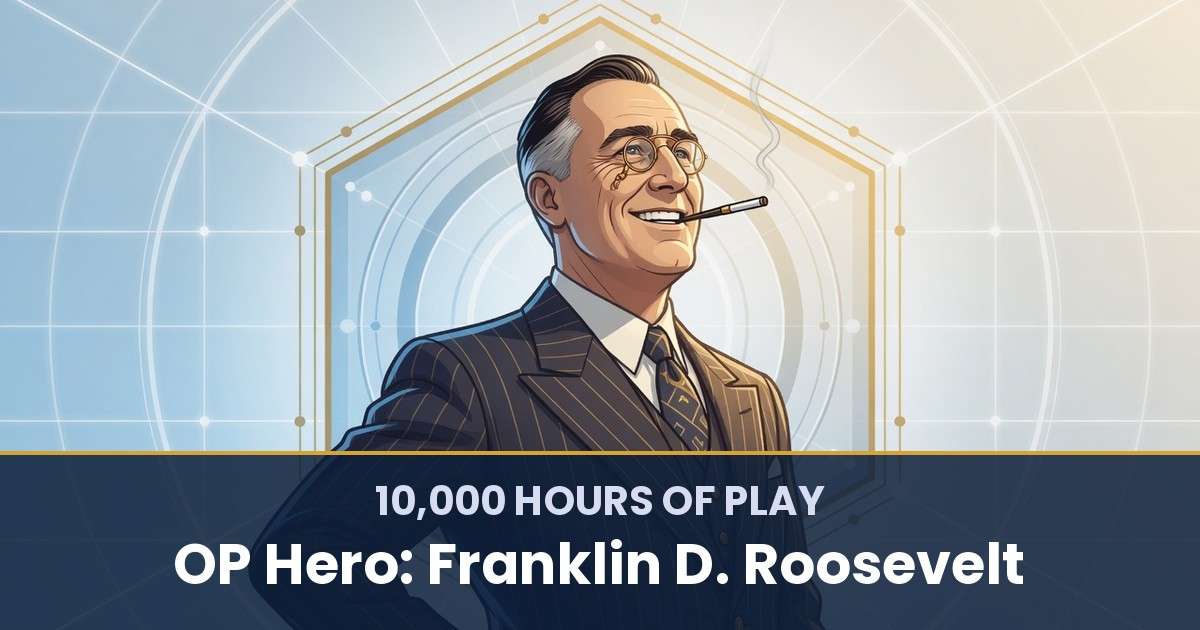


On the evening of March 12, 1933, eight days into his presidency, Franklin Roosevelt sat down in front of a radio microphone and spoke to roughly sixty million Americans as if each of them were alone with him in their living room. Every bank in the country was shut. People were terrified their savings had vanished.
He explained, in plain words, why the banks had closed and why the sound ones were about to reopen. He asked listeners to take their money back to the bank instead of stuffing it under a mattress.
The next morning, deposits outran withdrawals. The panic broke. A man who could not stand at a podium without heavy steel braces locked to his legs had just stopped a national run on the banking system with his voice.
That is the FDR paradox, and it is why he is such a clean run through the six-step framework I use to study legendary builds. His body was broken at the exact moment his ambition demanded it be whole. He won anyway, four times, by treating crisis itself as the game he was best at playing.
⚡ Speed Run Notes
- FDR’s real game was never a single office. It was taking systems on the edge of collapse (the Navy, New York, the U.S. economy, the Allied war effort) and keeping them from going over.
- His rarest stat was an optimism that survived contact with reality. Polio took his legs in 1921; he came back more disciplined and more persuasive, not less.
- The Fireside Chat was a learned skill, not a gift. He taught himself to use radio as a private conversation, and it became the most powerful communication tool any president had ever wielded.
- The First 100 Days of 1933 were a legislative blitz: fifteen major laws built with a “Brain Trust” of academics he assembled like a raid party.
- He failed loudly too. The 1920 vice-presidential run was a blowout, and the 1937 court-packing plan blew up in his face and cost him political capital for years.
- The lesson to steal: he chose problems no sane person wanted, because crisis was the one arena where his particular build was overpowered.
Table of Contents
- Step 1: The Game Franklin D. Roosevelt Was Playing
- Step 2: Attributes (The Innate Stats)
- Step 3: Roles (The Character Class Across Chapters)
- Step 4: Skills He Mastered
- Step 5: Allies Who Multiplied Him
- Step 6: Quests That Shaped the Saga
- What You Can Steal From Franklin D. Roosevelt’s Build
- Where this framework comes from
About Yu-kai Chou

Yu-kai Chou is the author of 10,000 Hours of Play — the book that treats your life as the most important game you’ll ever build a character in, and gives you the 6-Step framework (Game · Attributes · Role · Skills · Allies · Quests) to play it on purpose. He has spent two decades developing the system through which this post analyzes its OP Hero, and applies it to his own life and to the lives of the people he advises around the world.
Chou’s other framework, the Octalysis Framework, has been applied by LEGO, Microsoft, Porsche, Coca-Cola, Salesforce, and MrBeast, impacting over 1.5 Billion Users. He has taught the methodology at Harvard, Stanford, Yale, Tesla, Google, BCG, and IDEO, and has advised governments in eight nations including Ukraine, the United Kingdom, the Kingdom of Bahrain, Singapore, Taiwan, the Netherlands, Kazakhstan, and South Korea.
His work has been cited by Harvard, Stanford, MIT, Forbes, Wall Street Journal, Wired, US Department of Energy, NIST, NSF, NCBI, US Department of Education, ClinicalTrials.gov, and Google Scholar — with 3,700+ more academic publications. Explore his books here.

I wrote a whole book arguing that life works better when you treat it as a game, and Roosevelt is one of the strongest pieces of evidence I have for the comeback mechanic. His legs were taken at thirty-nine, and most people would have read that as game over. He read it as a respec. If you lift one thing from his build, lift his relationship to setback: he never pretended the polio did not happen, and he never let it write the rest of his character sheet either. He kept the stat that mattered, his optimism, and rebuilt everything else around it.
Step 1: The Game — What Franklin D. Roosevelt Was Actually Playing
From a distance his résumé looks like simple ambition climbing a ladder: state senator, Assistant Secretary of the Navy, governor, president. Tidy. Upward. Boring.
Look closer and the through-line is stranger. Roosevelt kept walking toward the burning building. As Assistant Secretary of the Navy from 1913 to 1920, he treated the First World War as a logistics and materiel problem to be solved at scale. As Governor of New York from 1929 to 1932, he turned the early Great Depression into a testing ground for relief programs nobody had tried. As the 32nd president, he met a collapsed economy and then a world war with the same instinct.
The game was not “win the next office.” The game was stabilize the system that is falling apart, and expand what the job is allowed to do while you are at it. Historians make the same point in drier language: he lifted the power of the American presidency to heights it had never reached, using one crisis after another to justify the expansion.
This is the same crisis-as-arena instinct you see in Abraham Lincoln’s build seventy years earlier: a leader who looks ordinary in calm weather and becomes overpowered exactly when the stakes turn existential. FDR was bored by stewardship. He came alive in emergencies, which is a strange and specific way to be wired.
Step 2: Attributes — The Innate Stats
Attributes are the stats you spawn with, and Roosevelt’s were visible long before the braces. He grew up an only child of immense privilege in Hyde Park, New York, educated at Groton from 1896 and Harvard from 1900, and the patrician polish never left him.
His rarest stat was durable optimism: a baseline confidence that bent under pressure but did not snap. The famous first-inaugural line, “the only thing we have to fear is fear itself,” was not a speechwriter’s flourish bolted onto a nervous man. Biographers who disliked his politics still concede the optimism was real equipment, present in the boy and intact in the dying president.
Stacked on top of that: social magnetism (he won his first New York State Senate seat in 1910, an unknown 28-year-old taking a Republican district mostly on charm and tireless personal campaigning), high risk tolerance (he broke with his own Hudson Valley class to back progressive reform, and bet on a vice-presidential run in 1920 that he lost badly), and political pattern recognition (an instinct for exactly how far an institution could be pushed before it pushed back).
That last stat is the kind of thing the Talent Triangle Method is built to surface: the place where natural wiring and lived obsession overlap. Roosevelt’s wiring read power dynamics the way other people read weather, and his obsession was public office. He spent his whole life inside that overlap, which is a large part of why the output looks effortless even when the man was in constant pain.
Step 3: Role(s) — The Character Class Across Chapters
Roosevelt multi-classed across five chapters, and the most important one was the one nobody would have chosen.
The Patrician Apprentice (1882–1910): elite schooling, a law career he found dull, and an early marriage in 1905 to his distant cousin Eleanor that connected him to another branch of a political dynasty.
The War Administrator (1913–1920): as Assistant Secretary of the Navy he effectively ran the day-to-day machine of a navy at war, pushing shipbuilding, anti-submarine measures, and supply across the Atlantic. Hands-on systems management at industrial scale.
The Wounded Rebuilder (1921–1928): in August 1921, vacationing at Campobello Island, he was struck by polio that paralyzed his legs for life. This is the chapter that defines the build. Rather than retire, he poured years into rehabilitation, first visited Warm Springs, Georgia in 1924, and founded the Georgia Warm Springs Foundation in 1927 to turn his private fight into a treatment center for other polio patients. He turned a personal disaster into an institution.
The Crisis Governor (1929–1932): Governor of New York as the Depression hit, using the state as a laboratory for unemployment relief and public works before the rest of the country caught up.
The System Architect (1933–1945): four terms as president, the only person ever to hold the office that long, remaking the federal government and then steering the Allied war effort until his death on April 12, 1945.
Step 4: Skills — The Real-Life Game Skills Franklin D. Roosevelt Mastered
Attributes are what you spawn with. Skills are what you grind. Six canon Real-Life Game Skills run through Roosevelt’s build, and they sit at very different points on the Skills Spectrum: he was a master of a handful of high-stakes moves rather than a dabbler in many.
Phoenix Rebirth (Paladin) — recovering from devastating failure and coming back stronger. Polio in 1921 should have ended his career by the standards of the era, when a visibly disabled candidate was considered unelectable. He rebuilt for a decade and re-entered as governor, then president. This is the cleanest Phoenix Rebirth in the entire OP Hero library.
Thunder Clap (Paladin): public speaking that charges up and inspires people. The Fireside Chats were Thunder Clap delivered through a wire. He learned that radio rewards intimacy, not oratory, and the first chat on March 12, 1933 ended a banking panic overnight by simply explaining the situation like a trusted neighbor.
Mastermind (Ranger) — creating, adapting, and executing complex plans. The First 100 Days of 1933 were a Mastermind clinic: the Emergency Banking Act on March 9, the Civilian Conservation Corps on March 31, the Agricultural Adjustment Act on May 12, and the National Industrial Recovery Act on June 16, all pushed through a single legislative sprint.
Concord of Elements (Druid): bringing multiple parties of different interests together. He assembled his “Brain Trust” of academics like Raymond Moley, Rexford Tugwell, and Adolf Berle into one governing coalition, then ran the same move at world scale with the wartime alliance.
Elemental Transposition (Mage) — reframing every problem as a fresh puzzle to solve rather than a position to defend. His own phrase for it was “bold, persistent experimentation.” When early programs faltered, he revised or scrapped them and tried again, which is how the Social Security Act of 1935 grew out of the disappointments of the first New Deal.
Terraform (Warlock): influencing the rule-makers and rewriting the rules themselves. Roosevelt did not just play the game of American government; he changed its rules, building permanent federal machinery for old-age security, labor protection, and financial regulation that outlived him by generations.
Step 5: Allies — The People Who Multiplied Franklin D. Roosevelt
The lone-leader reading of FDR falls apart the moment you list his party members.
Eleanor Roosevelt was the most consequential of them. As First Lady she became his eyes, his conscience, and a political force of her own, championing civil rights and social welfare and holding her own press conferences for women reporters starting March 25, 1933. Her own OP Hero build is formidable enough to stand entirely apart from his.
Louis Howe was the loyal strategist who refused to let the story end at the polio. He managed Roosevelt’s comeback through the 1920s and engineered the campaigns that carried him to the presidential nomination on July 2, 1932. Every hero needs the ally who keeps playing when the hero is down.
Frances Perkins was the conscience made operational. As Secretary of Labor from March 4, 1933, the first woman ever to sit in a U.S. Cabinet, she was a principal architect of the Social Security Act, turning Roosevelt’s broad intentions into durable law.
Harry Hopkins was the executor. He ran federal relief from May 1933 and then became FDR’s closest wartime aide, his personal emissary to Churchill and Stalin and a key hand behind Lend-Lease in 1941.
Winston Churchill was the great-power partner. From his appointment as British prime minister on May 10, 1940, he and Roosevelt forged the alliance that fought the war, sketched at sea in the Atlantic Charter of August 14, 1941. Churchill’s build ran on the same stubborn refusal to accept a losing board, which is exactly why the two of them clicked.
Step 6: Quests — The Milestones That Shaped the Saga
Quest 1: The Blowout (1920). Nominated for vice president on the Cox ticket, he campaigned hard and lost in a landslide to Harding and Coolidge in November. A national defeat at thirty-eight, and his first taste of being thoroughly beaten.
Quest 2: The Body Fails (1921). Polio at Campobello. The most important quest of his life was the seven years of rehabilitation that followed, mostly invisible, with no audience and no guarantee of a return.
Quest 3: The First 100 Days (1933). The legislative sprint that gave the federal government a new job description, fifteen major laws between March and June, fast enough that the country could feel a hand on the wheel.
Quest 4: Social Security (1935). Signed into law on August 14, the most durable thing he ever built. Old-age benefits and unemployment insurance that still run today, born out of the failures of the first wave of reform.
Quest 5: The Court-Packing Disaster (1937). Flush with a landslide re-election, he proposed on February 5 to add up to six new justices to a Supreme Court that kept striking down his programs. It backfired completely. Congress and the public revolted, the bill died, and he bled political capital for years. Even an overpowered character can wipe on a raid he called himself. Browse the other OP Hero profiles and you will find the same scar on nearly every legendary build.
Quest 6: The Grand Alliance (1941–1945). Lend-Lease, the Atlantic Charter, and the first meeting of the Big Three at the Tehran Conference from November 28 to December 1, 1943, where he helped lock in the cross-Channel invasion of France. He died on April 12, 1945, weeks before the German surrender he had spent his last years engineering.
What You Can Steal From Franklin D. Roosevelt’s Build
You probably cannot steal the optimism stat. That one looked installed from birth.
What you can steal is what he did with a forced respec. When polio rewrote his sheet, he did not try to play his old character with a broken body. He audited what still worked: the voice, the read on people, the appetite for crisis. He built a new role around the surviving strengths. Most people, hit with a setback, keep grinding the build that no longer runs. Roosevelt rerolled.
Steal the radio lesson too. His superpower in office was not volume; it was intimacy at scale. He figured out that the medium rewarded sounding like one trusted person in one living room, and he practiced until it was effortless. Whatever your channel is, the move is the same: stop performing to the room and start talking to the single human on the other end.
And keep the court-packing scar in view. The same boldness that produced the New Deal produced the worst blunder of his career within months of his biggest win. Aggression is a stat that does not know the difference between a good idea and a bad one. Use it, but put a check on it before it uses you.
This profile ran Roosevelt’s life through all six steps: Game, Attributes, Role, Skills, Allies, Quests. Run your own life through the same six and see what your character sheet actually says.
Where this framework comes from

Want the full system this profile is built on?
Every OP Hero piece runs through the same 6-Step framework from 10,000 Hours of Play: Unlock Your Real-Life Legendary Success. The book covers the full system, walks through Yu-kai’s own life run as the first applied case study, and gives you the worksheets to audit your own build.
Related Reading
- All OP Hero Profiles: the full library of legendary builds analyzed through the 10,000 Hours of Play framework.
- Winston Churchill, OP Hero: FDR’s wartime partner, whose build ran on the same refusal to accept a losing board.
- Eleanor Roosevelt, OP Hero: the ally who became a force of her own, with a character sheet strong enough to stand alone.
- Abraham Lincoln, OP Hero: the earlier crisis president who, like FDR, looked ordinary until the stakes turned existential.
- The 10K HP Framework: the full 6-Step system for treating your life as a game you can learn to play.
- The Skills Spectrum: how specialists, dabblers, and masters build different kinds of range.