
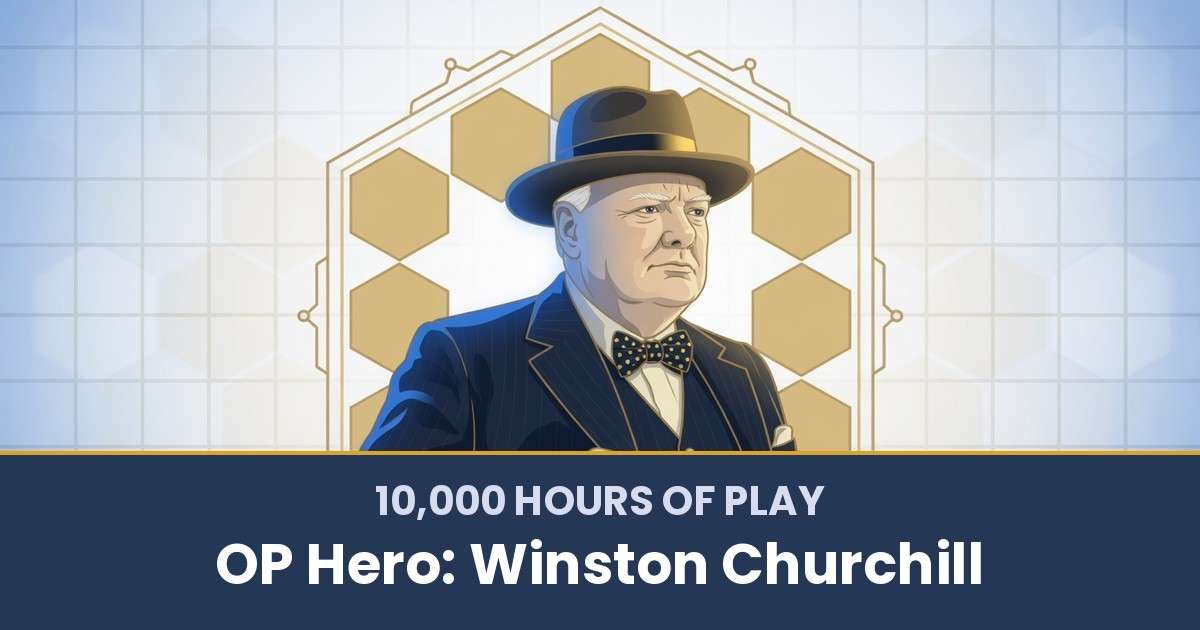


At 26, Winston Churchill wrote home to his mother and said he would be Prime Minister in twenty years. He had no portfolio, no party seat, no money, and no qualifications anyone in 1900 would have considered serious. What he had was an internal map of his own life, drawn in pencil four decades before he would ever sit in 10 Downing Street.
That single sentence to his mother is the most useful thing about him for any reader trying to build their own arc. Churchill is not famous because he was born for the moment of May 1940. He is famous because he spent forty years preparing for a moment nobody else could see, lost almost every fight in between, painted his way out of a breakdown, wrote his way out of bankruptcy, and was still sitting at the table when the test finally arrived.
People treat his life as a war story. It is closer to a long, ugly, beautifully run campaign of self-positioning, where almost every chapter looks like a setback until you zoom out.
This profile runs Churchill’s life through the 10,000 Hours of Play framework, the same six-step system I use on every OP Hero piece. The point is not to admire him from a distance. The point is to read his sheet — Game, Attributes, Roles, Skills, Allies, Quests — closely enough that you can borrow the parts that fit your own build.
⚡ Speed Run Notes
- Churchill’s Game wasn’t winning World War II. It was “get to the lever of British power and hold it through a civilizational test.” He committed to that Game in his twenties and refused to abandon it through three decades of failures most careers would not survive.
- His standout Attributes were physical courage, verbal brilliance, destiny-grade self-belief, and a stubbornness that read as arrogance until history happened to vindicate him.
- He cycled through at least five Roles — cavalry officer / war correspondent, reforming minister, disgraced cabinet exile, wilderness backbencher, wartime Prime Minister — and he played each one differently rather than dragging the same persona around.
- The Skills that actually unlocked his arc were Vision Manifestation, Foresight, Aegis, Thunder Clap, Phoenix Rebirth, and Lich Grind.
- His Allies multiplied him at every stage. Clementine was his conscience. Beaverbrook ran his planes. FDR funded the war. Brooke argued him out of his worst strategic ideas. Lindemann did his math.
- His Quest line is a textbook study in failure-as-tuition: Sidney Street, Dardanelles, the gold standard, the Wilderness Years, May 1940, the Iron Curtain speech, the 1951 return. Half of it looks like disaster on paper. All of it compounded.
Table of Contents
- Step 1: The Game — What Winston Churchill Was Actually Playing
- Step 2: Attributes — The Innate Stats
- Step 3: Role(s) — The Character Class Across Chapters
- Step 4: Skills — The Real-Life Game Skills Winston Churchill Mastered
- Step 5: Allies — The People Who Multiplied Winston Churchill
- Step 6: Quests — The Milestones That Shaped the Saga
- What You Can Steal From Winston Churchill’s Build
- Where this framework comes from
- Related Reading
About Yu-kai Chou

Yu-kai Chou is the author of 10,000 Hours of Play — the book that treats your life as the most important game you’ll ever build a character in, and gives you the 6-Step framework (Game · Attributes · Role · Skills · Allies · Quests) to play it on purpose. He has spent two decades developing the system through which this post analyzes its OP Hero, and applies it to his own life and to the lives of the people he advises around the world.
Chou’s other framework, the Octalysis Framework, has been applied by LEGO, Microsoft, Porsche, Coca-Cola, Salesforce, and MrBeast, impacting over 1.5 Billion Users. He has taught the methodology at Harvard, Stanford, Yale, Tesla, Google, BCG, and IDEO, and has advised governments in eight nations including Ukraine, the United Kingdom, the Kingdom of Bahrain, Singapore, Taiwan, the Netherlands, Kazakhstan, and South Korea.
His work has been cited by Harvard, Stanford, MIT, Forbes, Wall Street Journal, Wired, US Department of Energy, NIST, NSF, NCBI, US Department of Education, ClinicalTrials.gov, and Google Scholar — with 3,700+ more academic publications. Explore his books here.
What I find most useful about Churchill’s build, and most teachable for anyone reading this, is the relationship between his Vision Manifestation Skill and his refusal to fold during the 1929-39 stretch when everyone agreed he was finished. A normal career writes off a decade of irrelevance as failure. Churchill treated it as preparation. If you only lift one thing from his sheet, lift the habit of writing your future destiny down before you have any evidence for it, then living the in-between years as if that destiny were already a given.
Step 1: The Game — What Winston Churchill Was Actually Playing
Most people frame Churchill’s life around 1940 because that is when the world turned and he was the one standing there. That framing is wrong on the chronology. He was already on Move 47 by then.
His Game definition was visible at 26 and never changed: get to the highest lever of British state power, and hold it through a test that justified the whole climb. The mission was not service. The mission was command at the moment of greatest consequence.
You can hear this in his own voice across decades. In his 1930 memoir My Early Life he writes of an unshakeable belief in himself and admits he sought dangerous postings in Cuba, India, Sudan, and South Africa specifically to get noticed. In May 1940, after the King asked him to form a government, he wrote that “all my past life had been but a preparation for this hour and for this trial.” That’s not the diary entry of a man who got lucky. That’s the diary entry of a man who had been running the same simulation for forty years.
What makes his Game so usable as a model is that he picked a target whose difficulty kept escalating. Most people choose a Game whose difficulty runs out before their motivation does. They beat the level, get bored, and quit. Churchill’s Game had no ceiling because the test was always one tier above where Britain currently stood, which is exactly the kind of long-runway framing that the life-as-a-game approach is built to produce.
Step 2: Attributes — The Innate Stats
Attributes are the base stats you arrive with or develop so early they may as well be innate. Churchill’s sheet has a clean top four.
Physical courage. As a young officer he wrote of how he sought danger out and reliably found it. He took freelance dispatches in Cuba at 20, rode in the cavalry charge of the 21st Lancers at Omdurman in 1898, was captured by the Boers in 1899 and escaped 300 miles to Portuguese territory, then went back into combat. Personal physical fear simply did not register on his decision-making the way it does for most people. It read as recklessness for thirty years and then suddenly read as moral nerve in May 1940.
Verbal brilliance. His Harrow reports flagged English and history as the only subjects where he excelled. By 24 his first book, The Story of the Malakand Field Force, already had the full prose voice you hear in the 1940 speeches. The cadence was native. Most “great orators” rehearse their way to the rhythm. He had it at 23, before he had anything important to say. This is the rarest part of his sheet and the one closest to what the Talent Triangle Method calls a top-percentile innate channel: the thing you can sharpen but cannot manufacture from zero.
Destiny-grade self-belief. Friends from his Harrow years recorded the teenage Churchill saying it would one day fall to him to save the Capital and the Empire. He had no evidence for this. He simply held the belief as a fact, and let it organize the next forty years. Most people would call this delusion. In a small number of cases it is, instead, the load-bearing Attribute of the entire build.
Compulsive curiosity. As a young officer in Bangalore he constructed his own university — Gibbon, Macaulay, Plato, Aristotle, Schopenhauer — because he felt his formal education had failed him. He kept that pace for the rest of his life. The man who walked into the Admiralty in 1939 had been self-educating for forty-three years. It shows in every memo.
Step 3: Role(s) — The Character Class Across Chapters
One of the reasons Churchill is misunderstood is that people try to read his life with a single character class. He rotated through at least five, and he did not drag the same persona between them.
From 1895 to 1900 he was the Cavalry Officer / War Correspondent. He used battlefield exposure to build a name, financed it with dispatches to the Daily Telegraph and Morning Post, and turned each campaign into a book within months of the smoke clearing. The arc converted dangerous postings into political capital with brutal efficiency.
From 1900 to 1915 he was the Reforming Minister. Conservative MP for Oldham in 1900, defected to the Liberals in 1904, served as Under-Secretary for the Colonies, President of the Board of Trade, Home Secretary, and First Lord of the Admiralty. He pushed labour exchanges, national insurance contributions, and a wholesale modernization of the Royal Navy. He was thirty-six and already a name on every front bench.
From 1915 to 1929 he was the Disgraced Cabinet Exile turned Comeback Politician. The Dardanelles cratered him in May 1915. He resigned, took command of the 6th Battalion of the Royal Scots Fusiliers on the Western Front for five months in 1916, and clawed his way back as Minister of Munitions, then Secretary of State for War and Air, then Chancellor of the Exchequer.
From 1929 to 1939 he was the Wilderness Backbencher. Ten years out of office, written off, mocked. He wrote, painted, and warned about Hitler to a House of Commons that did not want to hear it. The years that looked like the end of his career were the years he was actually preparing for the role he had described to his mother in 1899.
And from 1940 to 1955, with one interruption, he was the Wartime Prime Minister and then the Statesman-Author. Different cadence, different output, different reading of the same Game.
Step 4: Skills — The Real-Life Game Skills Winston Churchill Mastered
Six canon Real-Life Game Skills carry the freight of his arc. Each is worth your attention because each one is closer to a process you can borrow than to a gift you cannot. The wider taxonomy of how Skills, Attributes, and Roles relate is laid out in the Skills Spectrum; what follows is how the spectrum applies in Churchill’s specific case.
Vision Manifestation (Warlock). Mentally rehearsing a future outcome so vividly that the rehearsal shapes your present behavior. Churchill wrote to his mother in 1899 that he would be Prime Minister in twenty years; in 1940 he wrote that he felt every previous chapter had been preparation for “this hour and for this trial.” Between those two sentences he organized every reading list, every cabinet position, every speech, and every painting holiday around a target he had not yet been given permission to chase.
Foresight (Ranger). Projecting future trends and risks before consensus catches up. Twice in his life this Skill saved his career and arguably saved the country: once at the Admiralty from 1911 to 1915 when he converted the Royal Navy from coal to oil and pushed for naval aviation before either was obvious, and again from 1933 through 1939 when he tracked German rearmament from his backbench using confidential information from sympathetic civil servants. Both times he was called alarmist. Both times he was right early enough to matter.
Aegis (Paladin). Ignoring public criticism and naysayers while pushing the Quest. The Wilderness Years are the textbook case. From 1933 to 1939 he was treated as a cranky relic. He kept warning. He kept writing. He held the position long enough for the world to come to him. Without this Skill the 1940 appointment never happens, because he is not in the room. Compare the same Skill at work in Abraham Lincoln’s run, where ignoring contemporary press treatment was as load-bearing as any battlefield decision.
Thunder Clap (Paladin). Public speaking that charges up and inspires people. June 4, 1940, “We shall fight on the beaches.” June 18, 1940, “Their finest hour.” August 20, 1940, “Never in the field of human conflict was so much owed by so many to so few.” October 29, 1941, the Harrow School line “Never give in. Never give in. Never, never, never, never—in nothing, great or small, large or petty—never give in”. March 5, 1946, the Iron Curtain speech at Fulton, Missouri. Each of these moved national or international opinion on the day it was delivered. The throughline is that he never delivered them cold. He drafted, walked, recited, and revised — the speeches were Lich Grind output dressed as Thunder Clap delivery.
Phoenix Rebirth (Paladin). Recovering from devastating failure and coming back stronger. Dardanelles was the worst political wound of his career. He responded with two unusual moves. He started painting, which he later described as the practice that restored his mind, and he asked to be sent to the Western Front as a battalion commander to rebuild his standing with men who actually had to fight. By 1917 he was back in cabinet as Minister of Munitions. Most careers die at Dardanelles. His came back twice, and the second comeback was 1940. The “go back to where it hurt, then keep going” pattern shows up in nearly every OP Hero profile for a reason.
Lich Grind (Warlock). Intense, secluded work periods. The Wilderness Years look from the outside like nothing was happening; from the inside they were a writing machine. The four-volume Marlborough: His Life and Times, the History of the English-Speaking Peoples, journalism for half a dozen papers, and the speeches that built the Hitler case were all produced at Chartwell during the years he was out of office. The grind paid two ways: it funded the household, and it built the historical and rhetorical scaffolding he would use in 1940. For a longer breakdown of how secluded-work Skills compound in this family, see the Lich Pact write-up.
Step 5: Allies — The People Who Multiplied Winston Churchill
Churchill is often written about as a soloist. He was not. His career is a clean illustration of how the right five or six people, attached at the right points, multiply a single sheet.
Clementine Churchill. His wife, his closest reader, and the only person who routinely told him he was wrong on the day he was wrong. Her letters to him during 1940-45 push back on staff treatment, on tone, on personnel decisions, in ways that no one else in his orbit dared. She kept him calibrated.
Lord Beaverbrook. Press baron and political fixer. As Minister of Aircraft Production he pulled fighter output forward at the speed Britain needed during the Battle of Britain. As an ally, he also gave Churchill a media spine that survived the war and the 1945 election loss.
Franklin D. Roosevelt. The wartime relationship that produced Lend-Lease, the Atlantic Charter, and ultimately American entry. Their correspondence runs to thousands of cables. Without that one Ally, the resource math of 1940-41 does not work.
General Alan Brooke. Chief of the Imperial General Staff and Churchill’s principal professional check. Brooke’s diaries record him talking the Prime Minister off bad strategic ideas on what felt like a weekly basis. Every visionary leader needs someone in the room whose job is to say no, not that one. Brooke was that man.
Brendan Bracken and Lord Cherwell. Bracken handled wartime information and political defense; Cherwell, the Oxford physicist Frederick Lindemann, did the math on bombing campaigns, food rationing, and statistics. Cherwell in particular let Churchill argue from data rather than instinct in cabinet, which is what kept his wartime decisions from collapsing under the weight of his own confidence.
Step 6: Quests — The Milestones That Shaped the Saga
His Quest log reads as a long sequence of campaigns, half of them lost on contact. Each one tuned the build.
Sidney Street siege (January 1911). As Home Secretary, Churchill personally went to the scene of an armed siege in East London and was photographed directing police. The episode marked him in the public mind as a figure willing to insert himself into hard situations. It also taught him the cost of looking too eager for the spotlight, a lesson he never fully absorbed.
Dardanelles / Gallipoli (1915). The defining failure. As First Lord of the Admiralty, Churchill championed a naval strike against the Ottoman straits that he believed would knock Turkey out of the war and open a supply line to Russia. The operation collapsed at enormous cost in Allied lives, and he was forced out of the Admiralty in May 1915. This is the cratering moment that every Phoenix Rebirth run requires.
Return to the gold standard (April 1925). As Chancellor of the Exchequer he restored sterling to gold at the prewar parity, on the advice of Treasury orthodoxy. The decision is widely associated with the deflation, industrial unemployment, and General Strike of 1926. He later called it the worst mistake of his life. The useful read is not that he made the call. It is that he could recognize the call as wrong, in writing, without it disqualifying him from later judgment.
Wilderness Years rearmament campaign (1933-1939). Out of office, he ran a six-year private intelligence operation, fed by sympathetic civil servants, to publish accurate German air-force numbers from the floor of the Commons. He was called a warmonger for it almost every week. The campaign is the reason he was in the building on May 10, 1940 at all.
The May 1940 premiership and the Battle of Britain. Becoming Prime Minister on the day Germany invaded the Low Countries. The Dunkirk evacuation. The decision to fight on rather than negotiate. The Battle of Britain. There is no shorter description of this Quest that does it justice. It is the test his entire build had been positioned for.
The Iron Curtain speech (March 5, 1946). Out of office again after the 1945 election loss, he delivered the Fulton, Missouri address that named the postwar division of Europe and helped frame the next forty years of Western policy. Few politicians get to define the next era from outside government. He did, because he kept writing and kept speaking even when no one was paying him for it.
The 1951 return. At 76, he won a general election and served as Prime Minister again until 1955. The interesting part is not the second term itself. It is that he was still on the field at all, still running the same Game he had defined when he was 26.
What You Can Steal From Winston Churchill’s Build
The lift from his sheet is not the war. Almost none of you will lead a country through a civilizational test. The lift is the operating loop he used to stay in position long enough for his moment to find him.
One: write your destiny statement before you have any evidence for it, and let it organize your reading list, your role choices, and your tolerance for boring chapters. Two: pick Skills with long compounding curves — writing, speaking, foresight, recovery — because those are the ones still paying out in your fourth decade of running the same Game. Three: treat your wilderness years as a writing project rather than a verdict. Four: keep the same five Allies for thirty years. Five: when you blow up a Quest, paint, write, and re-enter the game at a smaller scale before you try to come back at the level that broke you. That sequence is what gets you to the moment your build was always for. The catalog of every other run we’ve broken down lives on the OP Hero profiles page, including a philosophical companion piece on Marcus Aurelius whose wilderness years looked very different but ran on similar Skills.
Where this framework comes from

Want the full system this profile is built on?
Every OP Hero piece runs through the same 6-Step framework from 10,000 Hours of Play: Unlock Your Real-Life Legendary Success. The book covers the full system, walks through Yu-kai’s own life run as the first applied case study, and gives you the worksheets to audit your own build.
Related Reading
- All OP Hero Profiles — the running hub of every life-as-RPG breakdown.
- Abraham Lincoln — OP Hero profile
- Marcus Aurelius — OP Hero profile
- Martin Luther King Jr. — OP Hero profile
- Viktor Frankl — OP Hero profile
- Your Game of Life — explore what you want to want