
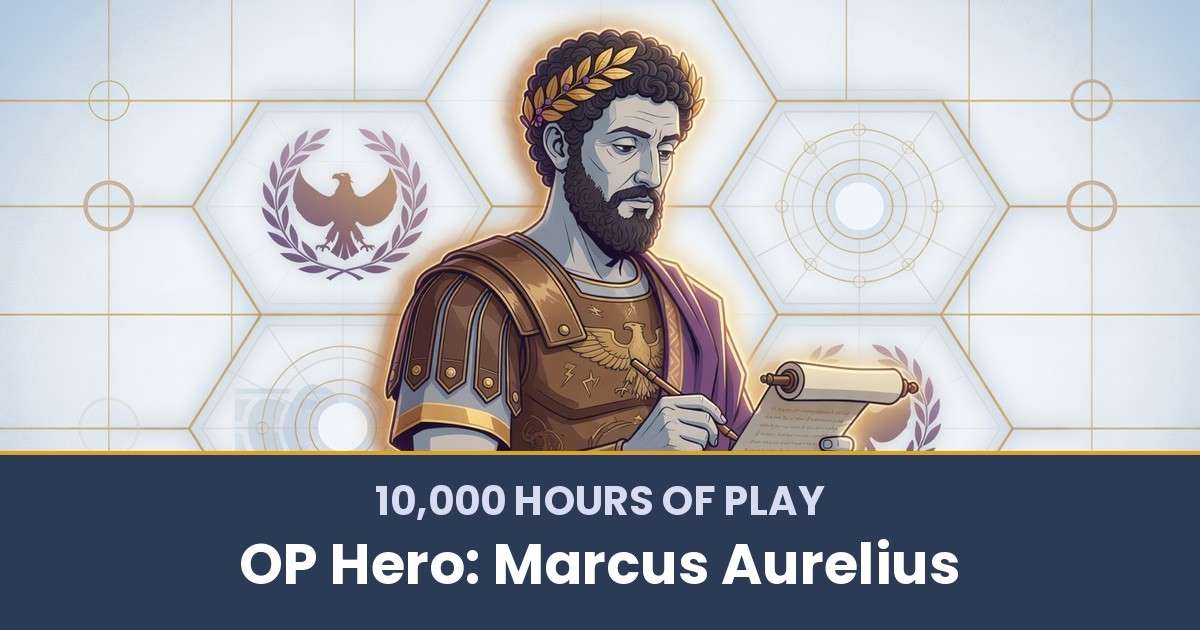


The most powerful man in the known world wrote himself private notes telling himself to stop being annoyed. He kept doing it for years. He kept doing it on a war front where Germanic tribes were sacking Roman towns, where a plague was killing roughly a quarter of the empire he ran, and where one of his own generals had just declared himself emperor.
Marcus Aurelius ruled Rome from 161 to 180 CE — twenty years he never asked for, on top of an already serious career he never asked for either. He inherited a script: be Caesar, be just, be useful. He didn’t get to choose the game. What he chose was how he played it.
And the way he played it has outlasted Rome itself. The journal he kept for himself — never written for publication — became the manual a billion modern people now reach for when life gets heavy. That is an absurd outcome. It is also a very clean OP Hero build, and the lens of the 10,000 Hours of Play framework makes that build legible in a way most history books don’t.
⚡ Speed Run Notes
- Marcus didn’t pick his Game — he inherited it at 17 and ran it on purpose for the next 42 years. The lesson is that you can play a game you didn’t choose extremely well.
- His standout Attributes were seriousness, fairness, and an unusual capacity for self-examination — visible in Book 1 of Meditations where he thanks every teacher who shaped him.
- He cycled Roles deliberately — student, Caesar, co-emperor, sole emperor, frontier general, writer — and refused to let any single Role consume the others.
- The Skills behind his run were Stoic: daily journaling, premeditation of adversity, the view-from-above, and the discipline of ignoring noise that didn’t change the work.
- His Allies multiplied him because he picked them for character first, ability second — and gave them the kind of trust most emperors couldn’t afford to give.
- His Quests included a plague, a 14-year frontier war, a betrayal, and a son who undid most of it. His response to all of them is the actual product.
Table of Contents
- Step 1: The Game — What Marcus Aurelius Was Actually Playing
- Step 2: Attributes — The Innate Stats
- Step 3: Role(s) — The Character Class Across Chapters
- Step 4: Skills — The Real-Life Game Skills Marcus Aurelius Mastered
- Step 5: Allies — The People Who Multiplied Marcus Aurelius
- Step 6: Quests — The Milestones That Shaped the Saga
- What You Can Steal From Marcus Aurelius’s Build
- Where this framework comes from
- Related Reading
About Yu-kai Chou

Yu-kai Chou is the author of 10,000 Hours of Play — the book that treats your life as the most important game you’ll ever build a character in, and gives you the 6-Step framework (Game · Attributes · Role · Skills · Allies · Quests) to play it on purpose. He has spent two decades developing the system through which this post analyzes its OP Hero, and applies it to his own life and to the lives of the people he advises around the world.
Chou’s other framework, the Octalysis Framework, has been applied by LEGO, Microsoft, Porsche, Coca-Cola, Salesforce, and MrBeast, impacting over 1.5 Billion Users. He has taught the methodology at Harvard, Stanford, Yale, Tesla, Google, BCG, and IDEO, and has advised governments in eight nations including Ukraine, the United Kingdom, the Kingdom of Bahrain, Singapore, Taiwan, the Netherlands, Kazakhstan, and South Korea.
His work has been cited by Harvard, Stanford, MIT, Forbes, Wall Street Journal, Wired, US Department of Energy, NIST, NSF, NCBI, US Department of Education, ClinicalTrials.gov, and Google Scholar — with 3,700+ more academic publications. Explore his books here.
What I keep coming back to with Marcus is how unglamorous his build looks from the outside. He didn’t pivot. He didn’t disrupt. He didn’t found anything you could put on a slide. He just kept showing up to a role he hadn’t asked for, kept training his own mind in private, and kept refusing to let the noise around him decide his next move. The lesson I’d lift is in Step 4 — the Skill of pulling the camera back when the moment feels too big to handle. That single move, repeated daily, is most of his life’s work.
Step 1: The Game — What Marcus Aurelius Was Actually Playing
Most OP Heroes choose their game. Marcus Aurelius didn’t. He was born Marcus Annius Verus in 121 CE into a Roman senatorial family. By the time he was 17, Emperor Hadrian had arranged for him to be adopted into the imperial line through Antoninus Pius. The game was picked for him before he could vote on it.
So he picked a meta-game instead. The actual mission he chased across four decades was not “rule Rome well” — that was the surface quest. The deeper game was the unification of philosopher and ruler. Could he govern an empire of 70 million people without becoming the kind of man emperors usually become? Could he stay just, rational, and useful while holding a level of unaccountable power that destroys almost everyone who touches it?
That’s the game Meditations is about. He writes in 6.30 — “Take care that you are not made into a Caesar, that you are not dyed with this dye.” He is, in that moment, the Caesar. The note is to himself.
This is the move turning life into a game trains you to make. If the obvious objective looks bleak or feels imposed, you can still choose what you’re actually playing inside it. The board is fixed. The win condition isn’t.
Step 2: Attributes — The Innate Stats
Book 1 of Meditations is essentially Marcus’s character sheet. He spends 17 short passages naming every person who shaped him and exactly which trait each one strengthened. It is one of the most honest stat audits anyone has ever written.
His standout innate Attributes were these.
Seriousness. Sources from Hadrian onward describe him as unusually earnest from boyhood. Hadrian reportedly called him Verissimus — “the most truthful one.” This wasn’t a learned discipline at 12. It was a default setting.
A philosophical bent. He adopted the rough cloak of a Greek philosopher as a teenager. His mother had to talk him out of sleeping on a hard plank. Most teenagers want to be soldiers or charioteers. He wanted to be Epictetus.
Fairness. Multiple ancient biographers note his unusual commitment to even-handed treatment of people regardless of class. The trait shows up in his juristic legacy — Roman law from his reign is studded with rescripts that protect slaves, women, and minors.
Diligence. The sustained habit of self-examination that produced Meditations over years on a freezing northern frontier is the trait, not the product.
The OP Talent Triangle Method says your build works best when your Attributes, what you naturally enjoy, and what the world rewards line up. Marcus is a strange case because the world rewarded him with absolute power he did not enjoy. But the Attributes themselves — seriousness, fairness, diligence — fit the role of “head of state” almost too well. The game came to him. His innate stats let him survive it.
Step 3: Role(s) — The Character Class Across Chapters
Marcus rotated Roles more deliberately than most rulers, and the order matters.
Student (121–138 CE). Tutored from age 6 by a parade of the empire’s best teachers — Diognetus introduced him to philosophy, Junius Rusticus to Stoicism, Herodes Atticus to Greek rhetoric, Fronto to Latin oratory. The Student Role lasted longer than most because his eventual job needed all of it.
Caesar / heir in training (138–161 CE). Adopted by Antoninus Pius on 25 February 138 CE per Hadrian’s succession plan. He held the consulship in 140 and 145, married Antoninus’s daughter Faustina the Younger, and spent 23 years watching his adoptive father run the empire calmly and competently. That apprenticeship was the whole point — Antoninus modeled the job before Marcus had to do it.
Co-emperor (161–169 CE). When Antoninus died on 7 March 161 CE, Marcus refused to take the throne alone. He insisted the Senate make his adoptive brother Lucius Verus a co-Augustus of formally equal rank. This was unprecedented. Rome had never had two ruling emperors. The move was structural humility on the scale of a constitutional invention.
Sole emperor (169–177 CE) and frontier general (166–180 CE). After Lucius Verus died in 169, Marcus held the empire alone while spending most of the rest of his life in legionary camps on the Danube. He was not a natural soldier. He learned the Role on the job, in his late forties and fifties, in a climate that wrecked his health.
Philosophical writer (172–180 CE). The most surprising Role, picked up last. Sometime in the 170s, on campaign, he started writing notes to himself in Greek. Meditations exists because he refused to let the frontier consume the philosopher. Like Abraham Lincoln running the Civil War while still writing his own speeches, Marcus refused to outsource the inner Role to the outer one.
Step 4: Skills — The Real-Life Game Skills Marcus Aurelius Mastered
Six canon Skills carry his run. Each one shows up in specific moments where you can point and say — yes, that’s the move.
Serenity (Druid) — meditation and journaling for inner peace. Meditations itself is the artifact. The book is not a treatise; it’s a private workout log. Most of the entries are reminders, not arguments. “When you wake up in the morning, tell yourself: the people I deal with today will be meddling, ungrateful, arrogant, dishonest, jealous, and surly.” That’s a journal prompt, written by a man who needed it more days than not.
Locked Heart (Warlock) — pain contrasting, the discipline of rehearsing worse outcomes to defuse current pain. The Stoics called it premeditatio malorum. Marcus practiced it daily. In Meditations 2.11, 4.48, and 7.56 he runs the same drill — imagine your death, imagine the loss of those you love, imagine ruin — so that when the smaller version arrives you are already inoculated. Viktor Frankl ran a related version of this Skill in Auschwitz two millennia later. The technique outlives the empire that invented it.
Cognitive Lens (Mage) — micro/macro zoom. Marcus repeatedly trains the “view from above.” In Meditations 12.24–25 he urges himself to picture human affairs from a cosmic altitude — the wars look like ant fights, the betrayals like quarrels at a feast. The lens didn’t make the wars less real. It made them less paralyzing. This Skill is what most modern readers actually mean when they say Meditations “got them through” something. They mean they learned to zoom out.
Aegis (Paladin) — ignore public criticism and noise while pushing the work. Marcus had every reason to be reactive. The Senate gossiped about him, the army occasionally muttered, and in 175 his most trusted eastern general declared himself emperor on a false rumor of Marcus’s death. Marcus’s response was strikingly muted. He had Cassius’s head returned to him and then refused to display it. The Quest mattered more than the reaction to the Quest. This is the same posture that lets a modern operator stay on the work — see the Skills Spectrum view of how mastery requires the strength to ignore distractions while you accumulate depth.
Loremaster (Druid) — weave compelling, lasting stories. Marcus never intended to be a writer. He kept private notes. And yet the notes have stayed in print, in dozens of languages, for 1,845 years. The Skill is not “write a bestseller.” It is the quieter version — make every sentence so honest with yourself that someone else, centuries later, can use it as if you had written it for them.
Phoenix Rebirth (Paladin) — recover from devastating failure. Marcus absorbed the Antonine Plague (which killed possibly five million Romans), the death of his co-emperor, multiple Marcomannic incursions, the loss of at least eight of his children, and a betrayal by his closest general. He kept ruling. The Phoenix move isn’t dramatic recovery; it’s the refusal to stop showing up. Twenty years of that is the Skill.
Step 5: Allies — The People Who Multiplied Marcus Aurelius
Marcus’s Allies were chosen for character before competence. That’s the inverted move most leaders never make.
Antoninus Pius — adoptive father and the live-action manual. For 23 years Marcus watched Antoninus run the empire without theatrics. The single passage in Meditations 1.16 is the longest tribute Marcus ever wrote anyone — and it reads like a checklist of how to behave in power.
Junius Rusticus — the Stoic mentor who handed him Epictetus’s Discourses. Marcus credits him explicitly in Meditations 1.7. Without that copy of Epictetus passed between teacher and student, Meditations probably doesn’t exist.
Marcus Cornelius Fronto — the Latin tutor whose surviving letters show the real friendship behind the office. They wrote each other for decades. Fronto worried about Marcus’s health, his marriage, his teeth. The letters are the rare evidence that the emperor had someone he could speak to without performing.
Lucius Verus — co-emperor, junior in age but elevated to equal Augustus by Marcus’s deliberate insistence. Verus took formal command in the Parthian War (162–166 CE) and won it, freeing Marcus to administer the empire from Italy. The dyarchy worked even though contemporaries doubted it would.
Galen — the imperial physician whose case notes from the Antonine Plague (in Methodus Medendi and De differentiis febrium) are the medical record of how the court actually managed the worst public health crisis in Roman history. Galen also went on to define Western medicine for the next 1,400 years — making Marcus the patient who, in a strange transitive sense, sponsored the longest-lived medical tradition in human history. This pattern — pick people for character first and trust them deeply — shows up across Helen Keller and other OP Hero builds. Allies don’t multiply you unless you trust them enough to let them.
Step 6: Quests — The Milestones That Shaped the Saga
Eight Quests define his run, and the failures matter as much as the wins.
The adoption (138 CE). On 25 February 138 CE Hadrian adopted Antoninus Pius on the condition that Antoninus in turn adopt Marcus. The 16-year-old’s life trajectory was decided in a single legal act. He didn’t get a vote. He got a job.
The accession (161 CE). When Antoninus died on 7 March 161 CE, Marcus could have taken the throne alone. Instead he forced the Senate to elevate Lucius Verus to co-Augustus. First dyarchy in Roman history.
The Parthian War (162–166 CE). Parthian incursions into Armenia triggered a full Roman counteroffensive under Statius Priscus and Avidius Cassius. Rome captured Ctesiphon and Seleucia. Wins on paper — but the legions came home carrying the plague that would kill millions.
The Antonine Plague (165–180 CE). Estimated mortality 5–10% of the empire’s population, possibly more in dense urban centers. Marcus emptied imperial coffers to fund state burials, sold palace property to keep the treasury solvent, and stayed at the front anyway. There was no winning this quest. The result is judged by whether Rome held together — and it did.
The Marcomannic Wars (166–180 CE). Fourteen years of war on the Danube against the Marcomanni, Quadi, Iazyges, and a dozen smaller groups crossing the frontier. Marcus spent most of his remaining life in legionary camps. He won the wars tactically but never converted the territory into stable provinces. A partial success that ate his health.
The Cassius revolt (175 CE). Avidius Cassius — the empire’s top general, hand-picked by Marcus — was proclaimed emperor by his own legions on a false rumor that Marcus had died. Marcus marched east to face him. Before the armies met, Cassius’s own officers killed him. Marcus then pardoned almost everyone implicated. This is the single most countercultural move he ever made. Rome expected proscriptions; he gave clemency.
Death at the front (180 CE). Marcus died on 17 March 180 CE at a military base on the Danubian frontier — sources name Vindobona (modern Vienna) or Sirmium. He never went home. He never finished the war.
The Commodus problem (180 CE onward). The clearest failure of his life. Marcus had elevated his son Commodus to Caesar in 166 and co-Augustus in 177, securing dynastic succession at the cost of breaking the previous five-emperor pattern of adoption-on-merit. Commodus inherited the empire and proceeded to undo most of what his father had built. The Stoic emperor’s last act was a Stoic failure: he chose family over the meritocratic chain that had produced him, and Rome paid for it for the next century.
What You Can Steal From Marcus Aurelius’s Build
Three moves transfer cleanly out of his run.
First — choose the meta-game when the surface game isn’t yours to pick. You don’t always get to choose your job, your family circumstances, or the era you were born into. You almost always get to choose what you’re actually playing inside those. Marcus was Caesar because Hadrian decided he would be. What he did as Caesar — refuse to be corrupted by it — was entirely his choice.
Second — keep a private journal that’s only for you. Not a brand. Not a newsletter. Not even a draft. Meditations survived by accident; it was never written to be read. The journal worked because it was private. The discipline is the product, not the publication.
Third — pick Allies for character before competence, and then actually trust them. Most leaders flip that order and then wonder why their teams underperform. Marcus picked Lucius Verus, Junius Rusticus, Fronto, and even Avidius Cassius for who they were, not what they could deliver — and then gave them real authority. Cassius eventually broke trust. The other three made everything else possible.
If any of this lands, the rest of the saga is on the OP Hero profiles hub — every entry runs the same 6-Step framework on a different human.
Where this framework comes from

Want the full system this profile is built on?
Every OP Hero piece runs through the same 6-Step framework from 10,000 Hours of Play: Unlock Your Real-Life Legendary Success. The book covers the full system, walks through Yu-kai’s own life run as the first applied case study, and gives you the worksheets to audit your own build.
Related Reading
- All OP Hero Profiles — the running hub of full 6-Step builds, one famous figure at a time.
- 10,000 Hours of Play by OP Hero: Viktor Frankl — the modern Stoic who ran Marcus’s Locked Heart Skill in Auschwitz.
- 10,000 Hours of Play by OP Hero: Abraham Lincoln — another reluctant leader who refused to let the office consume the inner man.
- 10,000 Hours of Play by OP Hero: Martin Luther King Jr. — Aegis under public attack, on a different stage and a different century.
- The OP Talent Triangle Method — how to audit your own Attributes and Role fit.
- The Skills Spectrum: Specialist, Dabbler, Master — how to plan where to go deep and where to stay broad.