
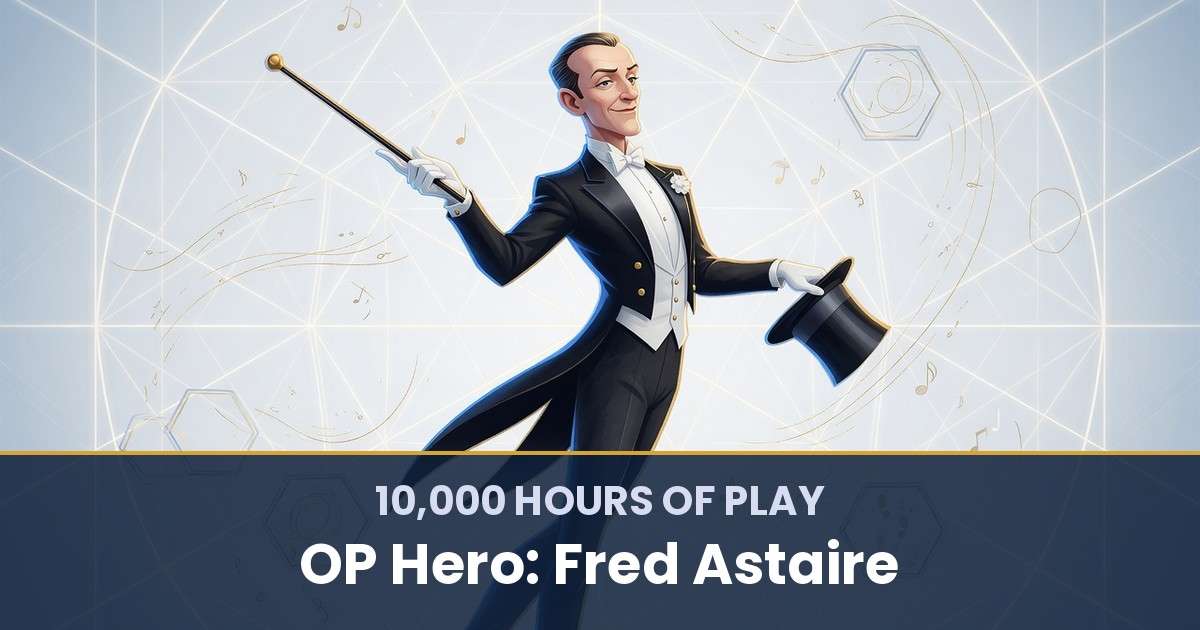
10,000 Hours of Play by OP Hero: Fred Astaire
Fred Astaire made dance look effortless by hiding brutal work. His life decoded through the 10,000 Hours of Play OP Hero framework.


On screen, Fred Astaire looks like the easiest man who ever lived. He glides across a ballroom floor in white tie and tails, tosses off a step that should be impossible, and makes you believe he just thought of it that second.
That ease is the single biggest lie in the history of show business, and Astaire built it on purpose. Behind every “effortless” thirty seconds were weeks of locked-door rehearsal, a stack of discarded takes, and a man re-doing a number because his hat sat one degree wrong.
He spent eight decades chasing one thing: dance that looks casual and feels inevitable while being engineered down to the frame. Nobody in popular entertainment has ever hidden harder work behind a lazier smile.
Read his life the way you would read a character sheet in a life-as-a-game framework (Game, Attributes, Role, Skills, Allies, Quests) and the magic stops being magic. It turns into a build you can study, and in a few places, copy.
⚡ Speed Run Notes
- Astaire’s real game was never fame. It was to make popular dance look effortless while engineering it with near-inhuman precision, what one biographer calls “the pursuit of effortless perfection.”
- His innate stats showed up early: rhythmic intelligence, a perfectionist’s visual eye, and an inventor’s playfulness with anything in the room.
- The signature skill was rehearsal nobody saw. He and choreographer Hermes Pan drilled in private for weeks so the camera caught something that looked spontaneous.
- He fought the studios to film dance his way: long, unbroken, full-body takes instead of flashy cuts, because choreography you chop up stops reading as dancing.
- His sister Adele retired in 1932 and forced him to re-spec from a sibling comedy act into a romantic solo lead. The setback became the launch.
Table of Contents
- Step 1: The Game Fred Astaire Was Actually Playing
- Step 2: Attributes, the Innate Stats
- Step 3: Roles Across the Chapters
- Step 4: The Real-Life Game Skills He Mastered
- Step 5: Allies Who Multiplied Him
- Step 6: Quests That Shaped the Saga
- What You Can Steal From Astaire’s Build
- Where This Framework Comes From
About Yu-kai Chou

Yu-kai Chou is the author of 10,000 Hours of Play — the book that treats your life as the most important game you’ll ever build a character in, and gives you the 6-Step framework (Game · Attributes · Role · Skills · Allies · Quests) to play it on purpose. He has spent two decades developing the system through which this post analyzes its OP Hero, and applies it to his own life and to the lives of the people he advises around the world.
Chou’s other framework, the Octalysis Framework, has been applied by LEGO, Microsoft, Porsche, Coca-Cola, Salesforce, and MrBeast, impacting over 1.5 Billion Users. He has taught the methodology at Harvard, Stanford, Yale, Tesla, Google, BCG, and IDEO, and has advised governments in eight nations including Ukraine, the United Kingdom, the Kingdom of Bahrain, Singapore, Taiwan, the Netherlands, Kazakhstan, and South Korea.
His work has been cited by Harvard, Stanford, MIT, Forbes, Wall Street Journal, Wired, US Department of Energy, NIST, NSF, NCBI, US Department of Education, ClinicalTrials.gov, and Google Scholar — with 3,700+ more academic publications. Explore his books here.
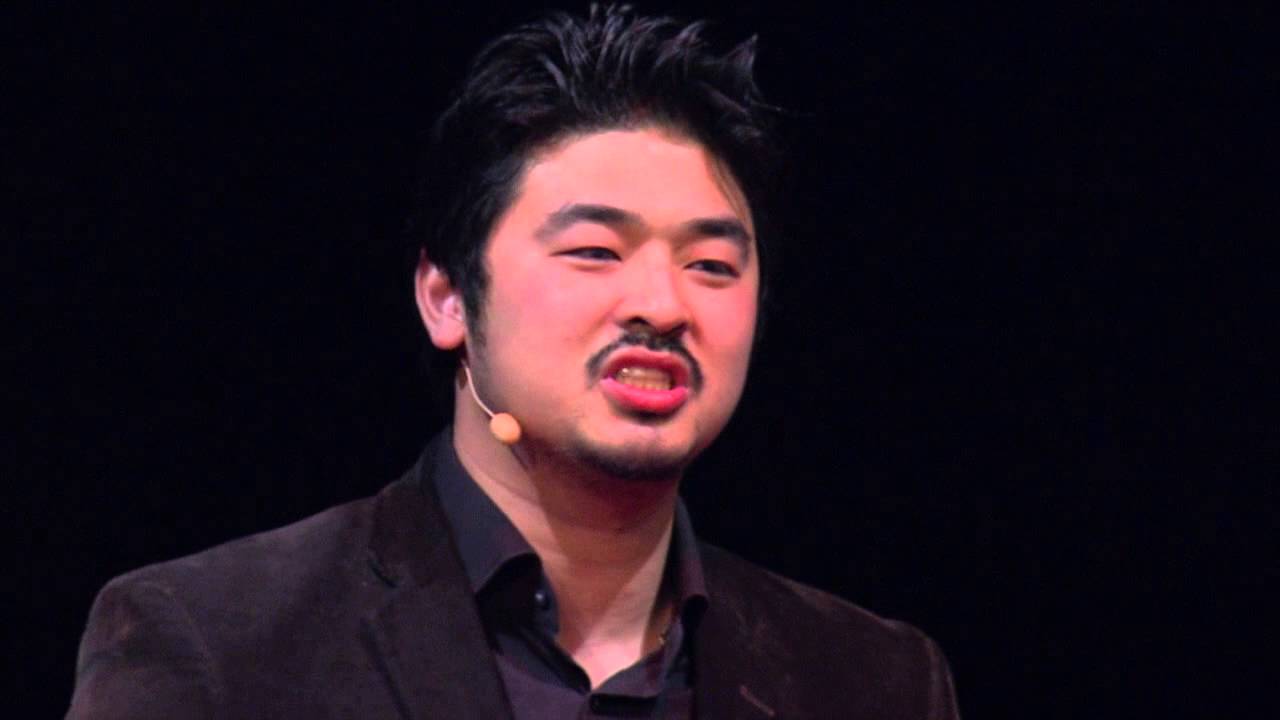
I keep coming back to Astaire because his build is the cleanest proof I know that “effortless” is something you manufacture, not something you’re born with. The man rehearsed in secret for weeks so that the public would think the steps fell out of him by accident. If you only steal one move from his sheet, steal that one: the polish people call talent is almost always private repetition they never got to see, and you can start banking those hours today.
Step 1: The Game Fred Astaire Was Actually Playing
Most people file Astaire under “great dancer” and stop there. That framing misses the game entirely.
His mission was not to be admired for dancing. It was to solve a much stranger problem: how do you make something staggeringly difficult look like it costs nothing? He wanted music, movement, and camera to lock together so cleanly that a routine felt witty and casual and inevitable, even though it was the product of obsessive control. Biographers keep returning to the same phrase for it, “the pursuit of effortless perfection.”
That is why his career reads as one long experiment rather than a string of hits. From the vaudeville circuits of his childhood through Broadway, Hollywood’s golden age, and finally television, he kept choosing projects that let him push the form itself. This is the heart of turning your life into a game you play on purpose: the people who go legendary are usually chasing a mission, not a trophy, and the trophies fall out as a byproduct.
His memoir was titled Steps in Time, and the title is almost a thesis. The whole life was an argument that you can refine a single craft, decade after decade, until the seams disappear and people mistake the engineering for grace.
Step 2: Attributes, the Innate Stats
Some of Astaire’s edge was visible long before any choreographer shaped it. These are his Attributes: the stats he rolled at the start that no rehearsal schedule installs in a person.
The first was raw rhythmic intelligence. As a child in the family act he picked up music and movement quickly, and as an adult he treated composers and choreographers as near-peers, contributing rhythmic ideas and insisting on exact musical phrasing. He heard structure in music the way other people hear a melody.
The second was a perfectionist’s visual eye. Collaborators described him re-doing a take over a tiny foot placement or the angle of a hat. That is temperament, not a learned work habit. He physically could not let a flaw stand once he saw it.
The third was playful inventiveness, the urge to turn anything nearby into a toy. Knowing which stats you actually rolled high in is the entire point of the Talent Triangle Method: you build your character around your real strengths instead of the ones you wish you had. Astaire built around rhythm, exactness, and invention, and pointedly did not pretend to be the booming leading-man type the dice never handed him. He even downplayed his own singing, then quietly became the voice songwriters wrote their best work for.
Step 3: Roles Across the Chapters
Astaire did not play one class for eighty years. He re-spec’d repeatedly while keeping the same core stats, which is how a performer stays relevant across generations.
He opened as a vaudeville child act, born Frederick Austerlitz on May 10, 1899, in Omaha, Nebraska, touring punishing live circuits with his older sister Adele. He leveled up into a Broadway and London musical-comedy star, headlining hits like Lady, Be Good! in 1924, Funny Face in 1927, and The Band Wagon in 1931, building the urbane, witty persona he would carry the rest of his life.
Then came the forced respec. When Adele married and retired in 1932, the legendary sibling act simply ended, and Fred had to prove he could carry a romantic lead alone. He re-spec’d again into a Hollywood screen-dance innovator at RKO, and later into a freelance mature stylist and, finally, a television elder statesman of dance. That willingness to keep switching class while protecting one core craft is a trait he shares with another perfectionist of the screen, Charlie Chaplin, who likewise reinvented his role across eras without ever losing the thing that made him him.
Step 4: The Real-Life Game Skills He Mastered
Attributes opened the door. Skills are what he did once he was through it, and the canon Real-Life Game Skills map almost uncomfortably well onto his story.
The foundation was Lich Grind (Warlock): intense, secluded work periods nobody else sees. Astaire and choreographer Hermes Pan rehearsed privately for weeks before a single frame was shot, drilling timing until a routine looked spontaneous on camera. The “accident” was manufactured in a closed room. That same buried-repetition pattern shows up in another master of physical craft, Bruce Lee, whose on-screen ease was also built from thousands of hours the audience never witnessed.
Sitting on top of that was Ninja Focus (Rogue): sustained, almost invisible discipline. The willingness to shoot a number again because of one wrong angle is what separates polish from “good enough,” and Astaire lived on the wrong side of “good enough” his entire career.
He also ran Elemental Ensemble (Mage), the ability to visualize a complex composition in the head and execute it with precision. He thought in full routines, locking music, movement, and camera path together, then choreographed everyday objects into partners: a hat rack, a set of golf clubs, a row of firecrackers. In Royal Wedding in 1951 he danced on the walls and ceiling of “You’re All the World to Me,” an illusion achieved by building the whole set inside a rotating room.
The last one is the one creators forget: Divine Shield (Paladin), the power to say no no matter how persuasive the pressure. Astaire insisted his dances be filmed in long, unbroken, full-body takes instead of the chopped-up close-ups studios loved, because choreography you cut to pieces stops reading as dancing. Holding that line against directors is half the reason the work still looks alive today.
Step 5: Allies Who Multiplied Him
Nobody runs a campaign this long solo. Astaire’s saga is full of allies who each unlocked a level he could not reach alone.
It starts with his sister Adele. She was his childhood-to-Broadway partner, and their act made him a proven stage performer years before Hollywood ever called. The most famous ally came next: Ginger Rogers, his screen partner across ten films from 1933 to 1949, beginning with Flying Down to Rio. Their pairing defined the cinematic musical and turned him into a movie star, not just a dancer.
Behind the camera, choreographer Hermes Pan was the quiet multiplier, his long-time collaborator on the routines themselves, who later won an Academy Award for choreography connected to Astaire’s work. And the songbook was built by giants: Irving Berlin, George and Ira Gershwin, Cole Porter, and Jerome Kern all wrote material that became core Astaire repertory. The lesson is one the 10K HP framework states plainly: the right ally does not add to your build, they multiply it. Astaire’s genius was real, but it was Rogers, Pan, and those songwriters who turned it into an era.
Step 6: Quests That Shaped the Saga
Strip the life down to its defining quests and the shape of the run becomes obvious, including the part that nearly didn’t happen.
The first quests were on stage: the childhood vaudeville debut with Adele, then the Broadway breakthroughs of the 1920s and early 1930s that made the Astaires transatlantic stars. Then came the setback that could have ended everything. Adele’s retirement in 1932 dissolved the act that was his whole identity, and Hollywood was not obviously waiting for a balding solo dancer in his thirties. There is a famous studio screen-test memo supposedly reading “Can’t act. Slightly bald. Can dance a little.” The line is repeated endlessly and is almost certainly apocryphal, but it captures the real doubt he had to dance straight through.
He cleared it anyway. Flying Down to Rio in 1933 launched the Rogers partnership, Top Hat in 1935 cemented it, and a stream of films followed, from Easter Parade in 1948 to Royal Wedding in 1951 to The Band Wagon in 1953. The honors caught up to the work: an honorary Academy Award in 1950 and the AFI Life Achievement Award in 1981, six years before his death on June 22, 1987. You can trace the same arc across the other OP Hero profiles: the legendary runs are almost always the ones where the worst setback got turned into the next chapter.
What You Can Steal From Astaire’s Build
You will never roll Astaire’s exact stats, and you do not need to. The transferable parts are not the gifts. They are the moves.
Bank the private hours nobody applauds, the way he and Hermes Pan drilled in a locked room for weeks before anyone saw a step. The polish the world calls talent is almost always repetition it never witnessed, a pattern that connects him to performers like Ella Fitzgerald, whose easy swing also rode on relentless unseen work. When a setback dissolves your old role, like Adele walking away in 1932, treat it as a forced respec, not a game over. And protect the one standard that makes your work yours, the way Astaire fought to keep his dances whole on film even when the easy edit was right there.
That is the OP Hero pattern, again and again: the build that goes legendary is rarely the one with the best opening hand. It is the one that keeps grinding the unseen hours, and keeps refusing to let the work get chopped down to “good enough.”
Where this framework comes from

Want the full system this profile is built on?
Every OP Hero piece runs through the same 6-Step framework from 10,000 Hours of Play: Unlock Your Real-Life Legendary Success. The book covers the full system, walks through Yu-kai’s own life run as the first applied case study, and gives you the worksheets to audit your own build.
Related Reading
- All OP Hero Profiles →: the full roster of legendary real-life builds analyzed through the 10K HP framework.
- The 10,000 Hours of Play Framework: the 6 Steps (Game, Attributes, Role, Skills, Allies, Quests) explained in full.
- Charlie Chaplin: OP Hero: another screen perfectionist who reinvented his role across eras.
- Bruce Lee: OP Hero: on-screen ease built from thousands of hours the audience never saw.
- The Talent Triangle Method: how to find the attributes your own build should be designed around.
- The Skills Spectrum: specialist, dabbler, or master, and which one a given game rewards.