
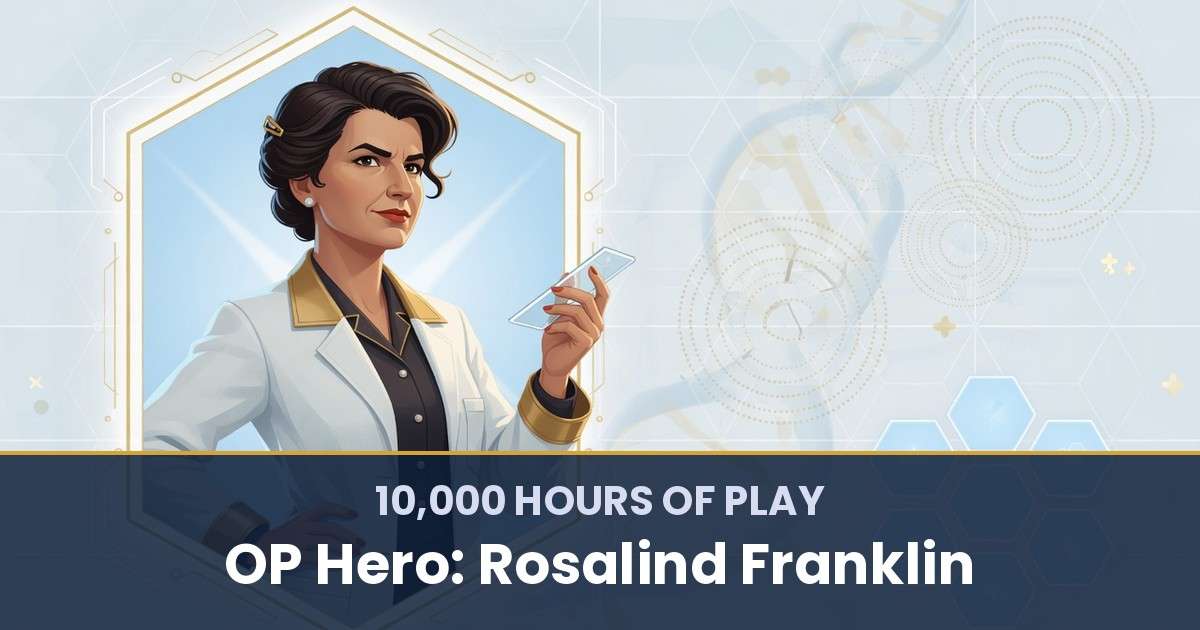


In May 1952, inside a basement lab at King’s College London, Rosalind Franklin and her student Raymond Gosling pointed an X-ray beam at a single, carefully prepared fiber of DNA and exposed a sheet of film for around a hundred hours. The result was Photo 51: the sharpest image of DNA anyone had produced, and the clearest evidence yet that the molecule was a helix.
That photograph helped crack the structure of life itself. Within a year, two scientists in Cambridge would publish the double helix and become household names. Franklin’s name was a footnote on the same pages, and she would be dead of cancer before the Nobel was handed out.
If you have ever done the hard, careful work and watched someone louder get the credit, her character sheet is worth studying closely. Franklin treated science as a game of extracting hidden structure from stubborn matter, and she played it with a precision almost no one could match. This is exactly the kind of life-as-a-game build the 10,000 Hours of Play framework exists to decode, and hers is more triumphant than the “robbed genius” headline suggests.
⚡ Speed Run Notes
- Franklin’s core game was never “discover DNA.” It was to make invisible molecular structure measurable, and she ran the same play on coal, on DNA, and on viruses across two decades.
- Her superpower was precision. She got images out of materials nobody else could read because she controlled every variable, from sample humidity to exposure time, with obsessive care.
- Photo 51 was not luck. It was the payoff of years spent mastering X-ray crystallography in Paris and building experimental discipline on coal long before anyone mentioned genes.
- The credit went elsewhere and she died at thirty-seven, but she did not stall. She left a hostile lab, founded her own group, and opened up virus structure in the years she had left.
- The move you can steal: pick the unglamorous technical skill nobody wants to grind, master it completely, and let it travel across every problem you touch.
Table of Contents
About Yu-kai Chou

Yu-kai Chou is the author of 10,000 Hours of Play — the book that treats your life as the most important game you’ll ever build a character in, and gives you the 6-Step framework (Game · Attributes · Role · Skills · Allies · Quests) to play it on purpose. He has spent two decades developing the system through which this post analyzes its OP Hero, and applies it to his own life and to the lives of the people he advises around the world.
Chou’s other framework, the Octalysis Framework, has been applied by LEGO, Microsoft, Porsche, Coca-Cola, Salesforce, and MrBeast, impacting over 1.5 Billion Users. He has taught the methodology at Harvard, Stanford, Yale, Tesla, Google, BCG, and IDEO, and has advised governments in eight nations including Ukraine, the United Kingdom, the Kingdom of Bahrain, Singapore, Taiwan, the Netherlands, Kazakhstan, and South Korea.
His work has been cited by Harvard, Stanford, MIT, Forbes, Wall Street Journal, Wired, US Department of Energy, NIST, NSF, NCBI, US Department of Education, ClinicalTrials.gov, and Google Scholar — with 3,700+ more academic publications. Explore his books here.

I keep coming back to Franklin because she is the cleanest argument I know that mastering one deep technical skill beats chasing recognition. She never had the platform her rivals had, and she still produced an image that changed biology, because the craft itself was unanswerable. The lesson I lift from her build is her Skills discipline: she ground a single hard technique to the point where her data could not be ignored, even by people who tried to leave her out of the story.
Step 1: The Game — What Rosalind Franklin Was Actually Playing
Every OP Hero is running one core game beneath the surface of their career. Franklin’s was not “win a Nobel” or even “study DNA.” It was to take stubborn, messy matter and force it to reveal its hidden structure through exact measurement.
She kept playing that same game on wildly different targets. First it was coal and graphite, where she worked out how the carbon was packed at the microscopic level. Then it was DNA. Then it was the architecture of viruses. The subject changed; the move never did.
What made it a real Game and not just a job is that she refused the easy version of the answer. The temptation in structural science is to guess a model and then go looking for data that flatters it. Franklin worked the other way around. She insisted the structure had to fall out of the evidence, not out of a hunch, and she would not commit to a conclusion until the measurements forced it.
That discipline is exactly why her DNA data became so decisive. She was not chasing a famous prize. She was chasing the truth of how matter is actually arranged, and she trusted that if she measured precisely enough, the answer would have nowhere to hide.
It is a quieter game than “be a celebrity scientist,” and far harder to fake. You cannot bluff your way to a clear diffraction pattern. Either the structure shows up on the film or it does not, and Franklin built her whole life around being the person who could make it show up.
Step 2: Attributes — The Innate Stats
Attributes are the stats you show up with before anyone trains you. Franklin had three that stand out, all visible long before she pointed an X-ray beam at anything.
The first was raw precision. As a child she was known for an exacting, almost relentless mind, the kind that needed answers to be correct rather than merely plausible. That trait later became her professional signature, where the difference between a blurry photograph and Photo 51 came down to controlling details other researchers ignored.
The second was pattern recognition. She could look at a tangle of spots and shadows on a diffraction film and read the order hiding inside the noise. Most people see static; she saw a helix. That ability to pull signal out of a confusing image is not something you can teach from scratch, and it is the engine behind every result she produced.
The third was fierce intellectual independence. Franklin did not defer to authority just because it was authority, and she did not stay parked in one comfortable specialty. She moved decisively from physical chemistry to biology to virology, picking the hard problem over the safe one each time. That independence cost her socially in some rooms, but it is also why her range was so wide.
If you want to find your own Game, the move is to look at the stats you already ran as a kid, before any job assigned you a role. Mapping that overlap is exactly what the Talent Triangle Method is built for. Franklin’s triangle of precision, pattern recognition, and independence all pointed at one target: making the invisible structure of matter legible.
Step 3: Role(s) — The Character Class Across Chapters
One Game, several Roles. Franklin’s character class kept changing while the mission held steady.
Her first role was the apprentice experimentalist. She earned her degree from Cambridge in 1941, then spent a research year in the laboratory of the physical chemist R. G. W. Norrish, learning how to run rigorous experiments and trust her own results over a senior scientist’s assumptions.
Next came the wartime applied chemist. From 1942 she studied the microstructure of coal and carbon, work that mattered for the war effort and earned her a Cambridge doctorate in 1945. It looked like a narrow industrial problem. It was actually where she built the precision toolkit that everything later depended on.
Then the X-ray crystallographer. A move to a Paris research lab in 1947 put her inside one of the best crystallography environments in the world, where she sharpened the diffraction technique into something close to an art form. This is the role that made Photo 51 possible.
At King’s College London she became the structural analyst at the center of the DNA problem, and later, at Birkbeck College, she leveled up again into an independent lab head running her own virus-structure group. Like Ada Lovelace a century before her, she did foundational scientific work whose full importance the world was slow to credit.
Step 4: Skills — The Real-Life Game Skills Franklin Mastered
This is where the build gets concrete. Franklin did not just have talent; she ran specific Real-Life Game Skills you can name and copy.
The first is Lich Grind (Warlock), the skill of intense, secluded periods of deep work. Franklin’s results came from long, solitary stretches at the apparatus, calibrating equipment and running exposures that could take many hours each. Her coal research, her Paris years, and her DNA imaging were all built on that willingness to disappear into the technical grind until the work was right.
The second is True Sight (Ranger), the ability to observe the keen details others miss. A diffraction photograph is a maze of dots, and the meaning lives in their spacing and symmetry. Franklin could read those patterns and see the helical signature, the water content, the geometry. That same skill of reading hidden structure is why the Skills Spectrum matters here: she was no dabbler in crystallography, she was a master who had logged thousands of hours of it.
The third is Arcane Wisdom (Mage), the skill of absorbing deep technical data and synthesizing it into a clear result. Producing the photograph was only half her work. Her measurements and calculations on the DNA samples helped point past an earlier three-strand idea toward the correct double-helix geometry, and that quantitative analysis was as important as the famous image itself.
The fourth is Courageous Heart (Paladin), the skill of charging into uncomfortable and even hostile territory. Franklin repeatedly chose the hardest, highest-uncertainty problems available, and she held her ground inside a King’s College environment that was difficult and often unwelcoming to her. The same hero pattern shows up in Tu Youyou, another scientist who pushed through institutional resistance to land a result the world could not argue with.
The fifth is Phoenix Rebirth (Paladin), the skill of recovering from a devastating setback and coming back stronger. The DNA episode at King’s was a professional wound: a difficult lab, exclusion from the credit, and a forced exit. What she did next is the part worth copying, and it is the subject of her quests below.
Step 5: Allies — The People Who Multiplied Franklin
No OP Hero levels up alone, and Franklin’s allies were the multipliers behind her best work.
The most direct was Raymond Gosling, the graduate student who worked alongside her at King’s. Together they produced and analyzed the DNA diffraction data, including Photo 51, and his partnership was central to getting that decisive image onto film.
Earlier, R. G. W. Norrish gave her advanced research training in the year after Cambridge, the apprenticeship that launched her experimental career and taught her to defend her own findings.
Her time in the Paris crystallography lab was its own kind of alliance. Surrounded by some of the strongest diffraction scientists of the era, she absorbed the technique at a level she could not have reached alone, then carried it back to England as her edge.
Finally, the research team she built at Birkbeck multiplied her in the hardest chapter of all. They let her keep producing major virus-structure work even as her health collapsed. The pattern is the same one you see in fellow scientist Marie Curie: surround yourself with people who amplify your actual work, not people who simply amplify your name.
Step 6: Quests — The Milestones That Shaped the Saga
Quests are the concrete milestones, the boss fights that define the save file. Franklin’s are unusually clear.
The first was her coal and carbon research through the 1940s. It established her as a serious experimental scientist and built the precision methods she would reuse for the rest of her life. Unglamorous, foundational, and the start of every long campaign.
The second was her crystallography training and work in Paris from 1947 onward. This was the quest that turned a capable chemist into a world-class X-ray analyst and set up everything that followed.
The third is the famous one. At King’s College in May 1952, she and Gosling captured Photo 51, and in April 1953 her DNA data appeared in Nature in the same issue that announced the Watson and Crick double-helix model. Her evidence was load-bearing for the discovery of the century.
The fourth quest is the setback, and it is the one that stings. The King’s College chapter is remembered for a hostile working environment and for Franklin being left outside the full crediting process for DNA. When the Nobel Prize was awarded for the double helix in 1962, she had already died, and the prize is not given posthumously. The failure was real, and it was not hers.
The fifth was her comeback at Birkbeck College, where she founded her own group and made major contributions to the structure of the tobacco mosaic virus. She rebuilt from scratch and opened a whole new field. If you want to see how other OP Heroes turned a brutal chapter into their best work, the OP Hero profiles are full of the same pattern.
The sixth was the quiet one. Diagnosed with ovarian cancer in the autumn of 1956, she kept working through eighteen months of surgeries and treatment, doing science in her remissions until her death on 16 April 1958, at thirty-seven. The work did not stop until she did.
What You Can Steal From Franklin’s Build
You are not going to photograph DNA, and that is not the point. Franklin’s character sheet is built from moves you can run starting this week.
Master the unglamorous technical skill nobody wants to grind. Crystallography was finicky, slow, and easy to skip. Franklin went deeper into it than anyone around her, and that depth is what made her data impossible to dismiss. The boring skill you are avoiding may be your future moat.
Let your edge travel. She ran the same precision play on coal, DNA, and viruses. One mastered technique applied across many problems beats a shallow grab bag of trends, every time.
Refuse to guess when you can measure. Franklin would not commit to a structure until the evidence forced it, and that patience is why her conclusions held up. In your own work, resist the flattering hunch and go find the data.
And measure your run by the work, not the credit. Franklin did not live to collect the recognition, but the image she made still changed biology. If the work is real enough, it outlasts who got the headline. Build the kind of thing that is true whether or not your name is on it.
Where this framework comes from

Want the full system this profile is built on?
Every OP Hero piece runs through the same 6-Step framework from 10,000 Hours of Play: Unlock Your Real-Life Legendary Success. The book covers the full system, walks through Yu-kai’s own life run as the first applied case study, and gives you the worksheets to audit your own build.
Related Reading
- All OP Hero Profiles: the full roster of legendary builds decoded through the 6-Step framework.
- OP Hero: Marie Curie: the scientist who, like Franklin, paid a steep personal price for work that reshaped her field.
- OP Hero: Ada Lovelace: another pioneer whose contribution the world was slow to fully credit.
- OP Hero: Tu Youyou: the researcher who pushed past institutional resistance to a result no one could argue with.
- The 10,000 Hours of Play Framework: the 6 Steps behind every OP Hero profile.
- The Skills Spectrum: how dabblers become masters by compounding reps in one craft.