
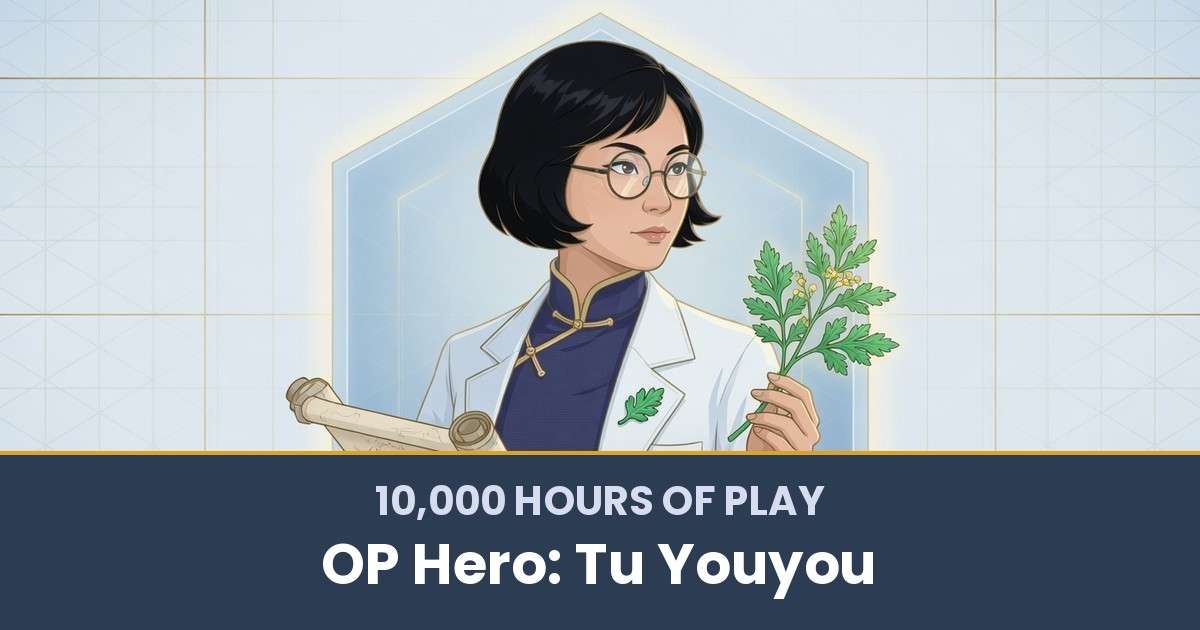


In 1969, a 39-year-old pharmacologist with no doctorate, no foreign training, and no membership in any Chinese academy was handed a problem that had already broken several teams of better-credentialed scientists. The problem was malaria. Soldiers fighting in Vietnam jungles were dying of it faster than they were dying of bullets. The Chinese government had launched a classified national program called Project 523 to find a cure inside traditional Chinese medicine. After three years of screening, the program had nothing.
The pharmacologist’s name was Tu Youyou. Six years later, she would have isolated a compound that has gone on to save several million lives. Forty-six years after that, she would walk to a podium in Stockholm and become the first mainland-China-trained scientist to win a Nobel Prize in a science category. She had no PhD when she did the work. She still did not when she won the prize.
Most accounts of Tu Youyou stop at the headline (“Nobel laureate discovered artemisinin”). The structural question is how the same operator, working inside one of the most resource-starved scientific environments of the 20th century, beat better-funded teams to a treatment for one of humanity’s oldest killers, and then keep going for another forty years?
⚡ Speed Run Notes
- Tu Youyou’s Game fits in one sentence: pull potent therapies for human-killing parasitic diseases out of traditional Chinese medicine and validate them with modern science.
- The “Three-No” status (no PhD, no overseas training, no academy membership) that the Chinese press kept flagging is the structural condition in her build that forced her into a research method built on classical texts.
- The 1971 breakthrough came from re-reading a 4th-century Chinese text by Ge Hong and noticing one detail: “soak in cold water.” That one inference rewrote the extraction chemistry.
- In 1972 Tu and two colleagues tested the refined extract on themselves before any clinical trial, a move that ended the program’s delays.
- The Nobel came in 2015. Most of those decades were spent inside a classified project where her contributions were collectively attributed, anonymous, or both.
- The lesson for your own life run: a forty-year compounding career comes from staying on the same one-sentence mission while letting your method, your tools, and even your public credit change underneath you.
Updated 10 October 2026: added the neutral-fraction chemistry, her 2016 prize-money funds, the 2019 drug-resistance paper, her 2025 US National Academy election, the first malaria drug for newborns, and common questions.
Table of Contents
- Step 1: The Game — What Tu Youyou Was Actually Playing
- Step 2: Attributes — The Innate Stats
- Step 3: Role(s) — The Character Class Across Chapters
- Step 4: Skills — The Real-Life Game Skills Tu Youyou Mastered
- Step 5: Allies — The People Who Multiplied Tu Youyou
- Step 6: Quests — The Milestones That Shaped the Saga
- What You Can Steal From Tu Youyou’s Build
- The 10K HP Frame
- Which Core Drives Her Arc Activated
- Modern Echo
- Frequently Asked Questions
- Where this framework comes from
- Related Reading
About Yu-kai Chou

Yu-kai Chou is the author of 10,000 Hours of Play — the book that treats your life as the most important game you’ll ever build a character in, and gives you the 6-Step framework (Game · Attributes · Role · Skills · Allies · Quests) to play it on purpose. He has spent two decades developing the system through which this post analyzes its OP Hero, and applies it to his own life and to the lives of the people he advises around the world.
Chou’s other framework, the Octalysis Framework, has been applied by LEGO, Microsoft, Porsche, Coca-Cola, Salesforce, and MrBeast, impacting over 1.5 Billion Users. He has taught the methodology at Harvard, Stanford, Yale, Tesla, Google, BCG, and IDEO, and has advised governments in eight nations including Ukraine, the United Kingdom, the Kingdom of Bahrain, Singapore, Taiwan, the Netherlands, Kazakhstan, and South Korea.
His work has been cited by Harvard, Stanford, MIT, Forbes, Wall Street Journal, Wired, US Department of Energy, NIST, NSF, NCBI, US Department of Education, ClinicalTrials.gov, and Google Scholar — with 3,700+ more academic publications. Explore his books here.
What I find instructive about Tu Youyou’s build is how much of the breakthrough is sitting inside a single Attribute most people would write off: comfort with reading across knowledge systems that nominally don’t speak to each other. Her edge was training that let her take Ge Hong’s 4th-century instruction and a 1960s organic-chemistry textbook seriously at the same time. The lesson I would lift for your own run is at Step 2: the rarest Attribute you have is often the one your formal credentials don’t reward, and the move that compounds is finding a Game where the under-rewarded Attribute is the load-bearing one.
Step 1: The Game — What Tu Youyou Was Actually Playing
One sentence: pull potent therapies for human-killing parasitic and infectious diseases out of traditional Chinese materia medica, and validate them with modern science.
That sentence covers her arrival at the Institute of Chinese Materia Medica at the China Academy of Traditional Chinese Medicine in 1955, the two years she spent in the Chinese countryside from 1959 to 1961 studying local remedies for tuberculosis and schistosomiasis, her appointment in January 1969 as the head of the Institute’s antimalarial research group inside the classified Project 523, the 1971 ether-extraction breakthrough on Sample 191, her decades of follow-on work into the 2010s on artemisinin resistance and dihydroartemisinin-piperaquine combination therapies, and her 2011 Nature Medicine paper on the discovery of artemisinin, framed as a gift from traditional Chinese medicine to the world — the title is itself a one-sentence Game statement.
The substrate kept moving underneath her. Tuberculosis became schistosomiasis became malaria became drug resistance. The Game did not. The Project 523 ethos that the press would later call her Three-No orientation, beyond the no-PhD, no-academy, no-overseas-training reading, has often been described as a vow-like commitment to push through hardship, accept personal risk, and refuse credit-seeking as a motivator. That orientation is the part of the one-sentence mission that protects the Game from being deformed by the other two things that usually deform careers: comfort and credit.
This matters because the Game an operator picks is what determines which Attributes are load-bearing and which are decorative. Most pharmacology careers in 1955 China assigned the highest weight to credentials, lab access, and Western training. Tu Youyou’s Game inverted that ranking. The load-bearing Attribute became cross-system reading.
Step 2: Attributes — The Innate Stats
Five Attributes show up early in the biographical record and stay online for the full forty-year run.
Cross-system pattern recognition. Tu Youyou was admitted to Beijing Medical College in 1951, where she studied pharmacy with a curriculum that deliberately combined modern Western pharmacology with traditional Chinese materia medica. By her own later accounting she read pharmacology and organic-chemistry textbooks “line by line” while also working through classical TCM texts. The Attribute is the willingness to hold two epistemologies in the head at the same time without forcing them to argue. It is the same Attribute the Talent Triangle Method would mark as the multiplier on her career: every Skill downstream of cross-system reading is worth more because of it.
Methodical, detail-obsessed curiosity. Colleagues consistently describe her early career as defined by an unusual willingness to log extraction conditions, solvent variations, and small physical changes in extracts that other researchers ignored. The 1971 breakthrough came from her noticing that high-temperature decoction — the default TCM preparation — kept destroying activity, and then testing solvent and temperature systematically until ether at low temperature worked. The biographies trace that careful logging back to her undergraduate years.
High risk tolerance for personal cost. In 1972, with toxicity of the early refined artemisinin extract still uncertain and animal data incomplete, Tu and two of her colleagues volunteered as the first human subjects for the compound. She would later describe this as a “team encouragement” decision. It is also an Attribute. She was willing to absorb the risk to keep the project moving.
Tenacity under bad conditions. Project 523 was a Cultural Revolution-era operation. The political environment was hostile to scientists, lab resources were scarce, and during the early years of the project she was separated from her young daughters, who had to be raised partly by relatives and a nursery. The malaria research itself ran on roughly four years (1969–1972) of repeated screening failures across more than two thousand traditional prescriptions before the ether-extraction breakthrough. Accounts of those years describe her in those years with the Chinese term 坚韧 (unyielding).
Low ego under collective attribution. Project 523 was classified, and for years many of Tu’s specific contributions were either collectively attributed to the program or published anonymously. She held neither a professorship nor a doctorate, and she remained largely unknown outside China until the 2011 Lasker-DeBakey Clinical Medical Research Award. When asked in interviews whether the lack of credit had bothered her, her recurring reply was that the achievement was saving lives, not personal honor. That kind of consistent low-ego orientation reads in the biographies as innate rather than performed.
Step 3: Role(s) — The Character Class Across Chapters
Four Roles, each one feeding into the next.
From 1951 to 1959 she was the Hybrid Apprentice. She studied at Beijing Medical College’s School of Pharmacy from 1951 to 1955, took her degree, and joined the Institute of Chinese Materia Medica in Beijing in 1955. From 1959 to 1962 she also completed a special two-and-a-half-year course in classical Chinese medicine sponsored by the Ministry of Health, which formalized her dual training. The Role focus was building Western pharmacology and TCM fluency in one head.
From 1959 to 1965 she was the Field Ethnopharmacologist. She spent roughly two years in the Chinese countryside investigating local remedies for tuberculosis and schistosomiasis. The Role was boots-on-the-ground: collecting plant samples, watching how local practitioners actually prepared remedies, and logging the gap between what the classical texts said and what worked in practice. The same Attribute stack that would later beat Project 523 was being calibrated here, on the cheaper problem of parasitic infections nobody was racing to cure.
From 1969 to 1978 she was the Classified-Project Lead Scientist. On January 21, 1969 the People’s Liberation Army’s Project 523 leadership assigned her to lead a small group at the Institute of Chinese Materia Medica focused on antimalarial herbs. The Role was: design the screening method, supervise the extraction work, coordinate animal testing, and shepherd compounds into human trials. The 1971 ether-extraction breakthrough on Sample 191 (qinghao, Artemisia annua) happened inside this Role. So did the 1972 self-experimentation and the first clinical trials of artemisinin extract in Hainan and Yunnan.
From 1979 onward she has been the Drug Optimization Strategist. The Institute of Chinese Materia Medica filed and published on the chemical structure of artemisinin in 1977 (initial publication was anonymous due to the classified nature of the program). Through the 1980s and 1990s she led work on dihydroartemisinin and combination therapies that became the World Health Organization standard for uncomplicated Plasmodium falciparum malaria. The Role is the long tail of the original Game: “how do we keep this working as the parasite evolves.” She was still publishing on artemisinin resistance into her eighties.
Step 4: Skills — The Real-Life Game Skills Tu Youyou Mastered
Five canon Real-Life Game Skills carry the build. Each one earns its slot from a specific moment in the public record.
Ley Line Infusion (Mage). Quickly absorbing a large amount of knowledge in a subject. The clearest firing is the 1969–1971 literature campaign. Tu’s team screened roughly 2,000 traditional Chinese prescriptions and reviewed more than 640 classical materia medica texts, narrowing the field to around 200 plant candidates with documented antimalarial use. Three years of compressed reading became the dataset everything that followed was searching inside.
Cognitive Lens (Mage). Zooming in on details and zooming out for strategy. The famous case is the 4th-century text Zhouhou Beiji Fang by Ge Hong, which she read closely during the deadlocked early 1971 work. The recipe for treating intermittent fever (which we now read as malaria) reads, in Tu Youyou’s own translation in her 2011 Nature Medicine commentary: “A handful of qinghao immersed with 2 liters of water, wring out the juice and drink it all.” The micro-detail she weighted is “soak” and “wring out the juice” rather than “decoct” or “boil.” She zoomed in to that single instruction, zoomed out to her chemistry training, and inferred that boiling was destroying the active compound. The next experiment used low-temperature ether extraction. Sample 191 worked.
Lich Grind (Warlock). Intense, secluded work periods. The 1969–1972 stretch is her Lich Grind. Four years of repeated screening failures against the most lethal form of malaria, under classified-project secrecy, in a country whose political environment was actively dangerous for the scientific class. She and her team ran extractions, animal infections, dose-response work, and toxicity checks at a hard pace and in near isolation.
Undying Rage (Warrior). Activating survival instincts to defeat an overwhelming challenge. The clearest firing is the July 1972 decision to self-experiment. The refined artemisinin extract had cleared animal trials but the team could not be certain it was safe for humans. Tu and two colleagues admitted themselves to a Beijing hospital and took the extract themselves before any external clinical trial. She would later write, in her 2011 Nature Medicine commentary: “During the Cultural Revolution, there were no practical ways to perform clinical trials of new drugs. So, in order to help patients with malaria, my colleagues and I bravely volunteered to be the first people to take the extract.” Undying Rage in the canon is the move where you make the cost of stopping higher than the cost of pushing through. The self-experiment did exactly that. After it, the program could not credibly delay.
Mastermind (Ranger). Creating, adapting and executing complex multi-step plans. Project 523 under her group’s coordination is the case study. The plan ran in order: the 640-text literature pass, the 200-candidate plant shortlist, the switch to low-temperature solvents, animal validation on rodent and then primate malaria, the self-experiment that unlocked human trials, the 1972 and 1973 field trials in Hainan and Yunnan, and the 1975 structural work that led to the 1977 publication.
Step 5: Allies — The People Who Multiplied Tu Youyou
Lou Zhiyun and the Institute team. Lou Zhiyun was one of Tu’s earliest collaborators on the qinghao extraction work and is credited alongside her on several of the foundational extraction-method papers from the mid-1970s. The Institute of Chinese Materia Medica group at Dongzhimen in Beijing was the load-bearing team. Without them, the 2,000-prescription screen and the 191 ether-extraction work do not run.
Ge Hong. The 4th-century alchemist and physician whose Zhouhou Beiji Fang (“Emergency Prescriptions Kept Up One’s Sleeve”) carried the cold-soak preparation note that broke the 1971 deadlock. Ge Hong was a time-displaced mentor, dead for sixteen hundred years, whose instruction still carried the answer.
Project 523 leadership and the People’s Liberation Army. The classified national program supplied the political cover, the funding, and the cross-institutional coordination across more than sixty Chinese research units that allowed a Cultural Revolution-era research push to happen at all. The Ally relationship here is unusual: the program was strict, often punitive, and the credit-allocation rules were collectivist enough that Tu’s individual contribution was obscured for decades. But without Project 523’s coordination layer the qinghao thread does not get sequenced, screened, and clinically tested at all.
The rodent-malaria team at the Academy of Military Medical Sciences. Specialists at the Institute of Microbiology and Epidemiology who ran the animal models that validated artemisinin’s activity before the human trials.
Her family. Tu’s husband Li Tingzhao, a metallurgical engineer, supported the work through years in which she was separated from her two daughters by both project secrecy and physical relocation. The cost of that period was real and lifelong, and the relationship survived it.
Step 6: Quests — The Milestones That Shaped the Saga
December 30, 1930 — Born in Ningbo, Zhejiang Province. Survives a tuberculosis infection at age 16 that pulls her toward medicine as a career.
1951 — Admitted to Beijing Medical College, School of Pharmacy. Enters the program that combines Western pharmacology with classical Chinese materia medica.
1955 — Joins the Institute of Chinese Materia Medica. Beijing. The base she will work from for the rest of her career.
1959–1962 — Special course in classical Chinese medicine. Two-and-a-half-year Ministry of Health course that formalizes her dual training. The cross-system Attribute hardens into a credential.
1959–1961 — Field study in the countryside. Investigates TCM remedies for tuberculosis and schistosomiasis. The Field Ethnopharmacologist Role goes live.
January 21, 1969 — Appointed head of the Institute’s antimalarial group inside Project 523. The classified national program is already three years old and has produced no candidate. She inherits the deadlock.
1969–1971 — The 640-text, 2,000-prescription literature campaign. Ley Line Infusion fires for two years before any laboratory result.
Early 1971 — The Ge Hong inference. Re-reading Zhouhou Beiji Fang, she notices the cold-soak preparation note and infers that high-temperature extraction is destroying the active compound.
October 4, 1971 — Sample 191. Low-temperature ether extraction of Artemisia annua achieves 100 percent inhibition of Plasmodium in the rodent model. The four-year deadlock is over.
July 1972 — Self-experimentation. Tu and two colleagues take the refined extract themselves at a Beijing hospital. No adverse effects. Clinical trials follow.
August–October 1972 — First field clinical trials in Hainan. More than 20 patients treated. The drug works. The setback in this Quest sits outside the lab, in the international scientific community’s slow recognition, which will take another four decades.
1975 — Structural elucidation of artemisinin. The sesquiterpene lactone structure with the rare endoperoxide bridge is confirmed. The 1977 publication appears under the collective name “Qinghaosu Antimalaria Coordinating Research Group” — anonymous in the way Cultural Revolution-era science required.
September 2011 — Lasker-DeBakey Clinical Medical Research Award. The work breaks out of China for the first time. Tu is 80 years old.
October 5, 2015 — Nobel Prize in Physiology or Medicine. Shared with William C. Campbell and Satoshi Ōmura. First China-trained scientist to win a Nobel in a science category for work done in mainland China. She is 84.
2017 onward — National honors and continued work on resistance. Awarded China’s State Preeminent Science and Technology Award in 2017. Continues publishing on artemisinin combination therapies and emerging resistance into her late eighties.
What You Can Steal From Tu Youyou’s Build
Three transferable patterns.
First, look hard at the Attribute your field’s scorecard ignores. Cross-system reading appeared on no 1965 Chinese pharmacology evaluation form and earned nobody tenure or an academy seat. It also turned out to be the Attribute that cracked a problem better-credentialed teams had failed to crack for three years. Audit your own stack for an Attribute the official rubric in your field treats as a hobby.
Second, when stuck, read deeper into existing knowledge before reaching for new experiments. The 1971 breakthrough did not come from new chemistry. It came from a 4th-century instruction the modern field had skimmed past. Most operators in a research deadlock reach for new tools, new collaborators, new funding. Tu Youyou reached for older texts, read them carefully, and found that the deadlock was an interpretation failure. The next time your work is stuck, start with the reading. It is cheaper, faster, and more often right than the field will tell you.
Third, the Game is allowed to outlive the credit. The Nobel arrived forty-six years after the work started, and for most of those decades Tu’s specific contributions were collectively attributed or anonymous. If she had built her career around credit, the four-year Lich Grind and the 1972 self-experiment would not have been worth the price. She built her career around the Game itself, and the credit caught up when it was ready.
The 10K HP Frame — Tu Youyou Through the 6 Steps Lens
The six steps above follow her from Ningbo to Stockholm. A second pass through the same six steps picks up what the first one moved past: the chemistry in the months after Sample 191, the prize money she gave away, and the drug-resistance fight she took on in her late eighties.
The Game. Her Game came with a deadline attached. Project 523 took its name from the date of its launch meeting, 23 May 1967, and its first customers were soldiers in the field. Every malaria season without a working drug added to the death count. That deadline shaped how she played. Two thousand prescriptions is a long list to screen, and her group screened it anyway, because a slower and more thorough search was still the fastest route to an answer that would hold up in a clinic.
The Attributes. One Attribute in her record shows up only after the breakthrough: patience with a result that already looks good enough. Sample 191 was active in mice in October 1971. She spent the following months refining the extract and checking its safety before any patient received it.
The Roles. After the Nobel she added a Role: funder of the next generation. In 2016 she gave two donations of one million yuan each from her prize. One set up the Tu Youyou Talent Award Foundation at Peking University Health Science Center. The other created an innovation fund at the China Academy of Chinese Medical Sciences to pull young researchers into traditional Chinese medicine research.
The Skills. Four more canon Skills show up in the record.
Devour (Warlock) is cutting a process or a product down until only the working part is left. Her team split the ether extract into an acidic portion and a neutral portion. The acidic portion was toxic and did nothing against the parasite, so they threw it away. What stayed behind was the neutral fraction, extract 191. At a Project 523 meeting in March 1972 she reported that it wiped out the parasites in the blood of infected mice and monkeys. The Lasker Foundation credits that cut with raising potency and lowering toxicity in one move. The pure crystalline compound followed on 8 November 1972.
Half of the breakthrough was knowing which part of the extract to throw away.
Hydra Riposte (Ranger) is answering a crushing attack with a fresh round of invention. By the 2010s the parasite was fighting back, with artemisinin resistance spreading through Southeast Asia. In June 2019 her team, which included researcher Wang Jigang, published “A Temporizing Solution to ‘Artemisinin Resistance’” in the New England Journal of Medicine. They proposed two fixes: stretch the standard three-day course to five or seven days, and swap out the partner drugs in combination therapies that had stopped clearing parasites. Wang explained the reasoning in one line: “The real effective time for artemisinin to kill parasites is limited to four to eight hours.” She was 88.
Guardian Restraint (Paladin) is holding pride in check. When she stood at the Karolinska Institutet on 7 December 2015 to give her Nobel Lecture, she titled it “Artemisinin – A Gift from Traditional Chinese Medicine to the World.” The biggest stage of her career, and the title handed the credit to a 1,600-year-old tradition.
Floral Blossom (Druid) is teaching and growing the people who come after you. The two 2016 funds are the clearest evidence. She used the largest cash prize of her life to pay for other people’s starts in the same field.
The Allies. Wang Jigang joins the Allies list for the late chapter. He explained the 2019 paper’s reasoning to the press when it came out.
The Quests. Three Quests close out the record so far: the 2019 resistance paper, the Medal of the Republic in September 2019, China’s highest honorary medal, and her election as an international member of the US National Academy of Sciences on 30 April 2025, at 95.
Which Octalysis Core Drives Tu Youyou’s Arc Activated
The Octalysis Framework sorts human motivation into eight Core Drives. Almost none of the usual career motivators were available to her. She went forty years without a senior title, an individual byline on the key papers, or foreign recognition, and four Core Drives kept her working anyway.
CD1 Epic Meaning & Calling
Epic Meaning & Calling is the drive people feel when the work serves something far larger than themselves. Project 523 was a national mission with lives attached to every month of delay. She described the 1972 self-test in her 2011 Nature Medicine commentary as something she and her colleagues did “in order to help patients with malaria.” Forty-three years later she named her Nobel Lecture after a gift to the world.
CD8 Loss & Avoidance
Loss & Avoidance is the drive to stop something bad from happening. Her career ran on it twice. In 1969 the loss was soldiers and villagers dying of falciparum malaria while three years of screening produced nothing. In 2019 the loss was the drug itself. A medicine that had saved millions could stop working if resistance spread, and she went back to the bench in her late eighties to slow that down.
She spent her eighties defending the drug she discovered in her forties.
CD7 Unpredictability & Curiosity
Unpredictability & Curiosity keeps people searching when they cannot see the result in advance. A screen of two thousand prescriptions is a search with no map. Most samples fail, and the one that works could be sitting anywhere in the pile. The extract that finally worked carried the number 191. The Ge Hong passage was a clue hidden in a 4th-century handbook. The open question of which sample would work, and why the promising herb kept failing, kept her group coming back to a problem that had stalled the program for years.
CD5 Social Influence & Relatedness
Social Influence & Relatedness covers the pull of the people around us. Her breakthrough was a team event at every step. Three people took the self-test together. The 1977 structure paper ran under the name of a coordinating research group. Her 2016 donations went to institutions, for students she would never meet. In a system that gave almost nobody individual credit, the people in that group kept each other going through four years of failure.
Two drives are close to absent. CD2 Development & Accomplishment, the drive behind titles and visible progress, was mostly denied to her for decades. CD4 Ownership & Possession barely registers: the work was classified, and the credit belonged to the program. Her motivation stack ran almost entirely on meaning, avoided loss, curiosity, and the team.
Modern Echo — Who’s Playing This Game Today
Since the Last Time We Told This Story
On 30 April 2025 the US National Academy of Sciences elected her an international member, one of 30 international members chosen that year. She was 95, and China Daily described her as head and chief professor of the artemisinin research center at the China Academy of Chinese Medical Sciences.
Her drug’s family kept growing. On 8 July 2025 Swissmedic approved Coartem Baby, an artemether-lumefantrine treatment from Novartis and Medicines for Malaria Venture for newborns and infants weighing 2 to under 5 kilograms. It is the first malaria medicine approved for babies that small, and artemether is an artemisinin derivative. Novartis CEO Vas Narasimhan marked the approval by saying the company had “stayed the course” against malaria for more than three decades.
The resistance problem she wrote about in 2019 has reached Africa. The WHO’s World Malaria Report 2025 lists artemisinin partial resistance as confirmed in Eritrea, Rwanda, Uganda, and Tanzania, and suspected in Ethiopia, Namibia, Sudan, and Zambia.
Brent Seales. The closest living echo of her method works on burned papyrus. Tu Youyou took a 4th-century text seriously and read it with modern chemistry. Seales, a computer scientist at the University of Kentucky, has spent two decades trying to read the Herculaneum scrolls, carbonized when Vesuvius erupted in 79 CE, without opening them. He built a “virtual unwrapping” system on X-ray CT in 2002. In a 2005 lecture at Oxford he proposed that the sealed scrolls could be read by noninvasive digital methods. In 2016 his team used the approach to read the charred En-Gedi scroll, revealing text from Leviticus.
The sealed Herculaneum scrolls took longer. In March 2023 he co-founded the Vesuvius Challenge with Nat Friedman and Daniel Gross, a global prize competition that opened the scan data to anyone. In May 2025 the project announced the title of a sealed scroll held at Oxford’s Bodleian Libraries, PHerc. 172: Philodemus, On Vices. Sean Johnson of the Vesuvius Challenge and Marcel Roth and Micha Nowak of the University of Würzburg read it at about the same time, each working on their own. On 25 June 2026 the challenge announced more recovered texts, titles, and authors. “We are finally able to read them,” Seales said.
The pattern matches hers point for point. An old text that experts had written off as unreadable or unreliable. A modern tool pointed at it with patience. Two decades between the first proposal and the first readable title. And credit spread across a crowd of contributors, much like the coordinating group that published artemisinin’s structure in 1977.
Frequently Asked Questions
What did Tu Youyou discover?
Tu Youyou discovered artemisinin, an antimalarial compound from sweet wormwood (Artemisia annua), during China’s classified Project 523 in the early 1970s. Artemisinin-based combination therapies became the World Health Organization’s standard treatment for uncomplicated falciparum malaria. She shared the 2015 Nobel Prize in Physiology or Medicine with William C. Campbell and Satoshi Ōmura.
How did an ancient Chinese text help Tu Youyou find artemisinin?
A 4th-century handbook by Ge Hong, Zhouhou Beiji Fang, told readers to soak a handful of qinghao in water and drink the juice. Tu Youyou read the instruction as a clue that heat was destroying the active ingredient. She switched to low-temperature ether extraction, and in October 1971 extract 191 cleared the parasite in infected mice.
Did Tu Youyou have a PhD?
No. Tu Youyou had no doctorate, no overseas training, and no membership in a Chinese academy when she did the work, which is why the Chinese press called her the “Three-No” laureate. She studied pharmacy at Beijing Medical College and later completed a Ministry of Health course in classical Chinese medicine.
Is artemisinin resistance spreading?
Yes. Resistance first spread in Southeast Asia, and Tu Youyou’s group proposed longer treatment courses and new partner drugs in a 2019 New England Journal of Medicine paper. By the WHO’s 2025 count, resistance is confirmed in four African countries and suspected in four more.
What honors has Tu Youyou received since the Nobel Prize?
China awarded her the Medal of the Republic, its highest honorary medal, in September 2019. In April 2025, at 95, she was elected an international member of the US National Academy of Sciences.
Where this framework comes from

Want the full system this profile is built on?
Every OP Hero piece runs through the same 6-Step framework from 10,000 Hours of Play: Unlock Your Real-Life Legendary Success. The book covers the full system, walks through Yu-kai’s own life run as the first applied case study, and gives you the worksheets to audit your own build.
Related Reading
- All OP Hero Profiles — the full catalog of builds analyzed through the 6 Steps.
- Katherine Johnson — OP Hero profile — the closest sibling for an under-credentialed woman scientist quietly anchoring a national-stakes program from inside a hostile credentialing system.
- Hedy Lamarr — OP Hero profile — another woman inventor whose work was unrecognized for decades while it silently powered a field she got no credit for.
- Rosalind Franklin, OP Hero profile: a scientist whose key result fed a Nobel-winning discovery while her own credit lagged for decades.
- Jonas Salk, OP Hero profile: another disease-fighting build where the operator gave the result away to the world.
- Jane Goodall — OP Hero profile — the Mastermind (Ranger) parallel: a researcher without the standard credentials running a multi-decade plan from inside a field that had not been built to accommodate her.
- The Talent Triangle Method — how to pick the Attribute, Skill and Role combinations your own Game is built on.
- The Skills Spectrum — Specialist, Dabbler, Master, Strategy. The taxonomy under every Skill mention in this profile.