
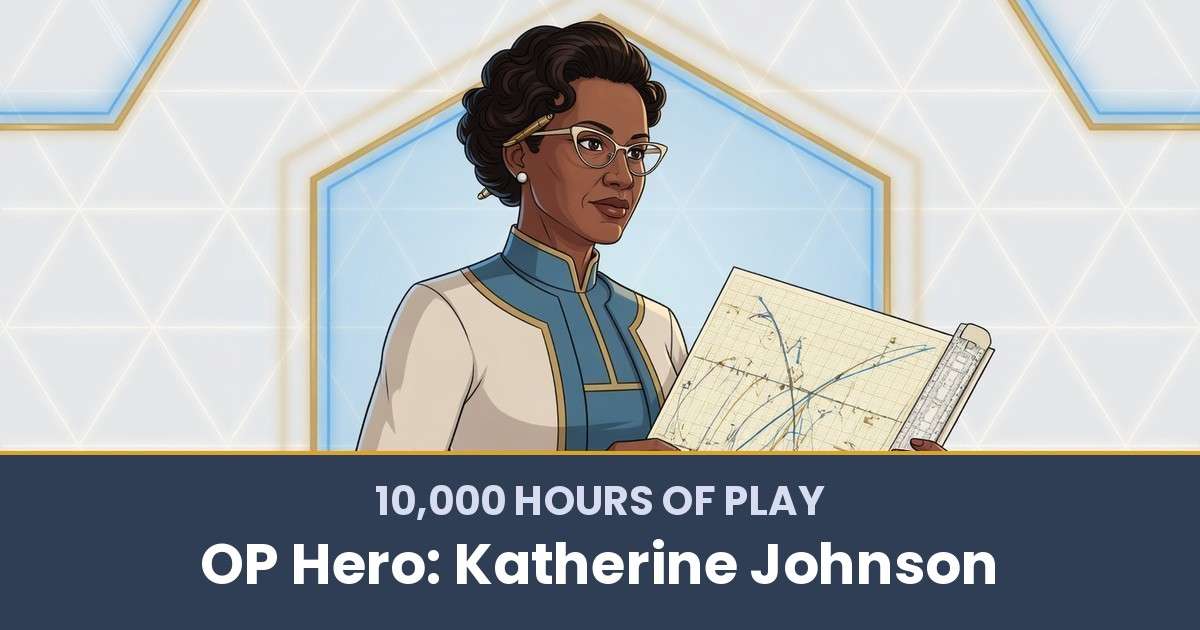


On February 20, 1962, John Glenn refused to climb into Friendship 7 until a woman in a back office at Langley had checked the orbital math by hand. The IBM 7090 had spit out the numbers. Glenn did not trust the machine. He trusted Katherine Johnson.
She spent close to a full day re-deriving the trajectory on paper, confirmed the computer was right, and Glenn flew. The flight made the American space program competitive. The hand-check made a single Black woman, working inside a segregated calculation pool, the last line of safety before the launch button.
That is the part of her story everyone tells. The interesting part is what came before it and after it — the build that put her in that chair, and the decades of orbital math that kept her there. If you treat her life as a save file in the 10,000 Hours of Play framework, what stands out is how cleanly the 6 Steps line up. She picked the Game young. She inventoried her Attributes early. She rotated through Roles without losing the through-line. And she chose Skills that would still matter when the computers caught up.
⚡ Speed Run Notes
- Johnson’s Game wasn’t “be a NASA mathematician.” It was use exact math to keep pilots alive, and open the door for the next Black woman to walk through after her.
- Her standout Attribute was numerical pattern recognition. She was placed in high school at 10 and college at 14 because the standard curriculum couldn’t keep up with her math.
- The 1962 Glenn hand-check is famous. The real lever was the 1960 NASA Technical Note D-233 she co-authored — the first report her division ever credited a woman on.
- She lost her first husband to a brain tumor in 1956 and kept working with three young daughters at home. Phoenix Rebirth, not as one moment, as an eight-year arc.
- The 2015 Presidential Medal of Freedom wasn’t the win — it was the public acknowledgement that the win had already happened, decades earlier, on hand-drawn graph paper.
Table of Contents
- Step 1: The Game — What Katherine Johnson Was Actually Playing
- Step 2: Attributes — The Innate Stats
- Step 3: Role(s) — The Character Class Across Chapters
- Step 4: Skills — The Real-Life Game Skills Katherine Johnson Mastered
- Step 5: Allies — The People Who Multiplied Katherine Johnson
- Step 6: Quests — The Milestones That Shaped the Saga
- What You Can Steal From Katherine Johnson’s Build
- Where this framework comes from
- Related Reading
About Yu-kai Chou

Yu-kai Chou is the author of 10,000 Hours of Play — the book that treats your life as the most important game you’ll ever build a character in, and gives you the 6-Step framework (Game · Attributes · Role · Skills · Allies · Quests) to play it on purpose. He has spent two decades developing the system through which this post analyzes its OP Hero, and applies it to his own life and to the lives of the people he advises around the world.
Chou’s other framework, the Octalysis Framework, has been applied by LEGO, Microsoft, Porsche, Coca-Cola, Salesforce, and MrBeast, impacting over 1.5 Billion Users. He has taught the methodology at Harvard, Stanford, Yale, Tesla, Google, BCG, and IDEO, and has advised governments in eight nations including Ukraine, the United Kingdom, the Kingdom of Bahrain, Singapore, Taiwan, the Netherlands, Kazakhstan, and South Korea.
His work has been cited by Harvard, Stanford, MIT, Forbes, Wall Street Journal, Wired, US Department of Energy, NIST, NSF, NCBI, US Department of Education, ClinicalTrials.gov, and Google Scholar — with 3,700+ more academic publications. Explore his books here.
What I personally find instructive about Katherine Johnson’s build is how patiently she stacked exactness on top of exactness. Most heroes who get overlooked in their twenties start optimizing for visibility. She optimized for being the right person to call when the numbers had to be perfect — and the visibility came thirty years later, because by then she was the only person the astronauts trusted. The Attribute lesson I’d lift is this: pattern recognition is a deeply rare innate stat. If you have it, the build to wrap around it is “make yourself the one who never gets a sign wrong.” The rest catches up.
Step 1: The Game — What Katherine Johnson Was Actually Playing
From the outside, her life looks like a long list of NASA assignments. Trajectories for Mercury. Calculations for Apollo. Reports for the Space Task Group. Eventually a medal.
That’s not what she was playing.
Her actual Game had two intertwined goals, and you can trace both of them from childhood through her last interviews. The first goal was operational: use precise, elegant mathematics to make difficult, high-stakes flight missions safely possible. Lives were riding on every signature she put on a trajectory report. The second goal was structural: open doors for Black Americans and women inside technical institutions that had been built to exclude them, by quietly excelling inside those institutions until they could no longer pretend her work wasn’t theirs.
The cleanest signal that both goals were always there is the 1939 decision. When West Virginia State College president Dr. John W. Davis selected her as one of three Black students — and the only woman — to integrate West Virginia University’s graduate math program after the Gaines v. Canada ruling, she said yes at 21 years old. She wasn’t dragged into the integration story. She volunteered for it.
This is what the Talent Triangle Method calls a True North Quest with a second clause attached. Most heroes pick a single Game. She picked one and pinned a permanent side mission to it. Every career move she made afterward — the teaching jobs, the NACA hiring, the insistence on sitting in editorial meetings women had been excluded from — served both clauses at once.
Step 2: Attributes — The Innate Stats
Johnson’s Attributes were visible by age ten, before any of the systems around her had a chance to shape them. Anyone writing about her career has to start here, because the rest of the build only makes sense in light of what she was born with.
Numerical and spatial pattern recognition. She had skipped enough grades that she was placed in high school at age 10. By 14 she was at West Virginia State College. By 18 she had a B.S. in mathematics and French, summa cum laude. The reason wasn’t more hours per night — it was that the standard curriculum literally couldn’t keep up with how she saw numbers. Her professors created special advanced math courses just for her, including classes anticipating graduate-level work.
Intrinsic mathematical curiosity. NASA’s own biography emphasizes that she pursued math “for fun.” She was the kid who would count the steps to church, count the dishes she washed, count the stars. Pure intrinsic motivation. This is exactly the kind of unconditioned love-of-the-game that the Talent Triangle Method tells you to inventory before you choose Skills to grind. You can train any skill. You can’t train the kid who actually wanted to spend Saturday doing arithmetic.
Persistence through systemic friction. Local segregated schools only went through eighth grade for Black children. Her father Joshua moved the family 120 miles to Institute, West Virginia, each school year so she could continue. She did this from age 10 through high school. The Attribute being trained was not just academic — it was the muscle for treating an unfair environment as a fixed boundary condition you route around, not a reason to quit.
Confidence to question authority. She is widely quoted as saying “I asked questions; I wanted to know why.” Inside a segregated NACA office in 1953, a Black woman who routinely asked engineers to defend their assumptions was building something rare — the credibility profile that twenty years later would make John Glenn ask for her by name.
Calm under high-pressure math. Her colleagues in the Flight Research Division consistently described her ability to stay precise on a deadline where small errors would put astronauts in the ocean. That is a separate stat from being good at math. Plenty of people can do the math when the stakes are low.
Step 3: Role(s) — The Character Class Across Chapters
Johnson rotated through six distinct Roles in her career, and the rotation itself is part of the build worth studying.
Gifted student / math prodigy (1918–1937). Accelerated through segregated schooling, finished high school at 14, completed her B.S. in mathematics and French at West Virginia State College in 1937. Class: a fast-leveling Mage with an unusually deep manual focus.
Teacher (1937–1952). Taught mathematics and French at Black public schools in Virginia and West Virginia. This is the Role most biographies skip over, but it was load-bearing. Fifteen years of explaining math to students built the pedagogical clarity that later made her NASA technical reports unusually readable. Class: Druid-leaning Mage — analytical, but also nurturing.
Human computer at NACA (1953–1958). Joined the segregated West Area Computing section at Langley under Dorothy Vaughan. Doing hand calculations for flight dynamics in a pool where Black women were given the work but not the credit. She was on loan to the Flight Research Division within weeks because her output was unmistakable.
Spaceflight trajectory specialist at NASA (1958–mid-1960s). After NACA became NASA in 1958, she worked in the Space Task Group on Project Mercury. Calculated launch windows, trajectories, and emergency return paths for Alan Shepard’s Freedom 7 in 1961 and John Glenn’s Friendship 7 in 1962. Class: pure Mage anchor.
Orbital mechanics analyst (mid-1960s–1986). Contributed to Apollo 11 lunar-module / command-module rendezvous calculations in 1969, Apollo 13 backup trajectory work in 1970, Space Shuttle planning, and Earth-observing satellite orbits including the Earth Resources Technology Satellite. The Role widened from “this mission” to “this entire class of missions.”
Elder stateswoman (1990s–2020). After her 1986 retirement, and especially after the 2015 Presidential Medal of Freedom and the 2016 Hidden Figures book and film, she became the public face of every Black woman in STEM who had been written out of an institutional story. Class: Paladin — Inspire and Attract.
Role transitions are where most careers stall. The senior engineer who can’t stop coding. The teacher who can’t move into administration. Johnson changed Role five times across one career, and each time the old Role’s habits got pruned, not stacked. The Skills Spectrum strategy calls this graduating from Specialist to Master to Strategist; she did it inside a segregated workplace, which is harder.
Step 4: Skills — The Real-Life Game Skills Katherine Johnson Mastered
Six canon Skills carry this build.
Arcane Wisdom (Mage) — absorb wide data, statistics, and information, then synthesize it into a clear output. The clearest single artifact is NASA Technical Note D-233, “Determination of Azimuth Angle at Burnout for Placing a Satellite Over a Selected Earth Position,” co-authored with T.H. Skopinski in 1960. The report derived the equations needed to determine the correct launch azimuth so a satellite would pass over a chosen point on Earth at a chosen time. It bridged theoretical orbital math and operational mission practice — and made her the first woman in her division to receive author credit on a research report.
Temporal Freeze (Mage) — lightning mental math. This is the Skill that made the Friendship 7 moment possible. When Glenn refused to fly until “the girl” had checked the IBM 7090’s trajectory, Johnson spent close to a day re-deriving the orbital equations by hand and confirming the numbers. Mental math at that scale isn’t a stunt; it’s the only way to recognize a wrong sign before a capsule splashes in the wrong ocean.
Nethermind (Mage) — intense focus on intellectual tasks. The same secluded-focus engine that powers the grind disciplines documented in the canon Skills set shows up in her closed-door verification work. Long hours on a single set of equations, alone, until the math closed.
Cognitive Lens (Mage) — zoom in on the detail, zoom out for the strategy. She did both. At the detail level: derive the exact integral. At the strategic level: insist on being in the editorial meetings where the engineers decided what got published, because “the data needed someone to defend it.” The same Skill of zooming between calculation and system also underwrites Ada Lovelace’s analytical engine notes — different century, same Mage move.
Courageous Heart (Paladin) — charge into uncomfortable zones, uncharted territory, hostile environments. The 1939 decision to be one of three Black students integrating WVU’s graduate math program is the canonical example. So is the quieter version of it she ran for forty years afterward: walking into engineering meetings that didn’t expect her, asking the questions, and not leaving until the numbers were checked. Same Skill, scaled across a career.
Phoenix Rebirth (Paladin) — recover from devastating failure and come back stronger. Her first husband James Goble died of an inoperable brain tumor in 1956, leaving her widowed with three daughters under 16. She kept showing up at NACA. She kept publishing. She married Jim Johnson in 1959, and went on to do her most consequential work — Freedom 7, Friendship 7, Apollo — in the decade that followed. Phoenix Rebirth doesn’t have to be public. Sometimes it’s just continuing to derive equations at a desk in Hampton, Virginia, while you raise three kids.
Step 5: Allies — The People Who Multiplied Katherine Johnson
Every Hidden Figures retelling makes her sound like she did it alone. She didn’t. Her build is a clinic in Ally selection.
Joshua Coleman (father). Moved the family 120 miles each school year so his daughter could attend a high school that taught Black children past eighth grade. The Game wouldn’t have started without that one logistical decision.
Joylette Coleman (mother). A former teacher who held the household to a standard of education and reinforced math at home. The Attribute didn’t bloom in a vacuum.
Dr. W.W. Schieffelin Claytor (math professor, West Virginia State College). Designed special advanced math courses just for her, anticipating graduate-level work, and mentored her toward research mathematics. He told her she “would make a good research mathematician” and built the curriculum to get her there. One mentor with one specific belief — and a 65-year career flowed downstream.
Dr. John W. Davis (president, West Virginia State College). Selected her in 1939 as one of three Black students to integrate WVU’s graduate program. He didn’t just open a door; he picked who walked through it.
Dorothy Vaughan (head, West Area Computing). Hired her into the West Computers in 1953 and let her be loaned to the Flight Research Division when her output justified it. Vaughan ran cover for an entire generation of Black women mathematicians at NACA. The same kind of structural Ally who shows up in Hedy Lamarr’s WWII inventor arc — somebody senior who refuses to let the system waste the talent.
Henry Pearson (aeronautical engineer, Flight Research Division). Pulled her onto his flight research team in 1953 and kept her there. He transitioned her from the generic computing pool into embedded research.
T.H. Skopinski (engineer). Co-authored NASA Technical Note D-233 with her in 1960, formally giving her author credit at a time when women in her division didn’t get credited. One co-author made the rest of her catalogue legible.
John Glenn (astronaut). Before Friendship 7, told the engineers to “get the girl to check the numbers” by name. Public trust from an astronaut who was the most-watched person in America that month was an Ally signal that could not be undone. Every later assignment ran through that endorsement.
Jim Johnson (second husband). Married her in 1959 and provided the personal stability through the Apollo years. The unglamorous Ally most biographies skip past.
Step 6: Quests — The Milestones That Shaped the Saga
Eight pivotal Quests trace the arc. One of them is a setback she didn’t choose.
1939 — Integrating West Virginia University. Selected as one of three Black students to integrate the graduate math program. She paused after one year of coursework when she became pregnant, returning to teaching full-time. The pause is the setback — a Quest she had to put down before she finished it. The fact that she picked it up in a different form, decades later, is what makes the build a 10K HP build and not a tragedy.
1953 — Joined NACA Langley. Entered the segregated West Area Computing section under Dorothy Vaughan. Within weeks she was on loan to the Flight Research Division. The hiring move that converted a teacher into a research mathematician.
1956 — Widowhood. James Goble died of an inoperable brain tumor, leaving her with three young daughters and a full NACA workload. She kept showing up. The Quest she didn’t ask for — and the one that proves the Phoenix Rebirth Skill was a real Skill, not just a description.
1960 — Co-authored NASA Technical Note D-233. With T.H. Skopinski, derived the launch-azimuth equations for placing a satellite over a chosen Earth position. The first co-authored research credit for a woman in her division. The artifact that opened every subsequent assignment.
1961 — Freedom 7 trajectory. Computed the trajectory, launch window, and splashdown coordinates for Alan Shepard’s May 5 suborbital flight. The Mercury-Redstone 3 capsule came down where she said it would.
1962 — Friendship 7 hand-check. John Glenn asked for her by name. She re-derived the IBM 7090’s orbital trajectory by hand over close to a full working day and signed off. The flight, on February 20, 1962, made the U.S. competitive with Soviet spaceflight for the first time.
1969–1970 — Apollo rendezvous and contingency. Contributed to the calculations that synchronized the Apollo 11 Lunar Module with the Command/Service Module in lunar orbit, allowing Armstrong and Aldrin to rejoin Collins for the return. The contingency and backup trajectory procedures she helped develop fed into the safe-return strategies used during Apollo 13’s oxygen-tank crisis in April 1970.
2015 — Presidential Medal of Freedom. President Barack Obama awarded her the Medal on November 24, citing her as a pioneering example of African-American women in STEM. The institutional acknowledgement that the rest of the saga had already happened. She lived to see the 2016 Hidden Figures book and film recast her into a permanent symbol — and died February 24, 2020, at age 101.
What You Can Steal From Katherine Johnson’s Build
If you read across the other OP Hero profiles, you’ll see that the heroes who compound the hardest are almost never the loudest. Johnson never gave a TED talk in her working years. She gave reports. Specifically, she gave reports the next engineer could pick up and use.
Three concrete moves are copyable for any reader’s own life run.
First — pick a Game with a second clause. Most heroes pick “be excellent at X.” She picked “be excellent at X, and pull the next person like me through the door behind me.” A second clause changes which assignments you take and which fights you pick. It also makes the wins matter more, because each one ratchets the door open another inch.
Second — let your most innate Attribute decide your Skills, not your job title. Her pattern recognition was the rare stat. Every Skill she chose — Arcane Wisdom, Temporal Freeze, Cognitive Lens — was a Mage Skill that compounded on top of that pattern recognition. She didn’t waste years grinding Warrior or Warlock Skills she could have learned but would never have outperformed people who were born to them. Inventory honestly. Build the deck that matches the Attribute you already have.
Third — make yourself the hand-check. The reason Glenn asked for her by name in 1962 is that she had spent nine years inside a segregated computing pool building a track record of being the one who didn’t miss a sign. You can build that track record from any role. Most people don’t, because it is unflashy and slow. It also turns out to be one of the most durable career assets you can compound.
The Game ended on her terms. The 6 Steps still work whether your Quest is a Mercury capsule or your own life — and the build is more copyable than the legend makes it look.
Where this framework comes from

Want the full system this profile is built on?
Every OP Hero piece runs through the same 6-Step framework from 10,000 Hours of Play: Unlock Your Real-Life Legendary Success. The book covers the full system, walks through Yu-kai’s own life run as the first applied case study, and gives you the worksheets to audit your own build.
Related Reading
- All OP Hero Profiles — the full 10,000 Hours of Play hero index
- Ada Lovelace — the first computer programmer as an OP Hero
- Hedy Lamarr — inventor build inside a hostile institution
- Albert Einstein — the patent-clerk-to-physicist arc
- Richard Feynman — physics as play
- The OP Talent Triangle Method — how to inventory your Attributes