
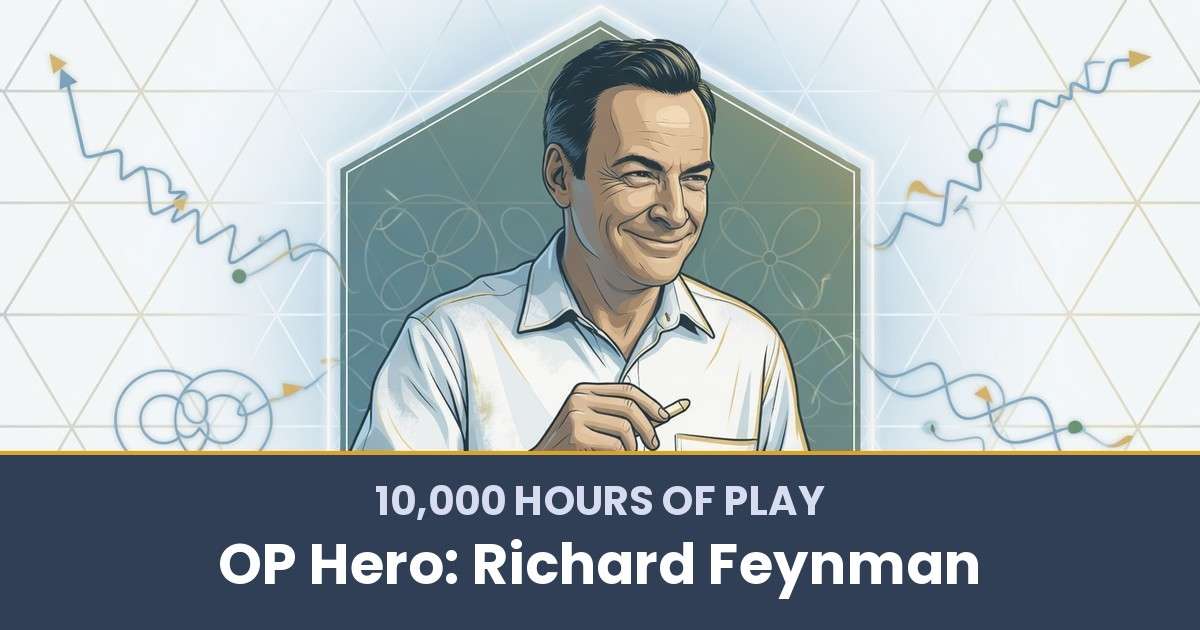


Most physicists in the late 1940s were drowning in the formal machinery of quantum electrodynamics. Richard Feynman walked into the room with a notebook full of little squiggly lines and arrows and said, in effect, this is what an electron is actually doing.
That notebook became Feynman diagrams. The little arrows became the path-integral formulation. Both became core tools of modern physics, won him a Nobel in 1965, and bypassed years of mathematical apparatus that his peers had spent careers building. He did it by playing.
If you map his life onto the 10,000 Hours of Play (10K HP) framework, Feynman is one of the cleanest case studies you will ever see of someone who treated reality as a puzzle and refused to stop poking at it. So let’s run his build through the 6 Steps and see what you can lift.
⚡ Speed Run Notes
- Feynman’s Game was never “win Nobel” — it was “don’t fool yourself, and find out how nature actually works.” The trophies came as side effects.
- His superpower wasn’t math. It was visualization — seeing electrons jiggle, photons spinning, paths summing — and then drawing the picture so simply that the math fell out.
- Path integrals look like a sum over every possible history. That’s exactly what they are. Feynman treated the universe like a save-and-reload game and computed reality from the menu of all possible playthroughs.
- Arline’s death in 1945 broke him. The breakthrough physics came years later, on the other side. Phoenix Rebirth was the bridge between the man at Los Alamos and the man at Cornell.
- The Feynman Lectures, his memoirs, and the Challenger O-ring demo all run on the same Skill: take something the experts cloak in jargon, then explain it so a smart kid gets it. That is Loremaster behavior, not lecturer behavior.
Table of Contents
- About Yu-kai Chou
- Step 1: The Game — What Feynman Was Actually Playing
- Step 2: Attributes — The Innate Stats
- Step 3: Role(s) — The Character Class Across Chapters
- Step 4: Skills — The Real-Life Game Skills Feynman Mastered
- Step 5: Allies — The People Who Multiplied Feynman
- Step 6: Quests — The Milestones That Shaped the Saga
- What You Can Steal From Feynman’s Build
- Where this framework comes from
- Related Reading
About Yu-kai Chou

Yu-kai Chou is the author of 10,000 Hours of Play — the book that treats your life as the most important game you’ll ever build a character in, and gives you the 6-Step framework (Game · Attributes · Role · Skills · Allies · Quests) to play it on purpose. He has spent two decades developing the system through which this post analyzes its OP Hero, and applies it to his own life and to the lives of the people he advises around the world.
Chou’s other framework, the Octalysis Framework, has been applied by LEGO, Microsoft, Porsche, Coca-Cola, Salesforce, and MrBeast, impacting over 1.5 Billion Users. He has taught the methodology at Harvard, Stanford, Yale, Tesla, Google, BCG, and IDEO, and has advised governments in eight nations including Ukraine, the United Kingdom, the Kingdom of Bahrain, Singapore, Taiwan, the Netherlands, Kazakhstan, and South Korea.
His work has been cited by Harvard, Stanford, MIT, Forbes, Wall Street Journal, Wired, US Department of Energy, NIST, NSF, NCBI, US Department of Education, ClinicalTrials.gov, and Google Scholar — with 3,700+ more academic publications. Explore his books here.

Feynman is one of my favorite OP Heroes to study because he proves the central claim of 10,000 Hours of Play: the people who reach the top of hard fields almost always got there by playing, not by grinding. He treated locks at Los Alamos, the dynamics of a wobbling plate in a cafeteria, and the foundations of quantum electrodynamics with exactly the same posture — “this is interesting, let me figure it out.” If you steal one thing from his build, steal his Skill at compressing complex things into pictures a smart 12-year-old can grasp.
Step 1: The Game — What Feynman Was Actually Playing
It is tempting to say Feynman’s Game was “win a Nobel Prize in physics.” He did, in 1965, shared with Schwinger and Tomonaga for quantum electrodynamics.
But that misses what was actually driving him. Listen to him in his own words, from the 1981 BBC Horizon interview that became the title essay of The Pleasure of Finding Things Out: the prize was a nuisance. The Game was the pleasure itself.
The Game Feynman played was the same one he sketched in his 1974 Caltech commencement address: “The first principle is that you must not fool yourself — and you are the easiest person to fool.” Honest understanding of nature, stripped of authority, jargon, and self-deception. That is the loop. Curiosity in, picture out, test it, tell the story. Repeat for forty years.
When you frame a Game that cleanly, you stop chasing the prize and start chasing the next legal move. Feynman’s “next legal move” was usually some variation of: take a piece of physics that everyone has agreed is settled or impenetrable, and re-derive it from scratch until you can draw it. That is what the 10K HP framework calls a self-renewing Game — one whose reward loop is the play itself, not the outcome. Trophies show up as side effects.
Step 2: Attributes — The Innate Stats
Attributes in 10K HP are the traits visible before the training shows up — what you got for free at character creation. Feynman’s stat sheet is well-documented from his own childhood stories and Gleick’s biography Genius.
Visual / kinesthetic model-building. As a kid he repaired radios “by thinking,” tracing failures with logical inference rather than schematics. His Nobel lecture is full of him describing little arrows, spinning tops, and mental pictures of electrons he could move and re-pose in his head. He saw physics before he wrote it.
Risk tolerance and rule-independence. At Los Alamos during the Manhattan Project he picked locks and cracked safes containing classified files, partly to make a point about security, partly because the lock was a puzzle. He proposed his path-integral approach to quantum mechanics when senior physicists thought it was naive. He did not need permission to take a shot.
Anti-authority skepticism. His father trained him from boyhood to distinguish naming a thing from knowing it. Look up a bird’s name in a hundred languages and you still know nothing about the bird, his father would say. That posture turned into Feynman’s lifelong defense against jargon-dressed nonsense.
Performance instinct. Even as a kid he turned explanations into theater. By Caltech he was famous for bongo drums, bar stories, and lectures so packed students sat on the floor. The storytelling was not a hobby grafted onto the physics — it was load-bearing.
This is where the OP Talent Triangle Method earns its keep. Feynman’s Attributes triangle — visualization, rule-breaking curiosity, and performance — is unusual. Most physicists have one or two of those. Combining all three is what made him not just a great physicist but a great communicator of physics, which is a different and rarer build.
Step 3: Role(s) — The Character Class Across Chapters
Feynman’s character class shifted at every major life chapter, but the underlying Game stayed the same.
Apprentice Theorist (1932–1942). Far Rockaway High School math nerd, MIT undergrad, Princeton doctoral student under John Wheeler. He invented his own trig notation as a teenager. His 1942 PhD thesis, The Principle of Least Action in Quantum Mechanics, planted the seed for the path-integral formulation that would later define his career.
Bomb Project Troubleshooter (1943–1945). Hans Bethe pulled him into Los Alamos at 25. Feynman led calculation teams under Bethe in the Theoretical Division, computed neutron diffusion and critical-mass estimates, and quietly invented better numerical methods because the official ones were too slow. The Trinity test on 16 July 1945 was the milestone. The safe-cracking and the bongo drums were the side quests.
Quantum Systems Architect (1945–1960s). Cornell first, then Caltech from 1950 onward. This is the chapter where the path-integral formulation, the Feynman diagrams, and the renormalized QED that won the Nobel all crystallized. Note the time gap: the 1949 Physical Review paper that introduced his diagrammatic method was published four years after Arline died and he came back broken from Los Alamos. The breakthrough wasn’t sudden. It was a comeback. (For a parallel chapter-shift in physics, see how Einstein’s Role evolved from patent clerk to relativity theorist.)
Master Explainer (1960s–1980s). The Feynman Lectures on Physics (1963–64, with Robert Leighton and Matthew Sands) were three volumes of undergraduate physics rebuilt from scratch. QED: The Strange Theory of Light and Matter (1985) explained the most accurate physical theory ever tested using only arrows on a clock face. By this chapter Feynman was less “famous physicist” and more “the Carl Sagan of fundamental physics, but funnier.”
Public Truth-Teller (1986–1988). The Rogers Commission appointed him to investigate the Challenger disaster after the shuttle exploded on 28 January 1986, killing all seven astronauts. He dropped a piece of O-ring rubber into a glass of ice water on live television, demonstrated that it lost resilience in cold, and effectively settled the proximate cause of the explosion in under a minute. His personal appendix to the commission’s report estimated that NASA management’s claimed launch-failure rate was off by roughly a factor of a thousand. He died of cancer two years later, in February 1988.
Step 4: Skills — The Real-Life Game Skills Feynman Mastered
Six canon Skills carry Feynman’s build. Each one shows up in a specific moment in the historical record.
Vision Manifestation (Warlock) — visualizing success so vividly that the picture shapes the work. Feynman’s whole physics method was this Skill weaponized. He described, in his 1965 Nobel lecture, holding the image of an electron’s path in his head and mentally manipulating it until the math fell out. The squiggly Feynman diagrams are not metaphors for the physics. They are the physics, drawn out. Most theorists work from equations toward intuition. Feynman worked from intuition toward equations and asked the equations to keep up.
Astral Projection (Mage) — Tier III, seeing all possible outcomes. The path-integral formulation of quantum mechanics, which he developed out of his 1942 thesis, literally sums over every possible history a particle could take between two points. To make a prediction, you let the universe play out all paths, weight them by phase, and add them up. It is the most Astral Projection thing anyone has ever done in physics, and it is now the standard tool for quantum field theory.
Cognitive Lens (Mage) — zoom in to the detail, zoom out to the strategy. The Challenger O-ring demo is Cognitive Lens compressed to a single shot. The Rogers Commission had stacks of NASA contractor reports about Solid Rocket Booster joint behavior. Feynman zoomed in to one component, one material property, one glass of ice water, and made the failure mode visible to anyone watching CBS that night. The same zoom-in / zoom-out instinct shows up across the Feynman Lectures — he constantly moves between “atoms in motion” and “this is how a record player works.”
Aegis (Paladin) — ignore the critics while pushing the Quest. When Feynman first presented path integrals and diagrams at the 1948 Pocono conference, the response from senior physicists like Bohr and Teller was not enthusiastic. The methods looked unrigorous, almost cartoonish. Feynman kept building. Within two years the type of grit it takes to push past peer derision paid off: Freeman Dyson published the 1949 proof that Feynman’s diagrammatic method was mathematically equivalent to Schwinger and Tomonaga’s formalism, and the physics community swung behind him.
Loremaster (Druid) — weave compelling, inspiring stories. The Feynman Lectures sold more than a million copies and remain in print sixty years later. Surely You’re Joking, Mr. Feynman! (1985, with Ralph Leighton) was a New York Times bestseller and turned a physicist into a household name. The QED Auckland lectures (1979) made quantum field theory comprehensible to non-physicists using nothing but arrows and a clock face. He never confused “complicated” with “deep” — a distinction worth meditating on if you ever find yourself dabbling versus actually mastering, the central tension the Skills Spectrum framework maps out.
Phoenix Rebirth (Paladin) — Tier III, recovering from devastating failure and coming back stronger. Arline Greenbaum, his high-school sweetheart and first wife, died of tuberculosis on 16 June 1945, two months before the Trinity test. Feynman described in his letters and later memoirs a multi-year period of grief and reduced output. The late 1940s were not a triumphal arc. They were a comeback. The Nobel-winning QED work came on the other side of the rebuild, not before it.
Step 5: Allies — The People Who Multiplied Feynman
Feynman was famously a lone wolf in style but is a textbook case of how an Alliance multiplies a hero in practice.
John Wheeler — Princeton thesis advisor. Wheeler-Feynman absorber theory was the playground where the path-integral seed germinated, and Wheeler’s habit of asking for the simplest possible version of any idea became Feynman’s interior monologue.
Hans Bethe — Cornell mentor and Los Alamos boss. Bethe pulled Feynman into the Manhattan Project in 1943, gave him the autonomy to invent computational methods on the fly, and continued backing his QED work through the late 1940s. Without Bethe’s institutional cover, Feynman’s early career looks very different.
Arline Greenbaum — first wife. The Ally who taught him “what do you care what other people think?” — the phrase that became the title of his second memoir. Her courage during her tuberculosis is what trained Feynman’s Aegis. She is gone by 1945 but her influence runs through everything he writes afterward.
Freeman Dyson — the translator. Dyson’s 1949 papers proving the equivalence of Feynman’s diagrammatic method with the Schwinger-Tomonaga formalism are what made Feynman’s tools usable by the broader physics community. Without Dyson, path integrals stay a curiosity. With Dyson, they become standard.
Murray Gell-Mann — Caltech rival and collaborator. Their friction in the 1950s and 60s pushed both men toward particle physics breakthroughs. Iron sharpens iron.
Ralph Leighton — the late-life recorder. Their bongo-session conversations became Surely You’re Joking, Mr. Feynman! (1985) and What Do You Care What Other People Think? (1988), the books that made Feynman culturally famous beyond physics.
The pattern: at every chapter, somebody else handled the part of the Game Feynman was bad at. Bethe handled institutional politics. Dyson handled formal proofs. Leighton handled bookmaking. Feynman handled physics and storytelling. Compare this to Tesla, who tried to do everything alone and watched the credit migrate to people with better Alliances.
Step 6: Quests — The Milestones That Shaped the Saga
1942 — PhD thesis at Princeton. The Principle of Least Action in Quantum Mechanics. The path-integral seed.
1943–1945 — Manhattan Project. Theory division group leader under Bethe at Los Alamos. The Trinity test on 16 July 1945 ends the Quest with a flash. The personal Quest of Arline’s death two months earlier ends differently.
1948–1949 — QED breakthrough. The Pocono conference in 1948 introduces diagrams and path integrals to mixed reviews. The 1949 Physical Review paper “Space-Time Approach to Quantum Electrodynamics” formalizes them. Dyson’s equivalence proof later that year wins the physics community over.
1961–1963 — The Feynman Lectures on Physics. Two academic years of Caltech undergraduate physics, rebuilt from scratch, recorded by Leighton and Sands, published as three volumes (1963–1965). Still in print, still the gold-standard “physics taught like it matters” reference.
1965 — Nobel Prize in Physics. Shared with Julian Schwinger and Shin’ichirō Tomonaga “for their fundamental work in quantum electrodynamics.” Three laureates, one prize.
1986 — Challenger investigation. The Rogers Commission. The ice-water O-ring demo. The appendix that estimated NASA management’s risk-rate claims were off by a factor of about a thousand. This is the Quest where Feynman became, briefly, the moral conscience of American engineering.
Notice the cadence: a Quest every five-to-ten years, each one pushed by a different combination of Skills, but every one of them pulling on Vision Manifestation and Cognitive Lens. The Game stayed the same. The board kept changing. (For a similar pattern in cadence and stamina, see the other OP Hero profiles — almost every great build looks like this when you zoom out.)
What You Can Steal From Feynman’s Build
Three things to lift from Feynman’s saga, ranked by lift-to-effort ratio.
One — define your Game so the reward loop is the play itself. “Win a Nobel” is a terrible Game. It has one boss fight and you mostly lose. “Maximize honest understanding of nature without fooling yourself” is a great Game. Every day has a legal move and the trophies show up as side effects. Rewrite your own Game until your daily loop is intrinsically rewarding even when the outcomes stall.
Two — visualize before you formalize. Feynman’s biggest physics wins came from “see it, then write the math.” Most people do it backwards. Whatever your domain, build a mental picture or a back-of-napkin diagram of the system before you reach for the spreadsheet or the equation. If you can’t draw it, you don’t understand it yet.
Three — explain it to a 12-year-old. Feynman’s lectures, memoirs, and the Challenger demo all run on the same Skill: take what experts cloak in jargon and tell it like a story a smart kid can follow. This is the cheapest way to find out whether you actually understand something. If your explanation needs unexplained jargon, you don’t.
That’s the build. Curiosity as the engine, visualization as the chassis, storytelling as the steering. Take whatever you’re working on this week and run it through Feynman’s Game: am I learning, or am I impressing? Can I draw the picture? Could I explain it to a smart twelve-year-old? If all three answers are yes, you’re playing the Game right.
Where this framework comes from

Want the full system this profile is built on?
Every OP Hero piece runs through the same 6-Step framework from 10,000 Hours of Play: Unlock Your Real-Life Legendary Success. The book covers the full system, walks through Yu-kai’s own life run as the first applied case study, and gives you the worksheets to audit your own build.
Related Reading
- All OP Hero Profiles — the full 10K HP gallery
- 10,000 Hours of Play by OP Hero: Albert Einstein
- 10,000 Hours of Play by OP Hero: Isaac Newton
- 10,000 Hours of Play by OP Hero: Charles Darwin
- The OP Talent Triangle Method — How to Find Your Edge
- The Skills Spectrum: Specialist, Dabbler, or Master?