
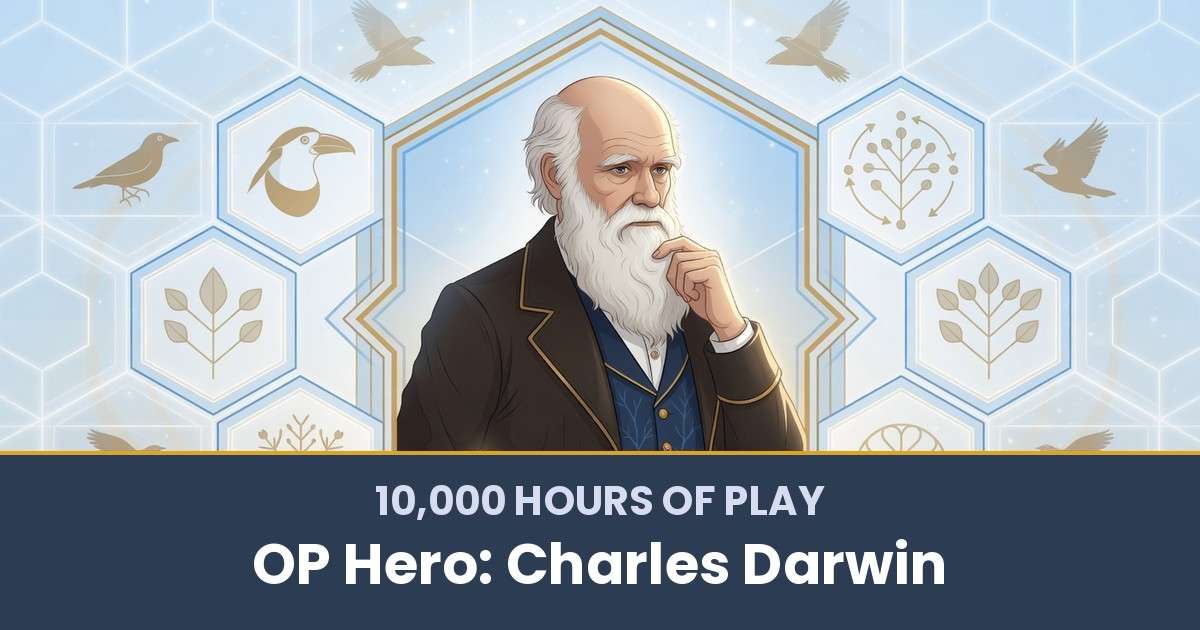


Charles Darwin had the answer in his notebook by 1838. He didn’t publish it until 1859.
That’s not writer’s block. That’s a 21-year stress test on the most dangerous idea of the 19th century, run by a man who knew his theory would crack open Victorian religion, his own marriage’s faith, and the reputation he had spent a decade building as a respectable barnacle specialist.
Most life stories celebrate the launch. Darwin’s life is interesting because of the wait — the slow, deliberate, almost paranoid construction of an argument so airtight that when the storm finally arrived in 1860, his theory walked out of it stronger than it walked in. Treat his run as a character build inside the 10,000 Hours of Play framework and the lesson sharpens fast. He wasn’t a genius who got lucky on a boat. He was a methodical observer who turned patience itself into a weapon.
⚡ Speed Run Notes
- Darwin’s core Game wasn’t “discover evolution.” It was: explain the diversity and distribution of life with enough empirical detail to survive hostile scrutiny from Victorian science and theology.
- His standout innate Attribute — obsessive observation of tiny variations — was visible by age 8, when he was already classifying shells and beetles. The Beagle voyage just gave it scale.
- He played at least five distinct Roles across his career: gentleman-collector, shipboard naturalist, barnacle specialist, evolutionary theorist, plant experimentalist. Each Role earned credibility for the next.
- The skill that broke the problem open wasn’t a flash of insight. It was an 8-year deep dive on barnacles he didn’t want to do — what we’d now call a Lich Grind — that built the taxonomic authority needed to land the bigger theory.
- His real superpower was Allies. Lyell, Hooker, Henslow, Huxley, Wallace, and Emma Darwin each multiplied a different part of his build. He couldn’t have shipped Origin alone.
- The 1858 Wallace letter — a near-perfect parallel of his own theory, arriving by mail from Indonesia — was the failure that became the catalyst. He had 21 years of notes. He needed an emergency.
Table of Contents
- Step 1: The Game — What Darwin Was Actually Playing
- Step 2: Attributes — The Innate Stats
- Step 3: Role(s) — The Character Class Across Chapters
- Step 4: Skills — The Real-Life Game Skills Darwin Mastered
- Step 5: Allies — The People Who Multiplied Darwin
- Step 6: Quests — The Milestones That Shaped the Saga
- What You Can Steal From Darwin’s Build
- Where this framework comes from
- Related Reading
About Yu-kai Chou

Yu-kai Chou is the author of 10,000 Hours of Play — the book that treats your life as the most important game you’ll ever build a character in, and gives you the 6-Step framework (Game · Attributes · Role · Skills · Allies · Quests) to play it on purpose. He has spent two decades developing the system through which this post analyzes its OP Hero, and applies it to his own life and to the lives of the people he advises around the world.
Chou’s other framework, the Octalysis Framework, has been applied by LEGO, Microsoft, Porsche, Coca-Cola, Salesforce, and MrBeast, impacting over 1.5 Billion Users. He has taught the methodology at Harvard, Stanford, Yale, Tesla, Google, BCG, and IDEO, and has advised governments in eight nations including Ukraine, the United Kingdom, the Kingdom of Bahrain, Singapore, Taiwan, the Netherlands, Kazakhstan, and South Korea.
His work has been cited by Harvard, Stanford, MIT, Forbes, Wall Street Journal, Wired, US Department of Energy, NIST, NSF, NCBI, US Department of Education, ClinicalTrials.gov, and Google Scholar — with 3,700+ more academic publications. Explore his books here.
Darwin’s run is the one I keep coming back to when people ask me what “patience” should look like inside a serious life goal. He’s the proof that an Attribute as quiet as compulsive note-taking — when you protect it for two decades and stack the right Allies around it — can absolutely move worlds. If you only steal one lesson from his build, steal the way he treated counter-evidence as a teammate, not an enemy.
Step 1: The Game — What Darwin Was Actually Playing
The mistake we make with Darwin is reducing his game to “publish the theory.” That was the deliverable, not the game.
The actual game he played from his mid-twenties until his death was this: explain the diversity and distribution of living and extinct organisms by discovering the true mechanism of species change, and document it so thoroughly that no hostile critic — religious, scientific, or social — can puncture it. Every project he ran for forty years served that mission, even when the project looked unrelated on the surface.
Coral reefs in 1842. Volcanic islands in 1844. South American geology in 1846. Barnacles for eight years. Pigeon breeding. Orchid fertilisation. Earthworms. To a casual reader those look like a man who can’t focus. To a reader holding the framework, those are a man methodically filling out the empirical case for one big argument, from seven different angles, before he ever stakes the argument in public.
This is what makes Darwin so useful as a 10K HP case study. Most people pick a Game in their twenties and then spend their thirties drifting because the Game wasn’t specific enough to filter their projects. Darwin’s Game was specific enough that even his sickbed correspondence served it. If your “game” can’t tell you whether to take a meeting on a Tuesday afternoon, it isn’t a Game yet — it’s a vibe.
Step 2: Attributes — The Innate Stats
Three Attributes show up so early in Darwin’s life they can only be innate. None of them were taught.
Compulsive observation of tiny variations. By age eight he was hoarding shells and minerals. By Cambridge in the late 1820s, he was the undergraduate hiring men to scrape moss off old trees and dredge fen-barges for rare beetles — the kind of obsession that classmates remember and gossip about. His own autobiography describes the passion for collecting as “very strong in me, and was clearly innate, as none of my sisters or brother ever had this taste.” Most people walk past a pile of rocks. Darwin counted them, sorted them, and noticed which ones didn’t fit the pile.
Pattern-seeking inference. Within months of returning from the Beagle in October 1836, he was already pulling threads across the specimens — Galápagos mockingbirds different on each island, South American fossil mammals resembling living South American mammals rather than European ones. By July 1837 he had opened Notebook B on the transmutation of species. By 1838 he wrote “I have at last got a theory by which to work.” The boy who counted beetles had grown into a man who couldn’t stop seeing structure underneath things.
Anxious risk tolerance. Darwin was physically anxious — he vomited before social events, suffered chronic illness from his thirties on, dreaded public confrontation. And yet at 22 he accepted an unpaid berth on a five-year voyage against his father’s wishes, and at 50 he published the most religiously inflammatory book of the century. His risk profile is a quiet but consistent yes to high-consequence moves. That combination — risk-tolerant build, anxious nervous system — is what Yu-kai’s Talent Triangle Method is designed to surface. Most heroes don’t look like heroes from inside their own bodies.
Step 3: Role(s) — The Character Class Across Chapters
Darwin ran at least five distinct Roles across his life, and each one earned credibility for the next.
Gentleman-collector (1826–1831). Edinburgh medical student, then Cambridge theology student, both unfinished. Joined the Plinian Society as a teenager. Did marine zoology projects with Robert Grant. The Role looked like a wandering son with no career — but the collecting skills were compounding.
Shipboard naturalist (1831–1836). Five years on HMS Beagle, sailing 27 December 1831 to 2 October 1836. He came home with thousands of specimens, a published journal, and a reputation as the most field-tested young naturalist in England.
Geologist and systematist (1837–1854). This is the Role that buys him credibility for everything that comes next. Coral reefs (1842), volcanic islands (1844), South American geology (1846), and the four-volume barnacle monograph (1851–1854) that won him the Royal Society’s Royal Medal in 1853. By the time he steps into evolutionary controversy in 1859, the establishment cannot dismiss him as a hobbyist.
Theorist of evolution (1859–1871). Origin of Species in 1859, Variation of Animals and Plants in 1868, Descent of Man in 1871. This is the Role everyone remembers, and it’s the third on the list, not the first.
Plant experimentalist and elder statesman (1860s–1882). Orchids, climbing plants, insectivorous plants, earthworms. The Role of the gardener-experimentalist that closed his life out — quieter, smaller-scale, just as rigorous. Like Marcus Aurelius writing the Meditations from a war camp at the end of his reign, Darwin spent his last decade running careful experiments in his own garden, knowing the big argument was already loose in the world.
Step 4: Skills — The Real-Life Game Skills Darwin Mastered
Four canon 10K HP Skills show up so clearly in Darwin’s run that you can date the moment he leveled each one.
True Sight (Ranger). The keen-detail Skill — observing what other people walk past. The diagnostic moment is the Pampean formation in Argentina, where Darwin noticed that giant extinct armadillo-like glyptodonts and small living armadillos shared the same continent. Anyone could see the bones. He saw the through-line: “this wonderful relationship in the same continent between the dead and the living,” as he later put it. That single observation seeded biogeography.
Cognitive Lens (Mage). The zoom-in-and-zoom-out Skill — alternating between microscope-level detail and continent-scale pattern. The barnacle work (1846–1854) is the micro lens; the eight-year monograph forced him to know every joint and plate of every species. The Origin of Species manuscript is the macro lens; he steps back and sees Lyell’s deep time, Galápagos finches, English pigeon breeding, and South American fossils as one phenomenon. Most thinkers can do one lens or the other. Darwin trained himself to swap between them on demand. The same range shows up in the Skills Spectrum — Specialist depth feeding Master synthesis.
Lich Grind (Warlock). Intense, secluded work periods — the same Skill profiled in the Lich Pact deep-dive, but in Darwin’s case it was sheer years of monastic concentration at Down House. The eight barnacle years are the most famous example: he didn’t want to do them, he doubted they mattered, and he later told a friend they had been “of considerable use to me, when I had to discuss in the Origin of Species the principles of a natural classification.” Without that grind, Wilberforce eats him alive in 1860. With it, he is one of the world’s senior taxonomists, and his theory has weight.
Loremaster (Druid). The Skill of weaving a compelling story out of evidence. Origin of Species is not just a science book; it’s a brilliantly structured argument that anticipates objections before raising them. His “golden rule” of immediately writing down every fact that contradicted his theory was the engineering behind that craft — he treated counter-evidence as raw material, not as an attack. That’s the same Skill Einstein used when he opened each new paper by listing the assumptions his theory needed to break. Both men understood that a story holds only if the reader’s strongest objections are already inside it.
Step 5: Allies — The People Who Multiplied Darwin
Darwin’s network is the part of his build that gets undersold. The man almost never left his house after 1842. He shipped Origin of Species through other people.
John Stevens Henslow — his Cambridge botany professor — recognized his observational talent, drew him into Cambridge’s scientific society, and recommended him for the Beagle berth in 1831. Without Henslow, no voyage. Without the voyage, no theory.
Charles Lyell — author of Principles of Geology — gave Darwin the conceptual gift of uniformitarianism, the idea that small forces operating over deep time produce large change. That’s the temporal frame natural selection needed. Lyell later co-orchestrated the 1858 Linnean Society reading that made the Darwin–Wallace papers public.
Joseph Dalton Hooker — botanist and closest scientific confidant — was the first person Darwin trusted with the theory in 1844. Hooker spent years stress-testing the argument privately, supplying global plant distribution data, and defending Darwin in public after Origin shipped.
Thomas Huxley — “Darwin’s Bulldog” — handled the public combat Darwin could not. The 1860 Oxford debate against Bishop Wilberforce was Huxley’s stage, not Darwin’s. Every OP Hero with a build like Darwin’s needs a Huxley.
Alfred Russel Wallace — independent co-discoverer of natural selection — sent the 1858 letter from Indonesia that ended Darwin’s twenty-year delay. Wallace was a competitor who became an Ally through Darwin’s willingness to share credit fairly. The 1858 joint Linnean paper named both men.
Emma Darwin — wife, religious counterweight, household anchor — kept the operation running through chronic illness, the death of three of their children, and decades of his retreat from public life. The Down House setup that made the work possible was hers as much as his.
Step 6: Quests — The Milestones That Shaped the Saga
Six Quests structure Darwin’s life.
Quest 1: The Beagle voyage (1831–1836). Five years at sea. The empirical bank account he draws on for the next four decades.
Quest 2: The 1842 sketch and 1844 essay. Two private documents in which he writes out natural selection in full — and then locks them in a drawer with instructions to his wife that they should only be published if he died. The man had a working theory and chose, deliberately, to sit on it for 15 more years.
Quest 3: The barnacle monograph (1846–1854). The least glamorous Quest of his life, and the one that earned him the standing to win the next war. Royal Medal 1853.
Quest 4: The setback — Annie Darwin’s death (April 1851). His daughter Annie died at age ten of a fever, most likely tuberculosis. Darwin’s faith broke. He never returned to organized Christianity. This is the failure that cracks the build open — and forces him to face that the universe runs without a benevolent designer behind it. The theory of natural selection becomes harder to delay after this. His Phoenix Rebirth (Paladin) is quiet, not loud — he goes back to work, but his relationship to the work has changed permanently.
Quest 5: The Wallace letter (June 1858). Alfred Russel Wallace, sick with malaria in the Spice Islands, writes Darwin a letter sketching out a theory of natural selection nearly identical to Darwin’s own. The letter destroys Darwin’s twenty-year delay strategy in a single morning. Lyell and Hooker engineer a face-saving joint presentation at the Linnean Society on 1 July 1858. Darwin spends the next 13 months frantically writing what becomes On the Origin of Species, published 24 November 1859. All 1,250 copies sell out the first day. His Aegis (Paladin) — the ability to ignore public criticism and push forward — is the only reason the book ever ships through the religious firestorm that follows.
Quest 6: The Descent of Man (1871) and the late experiments. Darwin lives 23 more years after Origin and uses every one of them to extend the framework — to humans, to plants, to behavior, to soil. By his death in April 1882 he is buried in Westminster Abbey, six feet from Isaac Newton.
What You Can Steal From Darwin’s Build
Three lessons for anyone running a long Quest.
Treat counter-evidence as a teammate. The “golden rule” — writing down every fact that contradicts your theory the moment you see it — is the single most load-bearing practice in Darwin’s notebook. Most people’s memory protects their argument by quietly forgetting inconvenient facts. Darwin’s memory protected his argument by surfacing the inconvenient facts first, so the public version had already answered them. If you’re working on something you care about, build a “counter-evidence file” and re-read it monthly.
Run a Lich Grind that doesn’t look related. The barnacle years are the lesson. Darwin spent eight years on a project that felt like a detour, and that detour bought him the credibility to land the bigger argument. If your current Quest doesn’t look related to your ultimate Game, ask whether it’s actually building the standing or the skill base your endgame needs. Sometimes the unsexy chapter is the load-bearing one. (For an applied version of this same pattern in the modern era, the Jensen Huang profile tracks how three decades of unfashionable chip work became overnight indispensable.)
Build Allies before the storm, not during it. The reason 1859 didn’t destroy Darwin is that Lyell, Hooker, and Huxley were all in place by 1850. The 1858 Wallace letter would have been catastrophic without a network already configured to absorb it. Most people network reactively, after a crisis. Darwin networked patiently for two decades before the crisis arrived. If you’re holding an idea that will eventually need defenders, the time to invest in those relationships is when the idea is still just an idea — not when it’s already in print.
Darwin’s run sits inside a longer canon Yu-kai is building one OP Hero at a time. If you want to see the whole shelf — entrepreneurs, scientists, artists, leaders — start at the OP Hero hub and pick the build closest to your own.
Where this framework comes from

Want the full system this profile is built on?
Every OP Hero piece runs through the same 6-Step framework from 10,000 Hours of Play: Unlock Your Real-Life Legendary Success. The book covers the full system, walks through Yu-kai’s own life run as the first applied case study, and gives you the worksheets to audit your own build.
Related Reading
- All OP Hero Profiles — the full library of 10K HP-framework character studies, updated as new heroes ship.
- 10,000 Hours of Play by OP Hero: Nikola Tesla — another 19th-century scientist whose theory-vs-public-acceptance arc is worth comparing to Darwin’s.
- 10,000 Hours of Play by OP Hero: Abraham Lincoln — a parallel patience-as-strategy build from the same decade.
- 10,000 Hours of Play by OP Hero: Viktor Frankl — for the meaning-under-suffering side of the build Darwin had to lean into after Annie’s death.
- The 10,000 Hours of Play framework hub — start here if you want to map your own Game · Attributes · Role · Skills · Allies · Quests.