
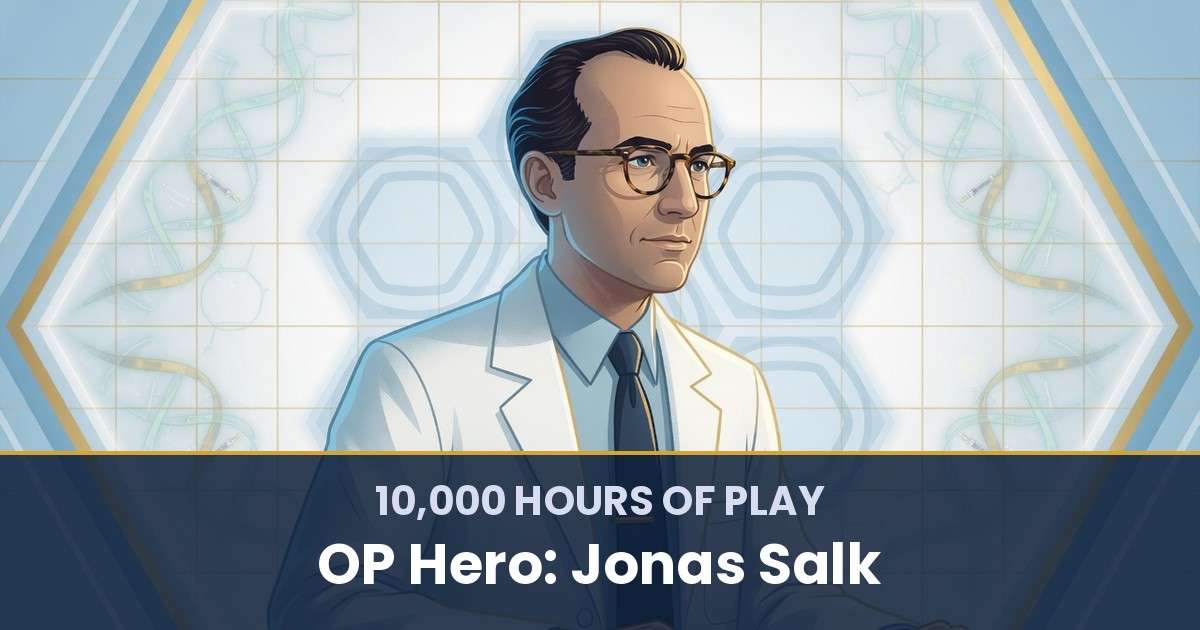


On April 12, 1955, in a packed auditorium in Ann Arbor, a scientist named Thomas Francis Jr. stepped to a microphone in front of hundreds of reporters and said the polio vaccine was “safe, effective, and potent.” Within the hour, church bells were ringing across the country. Strangers wept in the street. Factories paused their lines.
Polio had been the nightmare every American parent lived with each summer. It paralyzed and killed children with no warning and no cure. The man who built the vaccine that ended that terror was sitting nearby, forty years old, and he was about to do something that still sounds impossible.
Asked who owned the patent, Jonas Salk answered: “There is no patent. Could you patent the sun?”
He gave away what could have made him one of the richest men alive. That decision is the key to his whole character sheet, and his build is one of the most instructive I have ever run through the 6-Step framework. Let’s open it.
⚡ Speed Run Notes
- Salk’s real game was never “cure polio.” It was removing human suffering at population scale, which is why he kept chasing vaccines, then aging, then a whole philosophy of human survival for the rest of his life.
- His 1954 field trial enrolled 1,829,916 children, the largest medical experiment in history at the time. On April 12, 1955, it was declared a success.
- He bet on a killed-virus vaccine when most senior virologists were certain only a live virus could work. Backing the unpopular method was the whole breakthrough.
- In 1952 he injected himself, his wife, and his three sons with his experimental vaccine before testing it widely. He would not ask of a stranger’s child what he would not risk on his own.
- Months after his triumph, the Cutter incident killed five children and paralyzed dozens through a defective manufacturer’s lot. How he absorbed that is the real lesson, not the parade.
Table of Contents
About Yu-kai Chou

Yu-kai Chou is the author of 10,000 Hours of Play — the book that treats your life as the most important game you’ll ever build a character in, and gives you the 6-Step framework (Game · Attributes · Role · Skills · Allies · Quests) to play it on purpose. He has spent two decades developing the system through which this post analyzes its OP Hero, and applies it to his own life and to the lives of the people he advises around the world.
Chou’s other framework, the Octalysis Framework, has been applied by LEGO, Microsoft, Porsche, Coca-Cola, Salesforce, and MrBeast, impacting over 1.5 Billion Users. He has taught the methodology at Harvard, Stanford, Yale, Tesla, Google, BCG, and IDEO, and has advised governments in eight nations including Ukraine, the United Kingdom, the Kingdom of Bahrain, Singapore, Taiwan, the Netherlands, Kazakhstan, and South Korea.
His work has been cited by Harvard, Stanford, MIT, Forbes, Wall Street Journal, Wired, US Department of Energy, NIST, NSF, NCBI, US Department of Education, ClinicalTrials.gov, and Google Scholar — with 3,700+ more academic publications. Explore his books here.
What I find most instructive about Jonas Salk’s build is the patent decision. Most people, handed a once-in-a-century windfall, would take it and feel they had earned it. Salk gave it away because the point of the work was never the money; it was the mission underneath. If I could lift one move from his character sheet, it would be that clarity about the win condition. He knew exactly what game he was playing, so a fortune that did not serve it was easy to refuse.
Step 1: The Game — What Jonas Salk Was Actually Playing
Salk was born in New York City on October 28, 1914, the son of working-class immigrant parents with little formal schooling. He died in 1995 still chasing the same thing he had chased at twenty. That continuity is the tell.
The shallow version of his game is “cure polio.” But polio was one boss in a much longer campaign. Salk’s actual win condition was using science to remove needless human suffering for entire populations, not one patient at a time. You can watch that single objective drive three very different chapters of work.
In the 1940s it was influenza, building vaccines to protect soldiers and civilians during the war. From 1947 to 1955 it was polio. And from the 1960s until his death it was something stranger and bigger: founding a research institute, then writing books about human aging and what he called the “survival of the wisest,” asking how a species learns enough wisdom to keep itself alive.
This is the difference between choosing a project and choosing a Game. A man whose goal is “win the Nobel Prize” is finished the day the committee passes him over, and they did. Salk never won it. It barely registered, because his win condition was never a prize. It was a world with less suffering in it, and that game has no finish line. Picking an objective that large is the entire premise of treating your life as a game you design on purpose rather than one your field hands you.
Step 2: Attributes — The Innate Stats
Attributes are the stats you spawn with, the traits that show up before anyone could have trained them. Salk’s sheet shows at least four, visible from boyhood.
Self-directed curiosity. His parents barely finished school, yet he became a voracious reader and entered City College of New York at fifteen. Nobody in his environment supplied that hunger. He generated it.
Nonconformity. When he chose research over a lucrative medical practice, he picked the lower-status, lower-paying path on purpose. Later he would build an entire vaccine on a method most of his field had already dismissed. The instinct to ask “but what if the consensus is wrong?” is a stat, not a strategy.
High risk tolerance in service of a goal. He pushed for a nationwide trial of an unproven inactivated vaccine when senior virologists doubted it could ever confer real immunity. Then he made himself personally accountable for the largest medical experiment ever run. Comfort at that altitude of stakes is rare and early.
Systems-level pattern recognition. His wartime flu work was about standardizing vaccines across many strains, lots, and populations. He thought in systems, not single experiments, and that habit later let him frame biology, society, and human survival as one interconnected problem.
If you want to find your own innate stats instead of grinding the ones you lack, the Talent Triangle Method is the exercise I use. Salk’s legend sits squarely on the overlap of curiosity, nerve, and a mind that saw whole systems.
Step 3: Role(s) — The Character Class Across Chapters
Roles are the character classes you equip for a chapter of life. Salk re-classed several times, and each shift was deliberate.
Chapter 1: the striving scholar (1920s to 1939). A poor immigrant kid accelerates through CCNY and into NYU School of Medicine, earning his MD in 1939. Crucially, he gravitated to the laboratory instead of the bedside, choosing to fight disease at the source rather than treat it case by case.
Chapter 2: the apprentice virologist (1939 to 1947). Under Thomas Francis Jr. at the University of Michigan, he learned the craft of growing viruses, characterizing them, and turning them into standardized vaccines for the U.S. Army. This is where he downloaded the technical spellbook he would later aim at polio.
Chapter 3: the vaccine engineer (1947 to 1957). Running his own Virus Research Laboratory at the University of Pittsburgh from 1947, he designed, tested, and shipped the killed-virus polio vaccine, culminating in the 1954 trial and the 1955 announcement. This is the chapter the world remembers.
Chapter 4: the institution builder and biophilosopher (1957 onward). He stopped working at the bench and started building the place where others could. He founded the Salk Institute, then turned to writing about aging, evolution, and human survival. Marie Curie made a similar late move from lone experimenter to founder of an institution that outlived her, and you can see how that re-class shaped her build too.
Step 4: Skills — The Real-Life Game Skills Jonas Salk Mastered
Attributes are what you spawn with; Skills are what you grind. In the 10K HP system, every learnable Real-Life Game Skill belongs to one of seven Classes, and Salk’s loadout spans four of them.
Vision Manifestation (Warlock) — visualizing success so vividly that the picture guides the real work. Salk could see a safe killed-virus vaccine working at population scale when most of his field was certain that only a live, weakened virus could train lasting immunity. He held that picture for years and built backward from it, and the picture turned out to be right.
Arcane Wisdom (Mage) — absorbing wide data and synthesizing it into something usable. His influenza years taught him to standardize a vaccine across many viral strains and manufacturing lots, a logistics-and-data problem as much as a biology one. He carried that synthesis straight into the polio program, where the killed virus had to be produced reliably in monkey kidney cell cultures and inactivated with formalin every single time.
Courageous Heart (Paladin) — charging into the uncomfortable zone first. In 1952, before any large trial, Salk injected himself, his wife, and their three sons with the experimental vaccine. They produced antibodies and none of them got sick. He refused to ask a stranger’s child to bear a risk he had not first put on his own family.
Aegis (Paladin): ignoring public criticism and naysayers while pushing the quest forward. Albert Sabin, the leading advocate of a rival live vaccine, was openly dismissive of Salk’s approach, and much of the establishment treated him as a publicity-hungry upstart rather than a serious scientist. Salk kept building anyway. On the Skills Spectrum, this is where he was a true Master: holding the line on an unpopular method until the data settled the argument for him.
Spirit of Nature (Druid), turning the work into a value-driven mission bigger than himself. The refusal to patent the vaccine was not a stunt. It flowed from a settled belief that this knowledge belonged to everyone, the same belief behind the idea widely attributed to him: that our greatest responsibility is to be good ancestors. He made meaning the fuel, and it never ran dry.
Step 5: Allies — The People Who Multiplied Jonas Salk
No OP build is solo, and Salk’s was crowded with people who taught, funded, and validated him.
Thomas Francis Jr. was the mentor who handed him the operating system. He taught Salk virology and vaccine standardization at Michigan, and it was Francis, not Salk, who ran the independent evaluation of the field trial and announced on April 12, 1955 that the vaccine was “safe, effective, and potent.” A mentor who can also be your impartial judge is rare.
Basil O’Connor and the March of Dimes built the machine the science needed. O’Connor’s National Foundation for Infantile Paralysis financed the research and organized the trial infrastructure, raising money dime by dime from ordinary Americans so that nearly two million children could be tested. Without that fundraising engine, the breakthrough stays in a lab notebook.
The University of Pittsburgh lab team did the relentless bench work. From 1947 on, they grew the virus, ran the inactivation protocols, and checked the safety testing that made the vaccine real rather than theoretical.
The children and families at the D.T. Watson Home were the first human proof. Early small-scale trials there showed the vaccine was safe and produced antibodies, which is what justified scaling up to the national trial. Louis Pasteur leaned on the same kind of brave early volunteers to prove his rabies vaccine; you can see that pattern across his build as well.
His own wife and three sons functioned as a high-trust validation team in 1952, taking the experimental injection before the world did. Allies are not always institutions. Sometimes they are the people who let you test your conviction on them.
Step 6: Quests — The Milestones That Shaped the Saga
Quest 1: the wartime influenza vaccine (1940s). Working with Francis at Michigan, Salk helped develop and standardize flu vaccines for the army. This was the training quest, the place he learned that a vaccine is an engineering and logistics problem as much as a scientific one.
Quest 2: the killed-virus bet (1947 to 1953). At Pittsburgh, Salk committed to inactivating poliovirus with formalin rather than weakening it, against the grain of expert opinion. By the early 1950s he had shown in monkeys and small human trials that the killed virus could trigger protective antibodies without causing disease.
Quest 3: the great field trial (1954 to 1955). Beginning in April 1954, the trial enrolled 1,829,916 children, the largest medical experiment in history to that point. On April 12, 1955, it was declared a success, with the vaccine reported up to 80 to 90 percent effective against paralytic polio. It is hard to overstate the relief that swept the country that day.
Quest 4: the Cutter incident (1955). This is the setback, and it was brutal. Soon after rollout, a defective batch from Cutter Laboratories caused roughly 40,000 cases of abortive polio, permanently paralyzed 51 children, and killed 5. The disaster traced to a manufacturer’s faulty inactivation, not Salk’s design, but it shook public trust badly. The recovery loop here is real Phoenix Rebirth (Paladin): the program tightened its safety standards and pressed on, and the vaccine went on to drive polio toward elimination across the developed world.
Quest 5: the Salk Institute (1963). Rather than rest on the most famous medical achievement of his era, Salk founded the Salk Institute for Biological Studies in La Jolla, California, opening in 1963 with March of Dimes support. He built a permanent home for fundamental biology, his answer to never quite fitting the establishment that had kept him at arm’s length.
Quest 6: the last campaign (1980s to 1995). In his seventies, Salk turned his vaccine instincts on HIV, working on an experimental AIDS vaccine through the Immune Response Corporation until his death in 1995. He did not crack it. But that he was still hunting the same dragon at the end tells you everything about the Game. Line his arc up against any profile on the OP Hero roster and the same pattern shows: the mission outlives every individual win and loss.
What You Can Steal From Jonas Salk’s Build
Pick a Game, not a trophy. “Win the Nobel” expires the day you are passed over. “Remove suffering at population scale” runs for fifty years across flu, polio, aging, and AIDS. Choose a win condition large enough that no single rejection can end it.
Back the unpopular method when the logic is yours. Salk’s whole breakthrough was committing to a killed virus while the field bet on a live one. Consensus is data, not destiny. If you have actually done the reasoning, hold the line.
Take the first risk yourself. He injected his own family before he asked the country to trust him. Credibility is cheap to claim and expensive to earn, and the cheapest way to earn it is to go first.
Let the mission decide the money. Refusing the patent was not sacrifice; it was alignment. When you are clear on the game, the windfalls that do not serve it stop being tempting.
Survive the Cutter moments. Even a triumph can be followed by a disaster you did not cause. The build is defined by what you do in the months after, not the day of the parade. Norman Borlaug ran a similar save-millions campaign through his own years of doubt and failure. The Game is longer than any one result.
Where this framework comes from

Want the full system this profile is built on?
Every OP Hero piece runs through the same 6-Step framework from 10,000 Hours of Play: Unlock Your Real-Life Legendary Success. The book covers the full system, walks through Yu-kai’s own life run as the first applied case study, and gives you the worksheets to audit your own build.
Related Reading
- All OP Hero Profiles: the full roster
- 10,000 Hours of Play by OP Hero: Louis Pasteur, the other vaccine pioneer who proved his method on brave early volunteers
- 10,000 Hours of Play by OP Hero: Marie Curie, a scientist who founded an institution bigger than herself
- 10,000 Hours of Play by OP Hero: Norman Borlaug, the man whose work is credited with saving a billion lives
- What’s Your Edge Strength? The Talent Triangle Method, to map your own innate Attributes