
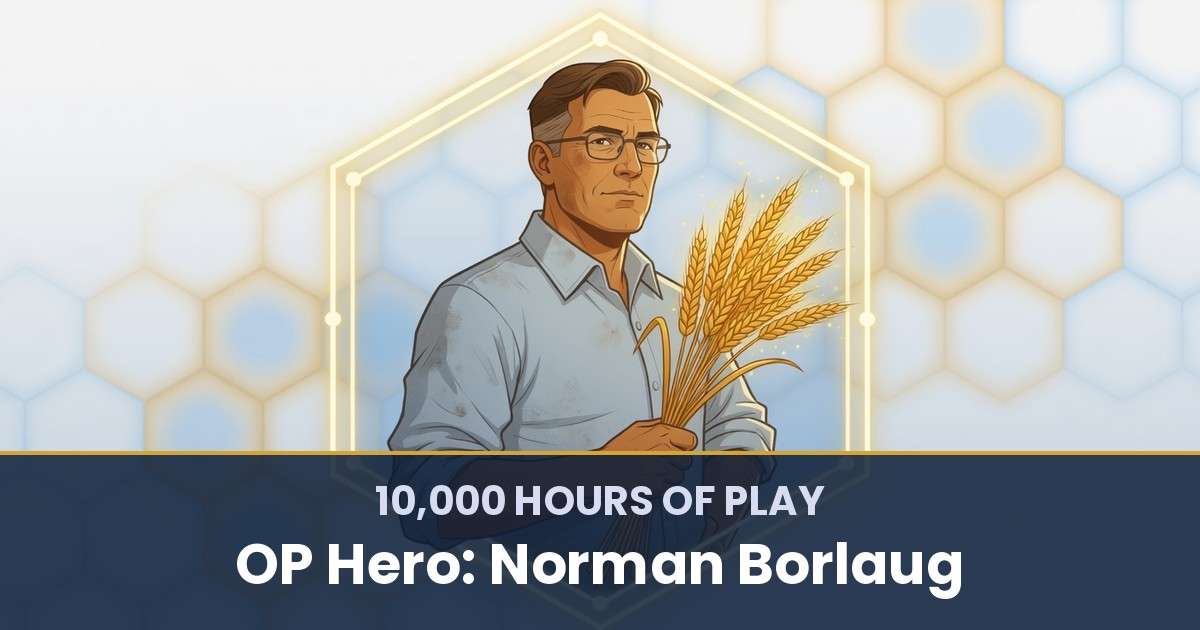


In September 1944, a 30-year-old plant pathologist named Norman Borlaug stepped off a plane in Mexico City to take a wartime assignment almost no one else wanted: figure out how to keep a poor country from importing half its bread.
By the time he died 65 years later, the wheat varieties he and his teams bred were feeding roughly half the planet, and credible estimates put the lives spared by the Green Revolution somewhere around a billion. The 1970 Nobel Peace Prize committee honored him for helping to provide bread for a hungry world. Borlaug himself never stopped warning that the breathing space was only temporary.
If you treat your life as a game, Borlaug is one of the cleanest character builds the modern era has produced: a farm kid with absurd stamina who picked one stat to max out (yield per acre) and refused to respec for the next seven decades. Here is what his 10,000 Hours of Play looks like when you read it through the 6-Step framework.
⚡ Speed Run Notes
- Borlaug’s “game” was singular and explicit for 65 years: use plant science and farming systems to make sure no child went to bed hungry. Every chapter pointed at the same target.
- His shuttle-breeding trick (two wheat generations per year, one in the Mexican highlands and one in the Sonora desert) broke the photoperiod barrier and made his varieties travel across latitudes.
- Crossing Mexican lines with Japan’s Norin 10 produced semi-dwarf wheats that could absorb 2-3× the nitrogen without falling over. That is the lever the Green Revolution turned.
- India imported about 18,000 tons of his Mexican seed in 1966; within three years, high-yielding varieties were on roughly 35 million acres across India and Pakistan.
- The play that earned him the 1970 Nobel Peace Prize was a Warlock build wrapped in a Druid coat: max grit and vision, kept warm by deep empathy for the smallholder farmer.
In This Article
About Yu-kai Chou

Yu-kai Chou is the author of 10,000 Hours of Play — the book that treats your life as the most important game you’ll ever build a character in, and gives you the 6-Step framework (Game · Attributes · Role · Skills · Allies · Quests) to play it on purpose. He has spent two decades developing the system through which this post analyzes its OP Hero, and applies it to his own life and to the lives of the people he advises around the world.
Chou’s other framework, the Octalysis Framework, has been applied by LEGO, Microsoft, Porsche, Coca-Cola, Salesforce, and MrBeast, impacting over 1.5 Billion Users. He has taught the methodology at Harvard, Stanford, Yale, Tesla, Google, BCG, and IDEO, and has advised governments in eight nations including Ukraine, the United Kingdom, the Kingdom of Bahrain, Singapore, Taiwan, the Netherlands, Kazakhstan, and South Korea.
His work has been cited by Harvard, Stanford, MIT, Forbes, Wall Street Journal, Wired, US Department of Energy, NIST, NSF, NCBI, US Department of Education, ClinicalTrials.gov, and Google Scholar — with 3,700+ more academic publications. Explore his books here.
What I personally take from Borlaug’s build is the discipline of choosing one quantitative target (yield per acre) and never letting prestige, comfort, or even praise pull him off it. Most of us play three games at once and wonder why none of them is winning. Borlaug picked one Quest in 1944 and was still grinding it as a 95-year-old man in 2009. If you take one thing from his Attributes column, take stamina; if you take one Skill, take the Lich Grind that earned him every other Skill in this profile.
Step 1: The Game — What Borlaug Was Actually Playing
Most life-game players are running several campaigns at once: career, family, hobby, status. Borlaug played one. The conviction his colleagues quoted back at him for decades, and that he returned to again and again, was that no child should go to bed hungry.
That sounds like a slogan. In Borlaug’s case it was a Quest target with measurable acceptance criteria. The deliverable was bushels per acre in the hands of poor farmers who could not afford imports. Every Role he took, every Skill he ground, every Ally he summoned was in service of bushels per acre. When the Rockefeller Foundation offered him better titles, he kept asking to stay closer to the field. When the Nobel came, he used the prize money to build the World Food Prize so the Quest would outlive him.
For a reader holding the 10K HP framework in one hand and Borlaug’s biography in the other, the lesson is hard to dodge: Step 1 is not what you say you want; it is what your calendar, your travel log, and your spouse’s frustration all agree you want. Borlaug’s calendar, his travel log, and Margaret Borlaug’s correspondence all said the same word for sixty-five years: wheat.
Step 2: Attributes — The Innate Stats
Attributes are the things you walked into the world with. They are the dials a coach can amplify but not install. Borlaug’s stat block is unusually legible because the people who knew him as a Cresco, Iowa, farm boy in the 1920s described the same person who showed up in Sonora in the 1950s.
Constitution / stamina was the load-bearing stat. He grew up doing hard physical labor on the family farm; at the University of Minnesota he wrestled competitively and worked through college; in Mexico he routinely put in 16-hour days in the wheat plots into his sixties. None of that was technique. It was the body and temperament he arrived with, sharpened by use.
Risk tolerance is the next dial. Borlaug took the Mexico assignment in 1944 when it was a wartime backwater, then pushed shuttle breeding when senior breeders called it agronomically unsound, then defended the Green Revolution publicly when critics tried to dismantle it. None of these were upside-asymmetric trades. They were all moves where the standard advice was to stay home, stay quiet, or pivot.
The third dial worth naming is empathy, of a very specific kind. He kept choosing varieties that smallholder farmers could actually plant, not showpieces for trial plots. His own framing — that no child should go to bed hungry — was a feeling, not a metric, and it kept him from the trap of optimizing for what was measurable in journals instead of what mattered in fields. The Talent Triangle reading of Borlaug puts stamina, risk tolerance, and field-level empathy at the center; the rest is what he built on top.
Step 3: Role(s) — The Character Class Across Chapters
Borlaug multi-classed cleanly, with each class change carrying the previous class’s hard-won knowledge into a wider arena.
The first class was Farm Kid: born March 25, 1914, near Cresco, Iowa, on a small family farm where he learned soil, weather, and the brutal honesty of a crop that doesn’t come in. The second class was Student-Athlete and Forest Service Trainee, at the University of Minnesota in the 1930s: wrestling, paying his own way, then briefly working for the U.S. Forest Service before pivoting into plant pathology and genetics under Elvin C. Stakman.
The third class is the one history remembers. From 1944, Borlaug became a Scientist-Engineer in Mexico, hybrid by necessity: plant breeder, field engineer, logistics coordinator, and stubborn negotiator with skeptical local farmers. The fourth class came in 1964, when he was appointed director of the Wheat Research and Production Program at CIMMYT (the International Maize and Wheat Improvement Center) near Mexico City. He shifted from individual scientist to Program Leader and Institution Builder, training young breeders from Asia and Latin America to do for their own crops what he had done for Mexican wheat.
The fifth and final class was Global Advocate and Elder Statesman, from the 1970 Nobel onward. He founded the World Food Prize in 1986, co-founded the Sasakawa-Africa Association the same year with Ryoichi Sasakawa and Jimmy Carter, and kept showing up in Ethiopia, Ghana, Sudan, and Tanzania into his eighties. The role kept changing; the Quest never did.
Step 4: Skills — The Real-Life Game Skills Borlaug Mastered
Six canonical 10K HP Skills carry most of the Borlaug story.
Vision Manifestation (Warlock) — the Skill of mentally rehearsing a result so vividly it shapes reality. Borlaug articulated the no-child-should-go-to-bed-hungry vision in the 1940s, decades before the yields existed to back it. He repeated it so consistently that funders, governments, and skeptical peers began to act as if it were already true; then the yields caught up.
Lich Grind (Warlock) — intense, secluded work periods. Borlaug’s Lich Grind was the Sonora field station. Two thousand miles of shuttling between the highland plots near Mexico City and the desert plots near Ciudad Obregón, year after year, 16-hour field days, often months at a time apart from his family. Most of the Skills below were earned during those sessions.
Cognitive Lens (Mage) — the ability to zoom in on a single detail and back out to the system in the same breath. Borlaug never let himself stay in one register. He could read a single rust pustule on a single leaf in the morning, then re-plan an international seed distribution program in the afternoon. The semi-dwarf breakthrough was a Cognitive Lens move: he saw the interaction between plant height, lodging, fertilizer response, and disease pressure as a single connected system and built varieties for the whole system, not the parts.
Aegis (Paladin) — ignoring criticism and naysayers while you push the Quest. Shuttle breeding was attacked by his own discipline; semi-dwarf wheats were attacked as unnatural; the Green Revolution was later attacked by environmentalists who held him responsible for monoculture and chemical inputs. Borlaug’s Aegis was not bravado. It was the willingness to keep working in the field while the argument played out in conference rooms.
Tactical Command (Ranger) — making people of very different talents work harmoniously. At CIMMYT from 1964 onward, Borlaug was running a coalition of Mexican smallholders, Indian and Pakistani agricultural ministries, American philanthropy, and Japanese geneticists. The semi-dwarf varieties only got into farmers’ hands because he could hold all those parties in the same room and keep them moving in the same direction.
Phoenix Rebirth (Paladin) — recovering from devastating failure and coming back stronger. Stem rust epidemics repeatedly wiped out promising lines through the 1940s and 1950s; new rust races kept emerging as old varieties lost resistance. Borlaug’s Phoenix Rebirth was institutional, not personal: every time a line collapsed, he had a successor in the breeding pipeline because shuttle breeding had compressed the cycle. The failure mode was assumed; the comeback was engineered.
Step 5: Allies — The People Who Multiplied Borlaug
Even players with maxed-out stats need an Alliance, and Borlaug’s was unusually deep.
Elvin C. Stakman, his PhD supervisor at the University of Minnesota, was the mentor who recommended him for the Mexican wheat program in 1944 and, after initial skepticism, backed the shuttle-breeding bet once results came in.
George Harrar, who later became president of the Rockefeller Foundation, ran the Mexican Agricultural Program; he recruited Borlaug, then defended the wheat program when others wanted to close it in the late 1940s before its real results arrived.
M.S. Swaminathan, director of the Indian Agricultural Research Institute, was the Indian counterpart who invited Borlaug in and made the Mexican semi-dwarf varieties release-ready inside India. He is often called the father of India’s Green Revolution; the work was a true joint build.
Henry Beachell ran the parallel rice play at IRRI in the Philippines, releasing the semi-dwarf rice variety IR8 in 1966. Beachell’s work was the rice mirror to Borlaug’s wheat work, and the two together carried Asia past the famine forecasts of the 1960s.
Ryoichi Sasakawa and Jimmy Carter were the late-life Alliance. In 1986 they co-founded the Sasakawa-Africa Association with Borlaug; Carter’s Carter Center partnered through the Sasakawa-Global 2000 program. That partnership is what kept Borlaug active in Ethiopia, Ghana, Sudan, and Tanzania into his eighties.
And one Ally history undercredits: Margaret Gibson Borlaug, who married him in 1940 and largely raised their children in Mexico City while he was at remote field stations such as Ciudad Obregón and Toluca for weeks at a stretch. Without that division of labor at home, the field labor would not have been possible.
Step 6: Quests — The Milestones That Shaped the Saga
Quest 1: Mexico’s wheat self-sufficiency (1944-1956). Borlaug arrived in September 1944 to find limited infrastructure, scarce irrigation, and a country importing roughly half its wheat. By 1956 Mexico was self-sufficient. The first decade was the proof that the system worked.
Quest 2: The semi-dwarf breakthrough (early 1950s to 1964). Norin 10 was a Japanese semi-dwarf wheat collected in postwar Japan by USDA agronomist Cecil Salmon and adapted by Orville Vogel at Washington State University. Vogel sent Norin 10 germplasm down to Borlaug, who began crosses with his Mexican high-yield, disease-resistant lines around 1953-1954. The first major Mexican semi-dwarf releases (Pitic 62 and Penjamo 62 in 1962; Sonora 64 and Lerma Rojo 64A in 1964) could absorb 2 to 3 times the nitrogen of older varieties without lodging. Yields doubled and tripled.
Quest 3: India and Pakistan, 1965-1969. The Indo-Pakistani War of 1965 hit while both countries were dependent on U.S. PL-480 wheat imports and facing severe grain deficits. Borlaug, Swaminathan, and their colleagues pushed the Mexican semi-dwarf seed through a wartime logistics maze. India imported about 18,000 tons of Mexican seed in 1966 for rapid multiplication. By 1968-1969 the new varieties were planted on roughly 35 million acres across India and Pakistan combined. Indian average wheat yields rose from roughly 0.8 to 0.9 tonnes per hectare in the early 1960s to about 1.7 by the mid-1970s. The doubling was real.
Quest 4: The Nobel and the megaphone, 1970. The 1970 Nobel Peace Prize, presented in Oslo on December 10, 1970, recognized his contribution to the Green Revolution and the millions it had fed. The line readers still quote from his Nobel lecture: “The Green Revolution has won a temporary success in man’s war against hunger and deprivation; it has given man a breathing space.” He dedicated the prize to the farmers and peasants who actually grew the wheat.
Quest 5: The Africa years and the World Food Prize, 1986 onward. Borlaug built two institutions late in life: the World Food Prize in 1986 (initially funded by General Foods, then endowed by Des Moines businessman John Ruan in 1990) and the Sasakawa-Africa Association the same year with Sasakawa and Carter. The Africa work was harder than Asia. Soils, infrastructure, and politics all worked against the playbook. Yields rose where SG 2000 had a foothold, but never at the Indian scale. This was the Quest where the Green Revolution playbook bumped into limits, and where Borlaug refused to retire from the field anyway.
The setback that doesn’t have a year number. The recurring rust epidemics (Puccinia graminis emerging in new races as old varieties lost resistance) were the steady-state failure Borlaug fought from 1944 to retirement. Several promising lines lost their resistance and had to be replaced. The doubled yields are the photogenic part; the Lich Grind years of re-selection are the part that paid for them.
What You Can Steal From Borlaug’s Build
Three lifts for your own 10K HP run.
First, pick a measurable Quest that is bigger than your career. Borlaug’s Quest was bushels per acre in the hands of the poor, not “be a great plant scientist.” Career follows Quest. Reverse the order and the math gets weak.
Second, treat your Skill stack as a system, not a list. The semi-dwarf breakthrough only worked because Borlaug had Cognitive Lens (Mage), Lich Grind (Warlock), Aegis (Paladin), and Tactical Command (Ranger) all firing on the same problem at once. Most of us pick one class and call it identity; the OPs in the OP Hero Hall multi-class. Use the Skills Spectrum as your audit: which Skills do you have at Specialist depth, which at Dabbler, and where is the next combo waiting?
Third, build a long Alliance, not a short network. Stakman, Harrar, Swaminathan, Beachell, Sasakawa, and Carter (many across multiple decades). Borlaug treated relationships as compounding assets. If you want a model of how to find your Alliance, the Jane Goodall profile in the OP Hero Hall is a useful sibling read; her Alliance ladder pulled her from chimpanzee field work to a global conservation institution by the same logic that pulled Borlaug from one Mexican wheat plot to feeding a planet.
Run your own build through the same six steps and the same five classes. The grid is honest. Most of the work is finding the Quest you would still be running at 95.
Where this framework comes from

Want the full system this profile is built on?
Every OP Hero piece runs through the same 6-Step framework from 10,000 Hours of Play: Unlock Your Real-Life Legendary Success. The book covers the full system, walks through Yu-kai’s own life run as the first applied case study, and gives you the worksheets to audit your own build.
Related Reading
- All OP Hero Profiles: the running hall of life-as-RPG case studies in the 10K HP framework.
- The 10K HP Framework: 6 Steps to Gamify Your Life
- Jane Goodall as OP Hero: another scientist whose Quest outgrew her career.
- Tu Youyou as OP Hero: a parallel “one molecule, one mission” Lich Grind build that saved millions of malaria patients.
- Charles Darwin as OP Hero: a Loremaster build adjacent to Borlaug’s Cognitive Lens game.
- Katherine Johnson as OP Hero: a Mage build that, like Borlaug’s, took the unglamorous seat closest to the data.