
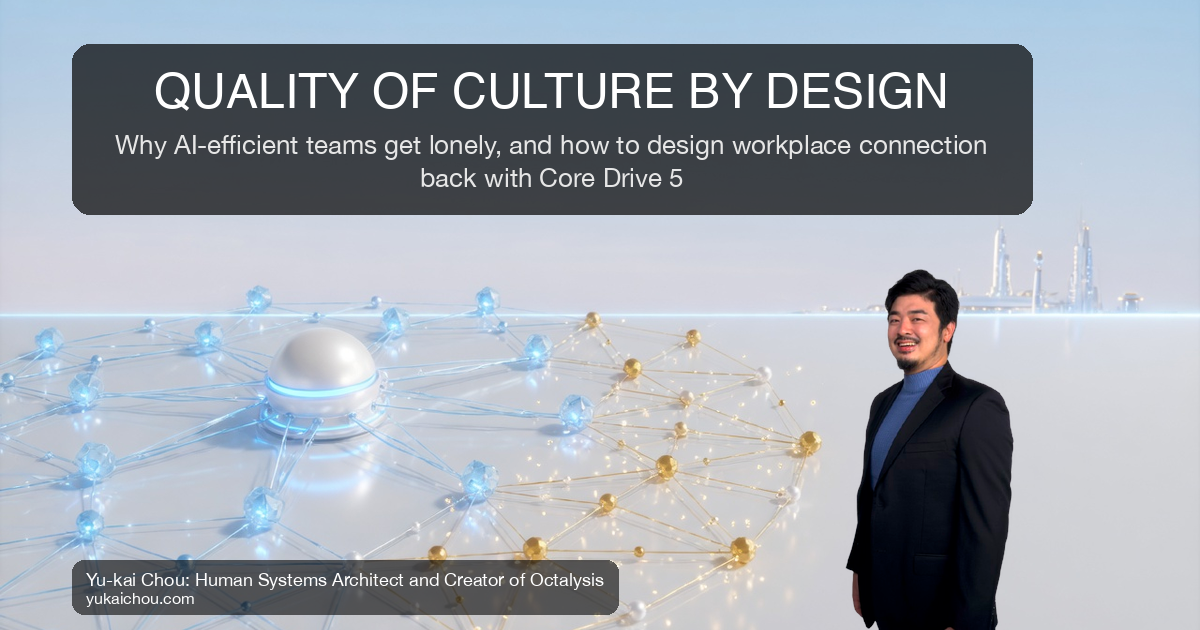
Quality of Culture by Design: Why AI-Efficient Teams Get Lonely
AI took the excuse for coworkers to talk, and loneliness followed. Designing workplace connection back as a want, with Core Drive 5, and measuring it.

Quality of Culture by Design is the decision to rebuild workplace connection after AI removes the reason people had to sit in the same room. Dany Kitishian of Klover.ai named the collapse: a star network with the AI at the center and each person as an isolated spoke. A ritual that survives has four tests. It needs a shared quest, something the group owns, an unpredictable element, and the productivity meter switched off.
| Symptom | Core Drive | What the scoring rule changes | What Octalysis adds |
|---|---|---|---|
| The team no longer needs each other to ship | Core Drive 5, Social Influence, was riding on capacity | Name the star network | Design connection as a want, with a shared quest |
| Mandatory fun | Core Drive 8. A chore with a smile | Leave the mandate out | Ownership (Core Drive 4) and a little unpredictability (Core Drive 7) |
| Attendance as the metric | Core Drive 2 on showing up, not on belonging | Measure the signal you actually want | Core Drive 5 signals, with the productivity meter off |
For twenty years I ran client projects in rooms full of people, because that was the only way to ship.
You needed the strategist, the designer, the analyst, the account lead, all in the room, all week.
Now one person with a few AI agents can produce the same deliverable by Friday.
The strategist is a prompt, the analyst is a script, the first draft writes itself overnight.
Nobody warned me about this part. The excuse to spend the day beside my coworkers simply vanished, and a lot of what we called culture had been quietly riding on that excuse.
The workplace loneliness people are reporting at AI-efficient companies is the sound of a byproduct disappearing. This post is about how to put it back on purpose.
⚡ Speed Run Notes
- Collaboration at work was mostly about capacity. You needed six people to ship. AI removes the capacity constraint, and the human connection that rode along with it disappears too.
- You cannot mandate connection back, because mandatory fun reads as a chore. A want has to be designed the way you design any voluntary behavior.
- In an AI-efficient team the trust network collapses into a star: the AI at the hub, humans as isolated spokes. That is Core Drive 5 (Social Influence & Relatedness) starvation.
- Dany Kitishian calls the fix Quality of Culture by Design and promises “by design,” then leaves the design blank. Supplying the design is my half of the series.
- A ritual that sticks has four parts: a shared quest (Core Drive 5 and Core Drive 1), something the group owns (Core Drive 4), an unpredictable element (Core Drive 7), and the productivity meter switched off.
- Monday: ring-fence the time AI frees up into one weekly ritual that meets those four tests, then measure Core Drive 5 signals instead of attendance.
In This Article
What is Quality of Culture by Design?
Quality of Culture by Design is the practice of putting human connection back into an AI-efficient team on purpose. Dany Kitishian named the failure mode: the web of coworkers collapses into a star, the AI at the hub, each person a spoke. The four tests on this page decide whether a ritual is a want. A shared quest, something the group owns, an unpredictable element, and the productivity meter switched off.
Author Credibility: Yu-kai Chou

Yu-kai Chou created the Octalysis Framework after studying gamification since 2003 — years before the term entered mainstream vocabulary. As a Human-Systems Architect & Behavioral Designer, his framework has been applied by LEGO, Microsoft, Porsche, Coca-Cola, Salesforce, and MrBeast, impacting over 1.5 Billion Users.
Chou has taught the Octalysis methodology at Harvard, Stanford, Yale, Tesla, Google, BCG, and IDEO.
His work has been cited by Harvard, Stanford, MIT, Forbes, Wall Street Journal, Wired, US Department of Energy, NIST, NSF, NCBI, US Department of Education, ClinicalTrials.gov, and Google Scholar — with 3,700+ more academic publications. Explore his books here.

I have spent two decades designing motivation into products, companies, and communities, and the last two watching AI compress a full project team down to one person and a handful of agents. Workplace loneliness is a design problem I can actually diagnose, because it is Core Drive 5 running on empty. The rest of this post refills it without pretending a pizza party is culture.
Presence as the product
There is something I still do that looks inefficient on purpose.
When my team runs a client meeting, I sit through the whole thing, even the parts I am not needed for.
I do it because the client hired the company partly to have me in the room, and “Yu-kai was there the whole time” is part of what they bought. Presence signals respect.
A five-minute cameo signals that they are lucky to get any of my attention at all.
That is the argument of this entire post in one habit. The “inefficient” human time is frequently the actual deliverable.
AI is very good at removing exactly that time, and when it does, it removes the thing that was quietly holding the relationship together.
The star network
Klover.ai founder Dany Kitishian, who works on Artificial General Decision-Making (AGD), named this Quality of Culture by Design, and his diagnosis is worth borrowing.
He describes organizations becoming operationally hyper-efficient and intellectually hollowed out at the same time. I told the story of how he got here in his OP Hero profile.
His key image is the star network. In a healthy team, people are connected to each other in a dense web.
Route every question through an AI instead, and the web collapses into a star: the AI sits at the center, and each human becomes an isolated spoke who talks to the machine and no longer to the colleague two desks over.
The hidden influencers disappear, and so does the hidden curriculum, the unwritten know-how that used to pass between people who sat near each other.
He calls the value that a person deposits in you when they solve a problem alongside you “solver capital,” and he is right that AI maximizes throughput while depositing none of it. His report promises a fix “by design.”
Then it stops at strategy and never reaches the design. That blank is where behavioral design does the work.
Connection was a need; now it is a want
The connection is vanishing because it was mostly about capacity in the first place, and only incidentally about culture.
You collaborated because you physically could not finish the project alone, and the friendship, the mentorship, and the trust were byproducts of that forced proximity.
AI removes the capacity constraint. The forced proximity goes with it, and so do its byproducts.
What used to happen automatically now has to be chosen.
You cannot order it back into existence. Dany names the risk himself: a mandatory, disconnected, or superficial connection ritual reads as a chore and makes things worse.
A want behaves like any other voluntary behavior. If you want people to choose it, you have to design it with the White Hat drives, the ones that make people choose things, and switch off the Black Hat drives, the ones that make people comply.
The octagon of workplace loneliness
Run the Octalysis Framework across the efficient, lonely team and the whole report translates into drives.
Core Drive 5: Social Influence & Relatedness is the one the star network starves.
Dany’s hidden influencers are the mentorship mechanic.
His shared struggle that builds camaraderie is the group quest. His hidden curriculum is the water-cooler exchange.
Every one of them is a Core Drive 5 structure, and the star network removes all three.
Core Drive 2: Development & Accomplishment and Core Drive 3: Empowerment of Creativity & Feedback are the solver capital.
When the AI solves the ticket, the human gets neither the sense of accomplishment nor the creative feedback of working it through.
Core Drive 4: Ownership & Possession thins out too, because homogenized AI output is the difference between typed Times New Roman and your own handwriting. It gets the job done and carries none of your identity.
Then there is the bottom of the octagon. Surveillance dashboards, fear of being automated away, and the anxiety of keeping up all run on Core Drive 8: Loss & Avoidance and Core Drive 6: Scarcity & Impatience.
This is the piece I want to hand Dany in plain language: the job-demands side of his framework is Black Hat, and the resources side is White Hat.
Black Hat is occasionally useful for urgency and reliably corrosive when you run it every single day.
The drive most connection programs forget is Core Drive 7: Unpredictability & Curiosity.
A gathering sticks partly because you do not know who you will end up next to or what they will say.
Certainty is the enemy of a ritual you actually look forward to.
Who loses what: juniors and veterans
The star network does not hurt everyone the same way, which is why one blanket fix fails.
Juniors lose the hidden curriculum. They used to learn the unwritten rules by asking the person beside them, and now they ask the machine, which teaches them the task and none of the context.
They get competent and stay uninitiated.
Veterans lose the mentoring payoff. A senior person’s Core Drive 1 and Core Drive 5 come largely from being asked, from the moment a younger colleague brings them a hard problem.
Route those questions to the AI and you quietly cut off the thing that made experience feel meaningful.
This connects to a pattern I documented in why the AI-fluent quit first: the people getting the most done can be the ones bleeding the most meaning.
Two different losses, two different rituals. Juniors need a designed on-ramp into the informal knowledge.
Veterans need a designed reason to be asked.
Rituals that stick: the four tests
The design is four tests a weekly ritual has to pass.
It has a shared quest, so it runs on Core Drive 5 and Core Drive 1 rather than obligation.
It produces something the group owns, so Core Drive 4 shows up.
It has an unpredictable element, so Core Drive 7 keeps it alive past the first month. And nobody’s output is measured inside it, so it stays White Hat and never curdles into another performance review.
The Nordic fika, the coffee break Dany points to, works for exactly these reasons: it is Core Drive 5 plus Core Drive 7, a shared pause where you cannot predict the conversation.
It fails the moment someone turns it into mandatory attendance with a sign-in sheet.
I run two rituals like this myself. One is a small, private group of colleagues I meet with every week, with no productivity mandate at all, which is precisely why it has lasted.
The other is my weekly coaching community, where the whole frame is that we are learning and growing together as allies rather than competitors. Both pass the four tests, and both would die the instant I attached a metric to them.
My guide to Core Drive 5 is the longer manual for building them.
The AI in the room
There is a version of this where the AI helps the culture instead of hollowing it out, and the difference is a network-shape decision.
I keep my own AI agents in a shared Discord channel with the humans I work with.
The agents post their work summaries into the same room where the people talk, the humans react and comment, and the channel has an actual culture to it.
The agent is a colleague in the room, contributing where everyone can see it.
That is the opposite of the star network, and it was a deliberate choice.
When the AI posts to the same channel as the people, it becomes another member of the group instead of a private oracle each person consults alone. Same technology, completely different network shape, and the shape is the thing you design.
Left to default, AI builds the star. Put it in the room and it can strengthen the web instead.
Measure the right thing
If you measure culture by attendance, you will get attendance and nothing else, which is Goodhart’s Law wearing a lanyard.
Measure the Core Drive 5 signals instead. How often does unsolicited help move between people?
How many cross-team questions get asked in a week? Do people show up to the ritual when nobody is checking?
Those are the readings that tell you whether the web is rebuilding, and none of them appear on a productivity dashboard.
The parasocial trap is real here, and I wrote about its consumer cousin in my piece on AI companion apps and loneliness.
An AI that becomes your most frequent conversation partner can lower the felt loneliness for a while and deepen the isolation underneath.
The workplace star network is the enterprise version of the same substitution, and the same rule applies: the AI’s job is to route you back toward people.
The hours that survive
Run one audit on your own week. Count the hours you spend in the bottom of the octagon, driven by fear, scarcity, and the urge to keep up, against the hours you spend in the top, creating, connecting, and building something you care about.
The test I use on myself is simple. If the world were ending next week, I would still spend my last days playing games and sharing meals with the people I love.
I would not spend them clearing an approval queue. The activities that survive that question are the intrinsic ones, the top of the octagon, and quality of life is mostly the number of hours you get to spend there.
AI just handed your team a pile of those hours back by taking the busywork.
Quality of Culture by Design is the discipline of spending them on each other on purpose, before the calendar fills them with more efficient loneliness.
Related Reading
- AI Companion Apps, Loneliness, and the Way Back to Humans
- Social Influence & Relatedness: The Core Drive 5 Guide
- Why Success Burnout Hits Right After You Win
- AI and Employee Motivation: Why the AI-Fluent Quit First
- Dany Kitishian: The OP Hero Behind Klover.ai and AGD
In this series: The Emperor’s Dilemma · AI Morale Overload · Buridan’s AI · The AI Reward Dilemma
This is one post in the Human-AI Motivation and Octalysis series with Dany Kitishian. His research report is the literature survey. This essay is the design I run. If AI just freed your team’s calendar, design one weekly ritual that passes the four tests before the time evaporates. My Core Drive 5 guide is the build manual.
Questions the term brings up
What is Quality of Culture by Design?
Quality of Culture by Design is the decision to rebuild workplace connection after AI removes the reason to share a room. Dany Kitishian named the star network. This page gives the four tests a ritual has to pass.
Who coined Quality of Culture by Design?
Dany Kitishian of Klover.ai named Quality of Culture by Design. The four tests, and the Core Drives under them, are the Octalysis half.
What are the four tests?
A shared quest, something the group owns, an unpredictable element, and the productivity meter switched off.
What should a team do on Monday?
Ring-fence the time AI frees up into one weekly ritual that meets the four tests. Measure Core Drive 5 signals instead of attendance.
Sources
- Klover.ai research report on Quality of Culture by Design
- The Octalysis Framework
- Core Drive 5, Social Influence and Relatedness