
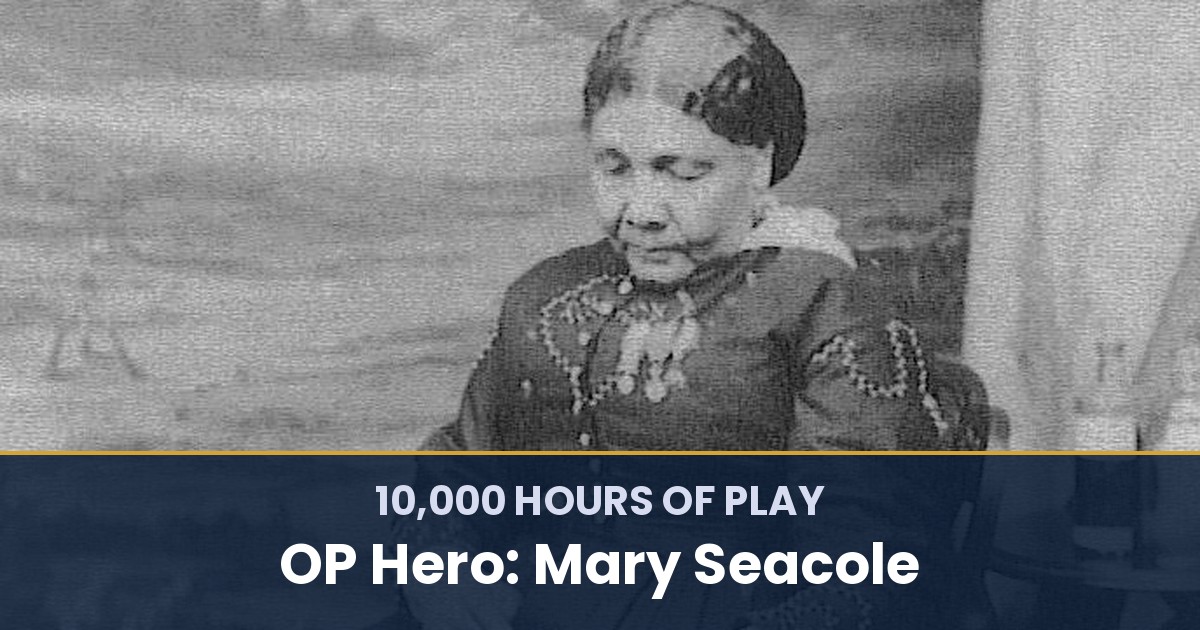


In the autumn of 1854, a widow from Kingston, Jamaica, nearing fifty, walked into the War Office in London and offered to go out to the Crimea to nurse British soldiers.
The War Office turned her away, and so did the Quartermaster-General’s department, the Medical Department, the managers of the Crimean Fund, and Elizabeth Herbert, the wife of the Secretary at War, who told her that the complement of nurses going out to Florence Nightingale was already full.
Her name was Mary Seacole, and by then she had treated cholera in Panama, survived the disease herself, and been asked by Jamaica’s medical authorities to help organize nursing during a yellow fever epidemic.
Within months she was in Balaclava anyway, at her own expense, running a hotel she had built from packing cases and salvaged iron, and riding out toward the fighting with mules loaded with food and bandages.
Run through the six Steps, her life answers a question the framework keeps returning to: what a player does when every official door is closed and she is certain that her Game is on the other side of it.
⚡ Speed Run Notes
- Mary Seacole’s Game was practical medicine on her own terms: follow the epidemic or the war, treat whoever turned up, and run a business beside the sick room to pay for it.
- Her innate stats: an appetite for travel that put her on a ship to London as a teenager, a pull toward the sick room that started with a doll, stamina that carried her to a war zone at fifty, and a refusal to defer.
- Canon Skills on the sheet: Siphoning (Warlock), Iron Skin (Warrior), Courageous Heart (Paladin), Adaptive Foraging (Ranger) and Loremaster (Druid).
- Her Allies were the people who vouched for her when institutions would not: a business partner, a war correspondent, a celebrity chef, and the officers who organized a fund after she went bankrupt.
- The Quest log runs from a cholera epidemic in Panama to a hotel at the front, a bankruptcy caused by peace, and an 1857 memoir that turned a ruined businesswoman into a public figure.
Table of Contents
About Yu-kai Chou

Yu-kai Chou is the author of 10,000 Hours of Play — the book that treats your life as the most important game you’ll ever build a character in, and gives you the 6-Step framework (Game · Attributes · Role · Skills · Allies · Quests) to play it on purpose. He has spent two decades developing the system through which this post analyzes its OP Hero, and applies it to his own life and to the lives of the people he advises around the world.
Chou’s other framework, the Octalysis Framework, has been applied by LEGO, Microsoft, Porsche, Coca-Cola, Salesforce, and MrBeast, impacting over 1.5 Billion Users. He has taught the methodology at Harvard, Stanford, Yale, Tesla, Google, BCG, and IDEO, and has advised governments in eight nations including Ukraine, the United Kingdom, the Kingdom of Bahrain, Singapore, Taiwan, the Netherlands, Kazakhstan, and South Korea.
His work has been cited by Harvard, Stanford, MIT, Forbes, Wall Street Journal, Wired, US Department of Energy, NIST, NSF, NCBI, US Department of Education, ClinicalTrials.gov, and Google Scholar — with 3,700+ more academic publications. Explore his books here.

Mary Seacole belongs in this series because she ran the Iron Skin problem in its purest form: five institutions refused her in one season, and her response was to fund the Quest herself and let the record argue for her afterward. The move I would lift from her character sheet is the one from the autumn of 1854, when she answered five refusals in a single season by booking her own passage.
Step 1: The Game — What Mary Seacole Was Actually Playing
Mary Seacole’s Game is easy to file under “nursing,” and the label has caused more argument than almost anything else about her.
She never trained in a hospital, never held a commission, and called herself a doctress, the Jamaican term for a practitioner who treated the sick with herbal remedies and the domestic medicine of the day. Her Game was wider than any one profession: to be useful wherever disease or war broke out, under her own name, on her own account.
The pattern repeats across three decades of her record. She treated patients in the Kingston cholera epidemic of 1850, followed cholera to Panama in 1851, answered Jamaica’s medical authorities during the yellow fever outbreak of 1853, and when the Crimean War began she tried to reach it through every official channel she could find.
The second rule of her Game was recognition from the men she served. She wanted to be remembered by them, and the soldiers’ name for her, Mother Seacole, was the kind of score she was keeping.
The third rule was that the business paid for the medicine. In Panama and again in the Crimea she ran a hotel and a store, and the money from officers’ dinners and provisions financed the care she gave to men who could not pay.
Her 1857 memoir makes the arrangement plain. The British Hotel she built near Balaclava was a refuge and a shop at the same time, and she describes both halves without embarrassment in the same chapters.
Step 2: Attributes — The Innate Stats
Attributes are the stats a player carries in before any training, and Seacole’s first one showed up in a child’s toy.
She was born Mary Jane Grant in Kingston, Jamaica, in 1805, to a free Jamaican woman known as a doctress who kept Blundell Hall, a boarding house for invalid army officers and their wives, and to James Grant, a Scottish soldier in the British Army. Her mother treated the guests, and the daughter watched.
In the first chapter of her memoir she writes that whatever disease was most prevalent in Kingston, her doll soon contracted it, and that she moved on from the doll to the dogs and cats before she was allowed near a patient. The pull toward the sick room came before any instruction in how to work in one.
The second attribute was an appetite for travel. By her own account she sailed to London twice as a young woman, around 1821 for about a year and again around 1823 for about two years, taking West Indian pickles and preserves to sell, and later visited Cuba, Haiti and the Bahamas, bringing shells and shell-work home from the Bahamas.
The third attribute was plain physical stamina. She was nearly fifty when she reached the Crimea in 1855, and the year that followed involved building a hotel from salvage, running it, and riding out to the fighting with supplies; the French chef Alexis Soyer, who met her there, described her as an old dame of a jovial appearance.
The fourth was a refusal to defer. When the managers of the Crimean Fund turned her down in 1854, she asked in print whether these ladies had shrunk from accepting her aid because her blood flowed beneath a somewhat duskier skin than theirs, and she left the question standing for her readers to answer.
In the Talent Triangle Method, the question is which Edge Strength gives you an unfair advantage in the right environment. Seacole’s was the pairing of the first and third attributes: a practitioner’s instinct for the sick room, carried by a body and a temperament that could follow an epidemic across an ocean.
Step 3: Role(s) — The Character Class Across Chapters
Seacole changed Roles with every change of geography, and the medical Role ran underneath all of them.
The first Role was apprentice in her mother’s house, learning Jamaican remedies and watching the army doctors who passed through Blundell Hall. The second was trader, on the voyages to London and around the Caribbean.
The third Role, wife, came in her thirties. She married Edwin Horatio Hamilton Seacole in Kingston on 10 November 1836, and the marriage ended with his death in October 1844, at about the same time her mother died.
Between those two dates came a Role she took on by necessity: rebuilder. A fire destroyed Blundell Hall in August 1843, and she rebuilt the business, which she would run alone after 1844.
The fifth Role was the independent doctress of the 1850 Kingston cholera epidemic, and the sixth was hotel keeper and cholera doctor in Panama. She went to Cruces in 1851, where her half-brother Edward ran the Independent Hotel, opened her own establishment there, moved on to Gorgona in 1852, and was back in Jamaica by 1853.
The seventh Role came with an invitation. During the yellow fever epidemic of 1853 the medical authorities in Jamaica asked her to help provide nursing at Up-Park Camp, the first time an institution sought her out rather than the other way round.
The eighth Role, rejected volunteer, lasted one London autumn in 1854. The ninth, sutler and nurse at the front, ran from early 1855 to the summer of 1856 in partnership with Thomas Day, a relative of her late husband.
Then came the Roles nobody plans for: bankrupt in November 1856, public cause in the winter that followed, and author by July 1857. In later life she moved between Jamaica and London, with a revived fund in 1867 whose patrons included the Prince of Wales, the Duke of Edinburgh and the Duke of Cambridge.
Step 4: Skills — The Real-Life Game Skills Mary Seacole Mastered
Attributes are inherited; Skills are the trained, repeatable moves on the character sheet. The names below, and the Class in brackets after each one, come from the Real-Life Game Skills list, and five of those Skills are legible in Seacole’s record.
Siphoning (Warlock) is extracting skills and knowledge rapidly from others, and her whole medical education was built this way. She learned remedies from her mother, picked up what she could from the army surgeons who boarded at Blundell Hall, and in Cruces in 1851 she examined the body of an infant who had died of cholera because she wanted to understand the disease she was treating.
Iron Skin (Warrior) is becoming unaffected by rejection after proactive outreach, and the autumn of 1854 is the textbook case. Five separate refusals in London would have ended most people’s Crimean plans; hers ended with a passage booked at her own expense and a business partner signed up.
Courageous Heart (Paladin) is charging into uncomfortable zones and hostile environments. Her memoir records her at the assault on the Redan on 18 June 1855, at the Battle of the Tchernaya on 16 August 1855, and at the final assault on Sevastopol that September, carrying food, wine and medical supplies on mules, treating French, Sardinian and Russian wounded at the Tchernaya, and dislocating her thumb on 18 June 1855 when she threw herself down to avoid a shell while among the wounded.
She also claimed to be the first British woman to enter Sevastopol after it fell. The claim comes from her own account, in a memoir written to rescue its author from bankruptcy, and it has been repeated ever since.
Adaptive Foraging (Ranger) is finding the right resources for the challenge in front of you, and the British Hotel is the proof. She and Day built it at Spring Hill near Kadikoi, outside Balaclava, out of salvaged driftwood, packing cases, iron sheets, and doors and window frames pulled from the abandoned village of Kamara, at a total cost of about £800.
The Times announced the venture on 9 March 1855, and the hotel was open that month, selling cooked meals, drink and provisions to officers while its owner treated anyone who came to the door sick.
On the Skills Spectrum, Seacole was a Specialist in practical medicine with a Dabbler’s working reach across trade, hospitality and construction, and in the Crimea the Dabbler’s trades paid the Specialist’s bills.
Loremaster (Druid) is weaving compelling stories, and in Seacole’s case the story was the asset that remained when the money was gone. Wonderful Adventures of Mrs. Seacole in Many Lands appeared from James Blackwood in July 1857, about 200 pages priced at one shilling and sixpence, with a preface by William Howard Russell of The Times, and it sold well enough to go into a second edition in 1858.
The National Portrait Gallery describes it as the earliest known autobiography by a Caribbean-born woman. The book spends little time on her first forty years and most of its length on Panama and the Crimea, because its author knew exactly which chapters her readers had paid for.
Step 5: Allies — The People Who Multiplied Mary Seacole
Seacole’s Allies share one pattern: when the institutions would not vouch for her, individuals did, and several of them had very public voices.
The first Ally was her mother, who supplied the training, the house and the model of a free Jamaican woman running her own medical and hospitality business in a slave colony. Her half-brother Edward supplied the next base, at Cruces in Panama, where his Independent Hotel gave her a reason to be in the town when cholera arrived.
Thomas Day was the partner who made the Crimea possible. A relative of her late husband, he put his name beside hers on the business, helped build and run the British Hotel, and shared the bankruptcy that followed the peace.
William Howard Russell, the war correspondent of The Times, was the Ally who turned a sutler into a public figure. His dispatch of 14 September 1855 called her a warm and successful physician, and in the preface to her book he wrote that he trusted England would not forget one who nursed her sick, who sought out her wounded to aid and succour them, and who performed the last offices for some of her illustrious dead.
Alexis Soyer, the celebrity chef who was also in the Crimea, put her into his own 1857 book, A Culinary Campaign, and the officers who had eaten at Spring Hill became her rescuers at home. Lord Rokeby wrote to The Times on 25 November 1856 appealing for money so that she could restart her business, and Punch published “A Stir for Seacole” on 6 December.
Her relationship with Florence Nightingale was a near miss rather than an alliance. Seacole visited the Barrack Hospital at Scutari on her way out in 1855 and was given a bed for the night, and years later, in an 1870 letter to Sir Harry Verney, Nightingale credited Seacole with kindness to the men and the officers and with some good done, and in the same letter complained of the drunkenness around her establishment.
The two women were playing different Games, and Nightingale’s letter is the clearest statement of the difference: one was building a profession with rules, the other was running a canteen and a sick room out of the same hut.
The last Allies arrived after the war. A sculptor, Count Gleichen, made a bust of her in 1871, and the revived fund of 1867 was the second time officers and patrons had raised money on her behalf.
Step 6: Quests — The Milestones That Shaped the Saga
Seacole’s Quest log alternates between epidemics she went toward and institutions that tried to keep her out.
The first completed Quest was the cholera epidemic in Panama. In Cruces in 1851 the first cholera case she saw was already dead; the next patient, whom she called her first cholera patient there, survived, and she treated many more before catching the disease herself toward the end of the outbreak and recovering after several weeks of rest.
The second Quest was the London autumn of 1854, and it reads as a defeat right up to its last line. Five refusals, then a decision to go anyway, and in early 1855 she sailed for Constantinople on the steamer Hollander.
The third Quest was the British Hotel, open in March 1855 and built out through that summer, and the fourth was the string of battlefield days that followed it through the summer, from the Redan in June to the fall of Sevastopol in September.
The fifth Quest ended in a failure she did not cause. The Treaty of Paris of 30 March 1856 ended the war before her stock could be sold, the market for a hotel at the front vanished with the army, and on 7 November 1856 she and Day were declared bankrupt at the Court of Bankruptcy in Basinghall Street, London. Their discharge came on 30 January 1857.
The sixth Quest was the comeback, and it had two halves. The public half was the Seacole Fund and the four-night Grand Military Festival at the Royal Surrey Gardens from 27 to 30 July 1857, with more than a thousand performers and a crowd in the tens of thousands, which netted her about £57 after the gardens company itself failed.
The private half was the book, published that same July, which did what the festival could not: it fixed her version of the story in print and kept her name in circulation for the rest of her life.
She died in Paddington, London, on 14 May 1881, leaving an estate valued at more than £2,500, and was buried at St Mary’s Roman Catholic Cemetery in Kensal Green.
The final Quest was played by other people. Her grave was restored and reconsecrated in 1973, she topped a 2004 poll of great Black Britons, a lost 1869 portrait of her by Albert Charles Challen resurfaced in the early 2000s and was acquired by the National Portrait Gallery in 2008, and on 30 June 2016 a statue by Martin Jennings was unveiled at St Thomas’ Hospital in London with Russell’s words from the preface etched into it.
What You Can Steal From Mary Seacole’s Build
Seacole’s build rewards study for three Skills in particular, and for one she never developed.
The first thing to steal is the Iron Skin response to rejection. She kept the Quest and changed the route, and the offices that had said no played no further part in it.
The second is the Adaptive Foraging habit of building with what the environment leaves lying around. A hotel made of packing cases and salvaged doors served officers for more than a year and cost about £800, and the men who ate there later raised the money that kept its owner afloat.
The third is the funding model that kept her medicine solvent. Anita Roddick ran the same one at The Body Shop from 1976, where the shops paid for the campaigns and from 1986 carried a Save the Whale campaign with Greenpeace, and Seacole’s hotel at Spring Hill paid for the sick room beside it in the same way: the commercial half of the Game funds the half the player cares about.
The fourth lesson is the Skill her character sheet needed more of: Foresight (Ranger), projecting future risks before they arrive. She stocked a hotel for a long war, the peace of March 1856 came faster than she had planned for, and the unsold inventory took her into the bankruptcy court eight months later.
She called her adventures wonderful and wrote them down herself, because she had learned in 1854 that nobody in an office would do it for her.
Where this framework comes from

Want the full system this profile is built on?
Every OP Hero piece runs through the same 6-Step framework from 10,000 Hours of Play: Unlock Your Real-Life Legendary Success. The book covers the full system, walks through Yu-kai’s own life run as the first applied case study, and gives you the worksheets to audit your own build.
Related Reading
- All OP Hero Profiles — the full hub
- 10,000 Hours of Play by OP Hero: Florence Nightingale
- 10,000 Hours of Play by OP Hero: Harriet Tubman
- 10,000 Hours of Play by OP Hero: Madam C.J. Walker
- 10,000 Hours of Play by OP Hero: Louis Pasteur
- Real-Life Game Skills: The 96-Skill System Behind 10,000 Hours of Play