
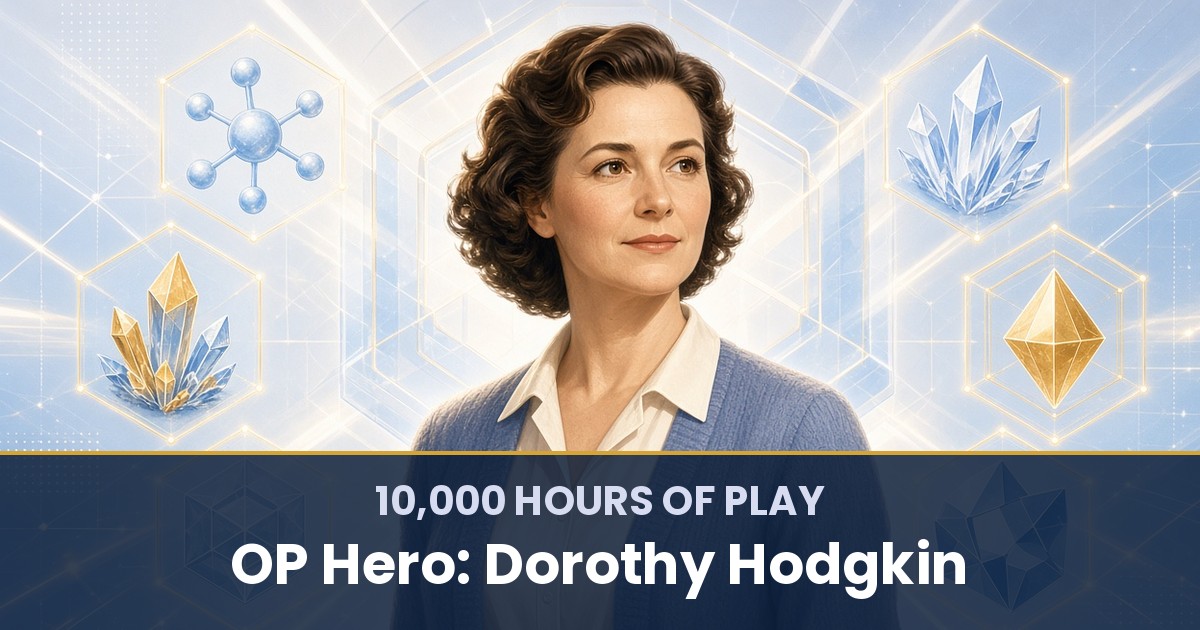


In 1935, a young Oxford chemist pointed an X-ray beam at crystals of insulin and took the first diffraction photographs of them ever made.
At that moment, protein crystallography barely existed, and insulin’s chemical sequence was still unknown.
Dorothy Hodgkin kept that project alive for roughly 35 years. Her group finally reported the three-dimensional structure of insulin in 1969, and she went on refining it into the 1980s.
Along the way she solved penicillin while the Second World War was still being fought, cracked vitamin B12 after nearly ten years of systematic analysis, and won the 1964 Nobel Prize in Chemistry. She did most of it with hands damaged by rheumatoid arthritis from age 28.
Run her life through the 6-Step framework and you get a masterclass in picking one Game and refusing to put it down.
⚡ Speed Run Notes
- Hodgkin’s Game was making the three-dimensional architecture of biologically important molecules visible, so chemistry and medicine could act on it.
- Her three defining Quests ran on long clocks: penicillin solved in 1945, vitamin B12 in 1954 after nearly ten years, insulin in 1969 after roughly 35.
- Five canon Skills defined the build: True Aim, Elemental Ensemble, Ninja Focus, Tactical Command, and Concord of Elements.
- Rheumatoid arthritis arrived in 1938, when she was 28. The mission did not pause; she built teams and methods around the constraint.
- Steal this: choose a target worth decades, then let every role, team, and technique you pick up serve that single commitment.
Table of Contents
About Yu-kai Chou

Yu-kai Chou is the author of 10,000 Hours of Play — the book that treats your life as the most important game you’ll ever build a character in, and gives you the 6-Step framework (Game · Attributes · Role · Skills · Allies · Quests) to play it on purpose. He has spent two decades developing the system through which this post analyzes its OP Hero, and applies it to his own life and to the lives of the people he advises around the world.
Chou’s other framework, the Octalysis Framework, has been applied by LEGO, Microsoft, Porsche, Coca-Cola, Salesforce, and MrBeast, impacting over 1.5 Billion Users. He has taught the methodology at Harvard, Stanford, Yale, Tesla, Google, BCG, and IDEO, and has advised governments in eight nations including Ukraine, the United Kingdom, the Kingdom of Bahrain, Singapore, Taiwan, the Netherlands, Kazakhstan, and South Korea.
His work has been cited by Harvard, Stanford, MIT, Forbes, Wall Street Journal, Wired, US Department of Energy, NIST, NSF, NCBI, US Department of Education, ClinicalTrials.gov, and Google Scholar — with 3,700+ more academic publications. Explore his books here.

Hodgkin never treated her arthritis as the headline of her story, and she never let a 35-year problem feel like a stalled one. What I would lift from her build is the clock discipline: she measured progress in constraints resolved per year instead of applause per quarter, and that is exactly the mindset shift I try to give anyone mapping their own Quests.
Step 1: The Game — What Dorothy Hodgkin Was Actually Playing
Hodgkin’s Game was to make the three-dimensional architecture of biologically important molecules visible, and then hand that knowledge to chemistry and medicine.
Her targets were never arbitrary choices: cholesterol, penicillin, vitamin B12, and insulin were all chemically difficult substances with direct medical importance, and solving each one changed what doctors and chemists could do next.
She stated the problem herself in the title of her Nobel Lecture, delivered on 11 December 1964: “The X-ray Analysis of Complicated Molecules.”
One sentence, and it covers five decades of work.
There is no quarterly scoreboard here, no market to win, and often no guarantee the molecule can be solved at all with the tools of the moment.
The payoff structure is closer to a decades-long raid than a ladder match, which is why her Attributes and Skills matter so much in the next sections.
During the war she described being “irresistibly drawn to inject myself into the situation” when penicillin’s structure became an urgent open problem. That pull toward consequential molecules, rather than convenient ones, is the clearest signature of her Game.
Step 2: Attributes — The Innate Stats
Four traits show up early in Hodgkin’s record, before any of the famous results.
Pattern recognition and spatial imagination came first. As an Oxford undergraduate in 1931 and 1932 she worked on thallium dialkyl halides and became one of the first researchers to apply X-ray crystallography to an organic compound.
Her whole career rested on inferring invisible three-dimensional structures from flat diffraction patterns, a task that punishes anyone without this stat.
Persistence over unusually long horizons is the trait everyone remembers. Vitamin B12 took nearly ten years of step-by-step analysis, and the insulin program ran from the 1935 photographs to the 1969 structure.
Boldness in problem selection is the third stat. She committed to insulin at a time when protein crystallography barely existed, and the 1935 photographs were taken while insulin’s chemical sequence was still unknown.
Collaborative orientation is the fourth stat on her character sheet. Her major results were team achievements involving chemists, crystallographers, biochemists, and technicians, documented across roughly six decades of surviving research papers.
If you want to map your own innate stats, the Talent Triangle Method is the exercise I recommend. Hodgkin’s strongest corners were spatial imagination and persistence, and every Quest below sits where those two overlap.
Step 3: Role(s) — The Character Class Across Chapters
Hodgkin moved through five Roles, and each one expanded the Game instead of replacing it.
The first Role was the apprentice crystallographer at Oxford. In 1931 and 1932 she worked under her supervisor Powell on thallium dialkyl halides, learning the craft on a problem nobody considered glamorous.
The second Role was independent molecular crystallographer. By 1935 she had taken the first X-ray photographs of insulin crystals, opening the project that would define her entire arc.
The move mirrors what Rosalind Franklin would later do with DNA fibers: stake a claim on a structure everyone agreed mattered and nobody knew how to see.
The third Role was wartime structural chemist. From 1941 she joined the urgent effort around penicillin, and her analysis established its beta-lactam and thiazolidine rings by 1945.
The fourth Role was research leader and teacher. She became University Lecturer and Demonstrator in 1946, Reader in X-ray Crystallography in 1956, and Wolfson Research Professor of the Royal Society from 1960 until 1977.
The fifth Role was public scientist and peace advocate. After the 1964 Nobel Prize she carried scientific standing into international work, chairing the Pugwash movement from 1976 to 1988 across Cold War divisions.
Each Role change added range without abandoning the mission. The insulin project ran quietly underneath all five.
Step 4: Skills — The Real-Life Game Skills Dorothy Hodgkin Mastered
Attributes are what you start with, and Skills are what you train. Hodgkin’s five documented Real-Life Game Skills span four Classes: Ranger, Mage, Rogue, and Druid.
True Aim (Ranger) is locking onto a precise target and committing. She became interested in insulin in 1934, photographed its crystals in 1935, and did not stop until the structure landed in 1969. Few careers show a cleaner 35-year lock.
Elemental Ensemble (Mage) is mentally visualizing complex compositions and executing with precision. Converting diffraction spots into the position of every atom in a molecule of insulin’s size, 788 atoms by the Keele account, is this Skill at grandmaster level.
Ninja Focus (Rogue) is sustained discipline on a task. The vitamin B12 structure came from nearly ten years of sequential analysis, with each experimental constraint narrowing the possibilities until the molecule gave way in 1954.
Tactical Command (Ranger) is making people of different talents work harmoniously. The 1954 Nature paper on B12 lists Brink, Lindsey, Pickworth, Robertson, and White alongside her, and the insulin group she led carried that structure from solution in 1969 through refinements into the 1980s.
Concord of Elements (Druid) is bringing parties with different interests to one table. As Pugwash chair from 1976 to 1988 she kept scientists from rival blocs talking about nuclear danger when their governments would not.
On the Skills Spectrum, Hodgkin reads as a deep specialist whose later Skills were all force multipliers for the same core craft.
Step 5: Allies — The People Who Multiplied Dorothy Hodgkin
Hodgkin’s results carry her name, but the record shows a dense alliance behind every structure.
Powell, her undergraduate supervisor, gave her the craft. Across 1931 and 1932 he put X-ray methods in her hands on an organic-compound problem when that combination was still new.
The crystallographer Bernal modeled the scale of her ambition. Her development ran through the Cambridge environment around Bernal, whose methods and scientific vision the Royal Society memoir credits with shaping her work.
Howard Florey’s Oxford team handed her the wartime Quest. Their penicillin trials on infected mice created the urgent need for a structure, and her crystallography answered it. The compound itself had started with Alexander Fleming.
Her B12 and insulin teams did the impossible arithmetic. The 1954 Nature paper names five collaborators, and the insulin group sustained a single program across generations of students and computing hardware.
Her students multiplied her reach beyond chemistry. Margaret Thatcher studied under her at Oxford in the late 1940s, one marker of how far her teaching rippled from the lab bench.
The pattern to copy here is a specific one: every ally either taught her the craft, raised her ceiling, handed her a worthy Quest, or carried the mission further than one person could.
Step 6: Quests — The Milestones That Shaped the Saga
Quest 1 was the apprenticeship result (1931 to 1932). The thallium dialkyl halide work made her one of the first to turn X-rays on an organic compound, and it set the method for everything after.
Quest 2 was opening the insulin campaign (1934 to 1935). The first X-ray photographs of insulin crystals established a claim she would spend 35 years honoring.
Quest 3 was the setback that never resolved (1938). After an infection following the birth of her first child, rheumatoid arthritis arrived when she was 28.
The disease was chronic and hit her hands hardest, during the exact years her career depended on fine laboratory work. She responded by leaning harder on collaborators, students, and increasingly capable computation, and the output never stopped.
Quest 4 was penicillin (1941 to 1949). She began during the secret wartime effort in 1941, obtained the decisive structural solution in 1945, and published in 1949, establishing the beta-lactam and thiazolidine rings that synthesis work then built on.
Quest 5 was vitamin B12 (1948 to 1956). She started in 1948 after the vitamin’s isolation, solved the structure in 1954, and published the final structural work across 1955 and 1956. The 1964 Nobel Prize in Chemistry followed, citing “her determinations by X-ray techniques of the structures of important biochemical substances.”
Quest 6 was insulin completed (1969 onward). The three-dimensional structure of rhombohedral 2-zinc insulin arrived in 1969, and refinement continued into the 1980s.
The honors trace the same arc: elected a Fellow of the Royal Society in 1947, and appointed to the Order of Merit in 1965 as the second woman after Florence Nightingale.
Her Quest log closes where it opened: the first entry and the last entry belong to the same molecule.
What You Can Steal From Dorothy Hodgkin’s Build
First, open your longest Quest early. Hodgkin photographed insulin in 1935 with no guarantee it was solvable, and that early claim gave her 35 years of compounding progress while others waited for certainty.
Second, accept the Quests that arrive as relay races. Penicillin came to her through Fleming’s discovery and Florey’s trials, and her willingness to run the structural leg made the whole chain matter.
Third, design around your constraints instead of denying them. Arthritis at 28 could have ended a career built on fine handwork, so she built teams and adopted computation that turned the constraint into a footnote.
Fourth, spend your late-game standing on something bigger than your field. She converted a Nobel Prize into twelve years of chairing Pugwash, putting scientific trust to work across a divided world.
Where this framework comes from

Want the full system this profile is built on?
Every OP Hero piece runs through the same 6-Step framework from 10,000 Hours of Play: Unlock Your Real-Life Legendary Success. The book covers the full system, walks through Yu-kai’s own life run as the first applied case study, and gives you the worksheets to audit your own build.
Related Reading
- All OP Hero Profiles (the full hub)
- 10,000 Hours of Play by OP Hero: Rosalind Franklin
- 10,000 Hours of Play by OP Hero: Alexander Fleming
- 10,000 Hours of Play by OP Hero: Florence Nightingale
- What’s Your Edge Strength? The Talent Triangle Method
- The Skills Spectrum: Specialist, Dabbler, or Master?