
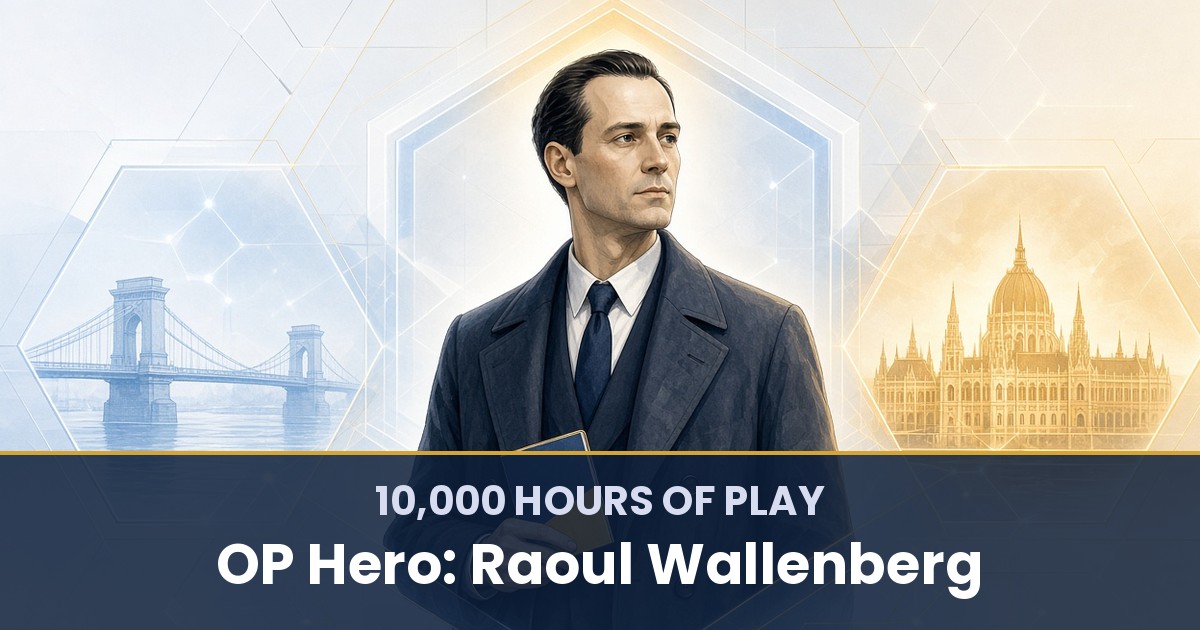


On 9 July 1944, a 32-year-old Swede stepped off a train in Budapest carrying a list of names and roughly 650 protective passports.
He had trained as an architect, worked in trade, and never held a diplomatic post in his life. Hungary’s Jews were facing deportation, forced labor, and murder, and the paperwork in his luggage was about the only weapon he had.
Six months later, Raoul Wallenberg had turned that luggage into a rescue system: a document office staffed by more than 300 people, some thirty buildings flying a neutral flag, and a shared protected zone sheltering around 30,000 people.
Then he climbed into a Soviet car and was never seen free again.
Run his life through the 6-Step framework and you get something sharper than a tragedy. You get a build in which every Step was spent on other people, and almost every move is one you can study.
⚡ Speed Run Notes
- Wallenberg’s Game was converting a neutral country’s diplomatic authority into physical protection for Hungarian Jews, and he kept widening that mission until the Soviets removed him from the board in January 1945.
- His build ran on risk tolerance, improvisation under pressure, an architect’s eye for what counts as official, and attention to individual people rather than categories.
- Five canon Skills defined the run: Bind Fate, Mind Shift, Mastermind, Courageous Heart, and Heroic Strike.
- He never worked alone: the War Refugee Board, the Swedish legation, other neutral diplomats, and more than 300 mostly Jewish staff turned one man’s mandate into a network.
- Steal this: Wallenberg owned no army and no budget of his own, so he spent Sweden’s reputation instead, and the borrowed authority worked like power he owned.
Table of Contents
About Yu-kai Chou

Yu-kai Chou is the author of 10,000 Hours of Play — the book that treats your life as the most important game you’ll ever build a character in, and gives you the 6-Step framework (Game · Attributes · Role · Skills · Allies · Quests) to play it on purpose. He has spent two decades developing the system through which this post analyzes its OP Hero, and applies it to his own life and to the lives of the people he advises around the world.
Chou’s other framework, the Octalysis Framework, has been applied by LEGO, Microsoft, Porsche, Coca-Cola, Salesforce, and MrBeast, impacting over 1.5 Billion Users. He has taught the methodology at Harvard, Stanford, Yale, Tesla, Google, BCG, and IDEO, and has advised governments in eight nations including Ukraine, the United Kingdom, the Kingdom of Bahrain, Singapore, Taiwan, the Netherlands, Kazakhstan, and South Korea.
His work has been cited by Harvard, Stanford, MIT, Forbes, Wall Street Journal, Wired, US Department of Energy, NIST, NSF, NCBI, US Department of Education, ClinicalTrials.gov, and Google Scholar — with 3,700+ more academic publications. Explore his books here.

Wallenberg’s build is the one I think about when someone tells me they are not a natural negotiator. He bluffed armed men with documents that conferred no real citizenship, and the bluff held because he kept showing up in person to back it. The move worth copying from his character sheet is Mind Shift backed by presence: a demand carries more weight when the person making it is standing in the room.
Step 1: The Game — What Raoul Wallenberg Was Actually Playing
Strip away the monuments and Wallenberg’s Game becomes concrete: take the protection a neutral state could legally extend to a handful of people, and stretch it until it covered as many Hungarian Jews as possible.
His formal assignment on paper was narrow and specific. He was to help issue protective documents to Jews with Swedish connections, under an operation backed by the Swedish government and the American War Refugee Board.
He treated the assignment as a starting position, and the pattern held across the whole run. Enter the system, claim its authority, stretch its rules, then use the access to shield people.
Protective passports soon grew into protective letters as well, letters led to buildings placed under the Swedish flag, and the buildings were eventually folded into a coordinated zone shared with other neutral missions and the Red Cross.
When the Arrow Cross seized power in October 1944 and the danger shifted from deportation trains to forced marches and street shootings, he changed tactics again rather than treating the original job as finished. He kept playing that Game, with the objective fixed and the methods moving, from 9 July 1944 until Soviet forces detained him in January 1945.
Step 2: Attributes — The Innate Stats
Attributes are the stats you spawn with. Training sharpens them, but nobody hands them to you in a classroom, and Wallenberg’s character sheet shows at least four.
Risk tolerance is the first stat on the sheet. He confronted German and Hungarian officials at deportation points and railway stations, sometimes threatening consequences he could not fully enforce, and he kept going back.
Improvisation under pressure is the second one. The Hungarian authorities first allowed 1,500 protective passes, the quota was pushed up to 4,500 through negotiation, and the office kept issuing thousands more beyond any number that had been approved.
Then there was an architect’s eye for what counts as official. He treated seals, flags, serial numbers, and official-looking buildings as components he could recombine into a protection network, and the components held because hostile officials had to calculate the cost of ignoring Swedish paper.
Underneath all of it sat attention to individuals. His operation never stayed an abstract passport program; he showed up at deportation sites for specific people and helped put roofs over specific families.
One honest caveat belongs in this section. The record documents these traits in a wealthy upbringing, an architecture degree, and a business career, and it documents them most vividly in 1944; whether they were visible in the nursery is interpretation, not evidence.
If you want to run this audit on yourself, the Talent Triangle Method walks you through it: separating what you were born with from what you trained, so you stop competing on stats you do not have.
Step 3: Role(s) — The Character Class Across Chapters
In RPG terms, Wallenberg multi-classed, and each chapter added a class without erasing the one before it.
He began as the heir of a prominent Swedish banking family, born on 4 August 1912 to a father who had died of cancer about three months earlier. His grandfather Gustaf, a diplomat, took a leading hand in shaping his education toward an international career.
The next class he picked up was architecture student. He studied at the University of Michigan from 1931 to 1935 and finished with a bachelor’s degree in architecture, then spent 1935 and 1936 working in Cape Town and in Haifa, where he met Jewish refugees from Nazi Germany face to face.
Back in Stockholm he leveled into international businessman at the Mid-European Trading Company, a firm run by the Hungarian Jewish businessman Kálmán Lauer. Company travel took him into Budapest and other parts of Nazi-dominated Europe, which taught him how German and Hungarian bureaucracies actually worked.
Then came the class he is remembered for. In July 1944 he was appointed a secretary at the Swedish legation in Budapest with full diplomatic privileges, and he reportedly demanded unusual freedom to bribe, to bypass ordinary channels, and to talk to anyone who could help.
The last class was imposed on him. From January 1945 he was a missing detainee, and the search for him ran for decades.
Compare that stack with Chiune Sugihara’s build. Sugihara was a career diplomat who bent his own government’s rules from inside the system, while Wallenberg was an outsider who was handed a diplomatic title precisely so he could do the same thing with fewer habits to unlearn.
Step 4: Skills — The Real-Life Game Skills Raoul Wallenberg Mastered
Attributes set the ceiling, and Skills are what you grind. Five canon Real-Life Game Skills show up across the Budapest run.
Bind Fate (Warlock) — leveraging someone else’s brand or resource to become powerful yourself. Wallenberg had no power of his own in Hungary, so he borrowed Sweden’s: the three-crown emblem on a protective pass, the flag over a rented building, the legation’s letterhead. Every one of those symbols made a guard weigh the diplomatic cost of acting.
Mind Shift (Warlock) — changing someone’s mind through persuasion or manipulation. The protective passports conferred no real citizenship, and their power came from appearance, bureaucratic confusion, and his willingness to threaten or negotiate. He is even reported to have dined with Adolf Eichmann in December 1944 and spent the evening telling him that Nazi Germany had already lost.
Mastermind (Ranger) — creating, adapting, and executing complex plans. The rescue office he built inside the legation grew to a staff of more than 300, most of them Hungarian Jews, producing documents, keeping lists, arranging food and medicine, and coordinating protection across roughly thirty Swedish houses.
Courageous Heart (Paladin) — charging into hostile environments. He went in person to railway stations and along the forced marches toward the Austrian border, demanding the release of people with Swedish papers.
Heroic Strike (Warrior) — bold statements that force a binary choice. Accounts put the number he and his staff pulled back from those marches at about 2,000 people, and the method behind that number was a confident demand, delivered in person to men with guns, that people holding Swedish papers be released.
On the Skills Spectrum, he was a Specialist who went deep fast, working one domain for six months with thousands of repetitions.
Step 5: Allies — The People Who Multiplied Raoul Wallenberg
Nobody completes a run like this solo, and Wallenberg’s ally roster was long.
Kálmán Lauer, his business partner, gave him the Hungarian connections and the vouching that put his name in front of the people choosing a rescuer.
The American War Refugee Board, through its Stockholm representative Iver C. Olsen, supplied the mission’s backing and much of its policy framework, even though Wallenberg carried a Swedish title.
The Swedish Foreign Ministry and the legation in Budapest gave him status, premises, documents, and institutional cover. Per Anger, already posted there, had helped build the protective-passport practice before Wallenberg arrived, so the newcomer expanded an operation rather than inventing one.
Other rescuers were running parallel operations across the city. The Swiss diplomat Carl Lutz ran a protective-letter operation that predated Wallenberg’s, and the papal nuncio Angelo Rotta issued protective papers of his own; together with the Red Cross, the neutral missions supported an International Ghetto of several dozen buildings that held around 30,000 people.
Then there were the hundreds of local Jewish staff and volunteers who typed, filed, delivered, and tracked the documents. The scale of the operation was impossible without them, and most of their names are not in the histories.
Estimates of lives saved run from thousands to tens of thousands, and institutions are careful to say the total belongs to the whole network rather than to one man.
Step 6: Quests — The Milestones That Shaped the Saga
Quests are the milestones that give a Game its structure, and six define this one.
The first quest was simply arriving in July 1944. Wallenberg reached Budapest on 9 July with a list of people to assist and about 650 protective passports, and within weeks he had widened the scope to protective letters, housing, and direct intervention.
The second was scaling the pass system past its approved quota, and the office kept the presses running well beyond the 4,500 passes it had been allowed.
The third quest was the protected houses. He rented and purchased buildings, raised the Swedish flag over them, and treated them as Swedish premises, which moved protection from a piece of paper to an address.
The fourth was the International Ghetto in late 1944, where diplomatic protection, housing, food, and relief work were consolidated into a territorial defense.
The fifth was the confrontation phase, from the Arrow Cross takeover in October 1944 into January 1945, when he kept intervening at deportation sites as the danger changed shape.
The often-told account of how he worked through the Hungarian police officer Pál Szalai to warn a German general away from massacring the Pest ghetto, home to about 70,000 people, rests on later testimony rather than on contemporaneous records. Treat it as tradition with a documented outcome: the ghetto survived until the Soviets arrived.
The sixth quest is the one he lost. On 17 January 1945 he left Budapest with a Soviet escort, reportedly to meet Marshal Rodion Malinovsky, and he told companions he did not know whether he was being taken as a guest or as a prisoner.
Soviet records later placed him in Moscow’s Lubyanka prison and claimed he died there on 17 July 1947, a report disputed by later witness accounts. A Swedish-Russian working group examined the case from 1991 to 2001 without resolving it, and Sweden formally declared him dead in October 2016.
The honors came in his absence: Righteous Among the Nations from Yad Vashem in 1963, and honorary United States citizenship in 1981, the second person after Winston Churchill to receive it.
What You Can Steal From Raoul Wallenberg’s Build
Three things are worth lifting from this character sheet.
First, the authority you borrow from an institution works like authority you own. You may not run the institution, but if you can act in its name and people already respect that name, you have leverage to spend. Figure out whose reputation you are allowed to carry into a room, and carry it deliberately.
Second, turn paper into places you can defend. A passport could be ignored one holder at a time, while a building under the Swedish flag had to be dealt with as a whole, which is why the protected houses mattered more than any single document. If your protection or your progress lives only in files, look for the equivalent of an address.
Third, build the office before you need it. The staff, the lists, the buildings, and the relationships with other missions were in place before the Arrow Cross terror began, which is why the system kept working when one man could not be everywhere.
Wallenberg spent six months in Budapest and the rest of his life in a prison nobody has fully accounted for, and the people his network protected went on to have children and grandchildren. The paperwork you are carrying right now might be worth more than you think, provided you are willing to stretch it.
Where this framework comes from

Want the full system this profile is built on?
Every OP Hero piece runs through the same 6-Step framework from 10,000 Hours of Play: Unlock Your Real-Life Legendary Success. The book covers the full system, walks through Yu-kai’s own life run as the first applied case study, and gives you the worksheets to audit your own build.
Related Reading
- All OP Hero Profiles: the full roster
- 10,000 Hours of Play by OP Hero: Chiune Sugihara
- 10,000 Hours of Play by OP Hero: Václav Havel
- 10,000 Hours of Play by OP Hero: Harriet Tubman
- 10,000 Hours of Play by OP Hero: William Wilberforce
- The OP Talent Triangle Method
- Real-Life Game Skill: The Lich Pact