

Every behavioral designer I meet has a favorite motivation framework. Maslow. Self-Determination Theory. Octalysis, if they’re kind to me. Almost none of them can tell me what happens in a user’s head in the three seconds before any of those frameworks get a vote. That’s the part Attachment Theory owns.
When a product shows up in a person’s life — a new onboarding screen, a customer-success email, a manager’s first one-on-one, a friend request, a dating-app match — the user doesn’t walk in as a blank motivation slate. They walk in with a pre-built internal working model of what closeness costs, whether reaching out is safe, and how long they should wait before deciding the other side will disappoint them. John Bowlby gave that model a name in 1969. Mary Ainsworth turned it into an experimental protocol in 1978. Fifty years of data later, it’s still the single best predictor we have of whether a relationship — human, organizational, or designed — will actually hold.
This is the S-Tier Behavioral Designer’s Guide to Attachment Theory. Not the LinkedIn-influencer version with four cute emojis and a promise to “heal your anxious attachment in 30 days.” The real one: Bowlby’s ethological gamble that attachment is a primary biological system (not a by-product of feeding), Ainsworth’s Strange Situation that made attachment categories empirically measurable, Main’s disorganized-fourth category that finally explained the cases that didn’t fit, Hazan and Shaver’s romantic-love extension that changed adult-relationship research, and the three serious scientific critiques that designers must know before they deploy the framework at scale.
By the end you’ll be able to explain Core Drive 5 to a neuroscientist without getting laughed out of the room, map your product’s churn curve onto attachment style distributions, and avoid the single most expensive mistake a gamification designer can make — treating every user as if they share your own attachment style.
⚡ Speed Run Notes
- Attachment is a biological system, not a habit. Infants form bonds because natural selection wired them to — not because caregivers feed them. Harlow’s monkeys and 50 years of replication settled that bet.
- The Strange Situation turned the bond into data. Ainsworth’s 20-minute separation-and-reunion protocol produced three categories: Secure, Anxious-Resistant, Avoidant. Mary Main added Disorganized later.
- Attachment carries forward as Internal Working Models. IWMs are cognitive priors about self-worth and whether reaching out is safe — updatable but sticky. Prototype stability runs about r = 0.39, not 0.8.
- The framework has three real cracks. Cross-cultural distribution variance, AAI-vs-self-report correlations near r = 0.09, and contested decade-over-decade continuity keep it a lens, not a horoscope.
- For Octalysis designers, attachment IS the substrate of CD5. Your product’s secure-base and safe-haven affordances decide whether any other Core Drive gets a hearing at all.
Table of Contents
In This Article
- What Is Attachment Theory?
- The Core Findings
- What Bowlby and Ainsworth Got Right
- Where Attachment Theory Falls Apart
- The Brain on Attachment
- Attachment Theory vs Other Theories
- Attachment Theory in the Real World
- The Elephant in the Room
- How to Apply Attachment Theory with the Octalysis Framework
- Practical Steps to Apply Attachment Theory
- Closing Thoughts
- Frequently Asked Questions
- References
- Related Reading
About Yu-kai Chou

Yu-kai Chou is an S-Tier Behavioral Designer and the creator of the Octalysis Framework, the gamification design system now applied to products and experiences reaching over 1.5 billion users. His book Actionable Gamification is one of the most-cited works in the field, and he has been ranked the #1 Gamification Guru in the World.
He has advised MrBeast, LEGO, Microsoft, Porsche, Tesla, Stanford, Harvard, and governments including Ukraine on turning behavioral psychology into product mechanics that actually change user behavior.
Verify: Wikipedia · Google Scholar · Wikidata · LinkedIn
What Is Attachment Theory?
Attachment Theory is the scientific account of how human infants form, maintain, and eventually generalize a specific emotional bond to a caregiver — and how that early bond shapes the adult’s expectations about closeness, support-seeking, and loss for the rest of their life. It began as a single, heretical claim from a British psychoanalyst named John Bowlby in the late 1950s: the infant’s attachment to the mother is not a by-product of feeding or conditioning. It is a primary biological drive, selected for by evolution, with its own behavioral repertoire, its own physiology, and its own failure modes.
That claim was radical in 1958. The psychoanalytic mainstream at the time — Melanie Klein, Anna Freud, and the rest of the Freudian school — explained the infant-mother bond as a secondary drive: the baby comes to care about mother because mother feeds. The behaviorist school said the same thing in different language: feeding is the primary reinforcer, mother becomes the conditioned reinforcer. Bowlby, working with distressed war orphans in London and reading Nobel-laureate-to-be Konrad Lorenz’s work on imprinting in greylag goslings, didn’t buy either story. His trilogy — Attachment (1969), Separation (1973), and Loss (1980) — laid out the alternative: a dedicated attachment behavioral system, as biologically real as the hunger or sexual systems, whose function is to keep the vulnerable infant in close proximity to a protective caregiver under conditions of threat.
Bowlby’s gamble paid off. Harry Harlow’s now-famous rhesus-monkey studies in the late 1950s and early 1960s showed that infant monkeys separated from their mothers and offered a wire “mother” with a bottle versus a terrycloth “mother” with no bottle spent dramatically more time clinging to the cloth mother, ran to her when frightened, and used her as a base from which to explore novel environments. Feeding was not the bond. Contact comfort was. Bowlby’s ethological framing got the monkey data first and won. By the mid-1970s, attachment was no longer a heretical position — it was the dominant developmental model for the parent-infant bond.
The second pillar of the framework came from Bowlby’s collaborator, an American developmental psychologist named Mary Ainsworth. Bowlby had the theory; Ainsworth had the empirical instrument. In 1969, after field observations in Uganda and Baltimore, Ainsworth published the Strange Situation Procedure — a 20-minute laboratory protocol built around eight three-minute episodes of increasing stress: mother and baby enter an unfamiliar room, a stranger arrives, the mother leaves, the mother returns, and so on. The baby’s behavior across separations and reunions was scored and clustered. The clusters turned out to be stable, replicable, and predictive of later developmental outcomes.
Ainsworth’s original three categories — Secure (B), Insecure-Resistant / Anxious (C), and Insecure-Avoidant (A) — became the working vocabulary of developmental psychology. A fourth category, Disorganized / Disoriented (D), was added by Mary Main and Judith Solomon in 1985 after researchers kept running into infants whose behavior in the reunion episode was bizarre, contradictory, or freeze-like in ways the original three-category system couldn’t accommodate. The Disorganized category is disproportionately associated with caregivers who were themselves frightened or frightening — often a trauma signature, sometimes an unresolved-loss signature in the parent’s own attachment history.
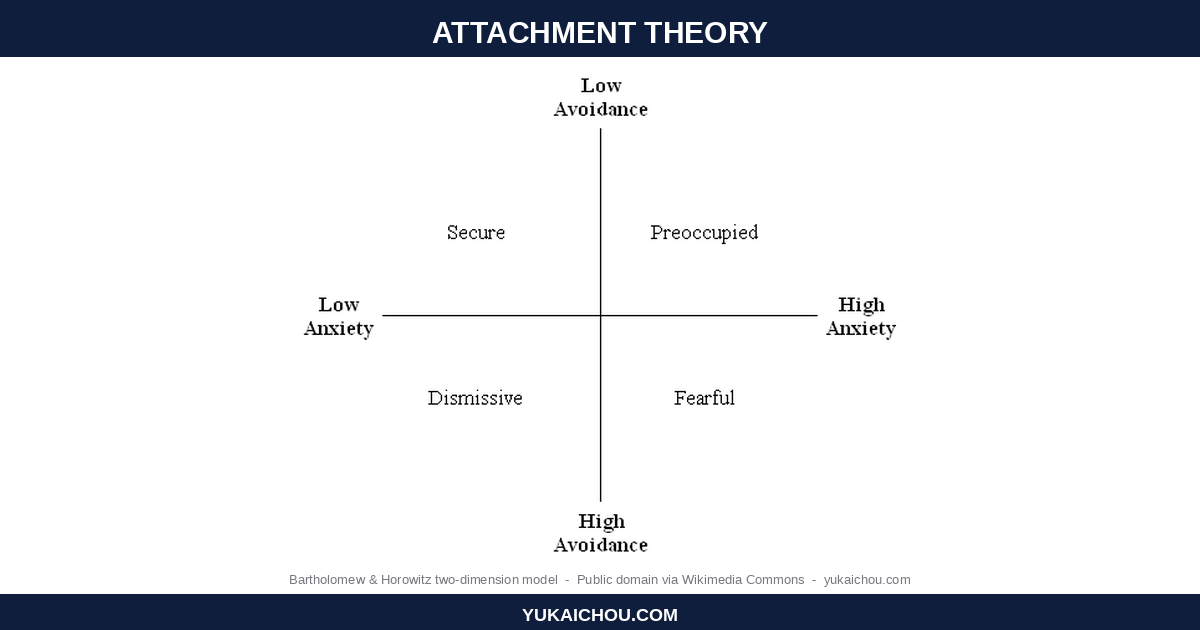
The third pillar came in 1987, when Cindy Hazan and Phillip Shaver published a short newspaper-survey study showing that the Ainsworth three-category distribution reproduced almost perfectly when adults were asked to self-describe their experience of romantic love. Secure adults reported comfort with closeness and interdependence. Anxious adults reported a craving for merger and a terror of abandonment. Avoidant adults reported discomfort with closeness and a preference for self-reliance. Hazan and Shaver’s paper did something neither Bowlby nor Ainsworth had done: it argued explicitly that the same attachment behavioral system that organizes the infant-caregiver bond also organizes adult romantic relationships. That claim opened a floodgate. By the late 1990s, “adult attachment” was a major research area in social and personality psychology, with its own instruments (ECR, ECR-R), its own dimensional models (anxiety and avoidance as two orthogonal axes rather than discrete categories), and its own clinical applications.
So the framework, stripped to its load-bearing claims, says four things. First, there is a dedicated attachment behavioral system in the human infant, evolved for proximity maintenance under threat. Second, this system’s operating parameters are tuned by the infant’s experience of the caregiver’s sensitivity and responsiveness across the first two years. Third, the tuning produces recognizable, measurable individual differences — styles — which are encoded as internal working models of self, others, and relationships. Fourth, those internal working models persist into adulthood and shape the adult’s experience of closeness, support-seeking, conflict, and loss, across romantic, professional, and designed relationships.
For a behavioral designer, the implication is unavoidable: whatever you build that asks a user to engage socially, ask for help, tolerate feedback, or depend on your product to deliver on a promise — you are interacting with a pre-built attachment system that was operational long before you entered the picture. You don’t get to choose whether attachment is in the room. You only get to choose whether your design accounts for it or not.
The Core Findings
Five core findings from 50+ years of attachment research matter for anyone trying to design for humans at scale. These are the parts of the framework that have survived multiple rounds of meta-analytic scrutiny and cross-cultural replication.
1. The attachment system has a measurable normative distribution
In low-risk, middle-class, Western samples using the Strange Situation, the modal distribution sits near 62% Secure, 15% Resistant, 23% Avoidant, with Disorganized appearing in roughly 15% of the same samples when Main’s scoring is applied. These are van IJzendoorn and Kroonenberg’s 1988 meta-analytic numbers from 32 studies, and they’ve held up across subsequent replications. Distributions shift systematically in high-risk samples: in maltreating populations Disorganized climbs over 80%, and in institutional-rearing samples (the Bucharest Early Intervention Project being the cleanest data set) Disorganized and Unclassifiable dominate until the child is moved into a high-quality foster placement.
2. Caregiver sensitivity is the proximal cause of classification
Ainsworth’s own Baltimore sample showed a clear link between the mother’s sensitivity to infant signals in the home (rated on four dimensions: sensitivity-insensitivity, acceptance-rejection, cooperation-interference, accessibility-ignoring) and the Strange Situation classification. Later meta-analyses — de Wolff and van IJzendoorn’s 1997 synthesis of 66 studies is the canonical one — confirmed the sensitivity-security link but pegged the effect size at a moderate r ≈ 0.24, smaller than Ainsworth’s original Baltimore correlation suggested. The sensitivity-Disorganized link runs through a different mechanism: frightened or frightening caregiver behavior (Main’s concept), not low sensitivity per se. The practical consequence is that what builds security in an infant is not perfection but what Allan Schore and Ed Tronick call “good enough” interactive repair — rupture, recognition, and reconnection, as a reliable pattern.
3. Internal working models are the carrier wave from infancy to adulthood
Bowlby coined “internal working model” (IWM) in 1973 to describe the cognitive-affective representation the child builds of (a) how available and responsive caregivers are and (b) whether the self is the kind of being to whom care comes. The two dimensions of the IWM — model of other and model of self — map cleanly onto Bartholomew and Horowitz’s 1991 four-category adult model (Secure: positive self / positive other; Preoccupied: negative self / positive other; Dismissing: positive self / negative other; Fearful: negative self / negative other). IWMs are not conscious beliefs; they’re proceduralized expectations that fire in milliseconds when the attachment system is activated. That’s why attachment style predicts behavior under stress far better than it predicts self-report on a calm day.
4. Continuity exists but is weaker than the framework’s popular image suggests
Fraley’s 2002 meta-analysis of attachment continuity from infancy to age 19 estimated prototype stability at r ≈ 0.39. That is a real, positive, reliably-detected continuity — but it is not destiny. Intervening experiences, particularly the death of a parent, divorce, major illness, or a prolonged relationship with a secure partner or therapist, shift attachment style in measurable ways. The popular “attachment style is set by age 3 and determines the rest of your life” story is not the research. The research is closer to: attachment style is an updatable prior with non-trivial inertia, and the inertia increases the longer the prior goes unchallenged.
5. Attachment style predicts consequential outcomes
Infant security predicts better peer competence in middle childhood, fewer externalizing problems in adolescence, and lower rates of anxiety and depression in adulthood, with effect sizes generally in the small-to-moderate range (d between 0.2 and 0.5 across outcome meta-analyses). Adult attachment style predicts marital satisfaction, conflict resolution strategy, caregiving behavior toward one’s own children, response to psychotherapy, and — particularly relevant for designers — the pattern of support-seeking in workplaces and online communities. Mikulincer and Shaver’s 2016 textbook, Attachment in Adulthood, is the single best synthesis of the adult-attachment findings across hundreds of these studies.
What Bowlby and Ainsworth Got Right
Attachment Theory is now among the most replicated and cross-culturally validated frameworks in developmental psychology. What specifically did Bowlby and Ainsworth get right that earns them this standing?
They reframed the bond as biological, not derivative
The single most important move Bowlby made was refusing to explain the infant-caregiver bond as a secondary consequence of feeding or conditioning. His ethological framing — attachment as a distinct behavioral system, evolved, dedicated, on a par with feeding or reproduction — was the theoretical precondition for everything that followed. Without it, the Harlow monkey data is an anomaly instead of a confirmation. Without it, the Strange Situation is a curiosity instead of a measurement. Without it, adult attachment is a metaphor instead of a continuation. Biology-first framing is what turned attachment from a clinical intuition into a research program.
They built a measurement before arguing the theory at scale
Ainsworth’s Strange Situation was more than clever; it was disciplined. She defined the scoring protocol in enough detail that independent researchers could classify the same infant and agree. Inter-rater reliability for Strange Situation classification sits at κ = 0.80 or higher with trained coders, which is extraordinary for a 20-minute behavioral observation. That reliability is what let thousands of subsequent studies accumulate evidence rather than argue about what “avoidant” even means. The lesson for designers: a framework without a reliable measurement is a vibe. A framework with a reliable measurement is a science.
They distinguished safe haven from secure base
The cleanest conceptual move in Ainsworth’s writing is the distinction between two caregiver functions. Safe haven is the function the caregiver serves when the child is distressed — the destination the child returns to for comfort. Secure base is the function the caregiver serves when the child is calm — the launchpad from which the child explores. A well-functioning attachment figure does both, and a well-functioning relational system alternates fluidly between the two. A caregiver who is only a safe haven produces a clingy, under-exploring child. A caregiver who is only a secure base produces a child who has nowhere to retreat under threat and eventually stops seeking comfort anywhere. For designers, this is the cleanest way to think about relational product affordances: does your product offer safe haven (help, reassurance, rollback) when users fail, AND secure base (exploration, experimentation, progression) when they succeed?
They predicted the Disorganized category before anyone had a name for it
Bowlby’s 1973 volume on Separation explicitly anticipated that the worst developmental outcomes would come not from inconsistent care or rejecting care, but from frightening care — caregivers who were themselves in states of terror, dissociation, or rage. He didn’t have the measurement yet. Main and Solomon’s 1985 Disorganized-category work delivered it, showing that infants whose caregivers exhibit frightened/frightening behavior develop a collapse of attachment strategy: the same figure is simultaneously the source of threat and the biologically-wired solution to threat, which produces approach-avoidance contradictions no coherent strategy can resolve. This is the signature of complex developmental trauma, and the theory predicted it 12 years before the measurement caught up.
They predicted the adult-relationship continuation
Bowlby wrote, in the 1980 Loss volume, that attachment “characterizes human beings from the cradle to the grave” — a claim most developmental psychologists at the time regarded as speculation. Hazan and Shaver’s 1987 paper, Bartholomew and Horowitz’s four-category extension in 1991, and the subsequent flood of adult-attachment research validated the claim empirically. The specific mechanism — internal working models as cognitive-affective priors that shape support-seeking and caregiving across the lifespan — turns out to be one of the more reliable individual-difference constructs in adult personality research, with test-retest reliability comparable to Big Five traits over 2- and 5-year windows.
Where Attachment Theory Falls Apart
A framework that has never been punctured by serious critique is almost certainly wrong in ways nobody has bothered to articulate. Attachment Theory is a framework with an honest record of absorbing critique, revising, and surviving — but only for readers who treat the critiques seriously. Here are the three that a behavioral designer must know before applying attachment thinking at scale.
Critique 1: The cross-cultural distribution problem
The first serious empirical challenge to Ainsworth’s framework came from cross-cultural work in the 1980s. Grossmann and Grossmann’s Bielefeld study found German infants classified as Avoidant (A) at rates approaching 49%, roughly twice the U.S. baseline. Takahashi’s Japanese samples produced the opposite pattern: no infants classified as Avoidant, but Resistant (C) classifications jumped to 32%. Van IJzendoorn and Kroonenberg’s 1988 meta-analysis showed the cross-cultural variance was real and non-trivial.
Three interpretations fought for dominance. The universalist interpretation, defended by van IJzendoorn himself, said the normative distribution (~62% B) reappears across almost all cultures once sample size is adequate, so the theory is basically sound. The cultural-relativist interpretation, associated with the Japanese developmentalist Takie Lebra and others, said the Strange Situation imports Western assumptions about independence that make Japanese infants look “anxious” when they’re actually showing culturally-normal distress at an unusually long separation. The moderate position, which most contemporary attachment researchers now occupy, grants that the framework generalizes cross-culturally at the level of the attachment behavioral system and its function, but that surface-level behavioral expressions and the meaning of “sensitivity” are culturally calibrated.
For a designer, the practical consequence is direct: an attachment-aware design built on U.S. normative distributions will silently mis-read users in other cultural contexts. A feature that reads as “warm, reassuring secure-base provision” in American English may read as “intrusive, over-reassuring, independence-denying” in Japanese or German product contexts. The underlying framework survives, but surface-level affordances do not travel unmodified.
Critique 2: The AAI-vs-self-report measurement schism
The second critique cuts deeper. There are two dominant adult-attachment measurement traditions, and they barely correlate with each other. The Adult Attachment Interview (AAI), developed by Mary Main and George Kaplan in the mid-1980s, is a semi-structured 90-minute interview that probes the adult’s memories of their own childhood attachment figures. It is coded for coherence of discourse, not content of memory. The Experiences in Close Relationships (ECR / ECR-R) tradition, developed by Brennan, Clark, Shaver, and Fraley in the 1990s, is a self-report instrument that measures two continuous dimensions: attachment-related anxiety and attachment-related avoidance.
Roisman, Holland, Fortuna, Fraley, Clausell, and Clarke’s 2007 meta-analysis of 10 studies looking at the AAI-ECR correlation found a mean r in the neighborhood of 0.09. That is not a small correlation — that is near zero. The two “attachment” measures, in other words, are not measuring the same construct. The AAI likely measures what Fraley and Shaver call “semantic” or autobiographical-coherence attachment representations. The ECR-R likely measures “episodic” or current-relationship attachment representations. Both are valid, both predict consequential outcomes, but they are not interchangeable.
A designer who reads popular attachment-style content is almost always getting the self-report / ECR version, and that version does not map neatly onto the developmental-outcome data that gives attachment theory its foundational credibility. Claims like “anxious attachment is caused by inconsistent caregiving” are talking about the AAI tradition; claims like “take this 20-question quiz to find your attachment style” are talking about the ECR tradition. Conflating them — which every self-help article on the internet does — is the single most common error in popular attachment writing.
Critique 3: The continuity and Disorganized-category challenges
The third critique has two strands. The first strand is the continuity question discussed above: Fraley’s prototype-stability estimate of r ≈ 0.39 from infancy to age 19 is real but modest, and the “attachment style is largely fixed in childhood” narrative that circulates in popular psychology is stronger than the data supports. Attachment style is updateable, and interventions that update it (therapy, stable long-term partnerships, parenting one’s own children with conscious reflection) have measurable effects. For a designer, this matters because the prior is not the person — an anxiously-attached user who has five years of reliable secure-base experiences with your product may present behaviorally as secure within your product context, even if their general attachment style hasn’t globally shifted.
The second strand is the Disorganized-category controversy. When Main and Solomon introduced the D category in 1985, they described it as a discrete fourth type. Subsequent work, particularly from Marinus van IJzendoorn and Carlo Schuengel, argued that D is better conceptualized as a dimensional breakdown in attachment strategy that can occur in any infant given sufficient frightening-caregiver input, rather than a stable type. A 2018 re-analysis by Marije Verhage and colleagues argued that D-category reliability across coding teams is lower than the original A/B/C reliability, which raises real measurement concerns. For clinicians and policy-makers using attachment classifications to guide child-protective decisions, this is a serious issue — a Disorganized classification carries weight, and the reliability of that classification matters. Most contemporary attachment researchers treat D as a valid but inherently more measurement-noisy category than A, B, or C, and design their studies accordingly.
The Brain on Attachment
Attachment Theory started as an ethological argument in the 1950s. In the last 25 years it has become a neuroscience. The biological machinery that implements the attachment behavioral system is now partially mapped, and the map reinforces the framework’s original claim that attachment is a primary system with dedicated physiology, not a by-product of other drives.
Oxytocin, vasopressin, and the pair-bonding circuitry
Work by Sue Carter on prairie voles in the 1990s, extended to humans by Markus Heinrichs, Ruth Feldman, and others, established that oxytocin (OT) and arginine vasopressin (AVP) are the primary neuropeptides regulating pair-bond formation and maintenance. OT release during skin contact, eye contact, and synchronous parent-infant interaction is the biochemical signature of “safe haven” caregiving. Individual differences in OT receptor density, particularly in the nucleus accumbens and ventral pallidum, predict pair-bonding capacity in voles and are associated with attachment-relevant behavior in humans. Ruth Feldman’s Israeli cohort studies show that maternal OT levels during pregnancy predict the mother’s sensitivity in the first six months of the infant’s life, and the infant’s own OT levels at six months predict observer-rated security at age three.
The amygdala, hippocampus, and threat-regulation
James Coan’s 2006 handholding fMRI study is the cleanest demonstration of attachment’s neural function. Married women were threatened with mild electric shocks in three conditions: holding their husband’s hand, holding a stranger’s hand, or holding no one’s hand. Threat-responsive brain regions — including the hypothalamus, anterior insula, and dorsolateral prefrontal cortex — showed systematically reduced activation under the spousal-hand condition, with the largest reduction in the most securely-partnered women. The attachment figure literally dampens threat reactivity at the level of the brain. This is the neural signature of “safe haven.” It’s why a co-regulating partner (or, in the workplace, a psychologically safe manager) produces measurable stress-hormone suppression even when nothing about the external threat has changed.
The HPA axis and attachment-related stress regulation
The hypothalamic-pituitary-adrenal (HPA) axis is the main endocrine stress-response system, with cortisol as its output. Attachment style predicts HPA reactivity in predictable ways: infants with Disorganized classification show elevated baseline cortisol and exaggerated cortisol response to the Strange Situation, securely attached infants show moderate reactivity with efficient recovery, and avoidantly attached infants show a pattern sometimes called “dissociated” reactivity — behavioral calm paired with elevated cortisol, suggesting the external performance of regulation without internal regulation. Megan Gunnar’s work through the 1990s and 2000s is the canonical research program on this. For designers, the relevance is that behavioral cues alone under-report what’s happening physiologically in avoidantly attached users — they can look fine on your dashboard and still be running hot on every physiological index.
Internal working models as predictive-processing priors
The most recent wave of attachment neuroscience, associated with Pascal Vrtička, James Coan, Ed Tronick, and the Karl Friston predictive-processing framework, treats internal working models as priors in a Bayesian brain architecture. In this framing, the attachment behavioral system is a prediction engine: given an ambiguous social signal, the brain predicts — based on the accumulated history of caregiver response — how available the other party is likely to be and how costly reaching out is likely to be. Secure priors produce approach behavior with moderate prediction error. Avoidant priors produce suppression of the attachment system’s output to reduce anticipated prediction error from expected unavailability. Anxious priors produce hyperactivation of the attachment system’s output to maximize the probability of eliciting response under expected inconsistency. The classical attachment strategies turn out to be compressible as three different Bayesian policies over the same observational data. This is a useful way for designers to think about the problem because it explains why the same product affordance — say, an optional chat-with-a-human button — produces wildly different usage patterns across attachment styles.
Attachment Theory vs Other Theories
Attachment Theory occupies a specific ecological niche among behavioral-science frameworks. It overlaps with several neighbors, and knowing where the overlaps are and where they stop is essential for designers who don’t want to end up running three frameworks that secretly describe the same thing.
Attachment vs Self-Determination Theory (SDT)
Self-Determination Theory (Deci & Ryan) posits three innate psychological needs: autonomy, competence, and relatedness. Attachment Theory is, in effect, a specialized account of the relatedness need — how it develops, how it goes wrong, and what its failure modes look like. SDT’s relatedness construct is thinner than attachment’s: SDT tells you the need exists and that frustrating it harms wellbeing. Attachment Theory tells you what the need looks like over developmental time, what individual differences in its expression look like, and which biological and cognitive mechanisms implement it. The two frameworks are complementary, not competing: if you’re designing for intrinsic motivation, SDT is the right frame; if you’re designing for relational experience at scale, attachment is the right frame; most mature products need both.
Attachment vs Cialdini’s Principles of Influence
Cialdini’s six principles (reciprocity, commitment, social proof, authority, liking, scarcity) are tactical; attachment is strategic. Cialdini tells you which influence levers produce short-term compliance. Attachment tells you which users will be disproportionately responsive to which levers, and at what long-term cost. Anxious users are disproportionately responsive to reciprocity and commitment levers (because those levers are offers of relational continuity). Avoidant users are disproportionately responsive to authority and scarcity levers (because those levers don’t require emotional disclosure). Secure users are moderately responsive to all six but the least manipulable by any single one. A designer who knows their user population’s attachment distribution can predict which Cialdini levers will over-perform and which will burn trust in their context.
Attachment vs Bartle’s Player Types
Bartle’s four player types (Achievers, Explorers, Socializers, Killers) describe what users want to do inside a game or product. Attachment style describes how they want to be related to while doing it. The two taxonomies are orthogonal: a securely-attached Achiever, an anxiously-attached Achiever, and an avoidantly-attached Achiever all pursue achievement, but they want achievement recognition, feedback, and peer comparison delivered in very different ways. A designer who segments only on Bartle is going to over-serve their achievement-layer and under-serve their relational layer.
Attachment vs Social Cognitive Theory
Bandura’s Social Cognitive Theory emphasizes observational learning, self-efficacy, and reciprocal determinism between person, environment, and behavior. Bandura’s “outcome expectancies” and Bowlby’s “internal working models” converge at 80%: both are cognitive priors that shape how a person reads an ambiguous social situation. They diverge on what forms them. Bandura emphasizes modeling and vicarious reinforcement. Bowlby emphasizes direct relational experience, particularly under conditions of distress. In practice, the two mechanisms likely operate in parallel. A designer building a community product should expect both to be in play.
Attachment vs Reiss’s 16 Basic Desires / Maslow’s Hierarchy
Steven Reiss’s 16 desires framework puts “social contact” and “family” as two of the 16. Maslow’s hierarchy puts “belonging” at level three. Both frameworks point at the same terrain that attachment covers in far greater resolution. If Reiss or Maslow is the map, attachment is the street view.
Attachment Theory in the Real World
Attachment research that stopped at the lab wouldn’t earn its place on this list. What makes the framework worth a behavioral designer’s attention is that attachment-style differences produce reliably measurable outcome differences across the domains where designers actually work. Four of those domains matter most.
The workplace: attachment at scale inside organizations
Mario Mikulincer and collaborators have built a substantial body of research on adult attachment in work contexts. The pattern is consistent across studies: secure employees show more constructive conflict resolution, better help-seeking behavior, more generous peer support, and lower rates of burnout. Avoidant employees show higher performance in autonomous individual-contributor roles but lower performance in roles requiring interdependence, and they report lower subjective engagement even when their objective metrics look fine. Anxious employees show high performance when tightly managed with frequent positive reinforcement but sharp drops when feedback is sparse or ambiguous, and they produce disproportionate manager-attention consumption per unit of output.
The managerial-attachment literature — work by Tiffany Keller Hansbrough, Ronit Kark, and others — maps leader attachment style onto leadership behavior. Secure leaders are more likely to practice what the literature calls “transformational” leadership (vision + individualized consideration). Avoidant leaders over-use “transactional” leadership (clear exchanges, minimal emotional content). Anxious leaders oscillate between over-involvement and withdrawal in ways that destabilize their teams. For a designer building HR tools, engagement platforms, or performance-management software, the attachment-style distribution of the user base is the single biggest variable controlling which features will land and which will become unused clutter.
Education: attachment in teacher-student relationships
The best synthesis of attachment in classrooms is Verschueren and Koomen’s work on teacher-student relationship quality. Their results track the Ainsworth pattern into middle-childhood settings: teachers who function as secure bases produce students with better self-regulation, more academic risk-taking, and fewer externalizing behaviors. When the teacher-student relationship resembles a safe haven (comfort under distress) without the secure base (exploration support), students show learned helplessness patterns. When it resembles a secure base without safe haven, students show the avoidant pattern — academic autonomy paired with suppressed help-seeking. For educational-product designers (EdTech especially), this is why a “help” button is not a feature; it is a relational affordance whose use rate is a function of the user’s attachment history with previous educational figures as much as of your UI design.
Digital product and UX: attachment in designed relationships
Churn patterns in consumer products align with attachment-style-plausible signatures in ways that most product teams don’t notice because they don’t slice their cohorts that way. Three patterns are common enough to describe in general terms. First, anxious churn: users who engage heavily in the first two weeks, request significant customer support, respond positively to reassurance, and then churn catastrophically after a single negative interaction. Second, avoidant churn: users who engage solidly but shallowly, never use social features, never respond to community prompts, and silently stop logging in with no support contact. Third, secure stable usage: users who engage moderately, use the help resources when needed, tolerate occasional bugs without abandoning, and are disproportionately represented in the long-term retention cohort.
Designers who segment churn by these plausibly-attachment-shaped patterns can deploy different retention interventions to each pattern. Anxious-pattern users benefit from consistent, predictable communication and from affordances that make support-seeking feel safe rather than weak. Avoidant-pattern users benefit from affordances that don’t require relational disclosure — clean documentation, async help, no “welcome back!” notifications. Treating both populations with the same “we’re a family!” retention playbook underserves both.
Healthcare and therapeutic alliance
The therapeutic-alliance literature is the most rigorous applied-attachment domain. Meta-analyses consistently find that the quality of the therapeutic relationship predicts outcomes across therapy modalities with an effect size (r ≈ 0.27) comparable to or larger than the specific-technique effect. Patient attachment style moderates this: avoidant patients do better with therapists who match their preference for emotional distance in the early sessions and gradually shift toward attunement; anxious patients do better with therapists who set and hold clear boundaries to prevent the therapeutic relationship from becoming the anxious attachment figure; secure patients do well across most therapist styles. For designers of mental-health products and coaching platforms, attachment-informed personalization of the coach-user match is probably the single highest-impact intervention most products haven’t tried yet.
The Elephant in the Room
Everything above is the careful, accurate, research-grounded version of attachment theory. But there is a version of “attachment theory” loose in the cultural conversation right now that is the research version’s evil twin, and any designer using attachment thinking professionally has to notice the difference.
The popular version — the one that lives in TikTok therapy-speak, dating-advice content, and the “what’s your attachment style?” quizzes — does three things the research doesn’t. First, it treats attachment style as a stable identity category, the way astrology treats sun signs. Second, it treats style as the primary explanation for any relational difficulty (“he’s avoidant, that’s why he didn’t text back”). Third, it treats insecure styles as pathologies to be healed rather than as adaptive responses to the relational conditions in which they developed.
None of this is the research. Attachment style is not an identity category; it is a behavioral prior that updates with experience. It is not the primary explanation for every relational event; it is one contributing variable alongside context, mood, cultural script, and the other person’s behavior. And insecure styles are not pathologies — they are, in the phrase Dan Siegel uses, coherent responses to incoherent environments. An avoidant attachment strategy that was lifesaving in a household where emotional expression was punished is not a dysfunction. It is an adaptive solution to a hard problem, which may or may not still be the right solution in a different environment.
Why does this matter for a designer? Because designers who absorb the popular version of attachment accidentally design against their users. They build onboarding that assumes users want emotional warmth and pathologize users who don’t respond to it. They build community features that assume ideal participation looks like secure relational behavior and inadvertently shame the 40% or so of users whose attachment history makes that kind of participation effortful. They deploy attachment-quiz segmentation as a personality-test marketing ploy without thinking about what it means to tell a user their relational capacity is limited.
The responsible designer uses attachment as an explanatory lens for population-level patterns and as a source of hypotheses about product affordances, not as an identity label to assign to individual users. Secure-base and safe-haven affordances are design goals; attachment style is a useful hypothesis about why some users consume those affordances more than others, not a license to segment the user base into A/B/C/D buckets for marketing-automation purposes.
How to Apply Attachment Theory with the Octalysis Framework

The Octalysis Framework is the system I built to describe the eight Core Drives that motivate human behavior. Attachment Theory maps most directly onto Core Drive 5: Social Influence & Relatedness — but to leave it there is to miss three-quarters of what the mapping offers. Attachment is not a feature of CD5. Attachment is the substrate on which CD5 runs, and understanding the substrate changes how every other Core Drive lands.
Attachment and Core Drive 5: Social Influence & Relatedness
CD5 is the core drive activated by friends, mentors, public recognition, social comparison, and belonging signals. The Game Techniques associated with CD5 — Mentorship, Social Treasure, Social Prods, Conformity Anchor, Group Quest — all assume that the user will process the social signal through a functional attachment system. For a securely-attached user, a “Mentor” affordance is received as what it is: an offer of guidance from a trusted authority figure. For an anxiously-attached user, the same affordance activates the attachment system harder than intended — they may idealize the mentor, over-consume their attention, and then feel devastated when the mentor’s availability inevitably fluctuates. For an avoidantly-attached user, the same affordance is read as a threat to autonomy and refused, even when the substantive benefit is clear.
The design implication is that CD5 Game Techniques need attachment-aware variants, not a single flavor. A Mentorship feature that works for secure users will under-serve the anxious population and drive away the avoidant population unless it offers (a) low-commitment introductory interactions (safe for avoidant onboarding), (b) explicit availability and boundary signals (safe for anxious regulation), and (c) a clear path to deeper engagement (safe for secure progression).
Attachment and Core Drive 3: Empowerment of Creativity & Feedback
CD3 is the drive to create, experiment, and receive meaningful feedback on the result. The attachment-theoretic concept of secure base maps directly onto CD3 affordances. A secure base — in product terms, a reliable, non-punishing baseline to which the user can return after creative risk — is the precondition for creative exploration. Rollback buttons, sandbox modes, undo functionality, drafts that don’t auto-publish: these are not UX niceties. They are attachment-theoretic secure-base affordances that make CD3 activation possible for users whose attachment history makes creative risk feel costly.
Attachment and Core Drive 8: Loss & Avoidance
CD8 is the drive to avoid aversive outcomes — loss, penalty, sunk cost. Anxiously-attached users run CD8 permanently in the background at slightly elevated intensity, because abandonment-anxiety is CD8 pointed at the relational layer. Loss-framed messaging (“You’ll lose your streak if you don’t log in!”) hits anxiously-attached users roughly twice as hard as it hits securely-attached users, and three times as hard as avoidantly-attached users — who, when threatened with loss, are more likely to disengage entirely than to comply. A CD8-heavy product that’s optimizing for the median user is silently running a high-CD8 design over a population where 15-20% of the users are experiencing it as relational threat and another 20-25% are opting out of the relationship altogether.
Attachment and safe haven vs secure base as White-Hat CD5 design
The distinction I find most useful for design practice is Ainsworth’s own: safe haven versus secure base. A well-designed relational product provides both. Safe-haven affordances are the ones users reach for when something goes wrong: human support, rollback, reassurance copy, error-recovery flows that don’t make the user feel punished for the error. Secure-base affordances are the ones users reach for when things are going well: exploration features, progression systems, creative tools, social discovery that assumes competence rather than neediness. A product with only safe-haven affordances feels infantilizing; users feel surveilled, over-helped, and over-coddled. A product with only secure-base affordances feels cold; users feel like failures when things go wrong and churn silently. The cleanest heuristic: audit your product for both, and make sure the ratio of safe-haven to secure-base affordances roughly matches the attachment distribution of your actual user base, which is probably richer in insecurity than your team’s internal-dogfooding intuitions assume.
The one-line hook
If you remember one sentence from this section, remember this: Attachment Theory is the substrate on which Core Drive 5 runs, and a product that gets CD5 wrong is almost always a product that got attachment wrong first.
Practical Steps to Apply Attachment Theory
If the framework above reads as overwhelmingly theoretical, here is the practitioner’s distillation. Five concrete steps a behavioral designer can take in the next sprint, whether you’re shipping a consumer product, running a workplace gamification, or designing an educational curriculum.
Step 1: Audit your product for safe-haven and secure-base affordances, separately
Take the ten most-used user-facing surfaces in your product. For each, answer two questions. First, if a user arrives here in distress (confused, frustrated, embarrassed by a prior error), does this surface function as a safe haven — i.e., does it offer reassurance, rollback, or human contact? Second, if a user arrives here calm and competent, does this surface function as a secure base — i.e., does it offer exploration, progression, or creative work? Most product audits I run find a significant imbalance: the product is heavy on secure-base affordances (growth, progress, achievement) and thin on safe-haven affordances (rollback, reassurance, human contact). The fix is rarely expensive. A single “we have your back — chat with support” affordance on a high-failure surface frequently moves the churn curve more than a feature release.
Step 2: Segment retention cohorts by relational pattern, not by demographic
Build three retention views of your user base. The first shows users with high early-intensity engagement, early support contact, and elevated churn risk after a negative event — your anxious-pattern cohort. The second shows users with moderate shallow engagement, no social-feature use, and silent churn risk — your avoidant-pattern cohort. The third shows everyone else, approximately your secure-pattern cohort. Do not label these cohorts “anxious” and “avoidant” in your marketing tools. Use internal-only names if you must, because the labels are hypotheses about a behavioral signature, not diagnoses of individuals. But design separate retention interventions for the anxious-pattern and avoidant-pattern cohorts. A “come back, we miss you!” email that works for the anxious-pattern cohort actively drives the avoidant-pattern cohort further away.
Step 3: Write two versions of every social feature’s copy
For any feature that offers a social affordance — a mentor introduction, a group chat invitation, a buddy system, a community prompt — write two copy variants. The warm variant uses relational language (“Your mentor is excited to meet you!”). The autonomous variant uses functional language (“Your assigned mentor has reviewed your goals. Book a session when ready.”). A/B test them with your retention cohorts as the segmentation variable. In my experience, the warm variant outperforms in anxious-pattern cohorts by 20-40%; the autonomous variant outperforms in avoidant-pattern cohorts by roughly the same amount; secure-pattern cohorts show little difference, which is itself informative. You may need only one variant live at a time — but shipping the wrong one to the wrong population is the single most common relational-design mistake I see.
Step 4: Design your error and failure surfaces as attachment events
Every moment a user sees an error, loses data, fails a quest, or faces a payment decline is an attachment event. The product has stopped being reliable, the user is in distress, and the product’s next surface will function either as safe haven or as additional threat. Too many products treat error surfaces as purely informational (“Error 503: Service Unavailable. Please try again later.”). That copy is correct but relationally illiterate. An attachment-aware error surface acknowledges the rupture, names the rollback path, and telegraphs reliable-return. The template I use: “Something went wrong. We’re looking into it. Your work is saved at [timestamp]. You can refresh, or come back in 5 minutes — we’ll be here.” That is a safe-haven affordance. It costs three lines of copy and materially reduces rage-quit probability on the next error.
Step 5: Train your team to notice their own attachment defaults
This is the step designers resist and that changes the most downstream. The product you ship reflects your team’s attachment defaults. A team with a heavy avoidant lean builds products with thin support surfaces, dense documentation, and a distaste for “hand-holding” that reads to many users as cold. A team with an anxious lean builds products with over-frequent notifications, excessive celebration copy, and relational affordances that feel like surveillance. A securely-leaning team builds products that offer differentiated support without performing warmth. None of this is a pathology — it’s an artifact of who the team hired and who self-selected into the role. But if the whole team shares the same relational default, the product will ship for people who share that default and under-serve everyone else. Running a quarterly exercise in which each designer articulates what relational style their default UI copy encodes is one of the cheapest high-impact quality practices I know.
Closing Thoughts
Attachment Theory is among the older behavioral-science frameworks that still earns its place in a designer’s active toolkit. It is older than most gamification, older than the field of user experience, older than the Octalysis Framework I use to describe motivation. And it keeps earning its place because every new generation of designers rediscovers, usually by shipping something that fails, that users are not empty motivation slates. They arrive pre-loaded with relational priors. Those priors were formed before the product team was hired. They will shape how the product is received, regardless of whether the product team accounts for them or not.
The responsible use of attachment thinking in design is neither the dismissive version (“attachment styles aren’t real, everyone just responds to incentives”) nor the pop-psychology version (“this user is anxious, let’s target them with abandonment-fear copy”). It is the middle path: attachment style as a population-level lens that tells you what failure modes to expect, what affordances to build, and which assumptions your product is silently running on top of. Bowlby wrote that attachment “characterizes human beings from the cradle to the grave.” That’s not a clinical claim. It is, for anyone designing for other humans, a design constraint. The sooner you internalize it, the better the things you ship.
If this framework is new to you, read Mikulincer and Shaver’s Attachment in Adulthood before you read anything else. If you’ve been working with the pop-psychology version, put it down and pick up Fraley’s shorter overview papers. And if you’re building a relational product — a community, a coaching platform, a workplace-engagement tool, a dating app — start the next sprint with a safe-haven audit. It will surprise you how much of what looks like a product problem is actually a relational problem the product was never designed to receive.
Frequently Asked Questions
What is attachment theory in simple terms?
Attachment theory is the scientific account of how infants form a specific emotional bond to a caregiver and how that early bond shapes expectations about closeness and support-seeking for the rest of life. John Bowlby proposed it in 1969. Mary Ainsworth turned it into a testable protocol in 1978. Together, they argued that attachment is a primary biological system, not a by-product of feeding, and that individual differences in how the bond functions — roughly grouped as secure, anxious, avoidant, and disorganized styles — persist into adult relationships.
What are the four attachment styles?
The four attachment styles are Secure, Anxious-Preoccupied, Dismissing-Avoidant, and Disorganized (sometimes called Fearful-Avoidant). Secure combines comfort with closeness and comfort with independence. Anxious-Preoccupied wants closeness and fears abandonment. Dismissing-Avoidant prefers self-reliance and suppresses need for others. Disorganized holds both a longing for connection and a fear of it, typically arising from frightening or unpredictable early caregiving.
Who created attachment theory?
John Bowlby, a British psychoanalyst, originated attachment theory through his trilogy Attachment (1969), Separation (1973), and Loss (1980). Mary Ainsworth, an American developmental psychologist and Bowlby’s longtime collaborator, created the Strange Situation Procedure in 1969 that made attachment classification empirically measurable. Mary Main added the Disorganized category in 1985. Cindy Hazan and Phillip Shaver extended the framework to adult romantic relationships in 1987.
Is attachment style fixed, or can it change?
It can change. Attachment style has real but modest continuity: Fraley’s 2002 meta-analysis estimates prototype stability at roughly r = 0.39 from infancy to age 19. Major life events — a sustained secure relationship, parenting, therapy, the loss of a caregiver — shift attachment style in measurable ways. The “your attachment is set in childhood and determines the rest of your life” story is stronger than the research supports.
How is attachment style measured in adults?
Two main instruments dominate. The Adult Attachment Interview (AAI), developed by Mary Main and colleagues in the mid-1980s, is a 90-minute semi-structured interview scored on coherence of discourse about early attachment figures. The Experiences in Close Relationships-Revised (ECR-R) is a self-report scale measuring two continuous dimensions: attachment-related anxiety and attachment-related avoidance. The two measures correlate surprisingly weakly with each other (mean r near 0.09), so they likely capture different aspects of attachment representation.
What is the Strange Situation?
The Strange Situation Procedure is Mary Ainsworth’s 1969 laboratory protocol for classifying infant attachment. It consists of eight three-minute episodes in which a mother and her 12-to-18-month-old infant enter an unfamiliar room, encounter a stranger, experience two separations, and reunite with the mother. The infant’s behavior across separations and reunions is coded by trained raters into categories (Secure, Insecure-Avoidant, Insecure-Resistant, and, since Main & Solomon 1985, Disorganized).
What is an internal working model?
Internal working models (IWMs) are Bowlby’s 1973 term for the cognitive-affective representations the child builds of caregiver availability and the self’s worthiness of care. IWMs are not conscious beliefs; they are proceduralized priors that fire in milliseconds when the attachment system activates. They shape how the person reads ambiguous social signals, predicts others’ availability, and regulates support-seeking under stress, well into adulthood.
Why does attachment matter for product and UX design?
Users do not arrive at a product as blank motivation slates. They arrive with attachment-shaped priors about whether closeness is safe, whether support will come when asked for, and whether the product can be relied on under stress. Those priors shape how every social feature, error surface, onboarding flow, and support interaction is received. A product designed without attachment-awareness silently mis-serves roughly 40% of its user base — the insecure portion — by assuming everyone shares the designer’s relational defaults.
How does attachment theory relate to Core Drive 5 in Octalysis?
Core Drive 5 — Social Influence & Relatedness — is the Octalysis drive activated by friends, mentors, public recognition, and belonging signals. Attachment Theory is the substrate on which CD5 runs. A CD5 feature (mentorship, social proof, group quest) lands very differently on securely, anxiously, and avoidantly attached users. Designing CD5 affordances without attachment-awareness is the single most common cause of relational features that under-perform across a significant portion of the user base.
What are the main critiques of attachment theory?
Three critiques matter. First, cross-cultural distributions vary (Germany skews avoidant, Japan skews resistant) in ways that suggest the Strange Situation imports Western assumptions about independence. Second, the AAI and self-report ECR-R traditions correlate at only around r = 0.09, meaning “attachment style” measured two different ways is not the same construct. Third, decade-over-decade continuity is real but modest (r ≈ 0.39), so the popular “fixed in childhood” narrative overstates the data. The framework survives all three, but only if used as a population-level lens, not as an individual-level identity label.
References
- Ainsworth, M. D. S., Blehar, M. C., Waters, E., & Wall, S. (1978). Patterns of attachment: A psychological study of the Strange Situation. Erlbaum.
- Bartholomew, K., & Horowitz, L. M. (1991). Attachment styles among young adults: A test of a four-category model. Journal of Personality and Social Psychology, 61(2), 226–244.
- Bowlby, J. (1969). Attachment and loss, Vol. 1: Attachment. Basic Books.
- Bowlby, J. (1973). Attachment and loss, Vol. 2: Separation: Anxiety and anger. Basic Books.
- Bowlby, J. (1980). Attachment and loss, Vol. 3: Loss: Sadness and depression. Basic Books.
- Brennan, K. A., Clark, C. L., & Shaver, P. R. (1998). Self-report measurement of adult attachment: An integrative overview. In J. A. Simpson & W. S. Rholes (Eds.), Attachment theory and close relationships (pp. 46–76). Guilford.
- Coan, J. A., Schaefer, H. S., & Davidson, R. J. (2006). Lending a hand: Social regulation of the neural response to threat. Psychological Science, 17(12), 1032–1039.
- De Wolff, M. S., & van IJzendoorn, M. H. (1997). Sensitivity and attachment: A meta-analysis on parental antecedents of infant attachment. Child Development, 68(4), 571–591.
- Feldman, R. (2017). The neurobiology of human attachments. Trends in Cognitive Sciences, 21(2), 80–99.
- Fraley, R. C. (2002). Attachment stability from infancy to adulthood: Meta-analysis and dynamic modeling of developmental mechanisms. Personality and Social Psychology Review, 6(2), 123–151.
- Hazan, C., & Shaver, P. (1987). Romantic love conceptualized as an attachment process. Journal of Personality and Social Psychology, 52(3), 511–524.
- Main, M., & Solomon, J. (1985). Discovery of an insecure-disorganized/disoriented attachment pattern. In T. B. Brazelton & M. W. Yogman (Eds.), Affective development in infancy (pp. 95–124). Ablex.
- Mikulincer, M., & Shaver, P. R. (2016). Attachment in adulthood: Structure, dynamics, and change (2nd ed.). Guilford.
- Roisman, G. I., Holland, A., Fortuna, K., Fraley, R. C., Clausell, E., & Clarke, A. (2007). The Adult Attachment Interview and self-reports of attachment style: An empirical rapprochement. Journal of Personality and Social Psychology, 92(4), 678–697.
- van IJzendoorn, M. H., & Kroonenberg, P. M. (1988). Cross-cultural patterns of attachment: A meta-analysis of the Strange Situation. Child Development, 59(1), 147–156.
- Verhage, M. L., Schuengel, C., Madigan, S., Fearon, R. M. P., Oosterman, M., Cassibba, R., Bakermans-Kranenburg, M. J., & van IJzendoorn, M. H. (2016). Narrowing the transmission gap: A synthesis of three decades of research on intergenerational transmission of attachment. Psychological Bulletin, 142(4), 337–366.
Related Reading
- Self-Determination Theory: An S-Tier Behavioral Designer’s Guide — the framework attachment theory extends at the relatedness layer.
- Cialdini’s Six Principles of Persuasion — tactical influence, with attachment style as the moderator of which principles over-perform.
- Emotional Intelligence — the skill layer that interacts with attachment style in real-world relationships.
- Learned Helplessness — what happens when safe-haven affordances fail repeatedly.
- The Octalysis Framework — the full Eight Core Drives map on which CD5 sits.
If this guide was useful, here is what to do with it.
Attachment is one of forty-plus behavioral constructs I teach at Octalysis Prime — the design school where the safe-haven, secure-base, and CD5-substrate scaffolding above is workshopped against your actual product. If you want the version of this material that comes with case studies, audit templates, and direct review of your wireframes, that is the path. Start at the Octalysis Framework to see how CD5 (Social Influence & Relatedness) integrates with the other seven Core Drives that attachment style silently moderates.
If you are leading a team that is about to ship an onboarding flow, a mentorship feature, an error-recovery surface, or a “we miss you!” retention campaign, you can book a working session with me directly. The audit format I run with clients is exactly the safe-haven vs. secure-base × anxious / avoidant / secure cohort lens above, applied to your three highest-friction relational surfaces. Most teams find at least one relational mis-match in their onboarding or churn-recovery flow they had not seen.
For the rest of the behavioral-design corpus — including the neighbouring constructs (Self-Determination Theory, Mindset Theory, Emotional Intelligence, Learned Helplessness) that should sit alongside attachment in any serious relational-design system — the Behavioral Framework Library indexes every pillar.