

The leaderboard motivates 15% of your users. The other 85% open the screen, see they’re ranked 4,212th, and quietly close the tab. Your boss asks why engagement dropped after you launched gamification. You don’t have a good answer, because the gamification wasn’t the problem. The gamification player segmentation was the problem, and you skipped it.
I’ve watched this scene play out for twenty years. Every gamification project I audit that’s underperforming has the same upstream defect: somebody picked Core Drives before they figured out who they were designing for. Player analysis isn’t a “nice to have” step you do after the brand colors. It’s the load-bearing wall. Get it wrong and your Core Drive selection is wrong, your game techniques are wrong, your onboarding is wrong, and your retention curve will tell on you within thirty days.
The good news: the Octalysis Framework gives you a clean map for this. Four segmentation challenges, each with a different decision rule. Once you can name them, you stop confusing one for the others.
⚡ Speed Run Notes
- Most gamification projects fail at the player analysis step, not at the game-technique step. Wrong segmentation cascades into every later choice.
- The first fork: are your segments doing the same actions for different reasons (player types) or fundamentally different actions (user groups)? Marketplaces, classrooms, and kid-products live in the second category.
- Player-type axes must connect to business metrics. Personality and learning-style axes don’t. If two types respond to the same triggers, they’re really one type wearing two hats.
- Culture sets your Black Hat tolerance. Mainland China sustains pressure-driven design for years; Japan’s duty orientation breaks any monetization built on user laziness.
- Gender is a weaker signal than profession. Self-selected behavior beats culture beats personality beats demographics, in that order.
- For small launches, niche relatability (“80% of Taiwanese-American gamification entrepreneurs joined”) beats raw volume every time. Scarcity flips marketing into a favor users want to do.
Why I’m the one writing this
I built the Octalysis Framework around the question “what motivates this specific human?” rather than “what works for users in general.” Over the last decade I’ve used it to segment players for clients ranging from MrBeast and LEGO to financial-services giants doing SEC compliance training, plus government clients with tens of millions of citizens to engage. The patterns in this post are the ones that survive across that range.
I wrote about the framework itself in Actionable Gamification, but segmentation is the part most readers underweight on first pass. The expensive failures I see in consulting almost never trace back to a bad Core Drive choice. They trace back to the player analysis the team didn’t do because nobody told them it was a discrete step.
The First Fork: Player Types vs. User Groups

Before you do anything else, answer one question: are these people doing the same things or different things?
Player Types means same desired actions, different motivations. A basketball game has two teams; both score and defend, just for different reasons. An e-commerce site has shoppers who all browse and buy, but some are deal-hunters (Core Drive 6, Scarcity), some are collectors (Core Drive 4, Ownership), some are social shoppers (Core Drive 5, Social Influence). Same loop, different motivational triggers. The design move is to pick the loop and modulate the triggers per type.
User Groups means fundamentally different desired actions. A marketplace’s buyers and sellers do completely different things. A children’s educational product has kids who use it and parents who buy it. A classroom has teachers and students operating on opposite sides of the table. The design move here is heavier: you potentially run separate Octalysis designs for each group, sometimes across all four experience phases (Discovery, Onboarding, Scaffolding, Endgame).
The trap I see most often is teams treating User Groups as Player Types. They build one product, slap a leaderboard on it, and wonder why retention is bimodal. Of course it’s bimodal. Half your users wanted to do something completely different from the other half, and you designed for the loud half.
The pragmatic shortcut for User Groups is to identify which group dominates which phase. For a children’s product, parents own Discovery (if they refuse, the kid never sees the product), but children own everything from first session onward. Design Discovery for the parent. Design the rest for the child. The same logic applies to B2B SaaS (decision-makers in Discovery, daily users in Scaffolding), healthcare (insurers and caregivers gate Onboarding, patients live in Endgame), and education (administrators set Discovery rules, students inhabit the daily loop).
Why Most Player-Type Models Fail
Once you know you’re working in Player Types territory, the next failure waits. People build axes that describe personality or learning style, then can’t translate the axes into design decisions, because the axes were never connected to business outcomes in the first place.
One of my advanced students, Ashley, was designing player types for a self-directed master’s program. Her two axes were Individual ↔ Social and Convergent ↔ Divergent thinking. Smart axes. Real distinctions. They produced four learner profiles you could plausibly identify in a classroom.
I told her: your axes describe how these people learn, not how their type affects whether they finish the program or refer a friend.
That’s the test. Player-type axes have to answer: how does this person’s type affect retention, monetization, virality, or whatever business metric this product cares about? If the answer is “it doesn’t, but it does affect their preferred study technique,” you don’t have player types yet. You have a learning-style chart.
Ashley’s fix was sharp. She kept the convergent/divergent axis but reframed what each side wanted from the program. Convergent students were there for the credential, so they responded to clear information, structured access to industry contacts, and visible career outcomes. Divergent students were there for the learning itself, so they responded to “did you know this class exists?” framing and curiosity-trigger Discovery flows. Same axis, different design implication, now connected to retention and word-of-mouth.
Three rules fall out of this:
- Two-by-two maximum. Always distill to four player types. Eight is too many. Sixteen is unmanageable. You cannot design distinct triggers and desired actions for sixteen segments without your product losing coherence before it ships.
- Axes must connect to desired actions. If two of your types respond to the same triggers, they’re not actually two types. Collapse them.
- Prioritize ruthlessly. “It’s better to be amazing to a smaller group than terrible to everyone.” Convert 90% of a small high-value segment and you’ll outperform converting 5% of a large low-engagement one. The math is unkind but it’s reliable.
There’s a less obvious trap inside player-type design: the Self-Reliant Paradox. Your “easiest” users, the ones who never file support tickets, always finish tasks, and never ask for help, can be the worst players for your community. They never refer friends, never engage other users, never create the social dynamics that compound. A player type that’s “low cost” for support can be “low value” for growth. Both numbers go on the scorecard.
Skill scales the trade-off floor. As your design sophistication increases, the experience quality for your non-priority types rises from maybe 60% to 70-75%. The trade-off never disappears, but it shrinks. Bad designers force a hard pick and accept the casualties. Better designers find ways to make the non-priority experience actually livable, sometimes by giving the secondary type its own quiet on-ramp inside the same product.
Cultural Octalysis Profiles
Different cultures don’t just prefer different Core Drives. They have different tolerances for them, shaped by historical and societal forces that long predate your product.
Mainland China
Heavily incentive-driven, with extreme FOMO patterns. Core Drives 4 (Ownership), 5 (Social Influence), 6 (Scarcity), and 7 (Unpredictability) all index high. The historical root matters: the Cultural Revolution destroyed traditional culture, then Deng Xiaoping’s “to get rich is glorious” reset social norms toward profit-chasing. People watched neighbors go from poor farmers to wealthy in a generation. That left a deep cultural signature: opportunities don’t wait, and you’d better grab yours.
Black Hat tolerance is unusually high. Mainland Chinese users will sustain Core Drive 6 and Core Drive 8 (Loss & Avoidance) pressure for years if it’s anchored by Core Drive 1 (Epic Meaning), typically family duty or social obligation. The 65-year-old nanny working overseas to buy her son a house in Beijing is enduring extreme Black Hat conditions, but she’s anchored by something White Hat at the top.
Design implication: 50+ resource types in a single mobile game can work in this market, but only if guided by Glowing Choice. Users follow “click here, click here, do this” flows and gradually learn the system through guided desired actions, not through information dumps. Layered complexity is fine. Unguided complexity collapses.
Nuance worth remembering: clean Western design still reads as “higher, more prestigious.” Chinese consumers tolerate complexity and appreciate elegance. Don’t confuse complexity tolerance with a preference for visual chaos.
Japan
Core Drive 1 (duty) and Core Drive 4 (responsibility) dominate. The classic case study is the U.S. rebate disaster. An American company offered Japanese customers mail-in rebates and assumed the same percentage would forget to redeem them. Every Japanese customer mailed back the form. The company lost a fortune.
The design lesson is not “Japanese consumers are more diligent.” It’s that any monetization model relying on user laziness or follow-through friction breaks immediately in a strong-duty culture. Free trials with auto-billing, opt-out forms, redemption hassles: all of it transfers value much less efficiently in markets where duty orientation is high.
India
Core Drive 3 (Empowerment of Creativity) indexes high in a particular way: systematic optimization. Indian players treat your product as a game whose rules need to be learned and exploited. They’ll find every payout edge case, methodically optimize their resource allocation, and stick with the optimization for the long run.
Complex incentive systems work well here, because users will methodically work through them. The same complexity that overwhelms a casual Western user becomes a feature for a player who enjoys solving the system itself.
Scandinavia and the Netherlands
Trust-based, big-picture cultures. The decision-making style is “this looks good, let’s move forward,” not “let me audit every line item.” Simpler designs with strong Core Drive 1 framing win. Excessive detail feels distrustful; it signals that you don’t trust your reader to understand the macro point without being shown the micro proof.
The universal layer
Glowing Choice transcends culture. Even in the highest-complexity-tolerance markets, the design trick that lets users handle 50 simultaneous resources is the same one that helps a Scandinavian user handle five: at every moment, one desired action is visually unmistakable. Mindless following of guided cues, the “oh reward boom reward” pattern, works across every culture I’ve designed for.
One ethics flag before you go global with this. Higher Black Hat tolerance is not Black Hat immunity. Two-week competitions are exciting in any culture. Year-long competitions burn people out in every culture, just at different rates. Many Chinese professionals I know plan to “retire to Australia” by 34. The pressure system works for the duration of the run, and then it asks for the body back. Designers who export Chinese-market mechanics to other regions without dialing the intensity down often discover the burnout curve six months after launch, when the metrics that looked great in week three start collapsing.
Where Personality Tests Fit
I’m sometimes asked whether you can use a personality framework like the Big Five (OCEAN) or Myers-Briggs directly as a player-type system. The honest answer is mostly no, but as an analytical lens, personality frameworks are useful for informing your player-type design.
Here’s how the Big Five maps to Core Drives if you ran each trait through Octalysis:
- Openness high → Core Drive 3 (creativity), Core Drive 7 (unpredictability and curiosity), growth-oriented Core Drive 2. Low → anti-Core Drive 7, low Core Drive 3, high Core Drive 8 (risk aversion).
- Conscientiousness high → Core Drive 4 (organizing), Core Drive 2 (detail), Core Drive 6 (urgency response). Low → me. I have almost no Conscientiousness. When something is fun, I don’t need discipline. When it isn’t, I procrastinate like everyone else.
- Extraversion high → White Hat Core Drive 5 (collaboration, appreciation). Low → low Core Drive 5 overall. Low Extraversion isn’t competitive OR collaborative; it’s the absence of the social driver in either direction.
- Agreeableness high → Core Drive 5 plus Core Drive 1 (genuine care plus higher purpose). Low → low Core Drive 5, low Core Drive 1.
- Neuroticism high → Core Drive 8 (worry, anxiety), Core Drive 6 (urgency), anti-Core Drive 7 (uncertainty equals stress). Low → emotional stability, but the Octalysis read depends heavily on what other traits accompany it.
The interesting cases sit at trait combinations. High Openness plus High Neuroticism is the Steve Jobs profile, driven toward new challenges and stressed about everything simultaneously. The strongest performers I work with often live at this intersection. The mirror profile, low Openness and low Neuroticism, is what I call the stoner profile: doesn’t want anything new, doesn’t care about anything either.
One trait worth flagging: Core Drive 1 is missing from the Big Five entirely. The willingness to sacrifice for a higher cause isn’t measured by OCEAN. It only appears tangentially under Agreeableness. That gap matters, because Core Drive 1 is the anchor that makes Black Hat sustainable in cultures with strong duty orientation, and the engine behind movements, religions, and high-stakes startups.
Practically: don’t use OCEAN scores as player types directly. Use them to inform your understanding, then translate to Core Drives for design. Two patterns work:
- Existing user base: profile your users on a personality dimension you can actually measure (a sign-up survey, a behavioral proxy). Customize Core Drive emphasis per profile.
- New product: define the target personality profile of your ideal user, then design Core Drives to match. The product will naturally select for users who fit, and you’ll spend less of your roadmap re-engineering it for users who never should have been your target in the first place.
Gender, Profession, and the Self-Selection Trap
Gender differences exist on bell curves. They are usually less predictive than other factors, and using gender as a primary segmentation axis often hides the variable that’s actually doing the work.
The tendencies are real. Men tend to anchor self-worth to Core Drive 2 (Development & Accomplishment) more heavily than women do. I’ve worked with men who really believed that without career success they had no human value, which is a brutal way to live. Women tend to derive self-worth from a wider portfolio: comforting, creating, supporting, building. Men’s Core Drive 3 expression often goes to status display (rare items, expensive skins, conspicuous gear). Women’s Core Drive 3 expression skews toward identity and uniqueness (“this represents who I am”). Men lean competitive on Core Drive 5; women lean collaborative. Men take more risks under Core Drive 7, including the dumb risks that explain why nine of ten startup founders are men.
But here’s the design move: instead of saying “I’m designing for women,” say “I’m designing for nurses, or teachers, or product managers.” Profession is more predictive than gender, because profession is self-selected and self-selection compounds. A nurse and an engineer have wildly different Core Drive profiles even when controlling for gender. The profession encodes years of self-sorting decisions that already filtered for the relevant traits.
The exception is contexts where gender really predicts behavior, dating products being the obvious example. Outside those narrow cases, gender works better as a tiebreaker than as your primary axis, and the time saved is time you can spend identifying the profession-level signals that will actually move your retention curve.
Niche Community Design and the Relatability Multiplier
The fear I hear most from early-stage founders is: “We can’t use Core Drive 5 social proof yet because we don’t have enough users.” That’s almost always wrong, and it’s wrong in an interesting way that flips into an advantage if you understand the underlying mechanic.
Three factors determine the social-norming power of any reference group. Comfort and uncertainty level (under uncertainty, people follow norms harder). Volume (more people equals more proof, but this is the weakest lever). And relatability, meaning how similar the reference group feels to you. Relatability is the strongest lever by a wide margin.
Watch what happens when I plug myself into a generic norm versus a niche one:
- “Lots of people joined this site.” → My internal response: “Yeah, but I’m a Taiwanese-American gamification entrepreneur who grew up in California and lives in Taipei. Those people aren’t me.”
- “80% of Taiwanese-American gamification entrepreneurs joined this site.” → My internal response: “Wait, that’s me. I have to join.”
The eBay case study is the cleanest version of this I’ve seen. eBay wanted small sellers to upload more photos and respond to buyers faster. The generic message (“the average eBay seller uploads four or more photos”) barely moved the needle. Small sellers read it and thought, “that’s the big sellers, not me.” When eBay reframed the same message as a niche norm (“the average seller in Fremont with fewer than 10 employees uploads four or more photos”), compliance jumped sharply. Sellers couldn’t dismiss the reference group anymore. It was them.
The corollary to relatability is that scarcity transforms marketing into a favor. Compare two messages:
- “Please tell your friends about us.” Internal response: “Why should I do your marketing?”
- “You can only invite three friends. Choose carefully.” Internal response: “Who deserves this? Let me post on Facebook to see who wants my exclusive invite.”
Clubhouse used this. Gmail used this. Five-thousand-dollar conferences use this. The $5K conference isn’t really about the content. It’s about knowing every person in the room paid $5K, which vets out the unserious before you ever shake a hand.
One critical rule though: scarcity needs a believable justification. Technical (“we’re load-testing the servers”) or values-based (“we want mission-aligned early members, not speculators”) both work. Arbitrary scarcity (“only 100 spots, no reason given”) makes people angry, because the message reads as manufactured. The mechanic is the same either way; what differs is whether your users feel selected or jerked around.
The Hierarchy of Segmentation Accuracy
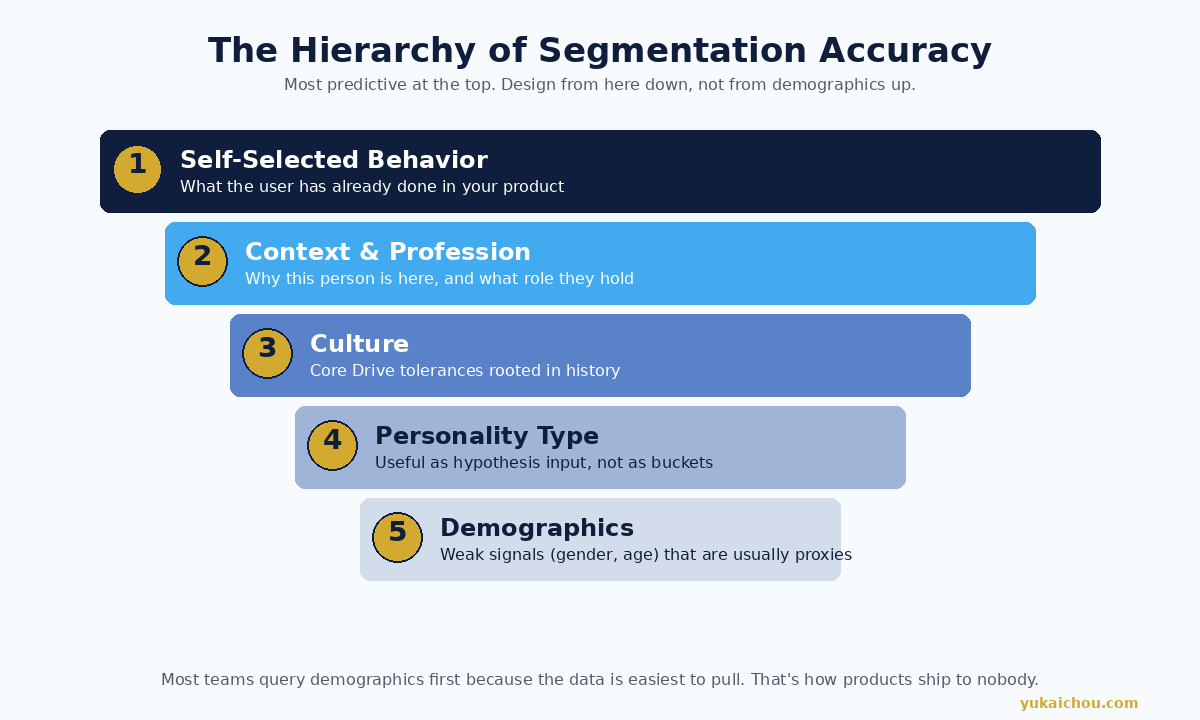
If you’ve followed the four-segmentation map this far, you’ve noticed the segments aren’t equally trustworthy. Some categories are more predictive of behavior than others. Designing from the wrong end of this hierarchy is how teams end up with Personality-Type Quadrants on a slide deck and a product nobody actually uses.
The hierarchy, ranked from most to least predictive:
- Self-selected behavior. What the user has already done in your product (or close adjacent products) is the strongest signal you’ll ever get. Past behavior eats every demographic for breakfast.
- Context and profession. Why is this person in your product right now? What’s the role context they’re operating from? A nurse using your product on shift behaves differently from the same nurse using your product at home.
- Culture. The Core Drive tolerance map runs deep. Mainland Chinese, Japanese, and Scandinavian users will accept and reject different design moves even if their other variables are matched.
- Personality type. Useful for informing design hypotheses. Not useful as a literal segmentation system, because personality lives on spectrums, not in buckets.
- Demographics. Gender and age are weak signals. They’re almost always picking up something else (profession, life-stage context, a self-selection variable) that you’d be better off measuring directly.
The pragmatic move is to design from the top of this list down, not from the bottom up. Most teams default to demographics first because demographics are easy to query in a database. That’s how you end up with “designed for women aged 25-34” on a brief that will not survive contact with a real user.
Even getting the segmentation wrong inside this framework is better than not having a framework at all. If your assumptions are documented and connected to design decisions, you can fix the assumptions when reality contradicts them. Without a framework, every signal feels equally important, and you have no way to update beliefs when the data comes in. A documented set of assumptions, even if half of them turn out to be wrong, will outperform vibes-based design every time, because debugging a documented system is tractable and debugging a vibe is not.
FAQs
What’s the difference between gamification player segmentation and standard user segmentation?
Standard user segmentation usually optimizes for marketing reach and conversion funnel design: who do we sell to, what’s their lifetime value, where do we spend ad dollars. Gamification player segmentation goes one layer deeper: among people we already converted, what motivates them differently inside the product? Both are needed. Marketing segmentation gets you the user. Player segmentation keeps them and turns them into a referrer.
Can I use Bartle’s player types for gamification design?
Bartle’s types (Achievers, Explorers, Socializers, Killers) were derived from MUDs in 1996, text-based multiplayer worlds. They’re a useful reference and they map cleanly onto Core Drives 2, 7, 5, and 5/6 respectively. But Bartle’s framework was designed for one game category. For consumer products, B2B tools, education, or compliance training, you’ll need axes that connect to your specific business metrics. Borrow the spirit of Bartle’s approach (player motivation as the segmentation axis), not the specific four types.
How many player types should a gamification design support?
Two to four. Two is fine if your product has a single dominant behavior loop with one major motivational split. Four is the upper limit before design coherence collapses. If you find yourself wanting eight or sixteen types, you’re probably designing for User Groups (different actions) rather than Player Types (different motivations for the same actions). Re-run the first-fork question: same actions or different actions?
Does culture-based segmentation hold up for second-generation immigrants and global remote teams?
Less reliably. Culture-based Core Drive tolerances are downstream of historical and societal forces. Second-generation users have a partial inheritance, often modulated by the dominant culture they grew up in. Global remote teams are even more mixed. The honest move is to treat culture as a hypothesis you test, not a verdict you apply. Always validate against actual user behavior in your product before designing around a cultural assumption.
What’s the single most common segmentation mistake?
Treating User Groups as Player Types. Building one product loop and slapping cosmetic differentiation on top, when the buyer and the user, or the teacher and the student, or the patient and the caregiver, actually need different products. Retention will tell you within a quarter that you got this wrong, but by then you’ve already shipped.
What to do with this
If you’re starting a gamification project this week, run the four segmentation questions before you pick a single Core Drive. Are you designing for Player Types or User Groups? Do your axes connect to business metrics? What cultural Core Drive tolerances does your audience bring? And how will you handle launch with a small audience? What’s your relatability play?
Get those four right and the rest of the Octalysis design is mostly mechanical. Get them wrong and no amount of clever Core Drive 7 unpredictability will save you. The work upstream of the design is the design.
If you want the deeper version of this material, the segmentation chapter in Actionable Gamification covers the math of player-type prioritization in more detail, and the Octalysis Framework page has the Core Drive reference if you need to map the cultural profiles back to specific drives. Build the segmentation right, and the rest of your gamification stops feeling like guesswork.