
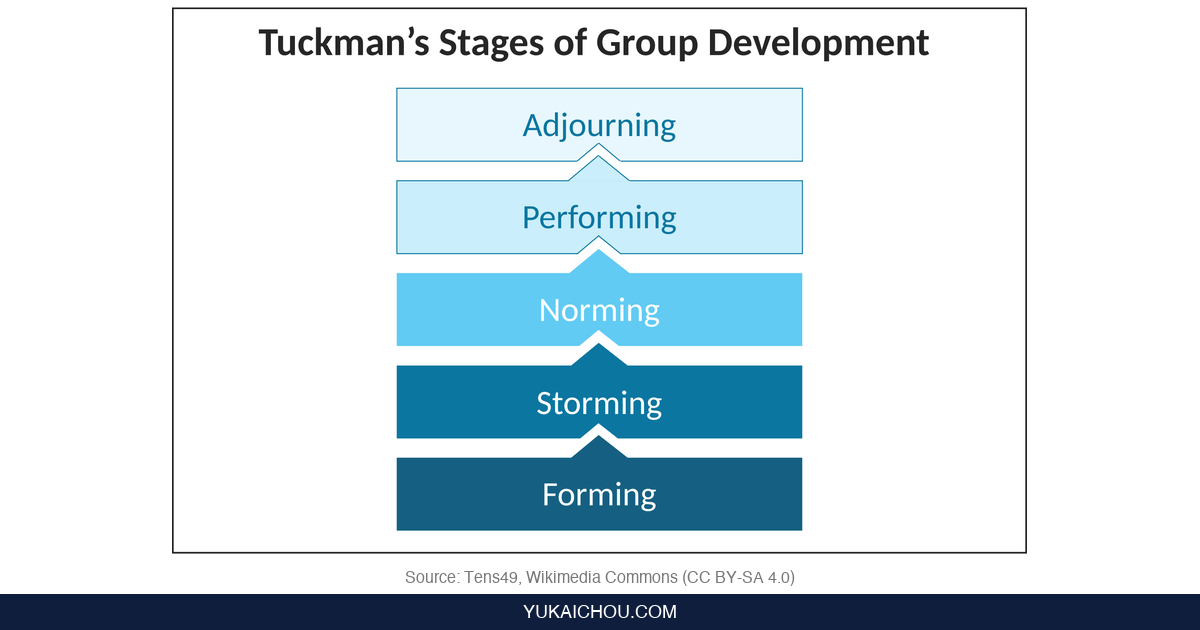

The most famous model of teamwork in business history rhymes.
That rhyme is doing more work than the evidence is.
In 1965, a 26-year-old research psychologist named Bruce Tuckman published what we now call Tuckman’s Stages of Group Development, proposing that groups mature through four phases: forming, storming, norming, performing.
Six decades later his four words run onboarding decks at Fortune 500 companies, agile retrospectives, military training, and the PMBOK Guide, where project managers memorize them as the “Tuckman ladder.”
Here is what almost nobody who uses the model knows: Tuckman built it from studies of therapy groups, called it a hypothesis in need of testing, and watched the follow-up research come back thin.
He said so himself, in print, twice.
So this guide does two jobs at once.
It gives you the deepest practical version of Tuckman’s Stages of Group Development I can build: what each stage looks like, the motivational psychology running underneath it, and how to design a team through the passage instead of white-knuckling it.
And it tells you the truth about the evidence, because a behavioral designer who treats a useful map as a law of physics eventually drives the team off a cliff the map never showed.

Speed Run Notes
- The model: Tuckman’s Stages of Group Development (1965) says teams pass through forming, storming, norming, and performing, with adjourning added in 1977. It came from a review of 50 studies, 26 of them therapy groups.
- The engine: storming is a motivational collision, which is what makes it designable: status contests from Core Drive 2 (CD2): Development & Accomplishment crashing into autonomy claims from Core Drive 3 (CD3): Empowerment of Creativity & Feedback.
- The evidence: Tuckman called his own model “a conceptual statement… subject to further test.” Only about half his sources showed a distinct conflict stage, and Gersick’s real project teams skipped the ladder entirely.
- The secret: the model’s real product is a reframe. Naming storming as a stage converts conflict from a failure signal into a progress signal, and that reframe changes how teams behave.
- The trap: suppressed storming compounds into pseudo-norming, polite surface agreement that collapses under the first real load. Remote and async teams are especially prone to it.
- The playbook: map each stage to its Core Drives and design the handoffs: onboard forming, referee storming, codify norming, protect performing, honor adjourning.
What’s below: Definition covers the model and its 1965 origin story. The Five Stages walks forming, storming, norming, performing, and adjourning one at a time. Got Right / Falls Apart weighs the model against Gersick’s punctuated equilibrium and the sample problem. Brain brings the neuroscience of exclusion and team synchrony. Comparisons covers Belbin, Lencioni, Hackman, and Google’s Project Aristotle. Real World runs agile teams, raid guilds, startups, and hospitals. Octalysis converts it all into a stage-by-stage design playbook with practical steps.
In This Article
- What Is Tuckman’s Stages of Group Development?
- The Five Stages, One at a Time
- What Tuckman Got Right
- Where the Model Falls Apart
- What’s Really Happening Inside the Brain
- Tuckman vs Other Team Theories
- Tuckman in the Real World
- The Elephant in the Room: The Model Survived on a Rhyme
- How to Apply Tuckman’s Stages with the Octalysis Framework
- Practical Steps: Taking a Team Through the Stages
- Frequently Asked Questions
Author Credibility: Yu-kai Chou

Yu-kai Chou created the Octalysis Framework after studying gamification since 2003 — years before the term entered mainstream vocabulary. As a Human-Systems Architect & Behavioral Designer, his framework has been applied by LEGO, Microsoft, Porsche, Coca-Cola, Salesforce, and MrBeast, impacting over 1.5 Billion Users.
Chou has taught the Octalysis methodology at Harvard, Stanford, Yale, Tesla, Google, BCG, and IDEO.
His work has been cited by Harvard, Stanford, MIT, Forbes, Wall Street Journal, Wired, US Department of Energy, NIST, NSF, NCBI, US Department of Education, ClinicalTrials.gov, and Google Scholar — with 3,700+ more academic publications. Explore his books here.

What Is Tuckman’s Stages of Group Development?
Tuckman’s Stages of Group Development is a model proposing that small groups mature through five sequential phases: forming (orientation and testing), storming (conflict over status and direction), norming (cohesion and shared standards), performing (productive work through flexible roles), and adjourning (task completion and separation).
Bruce Tuckman proposed the first four stages in his 1965 paper “Developmental Sequence in Small Groups,” published in Psychological Bulletin while he was a research psychologist at the Naval Medical Research Institute in Bethesda.
He did something clever and slightly audacious for a researcher in his twenties: he gathered 50 published studies of groups changing over time, sorted their observations, and proposed that underneath all of them sat one common sequence.
Twenty-six of those 50 studies were therapy groups.
Most of the rest were T-groups (sensitivity-training groups, the corporate encounter sessions of the 1960s) and one-shot laboratory groups.
Hold onto that detail, because it becomes the model’s biggest weakness later in this guide.
Tuckman’s most original move was splitting every group’s life into two parallel tracks.
The interpersonal track asks: how are we treating each other? Its stages were testing-dependence, conflict, cohesion, and functional roles.
The task track asks: how are we handling the work? Its stages were orientation, emotionality, relevant opinion exchange, and the emergence of solutions.
The four famous labels are the marriage of those two tracks, compressed into words that happen to chime: forming, storming, norming, performing.
In 1977, invited by the journal Group & Organization Studies to revisit the model, Tuckman and Mary Ann Jensen reviewed 22 newer studies and added a fifth stage: adjourning, the group’s ending, which some later writers renamed “mourning.”
From the beginning, Tuckman was more honest about the model than the industry that adopted it.
In the 1965 paper he wrote that the stages are best read as “a conceptual statement suggested by the data presented and subject to further test.”
Keep that sentence in mind for the entire guide.
The creator filed his model as a hypothesis, and the business world ratified it as law.
Tuckman himself moved on to a full career in educational psychology at Ohio State University, where he founded the Dennis Learning Center and built, among other things, the most widely used academic procrastination scale in the field.
He died in March 2016 at 77, having donated his brain to Alzheimer’s research, and having spent five decades watching four words he wrote at 26 outgrow everything else he ever published.
By then the model had been institutionalized: the Project Management Institute’s PMBOK Guide carried it to millions of certified project managers as the “Tuckman ladder.”
Few ideas in organizational life have traveled further on less data, which is exactly why a behavioral designer should study how this one traveled.
The Five Stages, One at a Time
Each stage is a different motivational configuration, which means each stage rewards a different design response.
Through the lens of the Octalysis Framework, my model of the 8 Core Drives of human motivation, a team is a small motivational economy.
Watch which Core Drives dominate at each stage and the model stops being four labels on a poster and starts being an instrument panel.
It is the same lens I run on every model in this Behavioral Framework Library, and Tuckman’s Stages reward it more than most.
Stage 1: Forming
A new team is a room full of strangers performing politeness.
Tuckman called this stage testing and dependence: members probe what behavior is acceptable, and they lean on whatever authority figure is available to tell them the rules.
Everyone is on their best behavior, and almost nothing real gets said.
Motivationally, forming runs on Core Drive 1 (CD1): Epic Meaning & Calling: the sense of joining something that matters.
It also runs on Core Drive 5 (CD5): Social Influence & Relatedness, the hunger to belong, and Core Drive 7 (CD7): Unpredictability & Curiosity, the novelty of new faces and an unwritten future.
Underneath the smiles sits Core Drive 8 (CD8): Loss & Avoidance: the fear of saying the wrong thing to people who have not yet decided who you are.
That CD8 undertow explains the strange emptiness of kickoff meetings.
People are motivated but guarded, present but not yet real.
The design job in forming is to give the group cheap, safe ways to be seen: structured introductions, small early wins, an explicit mission statement that feeds CD1 before the work gets hard.
Stage 2: Storming
Then somebody disagrees, and the room changes temperature.
Tuckman described storming as conflict and polarization around interpersonal issues: members resist group influence, push against the task, and test the leader.
Status gets contested, and the polite fictions of forming stop holding.
Most managers read this as malfunction.
Read it instead as a motivational collision, because that is what it is.
Every member arrives with Core Drive 2 (CD2): Development & Accomplishment demanding recognition of their competence, and Core Drive 3 (CD3): Empowerment of Creativity & Feedback demanding room for their way of doing things.
Put five competent people in a room and you have five competence claims and five creative visions competing for the same finite territory: decisions, airtime, direction.
The collision is the sound of people who care negotiating whose Core Drives get fed.
Classic group psychology says conflict binds to competition over scarce resources, the dynamic Muzafer Sherif engineered between boys’ camps in his Realistic Conflict Theory experiments.
Inside a team, the scarce resource is standing: whose judgment counts.
Storming feels like a Black Hat phase because the felt experience is CD8, the threat of losing face, position, or the team itself.
The content of the storm, though, is White Hat: competence and creativity fighting to matter.
That split is the whole design secret of this stage, and the Octalysis section below builds the playbook from it.
One more fact worth carrying: in Tuckman’s own 1965 review, only about half the studies showed a distinct conflict stage at all, and some groups moved straight from orientation to cohesion.
Storming is common, and it is real, and it is still not a law of nature.
Stage 3: Norming
If the team survives the storm without faking its way around it, something quieter happens: agreements start to stick.
Tuckman called this cohesion: the group develops shared expectations, in-jokes, working rhythms, and a sense of “how we do things here.”
Motivationally, norming is CD5 relatedness consolidating into identity, plus Core Drive 4 (CD4): Ownership & Possession attaching to the norms themselves.
The norms work because the team owns them.
A rule handed down from outside is compliance; the same rule forged in your own storm is property.
This is also where the group builds what researchers call team mental models: shared pictures of the task, the tools, and each other that let members predict one another without asking.
Norming has a failure mode the tradition itself flags: the group can start protecting harmony instead of truth.
Members hold back controversial ideas because conflict feels like a return to the storm they barely escaped.
Norming also has a free-rider problem: once identity feels secure and accountability blurs, social loafing creeps in and individual effort quietly drops.
Healthy norming codifies conflict instead of banning it: decision rules, feedback rituals, explicit ways to disagree that do not threaten membership.
Stage 4: Performing
Performing is the stage everyone wants and few teams reach.
Tuckman described it as functional role-relatedness: structure stops being the argument and becomes the tool, and the group’s energy finally pours into the task itself.
Members are competent, autonomous, and able to handle decisions without supervision, with dissent expected and channeled rather than suppressed.
In Octalysis terms, performing is the White Hat trifecta running clean: CD1 purpose, CD2 mastery visible in results, CD3 creative autonomy inside trusted structure.
It is the group-level cousin of the individual flow state: challenge matched to skill, feedback immediate, self-consciousness gone.
Leadership changes shape here rather than disappearing.
Research on shared leadership finds that in mature teams, influence distributes across members according to expertise, and the formal leader’s job shifts to protecting the conditions.
Motivation science backs the same shift: Self-Determination Theory applied to the workplace shows autonomy, competence, and relatedness feeding the intrinsic engagement that performing teams run on.
Two warnings before you laminate the trophy.
Performing is not a permanent address; Tuckman’s own tradition acknowledges that teams revert, and a leadership change, a new member, or a shifted mission can send a performing team straight back to storming.
And a team can look like it is performing while actually coasting on norming’s comfort, shipping adequate work on the strength of good vibes.
The difference shows up under load.
Stage 5: Adjourning (1977)
The stage Tuckman added last is the one designers skip most.
Reviewing the post-1965 literature with Mary Ann Jensen, he concluded that the life cycle needed an ending: the group completes its task, disbands, and members process the separation.
Later writers called it mourning, and the pun is earned.
Adjourning is a CD8 event: the loss of a working identity, a set of relationships, and a rhythm that took real effort to build.
Handled badly, it teaches people that investing in the next team is unsafe.
Handled well, it converts the loss into CD1 legacy: retrospectives that name what the team learned, artifacts that outlive the roster, endings treated as graduations instead of evaporations.
Watch how the best game designers close a raid tier or a season: ceremony, commemoration, carry-forward rewards.
Now watch how most companies close a project: a calendar invite disappears.
How to tell which stage you are actually in
Teams misdiagnose their own stage constantly, usually in the flattering direction.
Here are the signals I trust more than self-report.
Listen to the pronouns: forming teams say “I” and “you,” norming teams start saying “we,” and storming teams say “some people,” the pronoun of conflict going underground.
Watch the questions: forming teams ask clarifying questions (what are we doing), storming teams ask challenging questions (why are we doing it this way), performing teams ask each other for input without routing it through the leader.
Track where disagreement happens: in forming it happens nowhere, in storming it happens in meetings, in pseudo-norming it happens after meetings, in hallways and direct messages.
Time the silences: a forming silence is people waiting for permission, a storming silence is people calculating cost, a performing silence is people working.
And check the meeting-after-the-meeting: the moment decisions get relitigated in side channels, whatever stage the team believes it occupies, it has unfinished storming to do.
Ten minutes of honest observation against these signals beats an hour of stage-model debate.
What Tuckman Got Right
Three of Tuckman’s calls have aged so well that they now pass for common sense, which is the highest compliment a 1965 model can earn.
He reframed conflict as development
Before Tuckman, a team fighting looked like a team failing.
His sequence recast conflict as a chapter in the story, sitting between orientation and cohesion the way adolescence sits between childhood and adulthood.
That single reframe may have saved more teams than any technique in this guide, because teams that expect the storm stop treating it as evidence they should disband.
He saw the two tracks
Tuckman’s least-quoted insight is his best one: every group lives two lives at once, one interpersonal and one task-focused.
A team can be warm and useless, or productive and miserable, because the tracks move semi-independently.
Six decades later, every serious team framework still stands on that distinction, from psychological safety research to agile retrospectives that ask separately about the work and the working relationship.
He gave teams a shared language
Naming a thing changes how a group handles it.
“I think we are storming” is a sentence a junior engineer can say in a tense meeting without accusing anyone, and it moves the conversation from persons to process.
Shared stage language works as a coordination device: cheap to learn, neutral to invoke, and surprisingly disarming in the middle of an actual fight.
Where the Model Falls Apart
The model’s three structural weaknesses share one root: the evidence underneath it was never as sturdy as the diagram implies.
The sample problem: therapy groups posing as your product team
Twenty-six of the 50 studies in the 1965 review were therapy groups; most of the rest were sensitivity-training groups and one-shot laboratory groups.
Almost none were intact workplace teams with deadlines, bosses, and quarterly goals.
Therapy groups exist to surface interpersonal emotion, with a trained facilitator whose job is to make the implicit explicit.
Generalizing from them to a sprint team is generalizing from a greenhouse to a parking lot.
Tuckman knew it: the 1965 paper labels the model “a conceptual statement suggested by the data presented and subject to further test.”
The 1977 revisit with Jensen then reported that of 22 subsequent studies, exactly one had set out to directly test the model.
The most famous team model in the world entered its second decade with one direct empirical test on the books.
The linearity problem: Gersick watched real teams and saw a different shape
In 1988, Connie Gersick published the study Tuckman’s model had been waiting for, and it came back with different news.
She followed eight real project teams from first meeting to final deliverable, transcribing every meeting along the way.
None of them walked the ladder.
Each team locked a working pattern within minutes of its first meeting, coasted on it through an initial period of inertia, then hit a dramatic transition at almost exactly the midpoint of its calendar, dropping old assumptions and reorganizing for the endgame.
Gersick called the pattern punctuated equilibrium, borrowing the term from evolutionary biology: long stability, sudden change, timed by the deadline, with relationship maturation nowhere in the driver’s seat.
The clean way to hold both models comes straight from Tuckman’s own two tracks.
Gersick was watching the task track, where deadlines pace the drama; Tuckman’s stages live mostly on the interpersonal track, where trust and status get negotiated.
Your team can pivot its work at the midpoint while still being, relationally, a group of people who have never had one honest disagreement.
The determinism problem: stages without a mechanism
The model says conflict comes, then cohesion.
It never says why, for whom, or what makes the transition fire, which leaves it silent exactly where a designer needs guidance.
Only about half of Tuckman’s own sources showed a distinct conflict stage, and some groups skipped from orientation straight to cohesion.
Teams also move backward: a leadership change, a merger, or one senior hire can send a performing team back into the storm, a reversion the tidy forward arrow never depicts.
Treat the stages as weather patterns, never as train stations.
You will see these conditions, often in this order, and nothing guarantees the sequence, the timing, or a one-way trip.
What’s Really Happening Inside the Brain
The neuroscience explains why storming hurts, why norming soothes, and why performing teams start to think as one organism.
Start with the pain of the storm.
Naomi Eisenberger’s landmark 2003 experiment in Science put people in a scanner while a rigged video game excluded them from a ball-toss, and their dorsal anterior cingulate cortex, a region central to the distress of physical pain, lit up in proportion to how rejected they felt.
Social exclusion runs on pain hardware.
When a teammate’s idea gets steamrolled in a storming meeting, their brain files the event closer to injury than to information, which is why storming badly managed produces flinching, and flinching produces silence.
Norming is the nervous system learning it is safe to stop flinching.
Amy Edmondson defined psychological safety as a shared belief that the team is safe for interpersonal risk-taking, and her research on hospital teams found the safe ones reported more errors, because reporting had stopped being dangerous.
Norms are the group’s visible agreement about what will not be punished, which is why norms forged after a storm are load-bearing and norms imposed before one are decoration.
Performing has a stranger signature: synchrony.
A 2021 hyperscanning study by Reinero, Dikker, and Van Bavel recorded EEG from 174 people solving problems in four-person teams and found that inter-brain synchrony predicted collective performance for teams, while doing nothing for individuals working alone.
Teams that perform together literally oscillate together.
Read the three findings as a sequence and the model gets a physiology: storming is threat detection, norming is threat retirement, performing is what shared attention looks like once no brain in the room is budgeting for danger.
The design translation is direct.
Every hour a team spends in unresolved threat is an hour of cognition taxed by self-protection, which means the fastest route to a smarter team is rarely smarter members.
It is a cheaper storm: clear decision rules, low-cost dissent, and visible proof that losing an argument costs nothing that matters.
Tuckman vs Other Team Theories
Tuckman explains the passage; his rivals explain the ingredients, the timing, and the conditions, and a working designer needs all four.
Tuckman vs Gersick’s punctuated equilibrium
Use Tuckman to read the relationship, Gersick to read the calendar.
If your team has a hard deadline, plan for the midpoint spasm: Gersick found teams reliably reorganize halfway to the due date, whatever their interpersonal maturity.
Schedule the uncomfortable strategic review at the midpoint on purpose, and you convert her finding from ambush into tool.
Tuckman vs Belbin Team Roles
Meredith Belbin asked a different question: who should be on the team, mapping nine behavioral roles that balanced teams need.
My full guide to Belbin Team Roles covers the framework and its evidence; the practical marriage is composition before development.
Belbin tells you what mix to hire; Tuckman tells you what the mix will live through once hired.
Tuckman vs Lencioni’s Five Dysfunctions
Patrick Lencioni’s pyramid, absence of trust up through inattention to results, is storming and norming gone chronic, repackaged for the airport bookstore.
“Fear of conflict,” his second dysfunction, is a team that never finished its storm, and “artificial harmony” is the pseudo-norming this guide keeps warning about.
Lencioni is a practitioner’s model with thin peer-reviewed support, and it still earns its shelf space as a vivid diagnostic vocabulary for stuck stages.
Tuckman vs the conditions school: Hackman and Project Aristotle
Richard Hackman spent decades arguing that team effectiveness comes from designed conditions, a real team, compelling direction, enabling structure, supportive context, and coaching, rather than from managing interpersonal phases.
Google’s Project Aristotle landed on the same side after studying around 180 of its own teams across some 250 variables: the differentiator was psychological safety, with dependability, clarity, meaning, and impact behind it.
The conditions school quietly demotes Tuckman: build the right container and the storm stays small enough to be useful.
My read as a designer: conditions are what you control, stages are what you watch, and confusing the two turns managers into weather reporters when they should be building greenhouses.
Tuckman in the Real World
Four arenas show the stages, the reversions, and the cost of pretending the model is linear.
Agile teams and the re-org tax
Software organizations quote Tuckman more than anyone, then ignore his central implication.
Every re-org, every “team topology refresh,” every quarterly reshuffle sends performing teams back to forming, and the productivity cost of that reset never appears on the slide announcing the change.
Agile coaches watch it happen in sprint metrics: velocity dips after every roster change, then recovers as the team re-norms.
If you run an organization, price the developmental reset into every reshuffle, and stop being surprised when a rebuilt team ships slowly for a quarter.
Raid guilds: the stages with the politeness stripped off
Watch a World of Warcraft raid guild and you see Tuckman’s model running at high speed with the corporate varnish removed.
Recruitment posts and trial runs are forming, all best behavior and buffed resumes.
Loot disputes are storming in its purest form: CD2 status claims (who earned the drop) colliding with CD4 ownership instincts (whose item is it) in front of the whole group.
The guilds that survive respond by codifying norms into visible systems, loot-council rules or point systems that convert each raid night into earned, trackable credit, and that codification is norming made executable.
Server-first kills are performing: forty people executing a choreography no individual could design, then holding the screenshot as CD1 legacy.
Guild collapses usually trace to a skipped stage, typically a storm that leadership suppressed until it detonated.
Startups: co-founder storming is the stage most companies die in
Founding teams form in honeymoon conditions, all CD1 mission and CD7 possibility.
The storm arrives with the first real scarcity: one CEO title, one cap table, one product direction.
Startup post-mortems overflow with co-founder conflict, and my read is that most of those deaths were storming misread as betrayal.
The couples-therapy advice applies: the fight is rarely about the fight, and a fight about equity is usually CD2 recognition and CD4 ownership asking to be negotiated explicitly.
Founders who write the disagreement rules during forming, decision rights, equity logic, exit ramps, are pre-building the norms they will need when the storm tests them.
Hospitals and classrooms: leadership that changes shape per stage
A 2017 nursing-leadership study by Manges and colleagues followed hospital change teams through the stages and mapped what effective leaders did differently at each one.
Forming got coordinating behaviors: picking the team deliberately, setting goals, structuring the ground.
Storming got coaching: absorbing tension, building trust member by member, calming the waters without silencing the argument.
Norming and performing got empowerment: feedback loops, transferred leadership, room to run.
The same arc shows up in every project classroom I have taught: the instructor who runs week one like week ten, or week ten like week one, fails the team either way.
Leadership, in stage language, is a shape-shifting job, and the model’s real gift to leaders is the reminder to check which shape the moment needs.
The Elephant in the Room: The Model Survived on a Rhyme
Forming, storming, norming, performing outcompeted better-evidenced models for six decades because it is unforgettable, and unforgettable beats accurate in the marketplace of ideas.
Say the four words once and you own them forever.
The rhyme is a delivery mechanism: Core Drive 5 (CD5): Social Influence & Relatedness spreads what is easy to repeat, and Core Drive 7 (CD7): Unpredictability & Curiosity latches onto a pattern that resolves so satisfyingly.
Gersick’s punctuated equilibrium is the better-evidenced description of deadline teams, and it sounds like a graduate seminar, so the poster in the break room still says storming.
Denise Bonebright’s forty-year historical review of the model makes the same point in academic language: the model’s popularity ran far ahead of its validation, powered by usefulness and memorability.
And there is a second reason I still teach the model after spending half this guide prosecuting it.
Tuckman’s Stages function as a behavioral intervention wearing the costume of a description.
Tell an anxious team “conflict is a stage, and it usually precedes cohesion” and you have changed the team: the storm stops predicting death, Core Drive 8 (CD8): Loss & Avoidance loosens its grip, and people stay at the table long enough to actually reach norming.
Tell them “half of all teams show no clear stages” and you have handed them a shrug.
The map redraws the territory, in the right direction.
Using a placebo map with a clean conscience takes three rules, and they are the honesty clause in operational form.
First, deploy the model as language, never as forecast: “we are storming” is a useful sentence, “we will reach performing by March” is astrology with a Gantt chart.
Second, diagnose teams with it, never individuals: the moment “storming” becomes a label for the one engineer who keeps disagreeing, the model has turned into a tool for silencing exactly the dissent it was supposed to normalize.
Third, hold it loosely enough to drop: when your team’s reality stops matching the stages, believe the team, because Gersick’s teams were real and the ladder is a summary of other people’s therapy sessions from before the moon landing.
A designer can use that with a clean conscience, provided you remember which parts are physics and which parts are placebo, and never bet the roadmap on the placebo.
How to Apply Tuckman’s Stages with the Octalysis Framework
Each stage is a Core Drive configuration, so team design becomes a sequencing problem: feed the drives the current stage runs on, and pre-build for the drives the next stage will demand.

The Octalysis Framework maps the 8 Core Drives of human motivation; a team is those drives negotiating with each other in real time.
Here is the stage-by-stage instrument panel.
| Stage | Dominant Core Drives | Design lever | Failure mode |
|---|---|---|---|
| Forming | CD1 meaning, CD5 belonging, CD7 novelty; CD8 anxiety underneath | Mission framing, structured introductions, small early wins | Politeness mistaken for alignment |
| Storming | CD2 status and CD3 autonomy colliding; CD8 threat in the body | Referee the content, cap the threat: decision rules, structured dissent | Suppressed conflict re-emerging as politics |
| Norming | CD5 identity, CD4 ownership of the rules | Codify norms the team authored; make credit visible | Harmony protection; social loafing |
| Performing | CD3 autonomy, CD2 mastery, CD1 purpose running clean | Protect conditions, distribute leadership, stretch challenges | Coasting disguised as excellence |
| Adjourning | CD8 loss seeking resolution into CD1 legacy | Ceremony, retrospective, artifacts that outlive the roster | Endings by calendar-invite evaporation |
The team journey is the player journey, one level up
Octalysis divides an individual’s experience into 4 Experience Phases: Discovery, Onboarding, Scaffolding, and Endgame, each demanding different motivational design.

Tuckman’s Stages are the same insight at group scale: forming is the team’s collective onboarding, storming and norming are its scaffolding, performing is its endgame, and adjourning is the endgame’s ending.
The design implication carries over directly.
A game that greets a brand-new player with endgame difficulty loses them, and a manager who greets a forming team with performing-stage expectations does the same thing with a salary attached.
Design the storm as White Hat content inside a Black Hat container
The top of the Octalysis octagon holds the White Hat drives, CD1, CD2, and CD3, motivation that leaves people feeling powerful and purposeful.

The bottom holds the Black Hat drives, Core Drive 6 (CD6): Scarcity & Impatience, CD7, and CD8, urgent motivation that moves people fast and burns them out if it never lifts.

Storming is a White Hat argument experienced through Black Hat emotions: the content is competence and creativity, the sensation is threat and potential loss.
So referee accordingly, in both directions at once.
Keep the content White Hat by forcing the argument onto ideas: written proposals argued on merits, decision rules agreed before the fight, dissent assigned as a rotating role so disagreement becomes a job description.
Cap the Black Hat by shrinking what a lost argument costs: nobody loses membership, status, or voice by losing a decision, and the leader’s core storming job is making that visibly true.
Teams do not fear conflict; they fear what conflict might cost them, and a designer can lower the price.
Pre-build the next stage’s drives
The stages chain, so the smart move at every stage is seeding the next one’s fuel.
During forming, plant the CD4 ownership that norming will need: have the team author its own working agreements in week one, even rough ones, so the storm has a shared document to amend instead of a vacuum to fill.
During storming, bank CD5 relatedness for norming: pair the loudest opponents on a small joint task, because nothing converts a rival into a colleague faster than a shared, winnable problem.
Once norms settle, install the CD2 progress visibility that performing feeds on: dashboards, demo days, win logs that make mastery undeniable.
And while the team performs, prepare the CD1 legacy that adjourning will need: document as you go, so the ending has something to hand forward.
Practical Steps: Taking a Team Through the Stages
Six moves, in order, that convert this guide from theory into next Monday’s agenda.
- Diagnose the current stage out loud. Put the five stages in front of the team and ask everyone to vote where you are. The spread is the diagnosis: a team split between norming and storming is storming, with some members not yet safe enough to say so.
- Write the disagreement rules before you need them. In forming, agree how decisions get made (who decides, with what input, reversible how), and write it down. Norms authored early convert the storm from constitutional crisis into amendment process.
- Schedule the midpoint reckoning. Steal Gersick’s finding: put a ruthless strategic review at the exact midpoint of any deadline project, and let the team renegotiate direction on purpose before inertia decides for them.
- Referee storms by content and cost. Force conflicts onto ideas (written proposals, agreed decision rules) and shrink the price of losing (no lost standing, no lost voice). Watch for silence, because per the neuroscience above, silence usually means the price is still too high.
- Codify norming into visible systems. Turn “how we work” into artifacts: working agreements, credit systems, feedback rituals with names and calendar slots. Cascade goals explicitly, the way Management by Objectives intended, so alignment stops depending on telepathy.
- Protect performing and plan the ending. Guard the roster (every change resets the clock), keep challenge rising with skill, and close projects with ceremony: a retrospective, a recorded legacy, a clean handoff of what the team learned.
Tuckman Was the Beginning, Not the End
Keep the four words, keep the honesty clause that came with them, and do the design work the model itself never did.
A 26-year-old researcher sorting therapy-group studies in 1965 handed the working world its most durable piece of team language, plus an honesty clause the working world threw away.
Use the language; keep the clause.
Read your team’s stage like weather, design each passage with the Core Drives that actually power it, schedule Gersick’s midpoint on purpose, and give endings the ceremony that endings earn.
Do that, and the difference shows within one project cycle: storms that produce decisions instead of scars, norms the team defends because the team wrote them, and a performing stretch you protected long enough to matter.
If you want the full motivational architecture underneath this playbook, the 8 Core Drives, White Hat and Black Hat design, and the frameworks I use with client teams, start with my books.
Frequently Asked Questions
What are the five stages of group development?
Forming (orientation and testing), storming (conflict over status and direction), norming (cohesion and shared standards), performing (productive work through flexible roles), and adjourning (completion and separation). Tuckman proposed the first four in 1965; he and Mary Ann Jensen added adjourning in 1977.
Who created the forming-storming-norming-performing model?
Psychologist Bruce W. Tuckman (1938–2016) introduced it in his 1965 paper “Developmental Sequence in Small Groups” in Psychological Bulletin, based on a review of 50 studies of group behavior. He later became a professor of educational psychology at Ohio State University.
What happens during the storming stage?
Members stop performing politeness and start contesting status, direction, and working methods. In Octalysis terms it is a collision between Core Drive 2 (competence seeking recognition) and Core Drive 3 (autonomy seeking room), experienced through Core Drive 8 threat. Managed well, it produces the trust and decision rules the team uses forever after.
Can a team skip the storming stage?
Some groups in Tuckman’s own data showed no distinct conflict phase, so skipping is possible. Far more often the storm is suppressed, never skipped: the disagreements go underground and resurface as politics, passive resistance, or a blowup under deadline pressure. Suppressed storming produces pseudo-norming, which looks like harmony and fails under load.
How long does each stage last?
The model gives no timetable, and that silence is a real weakness. Duration varies with team size, stakes, meeting frequency, and leadership. Gersick’s research adds one reliable temporal marker: project teams tend to reorganize dramatically at the midpoint of whatever calendar they are given.
Is Tuckman’s model still valid in 2026?
It remains a useful shared vocabulary and a decent default map of the interpersonal track, and its empirical support is thin: it was built mostly from therapy-group studies, only one direct test existed by 1977, and Gersick’s field research found real project teams following a different pattern. Treat it as a diagnostic language, and design conditions rather than trusting stages to unfold.
What is the adjourning stage, and why is it sometimes called mourning?
Adjourning, added in 1977, is the team’s ending: the task completes, the group disbands, and members process the loss of a working identity. It earned the nickname “mourning” because well-functioning teams grieve. Designed endings, with retrospectives, ceremony, and preserved artifacts, convert that loss into legacy.
How is Tuckman’s model different from Gersick’s punctuated equilibrium?
Tuckman describes gradual relationship maturation through stages; Gersick observed real project teams locking a pattern in the first meeting, coasting, then transforming at the calendar midpoint. The clean reconciliation: Tuckman tracks the interpersonal side, Gersick tracks the task-and-deadline side, and real teams live on both tracks at once.
Do remote and hybrid teams go through the same stages?
The motivational dynamics are identical, and the passage gets harder: low-bandwidth channels suppress the honest friction storming requires, so remote teams drift into pseudo-norming, polite agreement without real alignment. Remote teams need deliberately designed disagreement, written debate documents, explicit decision rules, and dedicated high-bandwidth sessions for contentious calls.
How do I move my team from storming to norming?
Lower the cost of losing arguments and raise the structure around them: agree decision rules, force debates onto written proposals, pair rivals on small winnable tasks, and codify each resolved fight into a norm the team owns. Progress comes from making conflict cheap and productive, never from making it disappear.
References
- Tuckman, B. W. (1965). Developmental sequence in small groups. Psychological Bulletin, 63(6), 384–399. Full text (PDF)
- Tuckman, B. W., & Jensen, M. A. C. (1977). Stages of small-group development revisited. Group & Organization Studies, 2(4), 419–427. Full text (PDF)
- Gersick, C. J. G. (1988). Time and transition in work teams: Toward a new model of group development. Academy of Management Journal, 31(1), 9–41. Full text (PDF)
- Bonebright, D. A. (2010). 40 years of storming: A historical review of Tuckman’s model of small group development. Human Resource Development International, 13(1), 111–120. doi:10.1080/13678861003589099
- Eisenberger, N. I., Lieberman, M. D., & Williams, K. D. (2003). Does rejection hurt? An fMRI study of social exclusion. Science, 302(5643), 290–292. PubMed
- Edmondson, A. (1999). Psychological safety and learning behavior in work teams. Administrative Science Quarterly, 44(2), 350–383. JSTOR
- Reinero, D. A., Dikker, S., & Van Bavel, J. J. (2021). Inter-brain synchrony in teams predicts collective performance. Social Cognitive and Affective Neuroscience, 16(1–2), 43–57. Full text (PMC)
- Manges, K., Scott-Cawiezell, J., & Ward, M. M. (2017). Maximizing team performance: The critical role of the nurse leader. Nursing Forum, 52(1), 21–29. PubMed
- Rickards, T., & Moger, S. (2000). Creative leadership processes in project team development: An alternative to Tuckman’s stage model. British Journal of Management, 11(4), 273–283.
- Bruce W. Tuckman (1938–2016): biography and career overview. EBSCO Research Starters. Biography (EBSCO)
- Google re:Work. Guide: Understand team effectiveness (Project Aristotle). rework.withgoogle.com
- Wikipedia. Tuckman’s stages of group development. Wikipedia
Related Reading
- FOMO (Fear of Missing Out): An S-Tier Behavioral Designer’s Guide
- Citizenship Behavior: S-Tier Behavioral Designer’s Guide
- Pluralistic Ignorance: An S-Tier Behavioral Designer’s Guide
- Sociometer Theory: An S-Tier Behavioral Designer’s Guide
- The Chameleon Effect: An S-Tier Behavioral Designer’s Guide
Explore the full Behavioral Framework Library for 239 pillar guides to the psychology of behavior change.