


Last Updated: March 2026
⚡ Speed Run Notes
- Good blockchain gamification is rare because the category is flooded with economic mechanics pretending to be game mechanics. A token is not a reward in the game design sense — it's an asset. Confusing the two has destroyed more Web3 projects than any other single mistake. The three examples featured here got the distinction right.
- The winning projects use blockchain as infrastructure, not as the product. Users don't care about the ledger. They care about the experience the ledger makes possible. Projects that lead with tech lose users; projects that lead with experience retain them.
- CD4 (Ownership) is the drive blockchain enables uniquely — and the one most projects under-use. True digital ownership (assets that persist across platforms) is a genuine innovation. Most projects sell assets that don't actually move across platforms, which wastes the whole point of the technology.
- The best NFT projects design for community over speculation. Speculators leave after the first dump. Communities stay through cycles. The projects that optimize for community survive the bear market and compound the bull. This is a pattern that repeats across every cycle.
- The deepest insight: Web3 gamification is going to succeed when it stops trying to be “the future of games” and becomes “a better backend for specific kinds of games.” Grandiose framing alienates users. Humble, specific framing wins them. The three examples in this post are the humble, specific kind — which is why they're worth studying.
Blockchain gaming generated over $2.3 billion in Q3 2021 alone — and the projects that survived the crash did so because they understood something most crypto ventures missed: human motivation.
Below are three blockchain gamification examples that used behavioral design principles — from Play-to-Earn mechanics to gamified browsing — along with my own project that applies these lessons firsthand.
Author Credibility: Yu-kai Chou

Yu-kai Chou created the Octalysis Framework after studying gamification since 2003 — years before the term entered mainstream vocabulary. As a Human-Systems Architect & Behavioral Designer, his framework has been applied by LEGO, Microsoft, Porsche, Coca-Cola, Salesforce, and MrBeast, impacting over 1.5 Billion Users.
Chou has taught the Octalysis methodology at Harvard, Stanford, Yale, Tesla, Google, BCG, and IDEO.
His work has been cited by Harvard, Stanford, MIT, Forbes, Wall Street Journal, Wired, US Department of Energy, NIST, NSF, NCBI, US Department of Education, ClinicalTrials.gov, and Google Scholar — with 3,700+ more academic publications. Explore his books here.

Blockchain Gamification Example 1: Axie Infinity
You probably have already heard of Axie Infinity — which almost makes this a must-include on our list.
Traditional NFTs focus on just owning unique pieces of digital artwork or characters/cards which could go up in value and be traded later.
However, without fun uses for these NFTs, the value is purely speculative and barely based on need or utility.
To increase the value of these NFTs, Axie Infinity (inspired by another NFT project CryptoKitties) allowed people to “play” with these NFT creatures, including breeding more, buying land, upgrading the Axies, and battling each other.

The results of gamifying these NFTs made Axie Infinity the largest “Play-To-Earn” platform in the world. At its peak in November 2021, the AXS token market cap exceeded $9 billion USD, and daily trade volumes regularly surpassed $150 Million USD.
Active players of Axie Infinity could earn from a few hundred dollars a month to over $4,000 a month, which became a nice living for many people in countries like the Philippines.
(Warning: due to competitiveness of the platform, playing Axie Infinity may not guarantee actually earning money, and it is possible to invest into the game and lose money instead. By 2025, AXS had declined over 98% from its peak — a reminder that gamification can drive massive adoption, but unsustainable tokenomics without deeper Core Drives eventually collapse. This is a textbook example of what happens when Anti Core Drives go unchecked.)
From an Octalysis perspective, Axie Infinity heavily relied on Core Drive 4: Ownership & Possession (owning unique Axies), Core Drive 2: Development & Accomplishment (leveling up and winning battles), and Core Drive 6: Scarcity & Impatience (limited breeding cycles). The problem? When the financial incentive (an extrinsic motivator) dried up, there wasn’t enough Core Drive 3: Empowerment of Creativity to keep players engaged for its own sake.

Blockchain Gamification Example 2: Fulldive Social Web3 Browser
Fulldive is a mobile browser (much like Chrome or Safari) that is supercharged by Blockchain, Gamification, and VR.
Not only does Fulldive allow the consumption of millions of VR content from a mobile phone, you can also gain gamified rewards such as XP points, increase levels, NFT badges, and quests.
The in-browser coins can be traded for gift cards, charity, or cryptocurrencies too.
Because of their unique combination of gamification, blockchain/crypto/NFT, VR, and ad blocking, FullDive mobile browsers obtained over 15 Million Downloads across their app suite.
With their Gamified Social Browser alone, they achieved over 2.7 Million Downloads and a 4.73 rating from 111,000 ratings in their last update alone. (Note: the app has since been rebranded.)
Fun fact: Yu-kai Chou and The Octalysis Group actually had the blessing and pleasure to provide some help to the Fulldive Social Browser to make it more engaging.
Octalysis Group guidance helped (partially — we don’t claim full credit as their team worked hard to make everything happen) Fulldive’s Social Browser rating increase from 4.1 to 4.7, downloads from 600K to 2.7M, and the weekly retention rate from 12% to 29%.
The Fulldive case demonstrates how layering Core Drive 2: Development & Accomplishment (XP, levels) with Core Drive 4: Ownership & Possession (NFT badges, earned coins) on top of an everyday activity — browsing the web — creates sustained engagement loops that go beyond novelty.

Blockchain Gamification Example 3: Upland NFT
Buying virtual land has been a big topic in the Web3 world.
Over $75 million USD worth of virtual land alone was sold in The Sandbox and Decentraland during the 2021 boom.
However, an interesting project we have been eyeing is Upland, which combines owning virtual land, real world real-estate, and monopoly into one NFT game platform.
A user basically purchases pieces of NFT property that represent a real world location (such as a building in New York).
They can then earn a variety of currencies, rewards, and collections to increase their asset values.
There are a variety of strategies and optimizations in this monopoly game, making it engaging and enabling a valuation of $300 Million USD in its 2021 fundraising round. Upland remains active as of 2026 with ongoing seasonal events and new city expansions.
What makes Upland sticky from a gamification standpoint is its use of Core Drive 4: Ownership & Possession (collecting real-world properties as NFTs), combined with Core Drive 5: Social Influence & Relatedness (competing with neighbors, trading with other players) and Core Drive 7: Unpredictability & Curiosity (which property will appreciate next?).

Honorable Mention: Metablox NFT (my own Blockchain Gamification Project)
Similar to Upland, my own gamified blockchain project harnesses the power of owning NFTs based on real life locations (a block instead of an address or building).
However, we double down on the real world by allowing users to upload meaningful memories connected to that location and allow the Blox NFT to level up.

Leveled up Blox can generate an in-platform currency called MetaRent, which can then be used to bid for Landmarks such as the Golden Gate Bridge or Statue of Liberty.
The true purpose of Metablox is to motivate people to upload meaningful memories onto the Blockchain forever, so they will not live on a single server but can be immortalized like historical sites, museums, and landmarks.
I designed a detailed Game Loop to ensure long-term engagement as well as a steady rising in NFT utility, resulting in lasting value for owners.
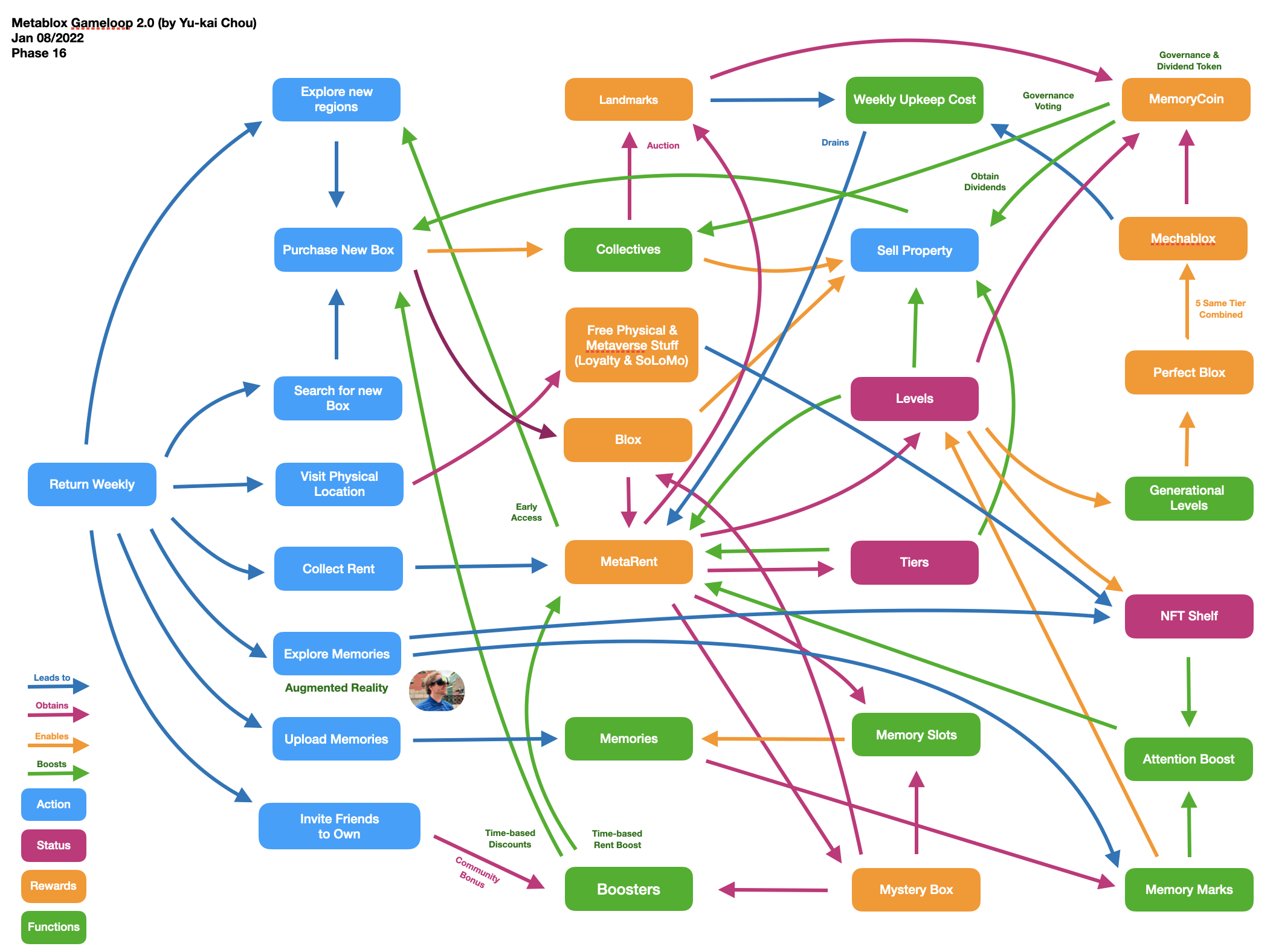
Metablox launched in February 2022, with minting starting in April 2022.
Octalysis Analysis: Why These Blockchain Gamification Examples Work (and Sometimes Don’t)
All three blockchain gamification examples above share a common thread — one that applies to gamification in any industry: they succeeded when they activated multiple Octalysis Core Drives simultaneously.

Axie Infinity combined ownership, accomplishment, and scarcity — but leaned too heavily on extrinsic rewards (earning money), which is a Left Brain, extrinsic motivator. When the economics shifted, the intrinsic engagement wasn’t strong enough to sustain the platform.
Fulldive embedded gamification into a daily habit (browsing), making the rewards feel like bonuses rather than the primary reason to use the product. That’s closer to sustainable White Hat gamification design.
Upland activated collection-set dynamics (Core Drive 4) tied to real-world locations, which creates an emotional connection that pure digital assets can’t match.
The lesson — and one I explore further in my Economy/Tokenomics Design Framework — is simple: blockchain gamification projects that rely solely on Core Drive 4 (speculation-driven ownership) without deeper motivational architecture tend to crash when market sentiment shifts. The ones that layer in Core Drive 3: Empowerment of Creativity and Core Drive 5: Social Influence & Relatedness have a much better shot at long-term survival.
Related Reading
- Metablox Whitepaper 2.0 Part I
- Metablox Resurgence: New Web3 Game Loop
- The Web3 Metaverse and How It Will Change Everything
- The Octalysis Framework for Gamification & Behavioral Design
- Game Design Technique: Collection Sets
- Actionable Gamification: Beyond Points, Badges & Leaderboards
- Top 10 Gamification Examples in the World