
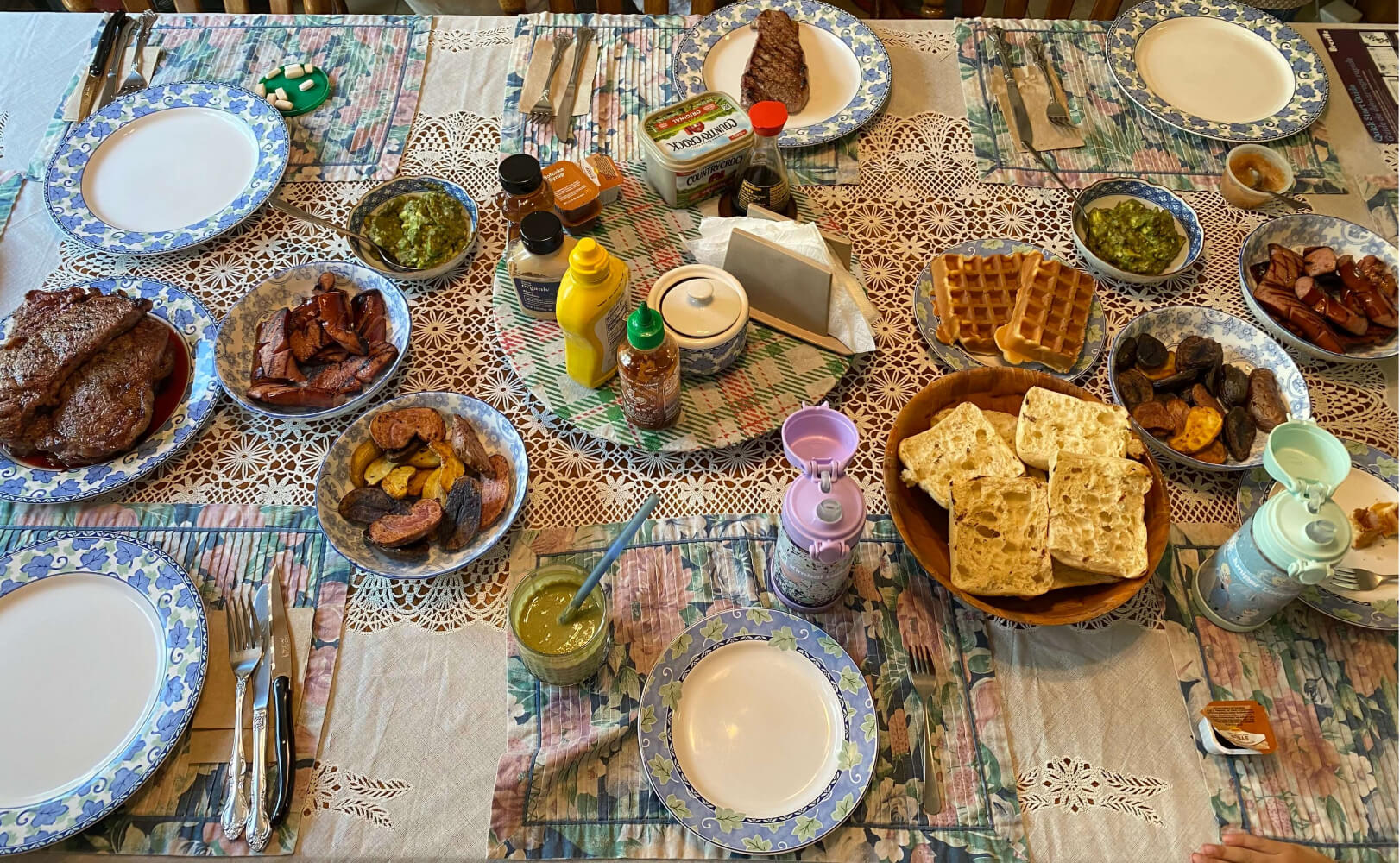

Most adults think children want entertainment when what they actually want is significance. A kid says, “I’m bored,” and we hear, “please distract me.” But that is often the wrong translation. A lot of the time they are really saying, “let me into real life.” They want to stir, carry, wipe, pour, crack, organize, and contribute. They do not want to sit on the sidelines forever while the grown-ups do all the meaningful things.
I learned this over and over again as a parent. The moments that grounded my kids most were rarely the polished activities I planned for them. It was when they got to help make breakfast, fold laundry, set the table, hand me ingredients, or join a task that actually mattered to the family. They were calmer, prouder, and more connected afterwards. Not because the work was easy, but because the work was real.
That is why I think so much modern parenting gets the sequence backwards. We assume work is what adults have to survive and play is what children need to feel alive. But children often come alive through meaningful work. Not wage labor, obviously. Not exploitation. I mean contribution. The kind of work that tells a child, “you matter here, your effort changes things here, and we trust you with something real.”
When children experience that, they stop acting like passive consumers of family life and start acting like junior contributors to it. That shift changes behavior much faster than another threat, another bribe, or another hour of screen time ever will.
⚡ Speed Run Notes
- Togetherness works because it activates Core Drive 5 (CD5): Social Influence & Relatedness. Kids calm down when they feel included in the tribe instead of managed by the tribe.
- Meaningful family tasks also build Core Drive 2: Development & Accomplishment. Children want to feel capable, not just comfortable.
- Threats may force action, but contribution builds identity. The child who helps with breakfast starts seeing themselves differently from the child who is only told to stop making a mess.
- Children usually need a role more than another distraction. The more real the role, the more seriously they treat it.
- The deepest insight is simple. Kids do not only learn through instruction. They learn through belonging, repetition, and the kind of responsibility that says, “you are one of us.”
Table of Contents
About the Author

Jun Loayza is a serial entrepreneur, product leader at YouTube, and the creator of the GRACE Parenting Framework — a behavioral-design approach to raising children grounded in five developmental pillars: Growth, Responsibility, Autonomy, Confidence, and Empathy. He graduated from UCLA in 2007 with degrees in Economics and Philosophy.
Jun has co-founded multiple startups including RewardMe and Untemplater, and has been Yu-kai Chou’s business partner for over 16 years. As a father of three, the GRACE framework grew out of his own daily parenting practice — testing behavioral-design principles on the hardest audience there is: his own kids.
Verify: LinkedIn · Author Archive
T = Togetherness
In Michaeleen Doucleff’s book Hunt, Gather, Parent, she uses the TEAM framing, and the T stands for togetherness. I think that is one of the most important parenting ideas modern families can relearn.
As parents, we often assume growth means sending children off to do things independently as early as possible. Clean your toys by yourself. Sit over there by yourself. Figure it out alone. Sometimes independence is the goal, but togetherness is often the better starting point. Before a child can carry a responsibility alone, they usually need to experience it beside someone else.
That is why children learn so much by watching us and joining us. If we are cleaning and they clean with us, they do not just learn the mechanics of picking things up. They learn the emotional meaning of household contribution. They absorb that this is what our family does. We work together. We take care of our space together. We do not wait to be threatened before we help.
From a design perspective, togetherness is powerful because it taps into autonomy, competence, and relatedness at the same time. The child gets to act, gets to improve, and gets to feel connected. That is a much richer motivational cocktail than “do this or lose a privilege.” Threats may create movement, but they rarely create belonging.
Togetherness also gives children a softer entry into hard things. A task that feels annoying or impossible alone can feel doable when it is shared. That is one reason I like a participation-first approach. It is not lowering the bar. It is creating a runway. Children do not usually wake up wanting isolation. They want access. They want to be where the meaningful action is happening.
When we repeatedly push them away from that action, they often compensate by demanding attention in other ways. They get louder, more chaotic, more dramatic, or more screen-hungry. Adults then read that as proof that the child needs firmer control. Often it is proof that the child needs a role. That distinction is exactly the difference between designing for actions versus motivations. If I only react to the behavior, I miss the deeper hunger that is producing it.
There is a practical side to this too. When a child helps me clean, cook, sort, or carry, I get dozens of tiny coaching moments for free. I can show them how to notice what needs doing, how to finish a small sequence, how to recover from a spill, and how to stay useful even when something is imperfect. None of those lessons land as strongly in abstract conversation. They land when the child is physically inside the work.
I am not saying every task has to become a family ritual. Sometimes a parent is tired, rushed, or simply needs to get something done quickly. But as a general principle, togetherness is underrated. Children who are allowed into real work feel less like background characters in the home. That matters.
Set the Right Expectations
When we teach children mainly through threats, the expectation becomes simple, do this or else. Do this or you lose the toy. Do this or you do not get dessert. Do this or I get angry. That may create short-term obedience, but it teaches the wrong long-term lesson.
If a child only cleans when the parent is present and prepared to enforce a consequence, then the behavior is not really internalized. It is leased. The moment the enforcer disappears, the behavior usually disappears too. That is why so many parents feel like they are managing constant compliance instead of raising increasing capability.
I want a different expectation in the household. I want my children to feel that they are part of a team, that the family runs on shared contribution, and that helping is not a weird exception that happens only under pressure. It is normal. It is who we are. That identity-level framing is much more durable than any single punishment could ever be.
The child who grows up with that expectation starts doing small helpful things without being chased. Not perfectly, of course, but increasingly. They begin to act from internal pride instead of external fear. That identity shift is closely related to what identity and consistency explain so well. Once a child begins seeing themselves as helpful, mature, or dependable, they start protecting that self-image through behavior.
There is also a confidence effect here. A child who is trusted with real family contribution feels less like a decorative object and more like a capable person. That feeling matters. It is part of what later becomes steadier emotional intelligence. They learn they can participate in a tense moment without collapsing, contribute when things are messy, and recover from imperfection without being shamed out of the process.
When the expectations are healthy, children stop reading every task as domination. They start reading tasks as participation. That does not mean they will never resist. It means the whole atmosphere shifts from coercion toward contribution, and that is a much better environment for maturity to grow.
It Is Not Our Job to Entertain Our Children
Our job is not to keep children constantly amused. Our job is to raise them.
That does not mean kids do not deserve rest, delight, stories, and simple pleasures. Of course they do. But many families make a subtle mistake by treating boredom as an emergency and screens as the fastest rescue. Over time that can teach children that any dip in stimulation should be solved by consumption.
I would rather teach them that boredom can be converted into contribution. If I am making eggs or waffles, they can help. If I am putting away groceries, they can carry something. If I am tidying a room, they can join. Yes, it is slower. Yes, it is messier. Yes, the eggs may not come out perfect. But the developmental return is so much higher.
Children are usually more tolerant of real effort than adults give them credit for. They can handle waiting, repeating, trying again, and making awkward attempts when they know the work counts. What drains them is often not effort itself, but effort that feels pointless, fake, or disconnected from reality. That is one reason pretend chores rarely have the same power as actual ones.
This is exactly why the examples in the knife lesson and the solo scoot to grandma’s house matter so much. In both cases, the child is trusted with something real. The task is not fake, the stakes are not imaginary, and the confidence that comes out of it is earned rather than sprayed on with praise.
When children help make breakfast, clean up toys, or carry family tasks, they are not just staying busy. They are building competence. They are also avoiding a quieter danger, the slide toward learned helplessness, where a child gradually concludes that adults do the meaningful things and children just wait, consume, and react. That is not a lesson I want to teach.
One reason entertainment becomes such a default is that it is easier for the adult in the short run. It is faster to put on a show than to hand a child a role and tolerate the extra slowness, mistakes, and supervision. I get that. I feel that too. But easier for the adult in the moment is not always better for the child over time.
There is also a family culture issue here. If children mainly experience adults as people who either serve them or scold them, then they never fully get initiated into household life. But if they experience adults as people who invite them into the real work of living, they start feeling like insiders. That changes behavior more deeply than another rule chart ever will.
That insider feeling matters more than we think. A child who feels like an insider watches differently, listens differently, and starts anticipating what might help next. They are no longer just orbiting the family. They are participating in it. That posture creates a completely different kind of maturity from the one produced by constant correction.
What the Work Is Really Teaching
When a child joins a real family task, the visible lesson may be how to stir eggs, wipe a counter, or fold a towel. But the invisible lessons are often more important. They are learning timing, patience, rhythm, contribution, and the basic truth that effort changes reality.
They are also learning what kind of place the family is. Is this a place where children are mostly obstacles to be managed, or is this a place where children are trusted to grow into meaningful roles? That question sits underneath so many daily interactions.
I think healthy togetherness also creates something like family-scale psychological safety. The child can try, wobble, spill a little, misjudge a step, and still remain part of the effort. They are corrected without being exiled. That makes them much more willing to keep trying.
Children who get that kind of environment usually become more resilient and less dramatic about small stressors. They stop treating every correction like an identity wound. They can hear, “try it this way instead,” without crumbling. That is one reason I care so much about how we frame chores and family work. The task itself matters less than the self-concept that grows around it.
The opposite pattern is easy to spot too. If children are mostly rewarded for being entertained, protected from every friction point, and corrected mainly through punishment, they often become more fragile than they need to be. They may look compliant for stretches, but they have less initiative and less inner steadiness when life asks something real of them.
And that fragility can hide for a long time because modern life is very good at cushioning it. An adult can keep solving, soothing, carrying, reminding, and preempting until the child appears fine. But eventually the world asks for self-starting behavior. At that point the gap shows up fast. The child may be bright and loved, but still oddly hesitant whenever no one else is structuring the moment for them.
So when I say kids do not just want TV, they want work, I am not romanticizing chores. I am pointing to something deeper. Children want access to adulthood in manageable pieces. They want to feel themselves becoming more capable. They want to contribute to the tribe. And when we let them do that, they often become calmer, prouder, and more connected than any purely entertainment-based solution can produce.
That is the long game. Not a clean kitchen for one afternoon. Not a temporarily quiet child. The long game is raising a human being who sees work as meaningful, family as collaborative, and themselves as someone who can matter inside both.
And if that sounds ambitious for something as small as helping with eggs or folding towels, that is exactly the point. Childhood is built out of small repetitions. The child does not become capable in one dramatic leap. They become capable through hundreds of ordinary moments where adults quietly say, in action more than words, you belong here, you can do this, and your contribution counts.
So yes, let them stir badly, carry clumsily, wipe imperfectly, and ask too many questions along the way. The point is not to preserve adult efficiency. The point is to help a child build a life where contribution feels normal, competence feels earned, and family life feels like something they are invited to shape rather than merely consume.
Related Reading
- GRACE Parenting: How to Use a Knife to Teach Kids Autonomy and Confidence
- GRACE Parenting: I Let My Daughter Scoot to Grandma’s House All Alone
- How to Get Siblings to Stop Fighting by Emphasizing Maturity
- The Octalysis Framework for Gamification and Behavioral Design
- What Is Gamification? Definition, Examples, and Framework
This article was written by Jun Loayza, creator of the Dad Smarter Not Harder podcast. Jun and Yu-kai work together on Metablox and Octalysis Prime.