
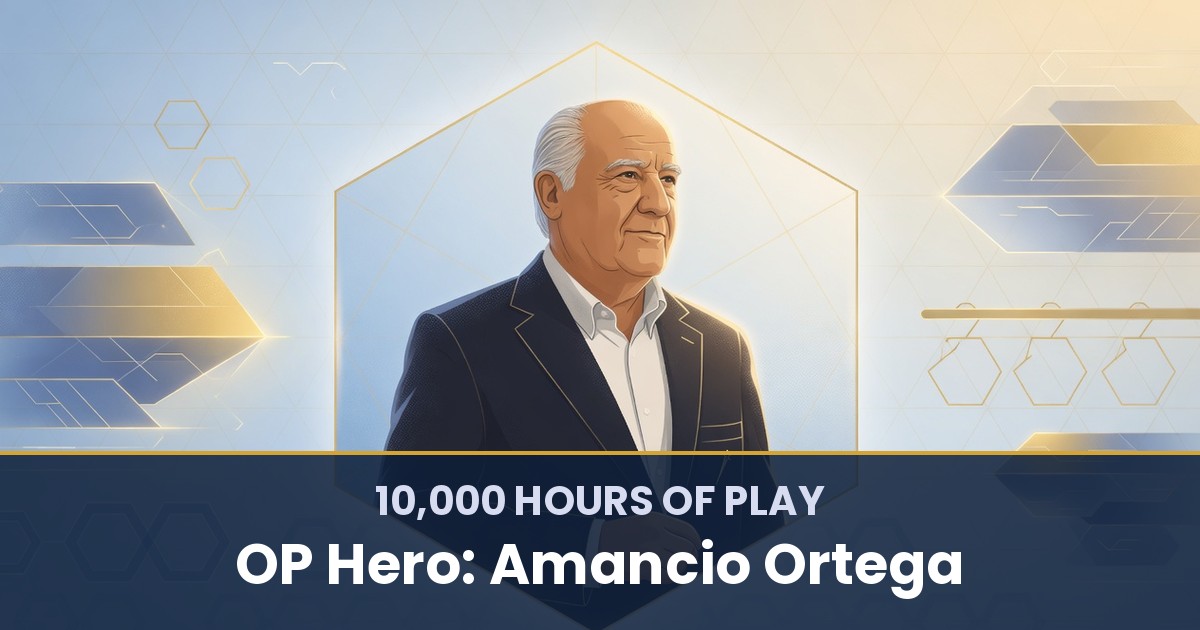


In 1975, a 39-year-old garment manufacturer in A Coruña, on Spain’s far northwest coast, opened a clothing shop under a name nobody had heard of yet: Zara.
The founding story told most often is a story about leftovers. A cancelled order had left his workshop holding finished clothes with no buyer, and Amancio Ortega decided to sell them himself.
By 2024, Zara alone counted 1,759 stores across 97 countries. The man who opened the first one gave almost no interviews along the way.
That silence makes Ortega an unusual case for the 10K HP framework. With almost no speeches or memoirs to lean on, his character build has to be read from the moves he made, and the six Steps below read them in order, from the shirt deliveries he made as a teenager to the chair he handed over in 2011.
⚡ Speed Run Notes
- Ortega’s Game held for five decades: shrink the time between what a customer wants and a garment on the rail, by owning every link from workshop to store.
- His Attributes show in his moves: commercial pattern recognition, systems thinking, an appetite for risk, and near-total indifference to public attention.
- His Roles climbed the whole value chain: shop errand boy, tailoring apprentice, manufacturer, retailer, group chairman, then owner-investor and philanthropist.
- His canon Skills: Track Treasure (Ranger), Cosmic Alignment (Mage), Devour (Warlock), and Cloak (Rogue).
- His Allies covered what he lacked: Rosalía Mera in the early workshop, José María Castellano on systems and logistics, Pablo Isla and Marta Ortega on succession.
Table of Contents
About Yu-kai Chou

Yu-kai Chou is the author of 10,000 Hours of Play — the book that treats your life as the most important game you’ll ever build a character in, and gives you the 6-Step framework (Game · Attributes · Role · Skills · Allies · Quests) to play it on purpose. He has spent two decades developing the system through which this post analyzes its OP Hero, and applies it to his own life and to the lives of the people he advises around the world.
Chou’s other framework, the Octalysis Framework, has been applied by LEGO, Microsoft, Porsche, Coca-Cola, Salesforce, and MrBeast, impacting over 1.5 Billion Users. He has taught the methodology at Harvard, Stanford, Yale, Tesla, Google, BCG, and IDEO, and has advised governments in eight nations including Ukraine, the United Kingdom, the Kingdom of Bahrain, Singapore, Taiwan, the Netherlands, Kazakhstan, and South Korea.
His work has been cited by Harvard, Stanford, MIT, Forbes, Wall Street Journal, Wired, US Department of Energy, NIST, NSF, NCBI, US Department of Education, ClinicalTrials.gov, and Google Scholar — with 3,700+ more academic publications. Explore his books here.
Ortega earns his place in this series because his build shows how far one primary Skill can carry a player when the right Allies cover the rest. If I could lift one move from his character sheet, it would be the way he brought in a systems builder for the part of the work he could not build alone.
Step 1: The Game — What Amancio Ortega Was Actually Playing
Manufacturing came first: in 1963 he set up Confecciones Goa, a small garment workshop, and in 1972 he registered it as a company.
The first Zara store followed in 1975, and in 1985 he incorporated Inditex as the group that held the whole chain together.
Each of those moves pulled Ortega one link closer to the customer. A maker who sells through other people’s shops hears what customers wanted long after the fact, while a maker who owns the shop hears it while the garment is still on the rail.
Read that way, his Game was to shrink the time and distance between what a customer wants and a garment that customer can buy, and to own every link in between so that nobody else could slow the loop down.
The comparison with Henry Ford shows how much the Game decides. Ford also owned his chain end to end at River Rouge, but he pointed that integration at a single product and kept the Model T for almost two decades while General Motors offered yearly models.
Ortega pointed the same kind of structure at change itself, and the payoff he took from owning the chain was the ability to switch designs quickly when customers moved.
Step 2: Attributes — The Innate Stats
Attributes are the stats you bring before any training. Four of Ortega’s show up consistently, from his teenage jobs to his retirement.
The first Attribute is commercial pattern recognition. A teenager who started out delivering shirts later saw that a garment factory could also be a retail business, and the 1975 store is the proof that he acted on what he saw.
The second Attribute is systems thinking, visible in the way he kept treating manufacturing, distribution and the shop floor as parts of one machine. That habit is why each business he founded plugged into the previous one instead of standing alone.
The third is an appetite for risk. Opening a shop under an unknown name was a bet, and so was taking Zara out of Spain from 1988 onward, into markets with very different tastes.
The fourth is an unusual indifference to public attention. He gave few interviews and rarely appeared in public even after Zara became famous, and that trait turns into one of his Skills in Step 4.
The OP Talent Triangle Method is built to surface your Edge Strength, the strength that feels so normal you never noticed it. Ortega’s looks like systems thinking, and he aimed it at an industry where the factory and the shop had usually been run as separate businesses.
Step 3: Role(s) — The Character Class Across Chapters
Ortega’s Role changed at least six times, and almost every change moved him one link along the same chain.
At about fourteen he left school and went to work as a delivery boy and shop assistant at Gala, a shirtmaker in A Coruña. His first class was the errand runner, the person who sees what customers buy and what they bring back.
At La Maja, a clothing shop where his siblings Antonio and Josefa also worked, he learned how garments are actually made. The apprentice class taught him the factory side of the same product he had been carrying across town.
From 1963 he played manufacturer, and according to biographical accounts his early output was quilted bathrobes, with the range later widening into lingerie and nightwear.
In 1975 he respecced into retailer, opening the first Zara store with his first wife and business partner, Rosalía Mera. The retailer class gave him something a manufacturer selling through other people’s shops rarely gets firsthand, which is the customer’s reaction at the moment of purchase.
From 1985 to 2011 he was chairman of Inditex. After 2011 his class became owner-investor and philanthropist: controlling shareholder of Inditex, chairman of his investment company Pontegadea, and founder of the Amancio Ortega Foundation, which he had set up in 2001.
Step 4: Skills — The Real-Life Game Skills Amancio Ortega Mastered
Attributes are the starting stats, and Skills are what a player grinds. Four canon Skills explain most of Ortega’s run.
The first is Track Treasure (Ranger): spotting a hidden opportunity that other people walk past. By 1975 Ortega owned a factory that made clothes for other people’s shops.
Opening his own store in A Coruña turned that factory into a retailer with a direct line to its customers, and Zara became the retail chain that the later Inditex group was built around.
The second is Cosmic Alignment (Mage): making many moving parts arrive at the same place at the same time. The system Ortega and his team built links design, production, distribution and stores in short loops.
Its working parts are well documented: small production runs, rapid replenishment, store managers relaying what customers ask for, and production close to Spain for the most trend-sensitive pieces.
That loop is what lets a collection change within weeks when customers move.
The third is Devour (Warlock): stripping steps out of a process until it runs lean. Owning both factory and shop removed the outside buyer who would otherwise sit between Ortega’s production and his customers.
Small batches did the same job inside the chain, because fewer finished garments sat in a warehouse waiting for demand to catch up.
The fourth is Cloak (Rogue): executing without being noticed. Ortega rarely gave interviews or appeared in public, so for decades Zara’s shoppers knew the brand far better than the man behind it, and the attention stayed on the stores and the clothes.
On the Skills Spectrum, Ortega sits on the Master track: one primary Skill, Cosmic Alignment, with the other three working as synergies that feed it.
Step 5: Allies — The People Who Multiplied Amancio Ortega
A founder who avoids the spotlight still needs a party, and Ortega’s Allies each covered a stat his own build lacked.
Rosalía Mera, his first wife and business partner, worked in the early workshop and opened the first Zara store with him in 1975. Many accounts call her a co-founder of Zara, although Inditex’s own materials name Ortega as the founder.
José María Castellano joined in 1984 and became the group’s systems builder. He was central to developing Inditex’s information systems, distribution and logistics, and he served as deputy chairman and chief executive from 1997 until 2005.
That partnership matters for anyone tempted to read Ortega’s Cosmic Alignment as a solo talent. The fast loop between stores and factories ran on systems that Castellano spent two decades building.
Pablo Isla became chief executive in 2005 and succeeded Ortega as chairman in 2011, a handover that let the founder step back without leaving the company.
Marta Ortega, his daughter, became non-executive chair on 1 April 2022, and the chair passed back into the founding family after eleven years.
Step 6: Quests — The Milestones That Shaped the Saga
Quest one was learning the trade from both ends: at about fourteen Ortega was delivering shirts for Gala, and at La Maja he learned how clothes are made.
Quest two was becoming a manufacturer, which he did by setting up Confecciones Goa in 1963 and registering it as a company in 1972.
Quest three began as a setback, if the account told most often is right: a cancelled order left the workshop with finished stock and no buyer, and Ortega’s answer, in 1975, was a shop of his own in A Coruña.
Quest four was proving that the system could travel. Inditex was incorporated in 1985, and Zara opened in Porto in 1988, New York in 1989 and Paris in 1990.
Quest five was taking the company public: Inditex listed on the Madrid Stock Exchange on 23 May 2001, and investor demand ran to roughly 26 times the shares on offer.
Quest six was handing over the controls. Ortega stepped down as chairman in 2011 and kept his controlling stake, and in October 2015 a rise in Inditex shares briefly put him first on the Forbes real-time billionaires ranking.
He also turned to Pontegadea and to his foundation, which in 2017 announced about €320 million for cancer screening and treatment equipment in Spain’s public health system.
What You Can Steal From Amancio Ortega’s Build
First, find the slowest link between your work and the person it serves, and try to own it. Ortega’s first big move removed the outside buyer that stood between his factory and his customers.
Second, read your Attributes from your own behavior instead of waiting for someone to describe them to you. Ortega’s systems thinking shows up in the sequence of businesses he built, and yours will show up in the problems you keep volunteering to fix.
Third, treat each Role as field research for the next one. Every class he played, from errand runner to chairman, gave him direct experience of a link he would later redesign.
Fourth, recruit Allies for the stats you lack. Castellano built the systems and Isla took over the chief executive’s job, which let the founder step back without breaking what he had built.
Fifth, decide how much attention your Quest needs before you spend energy on visibility. Ortega built a brand with stores in 97 countries while giving almost no interviews.
Where this framework comes from

Want the full system this profile is built on?
Every OP Hero piece runs through the same 6-Step framework from 10,000 Hours of Play: Unlock Your Real-Life Legendary Success. The book covers the full system, walks through Yu-kai’s own life run as the first applied case study, and gives you the worksheets to audit your own build.
Related Reading
- All OP Hero Profiles — the full hub
- 10,000 Hours of Play by OP Hero: Ingvar Kamprad
- 10,000 Hours of Play by OP Hero: Coco Chanel
- 10,000 Hours of Play by OP Hero: Kiichiro Toyoda
- 10,000 Hours of Play by OP Hero: Sam Walton