
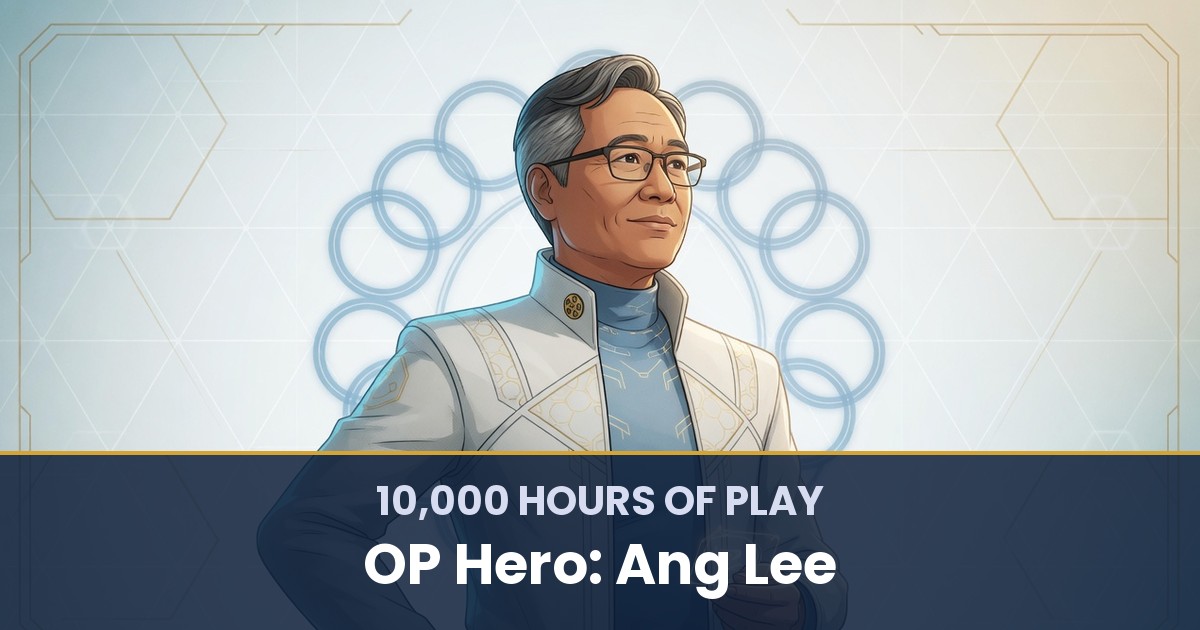


In the late 1980s, a film-school graduate in his thirties spent his days at home writing screenplays that nobody wanted to make.
His wife, Jane Lin, a microbiology researcher, supported the family. He had already failed Taiwan’s college entrance exam twice, disappointed a father who hoped he would become a professor, and won student awards that did not turn into a single feature deal.
That stretch lasted roughly six years. Then two of his scripts won prizes in a Taiwanese screenplay competition, and in 1992, at about thirty-seven, Ang Lee finally directed his first feature.
Fourteen years later he became the first Asian director to win the Academy Award for Best Director. Seven years after that, he won it again. Below, his life runs through the six steps of the 10,000 Hours of Play framework: game, attributes, roles, skills, allies, and quests.
⚡ Speed Run Notes
- Ang Lee’s game: make films about people caught between cultures, duties, and desires, and make them land with audiences who share none of that background.
- His first feature arrived at about 37, after roughly six years of unemployment spent writing scripts while his wife supported the family.
- He changed genre almost every film: Taiwanese family comedy, Jane Austen, wuxia, a Marvel blockbuster, a Western romance, a 3-D survival epic.
- Two Best Director Oscars (2006, 2013) and two Golden Lions, plus two Golden Bears for his films. Also two expensive 120-frames-per-second experiments that lost money.
- His signature Skill is Shapeshift (Druid): walk into a culture that isn’t yours and learn it until you can direct it from the inside.
Table of Contents
About Yu-kai Chou

Yu-kai Chou is the author of 10,000 Hours of Play — the book that treats your life as the most important game you’ll ever build a character in, and gives you the 6-Step framework (Game · Attributes · Role · Skills · Allies · Quests) to play it on purpose. He has spent two decades developing the system through which this post analyzes its OP Hero, and applies it to his own life and to the lives of the people he advises around the world.
Chou’s other framework, the Octalysis Framework, has been applied by LEGO, Microsoft, Porsche, Coca-Cola, Salesforce, and MrBeast, impacting over 1.5 Billion Users. He has taught the methodology at Harvard, Stanford, Yale, Tesla, Google, BCG, and IDEO, and has advised governments in eight nations including Ukraine, the United Kingdom, the Kingdom of Bahrain, Singapore, Taiwan, the Netherlands, Kazakhstan, and South Korea.
His work has been cited by Harvard, Stanford, MIT, Forbes, Wall Street Journal, Wired, US Department of Energy, NIST, NSF, NCBI, US Department of Education, ClinicalTrials.gov, and Google Scholar — with 3,700+ more academic publications. Explore his books here.
What draws me to Ang Lee’s build is how long he stayed in the waiting room without leaving the game. Six years of scripts with no feature is exactly the stretch where most people quietly switch careers, and he used it to stockpile the stories that later launched him. The habit I’d lift from him is how he prepared for worlds he didn’t grow up in: months of research before a single frame.
Step 1: The Game — What Ang Lee Was Actually Playing
Step 1 is choosing your game, and Ang Lee’s game is easy to misread from a list of his credits.
On paper he looks like a director who keeps changing jobs. A Taiwanese family comedy, then a Regency romance, then a martial-arts epic, then a comic-book blockbuster.
Underneath, one mission repeats. He keeps building films about people caught between identities: Taiwanese and American, tradition and modernity, duty and desire, restraint and release.
Then he tries to make those films work for audiences who share none of that background.
That second half is the hard part. Plenty of directors make culturally specific films. Plenty make crowd-pleasers. Lee kept trying to do both at once, on the bet that the emotional core could survive translation without being flattened.
You can trace the pattern from his first three features, Pushing Hands (1992), The Wedding Banquet (1993), and Eat Drink Man Woman (1994), all family conflicts across generations and cultures.
The same tension shows up in the repressed sisters of Sense and Sensibility, in the hidden love of Brokeback Mountain, and in the competing versions of truth in Life of Pi.
Step 2: Attributes — The Innate Stats
Attributes are what you bring before training. Lee’s show up early, and a couple of them show up as failures.
Cross-cultural empathy. He grew up in Taiwan, moved to the United States for university, and spent his career with characters who can’t be contained by one social identity.
Patience under uncertainty. Failing the college entrance exam twice would have ended a lot of stories. So would six years without a directing job. Lee’s stat here is the ability to keep working without any external signal that the work will pay off.
Pattern recognition across unlike material. He saw the same emotional machinery in a Taiwanese family kitchen, in Jane Austen’s drawing rooms, and on a mountainside in the American West. That is how a director moves between genres without losing his voice.
Formal curiosity. Theater, short films, literary adaptation, wuxia choreography, digital effects, 3-D, and high-frame-rate capture. He kept reaching for new tools instead of repeating the format that had just worked.
One stat is missing. Nothing in his early record suggests test-taking talent, and his father’s preferred path for him, a conventional academic career, played to exactly the stat he lacked.
That mismatch is what the OP Talent Triangle Method is built to catch: a path that ignores your strongest stats will grind you down no matter how hard you work it.
Step 3: Role(s) — The Character Class Across Chapters
Lee changed class roughly every five to ten years, and each change came with a new kind of risk.
Arts student (1972–1975). After the exam failures he entered the National Taiwan College of Arts, where he studied theater and got interested in acting, stage direction, and movement.
Immigrant apprentice (mid-1970s to mid-1980s). He earned a B.F.A. in theater at the University of Illinois, then entered New York University’s graduate film program. At NYU he worked as an assistant on Spike Lee’s thesis film, Joe’s Bed-Stuy Barbershop: We Cut Heads.
Unemployed screenwriter (mid-1980s to early 1990s). The waiting-room class. No features, a lot of scripts, and a household running on his wife’s income.
Taiwanese family-drama director (1992–1994). The three films that established his themes of family, generational conflict, and cultural negotiation.
International literary adapter (1995–1999). Sense and Sensibility took him into the nineteenth-century England of Jane Austen. The Ice Storm took him into American suburban alienation.
Global genre filmmaker (2000–2003). Crouching Tiger, Hidden Dragon and Hulk, one a worldwide breakthrough and one a hard lesson.
Prestige auteur and technology experimenter (2005 onward). Brokeback Mountain, Lust, Caution, Life of Pi, and then two films shot at 120 frames per second.
Step 4: Skills — The Real-Life Game Skills Ang Lee Mastered
Attributes are the dice you rolled. Skills are what you grind. Lee’s record shows four canon Real-Life Game Skills, each tied to a specific chapter.
Lich Grind (Warlock) — intense, secluded work periods. The six unemployed years were a long Lich Grind: writing at home, developing scripts, and waiting for financing. Two of those scripts, Pushing Hands and The Wedding Banquet, won prizes in a Taiwanese screenplay competition, and producer Hsu Li-kong at Central Motion Picture Corporation then backed Pushing Hands.
Shapeshift (Druid) — adapting to new environments and people to build relatedness. When a Taiwanese director took on Jane Austen, he spent about six months on period research before production. The result won the Golden Bear at Berlin in 1996 and earned seven Oscar nominations, with Emma Thompson winning for her adapted screenplay.
He ran the same Skill again on the American West for Brokeback Mountain. Each time, he learned the world first and directed it second.
Revive (Paladin): recovering from failure and taking new action toward the next Quest. Hulk (2003) drew a mixed reaction from critics and audiences after the triumph of Crouching Tiger. His next move was a smaller, quieter film, Brokeback Mountain, which won the Golden Lion at Venice in 2005 and then the Best Director Oscar in 2006.
Courageous Heart (Paladin): charging into uncharted territory. Life of Pi is a survival story built around a boy, a tiger, and a lifeboat on open ocean. Lee shot it in 3-D, built a large wave tank in Taichung, Taiwan, and worked with Rhythm & Hues to create a tiger that was mostly digital.
It won four Oscars, including his second for Best Director, and grossed about $609 million worldwide.
On the Skills Spectrum, Lee sits in an interesting spot. His theme stays specialist-narrow, but his toolkit reads like a dabbler’s, because each new genre was a deliberate way to acquire a new craft vocabulary.
Step 5: Allies — The People Who Multiplied Ang Lee
Lee’s story is usually told as a lone artist finally breaking through. The allies tell a different story.
Jane Lin. They met at the University of Illinois. During the unemployed years, her work as a microbiology researcher kept the household running, which is what made the Lich Grind survivable at all.
James Schamus. A screenwriter and producer who became Lee’s long-term creative partner, writing or producing much of his early and middle career. Schamus was the bridge between Lee’s personal themes and scripts that English-language financiers could say yes to.
Ted Hope and Good Machine. Hope’s production company, co-run with Schamus, produced Lee’s films through the independent phase and gave him an institutional base while he was still an unknown.
Hsu Li-kong. The Central Motion Picture Corporation producer who helped finance Pushing Hands, turning a prize-winning script into an actual first feature.
Yuen Woo-ping. The action choreographer on Crouching Tiger, Hidden Dragon. Lee brought the drama; Yuen brought the fight language that made the film travel.
At every level-up, Lee found someone whose strongest stat covered his weakest one, from rent money to English-language script craft to wire-work choreography.
Step 6: Quests — The Milestones That Shaped the Saga
Quest 1: The student shorts (1982–1984). At NYU, Shades of the Lake won Taiwan’s Best Drama Award for short film, and Fine Line won NYU’s Wasserman Award for Outstanding Direction and was broadcast on PBS. Proof of ability, with no feature deal attached.
Quest 2: The waiting room (mid-1980s to 1991). This is the setback quest, and it lasted about six years. Lee wrote, pitched, and waited while Jane Lin’s income carried the family. It ended when his scripts won in Taiwan and Pushing Hands reached production in 1992.
Quest 3: The Golden Bear (1993). The Wedding Banquet won the top prize at the Berlin International Film Festival and earned an Oscar nomination for Best Foreign Language Film. Three years later, Sense and Sensibility won the Golden Bear too.
Quest 4: Crossing over with wuxia (2000). Crouching Tiger, Hidden Dragon received ten Oscar nominations and won four, including Best Foreign Language Film. It grossed about $128 million in North America, the highest total for a foreign-language film in the United States at the time.
Quest 5: Two Oscars for Best Director (2006 and 2013). Brokeback Mountain made him the first Asian director to win the award. Lust, Caution added a second Golden Lion at Venice in 2007. On February 24, 2013, Life of Pi brought the second Best Director Oscar.
Quest 6: The 120-frame gamble (2016 and 2019). A second setback, and a self-chosen one. Billy Lynn’s Long Halftime Walk was shot in 3-D at 120 frames per second in 4K, and grossed roughly $30 million worldwide against a production budget of about $40 million.
Gemini Man (2019) used 120 frames per second again and underperformed, grossing about $166 million worldwide on a reported budget near $140 million.
Both films were Courageous Heart plays that did not pay off at the box office.
What You Can Steal From Ang Lee’s Build
Treat the waiting room as a grind zone. Lee’s six unemployed years were when he wrote the scripts that launched him. If you are between quests, the question is what you are stockpiling.
Hold the theme still and move the genre. His mission stayed fixed for nearly three decades while the format changed almost every film. That combination let him grow new skills without losing a recognizable identity.
Earn the right to tell the story. Six months of research before Sense and Sensibility is the Shapeshift price of entry.
Recruit for your weakest stat. Rent money, English-language script craft, fight choreography: each ally Lee picked covered a gap he could not close alone.
Budget for expensive experiments. The 120-frame films lost money. He tried them anyway, after two Oscars, when repeating a proven formula would have been easy.
Pick the one unfamiliar world your next project needs you to understand, and start the six months of research this week.
Where this framework comes from

Want the full system this profile is built on?
Every OP Hero piece runs through the same 6-Step framework from 10,000 Hours of Play: Unlock Your Real-Life Legendary Success. The book covers the full system, walks through Yu-kai’s own life run as the first applied case study, and gives you the worksheets to audit your own build.
Related Reading
- All OP Hero Profiles: the complete library
- 10,000 Hours of Play by OP Hero: Akira Kurosawa
- 10,000 Hours of Play by OP Hero: Alfred Hitchcock
- 10,000 Hours of Play by OP Hero: Hayao Miyazaki
- 10,000 Hours of Play by OP Hero: Bruce Lee
- What’s Your Main Stat? The 10,000 Hours of Play Attribute Test