
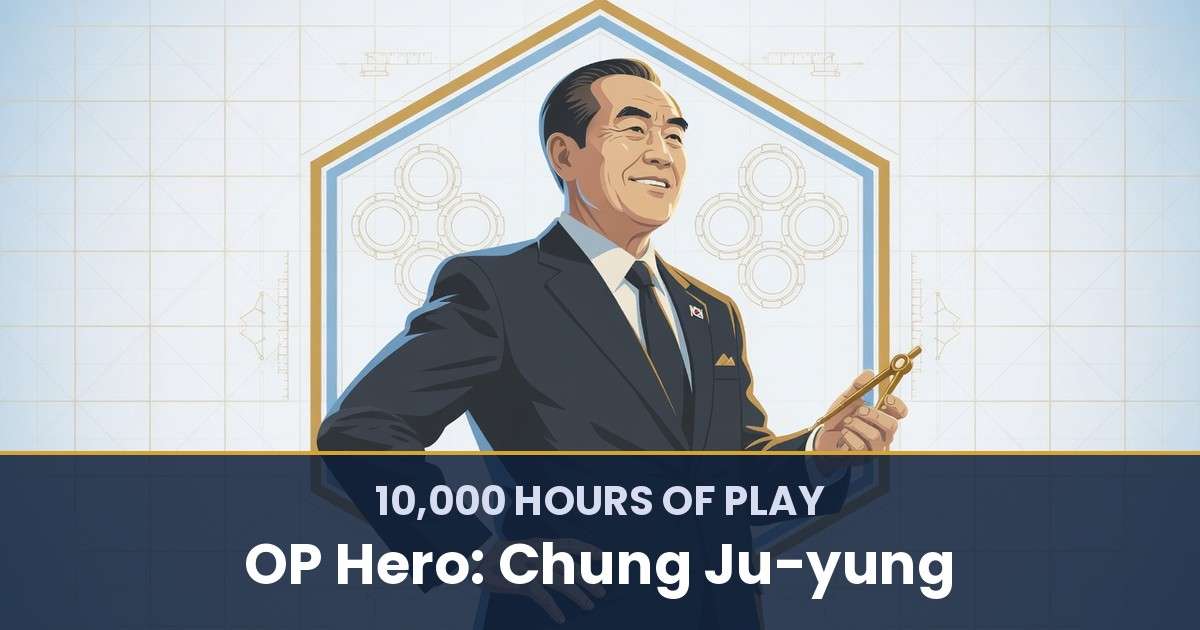


June 16, 1998. An 82-year-old man in a plain dark suit stands at Panmunjom, the truce village on the most heavily fortified border on the planet, and gives a signal.
Fifty trucks rumble north across the line into North Korea. Their cargo is 500 cattle.
Chung Ju-yung was going home. He had been born just up that coast, in a village now stranded on the wrong side of the border, and he had left it as a teenager by taking the money from one of his father’s cows to buy a train ticket to Seoul.
Sixty-five years later he was settling the account. Not one cow. He would bring 1,001 in all: one for the animal he took, a thousand more as interest.
In the decades between the theft and the repayment, he built Hyundai. From a rice-delivery route and a primary-school education he assembled the largest industrial group in Korea: the biggest shipyard on Earth, the country’s first homegrown car, expressways, refineries, and offshore platforms, grown out of a nation that in 1953 was among the poorest anywhere.
Run Chung’s life through the 10,000 Hours of Play framework and the improbable stops looking like luck. It reads like a character sheet: a specific set of stats, roles, and Skills, played by a man who refused the word impossible. Here is the build.
⚡ Speed Run Notes
- Chung Ju-yung played one Game for seven decades: take ground everyone had written off and make it produce. He turned a rice route and a primary-school education into Korea’s largest chaebol.
- His signature move was selling the result before it existed. In 1971 he financed the Ulsan shipyard with a photo of an empty beach and a 500-won note, then built the yard and the supertankers inside it at the same time.
- The Attributes showed early: an engine of will, an appetite for risk that had him running off the farm as a boy, and a builder’s speed he stamped on the company as palli-palli, “hurry-hurry.”
- Five canon Skills carry the build: Vision Manifestation, Undying Rage, Courageous Heart, Hydra Riposte, and Concord of Elements.
- His worst public defeat came in politics: a 1992 presidential run that took 16.1% for third place. His final act repaid a childhood debt with 1,001 cattle driven across the DMZ.
Table of Contents
- About Yu-kai Chou
- Step 1: The Game Chung Was Actually Playing
- Step 2: Attributes, the Innate Stats
- Step 3: Role(s) Across Chapters
- Step 4: The Real-Life Game Skills He Mastered
- Step 5: The Allies Who Multiplied Him
- Step 6: The Quests That Shaped the Saga
- What You Can Steal From Chung’s Build
- Where this framework comes from
- Related Reading
About Yu-kai Chou

Yu-kai Chou is the author of 10,000 Hours of Play — the book that treats your life as the most important game you’ll ever build a character in, and gives you the 6-Step framework (Game · Attributes · Role · Skills · Allies · Quests) to play it on purpose. He has spent two decades developing the system through which this post analyzes its OP Hero, and applies it to his own life and to the lives of the people he advises around the world.
Chou’s other framework, the Octalysis Framework, has been applied by LEGO, Microsoft, Porsche, Coca-Cola, Salesforce, and MrBeast, impacting over 1.5 Billion Users. He has taught the methodology at Harvard, Stanford, Yale, Tesla, Google, BCG, and IDEO, and has advised governments in eight nations including Ukraine, the United Kingdom, the Kingdom of Bahrain, Singapore, Taiwan, the Netherlands, Kazakhstan, and South Korea.
His work has been cited by Harvard, Stanford, MIT, Forbes, Wall Street Journal, Wired, US Department of Energy, NIST, NSF, NCBI, US Department of Education, ClinicalTrials.gov, and Google Scholar — with 3,700+ more academic publications. Explore his books here.
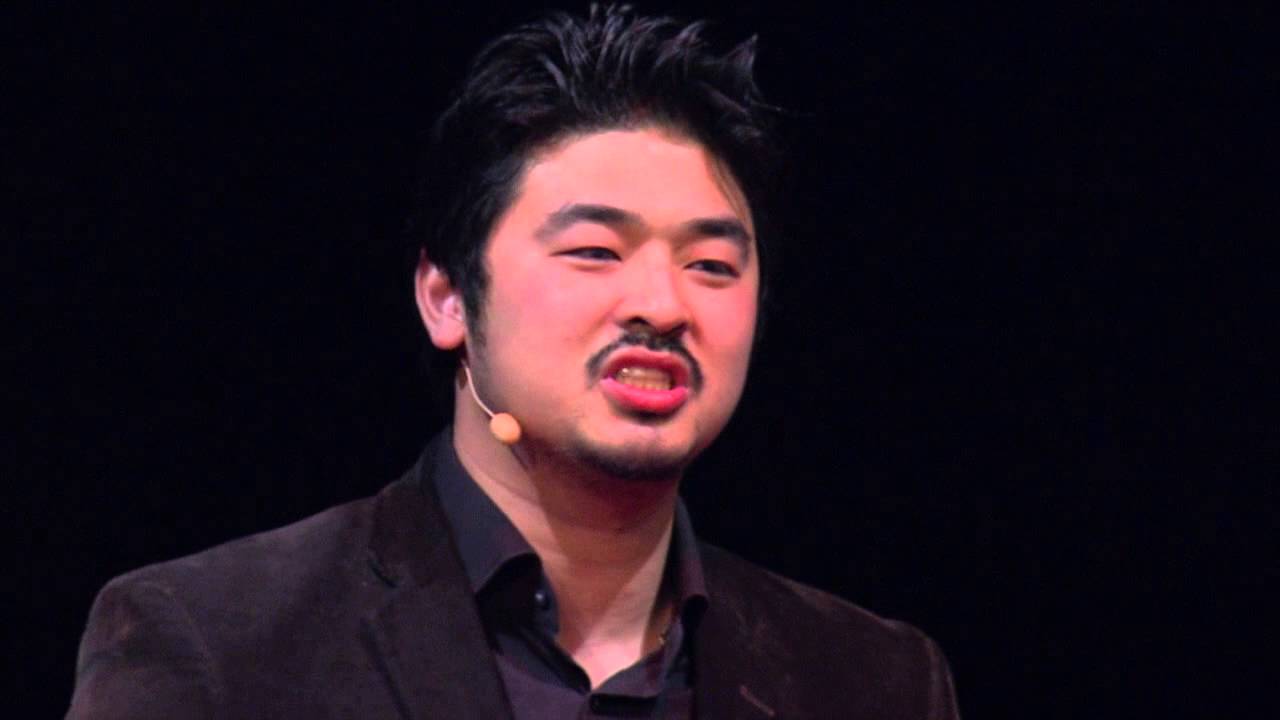
What grabs me about Chung’s build is that he treated will as a Skill he could train, not a mood he waited for. He had no capital, no shipbuilding industry, and barely any schooling, so he manufactured belief on purpose and made reality catch up. The stat I would lift for your own sheet is his Vision Manifestation. He sold two supertankers off a blueprint before the shipyard existed, which left him no option but to build the thing he had already promised. Commit out loud first, then let the weight of the promise pull the work into being.
Step 1: The Game — What Chung Ju-yung Was Actually Playing
Strip away the trucks and the shipyards and Chung’s Game stayed constant from his first rice deliveries to his last board meeting: take a piece of ground everyone had dismissed, and make it produce.
A barren stretch of coast at Ulsan became the largest shipyard on Earth. A tidal mudflat at Seosan Bay became farmland. A rented room and a secondhand truck became the biggest construction company in the country.
The through-line was a refusal. When his own engineers called a plan impossible, his answer became the most quoted sentence in Korean business: “Have you even tried it? How do you know it can’t be done if you haven’t tried?”
That was not folksy branding. Chung had watched Korea lose its language and its harvests under occupation, then lose most of its buildings in the war, and he had concluded that the one asset a poor country fully controls is the willingness of its people to attempt the unreasonable thing.
His Game carried a second win condition that only came into focus at the end. He wanted to close the circle with the North: the region he came from, the farm he ran away from, the border that had cut his birthplace out of the country he built.
Industry was the public quest. Going home was the private one, and he chased both to the last year of his life.
Step 2: Attributes — The Innate Stats
Attributes are the stats you bring before any training. Chung’s were loud from childhood.
An engine of will. The famous line about trying was not a slogan invented by the marketing department. It was how he had already lived for forty years by the time it got printed on posters. He generated forward motion the way other people generate excuses.
An appetite for risk. As a boy he ran away from the family farm again and again, chasing the city against his father’s wishes. One of those escapes was funded by the money from a family cow. The willingness to bet what little he had, and to absorb the consequences, never left him.
A builder’s hands and a builder’s eye. With only a primary-school education, Chung learned by doing the labor himself, first as a dockworker and mechanic, later as a contractor who could out-argue his own engineers because he had personally hauled the loads and turned the wrenches.
Relentless speed. He drove Hyundai at a tempo Koreans still call palli-palli, hurry-hurry, compressing schedules that rivals called reckless and delivering on them often enough to make the recklessness look like foresight.
If you want to run this exercise on yourself, the Talent Triangle method is the tool for surfacing which innate stats have been showing up in your own story since childhood.
Step 3: Role(s) — The Character Class Across Chapters
Chung’s saga runs through five classes, and each one was earned at the bottom before it paid off at the top.
The delivery boy (1930s). He arrived in Seoul with nothing, worked the docks and a construction site, then carried rice for the Bokheung store. When the owner fell ill in 1937 and handed him the shop, he ran it well enough to make it his own, until colonial rice rules shut it down in 1939.
The mechanic (1940 onward). He opened the A-do auto-repair garage with a borrowed stake and grew it from twenty workers to seventy in three years. Machines taught him what schooling had not.
The contractor (from 1947). After liberation he founded Hyundai Engineering & Construction, survived the war by taking U.N. and U.S. military work, and rebuilt each time the country did.
The industrialist (1967 to 1972). Hyundai Motor in 1967, then Hyundai Heavy Industries and the Ulsan shipyard in 1972. He stopped taking contracts and started founding industries.
The statesman (1980s to 1998). He led Seoul’s Olympic bid, ran for president, and turned diplomat toward the North. This last class change is the sort of arc you also see in Kiichiro Toyoda’s OP Hero profile, another founder who rebuilt a wrecked postwar economy one factory at a time.
Step 4: Skills — The Real-Life Game Skills Chung Ju-yung Mastered
On the Skills Spectrum, Chung sits at the strategist end: a generalist who could parachute into shipbuilding, cars, or land reclamation and win. Five canon Skills carried the build.
Vision Manifestation (Warlock) — visualizing success so vividly it shapes reality. In 1971, turned down by banks in America and Japan, Chung walked into Barclays in London carrying a photo of an empty Ulsan beach and a 500-won note stamped with a 16th-century Korean turtle ship. His pitch: Koreans built ironclad warships centuries before Britain, so they could certainly build tankers. He left with roughly $43 million and orders for two supertankers on a yard that did not yet exist.
Undying Rage (Warrior) — activating survival instinct to defeat an overwhelming challenge. With the loan secured, he built the shipyard and the ships at the same time, pouring the docks while welding the hulls, and delivered the first vessels in 1974. By 1983 Hyundai was the largest single shipbuilder in the world.
Courageous Heart (Paladin) — charging into territory where you have no footing. In 1976 Hyundai won the Jubail industrial-port contract in Saudi Arabia, worth about $930 million, close to a quarter of Korea’s entire national budget that year. Chung had his crews fabricate giant steel jackets in Ulsan and barge them thousands of miles across open ocean to the Persian Gulf, a logistics gamble foreign engineers considered lunacy. The same nerve shows up in Cornelius Vanderbilt’s OP Hero build, another self-made industrialist who bet everything on moving heavy things faster than anyone thought possible.
Hydra Riposte (Ranger) — countering a crushing attack with sudden innovation. At Seosan Bay in the 1980s, the final gap in a sea wall had a tidal current near eight meters per second that swept away boulders the size of houses. Chung’s fix was pure improvisation: he sank a retired supertanker across the channel to still the water long enough to close the gap. Engineers still call it the “Chung Ju-yung method.”
Concord of Elements (Druid) — bringing hostile parties into the same room. The 1998 cattle crossing was not sentiment alone. It opened Hyundai Asan and the Mt. Kumgang tours, the first real channel of inter-Korean commerce, and helped set the table for the 2000 summit between the two governments.
Step 5: Allies — The People Who Multiplied Chung Ju-yung
A build this large was never a solo run. Chung’s Alliance was part family, part foreign expertise, part the Korean state.
His brothers ran the empire’s wings so he could keep starting new ones. Chung Se-yung took the wheel at Hyundai Motor, freeing the founder to chase shipyards and deserts while the car business matured.
Charles Longbottom and the British shipbuilders gave the Ulsan gamble its credibility. The consultant vouched for Hyundai, and the A&P Appledore yard supplied the design know-how a company with zero ships had no other way to buy.
George Livanos, the Greek shipowner, made the whole thing bankable by ordering those first two supertankers before the yard broke ground. Orders in hand turned a wild idea into a financeable one.
President Park Chung-hee and the export-driven state handed Hyundai nation-scale quests, from the Gyeongbu Expressway to the heavy-industry push, and Chung delivered them fast enough to keep earning the next one.
His sons carried the pieces forward, from Hyundai Motor to Heavy Industries to the Group itself. The reliance on a tight inner circle to scale is a pattern you also see in Jack Ma’s OP Hero profile, where a founder’s early team became the multiplier on everything that followed.
Step 6: Quests — The Milestones That Shaped the Saga
Quest 1: Pave the spine of a country (1968 to 1970). Hyundai built much of the Gyeongbu Expressway connecting Seoul and Busan, at a speed that announced the company as the state’s go-to builder. Reward: the credibility that unlocked every larger quest.
Quest 2: Build a shipyard from a beach (1971 to 1974). The Barclays pitch, the simultaneous construction of yard and ships, and the first deliveries. This is the run that turned a contractor into a global industrialist.
Quest 3: Put Korea on wheels (1967 to 1975). Hyundai Motor launched in 1967, and by 1975 it was producing the Pony, the first mass-produced car designed in Korea rather than assembled from someone else’s kit. A national industry started here.
Quest 4: Conquer the desert (1976). Jubail, the steel jackets, the ocean barges. The contract that proved a Korean firm could out-build the West on the West’s biggest stage.
Quest 5: The defeat (1992). Here is the setback the highlight reels skip. Chung founded the Unification National Party and ran for president, convinced a builder could run a country. He took 16.1% of the vote and finished third behind Kim Young-sam and Kim Dae-jung, then faced tax investigations widely read as political payback. His win-everything streak met the one arena that would not bend to palli-palli.
Quest 6: Pay the cow back (1998). At 82 he drove 1,001 head of cattle across the DMZ, opened the North to Hyundai tourism, and reached the birthplace he had left as a runaway. The instinct to convert a private mission into a public institution echoes Konosuke Matsushita’s OP Hero profile, another industrialist who spent his final chapters building for a cause larger than the balance sheet.
What You Can Steal From Chung Ju-yung’s Build
Promise the result before you can prove it. Chung sold supertankers off a photograph and a banknote, then built a shipyard to keep his word. A public promise you cannot yet back is one of the strongest forcing functions there is, provided you are willing to do the work it demands of you afterward.
Make speed a Skill, not an accident. Palli-palli was a deliberate advantage. When the field expects two years, delivering in one is not just faster, it changes who gets the next contract.
Improvise at the point of failure. The tide beat the boulders, so he sank a ship. When the standard method breaks, the win usually comes from someone willing to try the move that sounds absurd in the meeting.
Let the last quest be personal. Chung spent his final years repaying a cow and reaching a village most people would have filed under nostalgia. The most durable builds tend to end on a specific human debt repaid, not a bigger number posted.
Chung’s sheet sits alongside every other legend we have profiled. Scan the full roster of OP Hero profiles and you will notice how many of the greatest builds began with someone who had nothing but the refusal to accept that it could not be done.
Where this framework comes from

Want the full system this profile is built on?
Every OP Hero piece runs through the same 6-Step framework from 10,000 Hours of Play: Unlock Your Real-Life Legendary Success. The book covers the full system, walks through Yu-kai’s own life run as the first applied case study, and gives you the worksheets to audit your own build.
Related Reading
- All OP Hero Profiles: the full hub of legendary builds analyzed through the 10,000 Hours of Play framework.
- 10,000 Hours of Play by OP Hero: Kiichiro Toyoda: the Toyota founder who built a postwar auto industry out of a loom company.
- 10,000 Hours of Play by OP Hero: Cornelius Vanderbilt: a self-made tycoon who turned ferries and rail into an industrial empire.
- 10,000 Hours of Play by OP Hero: Jack Ma: another founder who talked an impossible venture into existence and scaled it through his team.
- 10,000 Hours of Play by OP Hero: Konosuke Matsushita: the poverty-to-industry builder who spent his last decades on a cause larger than profit.