
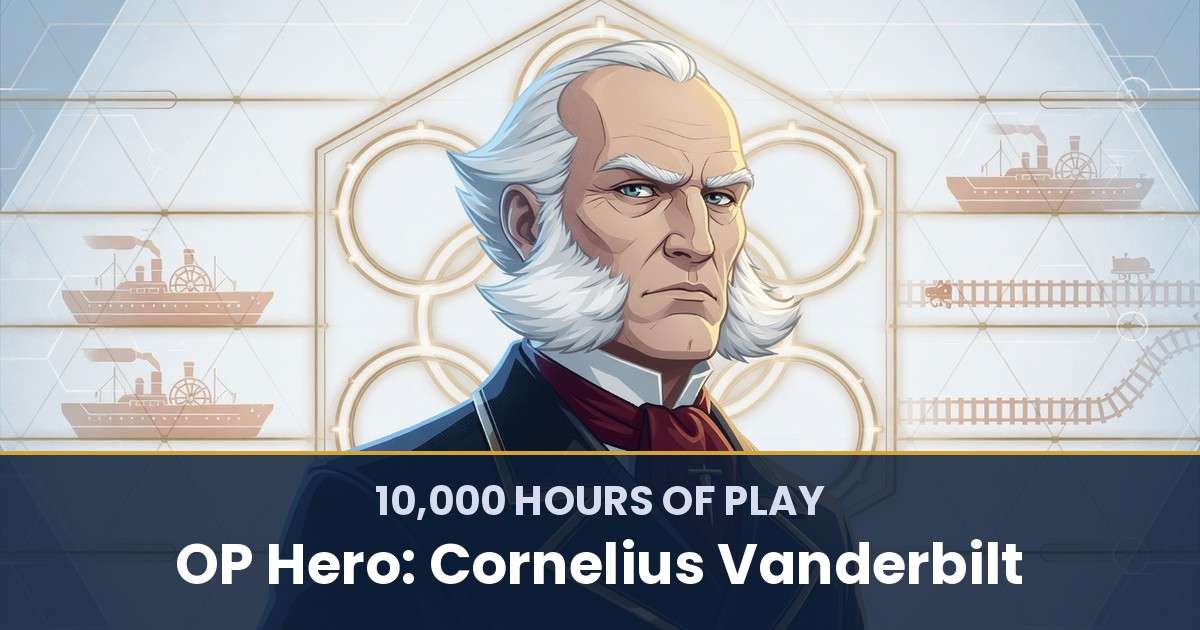


In the spring of 1853, Cornelius Vanderbilt did something no self-made American tycoon had tried before. He handed the daily running of his empire to subordinates, loaded his family onto a steam yacht he had built for himself, the North Star, and sailed for Europe to let the Old World look at a man who had started with one small ferryboat.
While he was away, two of his own lieutenants, Charles Morgan and Cornelius Garrison, quietly took control of his most profitable line: the Accessory Transit Company that carried Gold Rush travelers across Nicaragua.
The letter he is said to have written when he got home has been repeated for 170 years. The exact wording is almost certainly apocryphal, but the substance is well documented. He told them he would not bother suing, because the law moved too slowly. He would ruin them instead. Within two years, he had.
Most people file Vanderbilt under “robber baron” and move on. Run his life through the six-step framework in 10,000 Hours of Play, which treats your life as a game you can learn to play on purpose, and a clearer figure shows up: a man who picked one game, compounded a single advantage for six decades, and turned the worst betrayal of his career into the fuel for his largest expansion.
⚡ Speed Run Notes
- Vanderbilt played one game his whole life: control the arteries of movement. He rode that single idea from a Staten Island ferry through harbor steamboats to the Eastern railroads, and died in 1877 with a fortune above $100 million.
- His signature move was the price war backed by ruthless cost discipline. He would slash fares below what rivals could survive, run leaner than they could, and buy them out once they broke.
- His sharpest attribute was pattern recognition: he saw steam beat sail, then rail beat water, and shifted his capital each time while older operators stayed put.
- His defining setback was the 1853 seizure of his Nicaragua transit line by Morgan and Garrison while he toured Europe. He came back and crushed both men.
- Late in life the operator became a builder. The 1869 consolidation of the New York Central and a $1 million gift founding Vanderbilt University in 1873 turned a fortune into a system and a legacy.
Table of Contents
About Yu-kai Chou

Yu-kai Chou is the author of 10,000 Hours of Play — the book that treats your life as the most important game you’ll ever build a character in, and gives you the 6-Step framework (Game · Attributes · Role · Skills · Allies · Quests) to play it on purpose. He has spent two decades developing the system through which this post analyzes its OP Hero, and applies it to his own life and to the lives of the people he advises around the world.
Chou’s other framework, the Octalysis Framework, has been applied by LEGO, Microsoft, Porsche, Coca-Cola, Salesforce, and MrBeast, impacting over 1.5 Billion Users. He has taught the methodology at Harvard, Stanford, Yale, Tesla, Google, BCG, and IDEO, and has advised governments in eight nations including Ukraine, the United Kingdom, the Kingdom of Bahrain, Singapore, Taiwan, the Netherlands, Kazakhstan, and South Korea.
His work has been cited by Harvard, Stanford, MIT, Forbes, Wall Street Journal, Wired, US Department of Energy, NIST, NSF, NCBI, US Department of Education, ClinicalTrials.gov, and Google Scholar — with 3,700+ more academic publications. Explore his books here.

What draws me to Vanderbilt’s build is how much he did with one idea. He never diversified into a dozen games. He found the single thing he understood better than anyone alive — the economics of moving people and goods — and he pressed on it for sixty years, first with boats and then with trains. Most of us keep hunting for a new advantage every few years and never let any of them compound. If you steal one thing from the Commodore, steal that patience with a single edge. His ruthlessness is not the part worth copying. The willingness to bet a lifetime on one well-understood game is.
Step 1: The Game — What Cornelius Vanderbilt Was Actually Playing
A young man in 1810 could chase a lot of games. Land, cotton, banking, politics. Vanderbilt looked at all of it and picked movement.
His real game was never “ships” or “trains.” It was control of the arteries that commerce had to flow through. He wanted to own the chokepoints, the routes everyone else depended on, so that whoever wanted to move goods or people through New York had to pay him to do it. The vehicle changed across his life. The game did not.
That is why he could abandon the very business that made him famous. He built the largest steamship operation in America and then, in his sixties, began pouring that money into railroads because he could see they would become the new arteries. A man attached to ships would have defended his ships. Vanderbilt was attached to the game underneath them, so he followed it onto the rails without hesitation.
This is the quiet lesson at the heart of playing your life as a game. The obvious ambition was to get rich. The deeper move was choosing a single arena he could understand better than anyone and refusing to be distracted from it for six decades. Pick the arena well and every year of effort stacks on the last. Scatter across arenas and the compounding never starts.
Step 2: Attributes — The Innate Stats
Attributes are the dials you show up with. Vanderbilt trained hard for seventy years, but a few were set high from the very beginning.
The first is raw risk tolerance. At sixteen he borrowed $100 to buy a small boat and start a ferry between Staten Island and Manhattan, instead of taking safe wages on someone else’s vessel. He ran it so hard, in such long hours, that the boat earned a nickname for punishing everyone aboard. The appetite for a bold bet was there before he had anything to lose.
The second is competitive aggression that bordered on hunger. He did not want to survive a rivalry. He wanted the other man gone. That drive shows up in his teens and never leaves, straight through to the railroad wars of his seventies.
The third is the one that actually made the fortune: pattern recognition in new infrastructure. He saw that steam would beat sail years before most sailmen took it seriously, and moved. Decades later he saw that rail would beat water, and moved again, shifting his capital while peers his age clung to the boats that had made them.
If you want to find your own high dials before you spend a decade building on them, that is exactly what the Talent Triangle Method is for. Vanderbilt’s triangle points cleanly at nerve, aggression, and an eye for where the world was about to move.
Step 3: Role(s) — The Character Class Across Chapters
Nobody plays one class for a whole life, and Vanderbilt respecced several times while keeping the same core stats.
He opened as a teenage ferryman, a hands-on operator piloting a single boat and undercutting local fares to win the harbor traffic. By his twenties he had leveled into a steamboat captain and contractor, running boats for the established owner Thomas Gibbons and executing the aggressive strategies that would define his style.
Then came the class that made him a household name: independent steamboat magnate. Through the 1830s and 1840s he owned lines up the Hudson and across Long Island Sound, building an integrated web of routes and schedules that slowly strangled his rivals. People started calling him “the Commodore,” and the nickname stuck for the rest of his life.
His final class was the one he grew into last and is remembered for most: railroad consolidator and system builder. In the 1860s he stopped merely operating and began combining whole railroads into unified trunk lines, reshaping how the Eastern United States moved. It is the same arc you see in other Gilded Age titans like Andrew Carnegie, who also climbed from hands-on operator to system architect before turning to giving the fortune away. Each of Vanderbilt’s classes funded the next. The ferryman bought the steamboats, the steamboats bought the railroads, and the railroads built the dynasty.
Step 4: Skills — The Real-Life Game Skills Cornelius Vanderbilt Mastered
Attributes get you to the first boat. Skills are what Vanderbilt actually trained, and five stand out, each written in the canon 10K HP format of Skill Name (Class).
Foresight (Ranger): projecting where a trend is heading and committing capital before the crowd agrees. His whole fortune rests on two calls made early, sail to steam and then water to rail. He did not invent either technology. He read the direction of the current sooner than his competitors and turned the boat.
Devour (Warlock): stripping a business down to run leaner than anyone else can. His famous price wars only worked because his operations were so lean that he could survive fares no rival could match. He would cut prices to the bone, absorb the pain longer than the other side, and buy them out when they cracked. The low cost base was the weapon; the fare cut was just how he swung it.
Greed Alchemy (Warlock): using financial leverage to turn profit into exponentially more profit. Vanderbilt never let money sit still. Cash from the ferries bought steamboats, cash from the steamboats bought railroads, and each larger position threw off the capital to seize the next one. He compounded ownership the way most people compound interest.
Terraform (Warlock): reshaping the rules of the field itself. As a young captain he ran boats for Thomas Gibbons in open defiance of a state-granted steamboat monopoly, and that fight became the Supreme Court case Gibbons v. Ogden in 1824, which broke the monopoly and opened interstate waters to competition. Vanderbilt spent the rest of his life operating in the more open landscape that fight created.
Phoenix Rebirth (Paladin): recovering from a devastating failure and coming back stronger. The 1853 seizure of his Nicaragua transit line, engineered by two of his own men while he was abroad, was the deepest betrayal of his career. He did not retreat. He built a competing operation, waged war on the men who had taken his, and forced his way back to dominance.
One thing worth naming for your own build: a skill only pays once you push it from casual to deep. That is the argument behind the Skills Spectrum, and Vanderbilt’s price war is the proof. Plenty of operators cut prices when cornered. He turned undercutting into a repeatable machine, backed by a cost discipline he refined over decades, until the fare war became something he could win on purpose rather than in desperation.
Step 5: Allies — The People Who Multiplied Cornelius Vanderbilt
No one builds a hundred-million-dollar fortune alone, and Vanderbilt’s allies were a strange mix of employers, family, and rivals he learned to use.
Thomas Gibbons came first. Hiring on to run Gibbons’s steamboats in the 1810s gave the young Vanderbilt his real education, and tied his early rise to the legal war that destroyed the steamboat monopoly. A great early employer is the ally who hands you a stage bigger than you could have built yourself.
Daniel Drew was the ally who wore a rival’s mask. The two men were competitors on the water and later secret partners, cutting arrangements that reduced their direct fights and, in time, made Drew a recurring inside player in Vanderbilt’s railroad battles. Some of the most useful allies are the ones you first meet across the table.
The most important ally was his own son, William H. Vanderbilt. For years the father doubted him, then slowly recognized that William was the only person who could actually run what he had built. When Vanderbilt died in 1877 he left roughly 95% of his fortune to William, betting the entire dynasty on one heir, and William proved him right by enlarging it. This is the same ruthless-consolidation instinct you find in John D. Rockefeller, who likewise trusted a tight inner circle to hold an empire together. The lesson is quieter than the price wars: concentrate your legacy in the hands that can carry it.
Step 6: Quests — The Milestones That Shaped the Saga
Five quests carry the arc, and the framework insists on including the one that broke.
The first was Gibbons v. Ogden. By running boats in defiance of the New York monopoly and backing Gibbons through the courts, Vanderbilt helped win the 1824 Supreme Court decision that opened the waters to open competition, the very condition his whole career would exploit.
The second was the Nicaragua transit route. During the California Gold Rush around 1851, Vanderbilt built the Accessory Transit Company to carry travelers between the Atlantic and Pacific across Nicaragua, a faster path than the overland trek, and it became one of his richest lines.
Then the setback that reframes everything. In 1853, while he toured Europe on the North Star, his associates Charles Morgan and Cornelius Garrison seized control of that Nicaragua company and cut him out. It was the worst blow of his career, and it came from inside. His response was to build a rival service, out-compete them, and drive both men to terms. The betrayal cost him a company and bought him a decade of proof that no one could take what he had and keep it.
The fourth quest moved him onto the rails for good: the Harlem Railroad corner of 1863, where he quietly bought up the stock and squeezed the speculators who had bet against him, seizing hard control of a railroad and announcing that the Commodore had arrived in a new game. The fifth was the crown of the whole life, the 1869 consolidation of the New York Central and Hudson River lines into a single trunk route into New York City, a system that reshaped American transport and made his name permanent. For a shelf of other lives run through this same six-step lens, the full library of OP Hero profiles is the place to wander next.
What You Can Steal From Cornelius Vanderbilt’s Build
The easy read on Vanderbilt is that he was simply harder and greedier than everyone around him, and there is truth in it. The more useful lesson sits one layer down, in two habits you can copy without ever running a monopoly.
The first is committing to one game and letting it compound. He did not chase a new industry every few years. He found the arena he understood best, the economics of moving things, and stayed in it from a teenage ferry to a national rail network, letting sixty years of learning stack into an edge no rival could catch. Most of us abandon our advantage right as it starts to compound, jumping to the next shiny arena and resetting the clock to zero.
The second is what he did in 1853. The comfortable response to being robbed from the inside, at nearly sixty and already rich, is to lawyer up, lick the wound, or simply retire on what you have. He treated the betrayal as a signal to attack, built a competing operation, and made the men who crossed him regret it for years. He refused to read a loss as an ending.
So the concrete version is small enough to use this week. Name the one game you understand better than the people around you, and resist the urge to trade it for a newer one before it has paid off. Then, the next time someone or something knocks you down hard, skip the part where you decide it is over. Ask what you can build in response, and start building it. That is how a boy with one $100 boat ends up owning the railroads.
Where this framework comes from

Want the full system this profile is built on?
Every OP Hero piece runs through the same 6-Step framework from 10,000 Hours of Play: Unlock Your Real-Life Legendary Success. The book covers the full system, walks through Yu-kai’s own life run as the first applied case study, and gives you the worksheets to audit your own build.
Related Reading
- All OP Hero Profiles: the full library of legendary lives run through the 6-Step framework.
- 10,000 Hours of Play by OP Hero: Andrew Carnegie: the steel titan who ran the same operator-to-architect arc, then gave the fortune away.
- 10,000 Hours of Play by OP Hero: John D. Rockefeller: another Gilded Age builder who won through relentless consolidation.
- The Talent Triangle Method: how to find the innate stats worth building a life on.
- The 10,000 Hours of Play Framework: the six steps behind every OP Hero profile.