
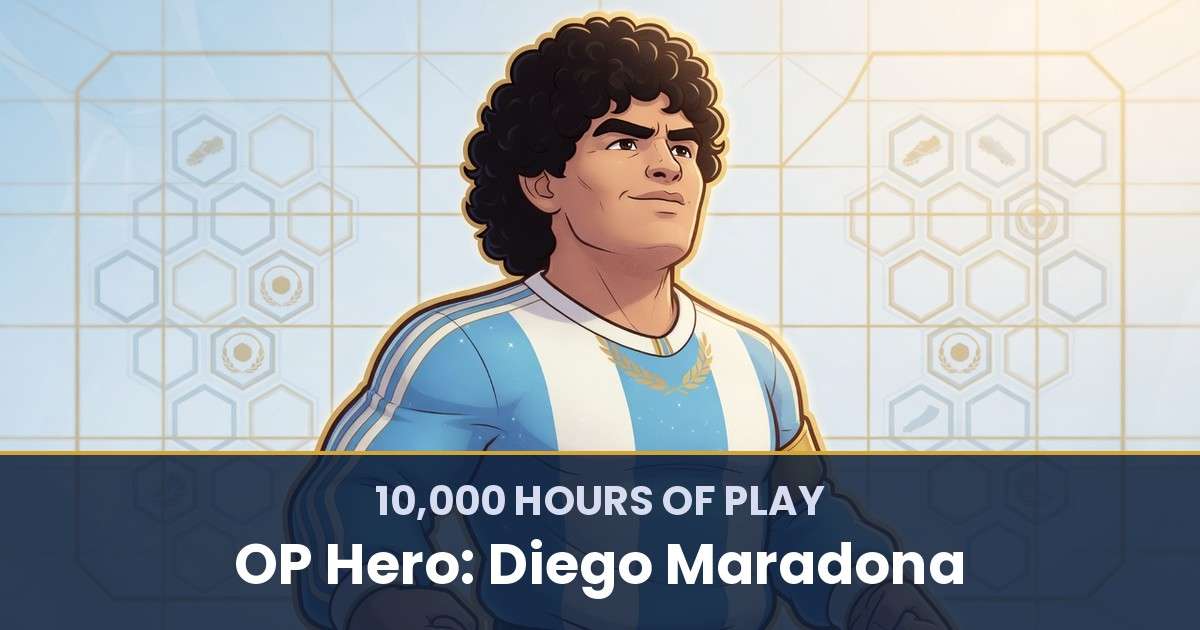


On 22 June 1986, in the 51st minute of a World Cup quarter-final against England, a 25-year-old from a Buenos Aires shantytown collected the ball inside his own half, turned, and ran through half a national team before rolling it into the net. Four minutes earlier he had punched a different goal past the same goalkeeper and called it the hand of God.
In the space of four minutes, Diego Maradona had shown the two traits people still argue about: a talent he had built in the street, and a willingness to bend any rule to win.
He stood 1.65 metres tall. He was not fast. Yet he carried a team most experts rated ordinary to a world title, and he did it while insisting the whole time that he was playing for the poor kids of Villa Fiorito, not for the federations or the sponsors.
⚡ Speed Run Notes
- Maradona’s core game was never just football. It was proving that individual genius from the poorest barrio could beat richer nations and bigger institutions on the largest stage.
- His edge was innate: freakish body control at 1.65 m, field vision scouts spotted at age 8, and a risk-seeking wiring that made him dribble where others passed.
- His character class kept changing, from street prodigy to teenage playmaker to global superstar to king of Naples to national coach. Each role had its own powers and its own traps.
- His 1986 run (5 goals, 5 assists) is a case study in willing a result into existence when the squad around you is merely good.
- His setbacks were as extreme as his peaks: a 15-month drug ban, a 1994 World Cup expulsion, and years of health crises.
Updated 13 October 2026 with new career detail, two modern echoes, and answers to common questions.
Table of Contents
About Yu-kai Chou

Yu-kai Chou is the author of 10,000 Hours of Play — the book that treats your life as the most important game you’ll ever build a character in, and gives you the 6-Step framework (Game · Attributes · Role · Skills · Allies · Quests) to play it on purpose. He has spent two decades developing the system through which this post analyzes its OP Hero, and applies it to his own life and to the lives of the people he advises around the world.
Chou’s other framework, the Octalysis Framework, has been applied by LEGO, Microsoft, Porsche, Coca-Cola, Salesforce, and MrBeast, impacting over 1.5 Billion Users. He has taught the methodology at Harvard, Stanford, Yale, Tesla, Google, BCG, and IDEO, and has advised governments in eight nations including Ukraine, the United Kingdom, the Kingdom of Bahrain, Singapore, Taiwan, the Netherlands, Kazakhstan, and South Korea.
His work has been cited by Harvard, Stanford, MIT, Forbes, Wall Street Journal, Wired, US Department of Energy, NIST, NSF, NCBI, US Department of Education, ClinicalTrials.gov, and Google Scholar — with 3,700+ more academic publications. Explore his books here.
What I find instructive about Maradona’s build is that his greatest weapon and his greatest weakness ran on the same wiring: a refusal to accept the odds he was handed. It won him a World Cup and it wrecked years of his life. The lesson I lift from his run is that a raw attribute, in his case an all-in appetite for risk, is not good or bad on its own. What decides your saga is the role you put it in and the allies you let steer it.
Step 1: The Game — What Maradona Was Actually Playing
Most biographies score Maradona on trophies. That misreads the game he thought he was in.
His real game was redemption by proxy. He grew up in Villa Fiorito, a poor neighborhood near Buenos Aires, the fifth of eight children in a working-class family. From the age of three he slept with a football, and as a boy he told reporters, “My first dream is to play in the World Cup; my second dream is to win it.” That was not a soundbite. It was a win condition he set before he had anything else, and he spent the next three decades chasing it.
Every time he took on a stronger opponent, whether richer clubs, powerful federations, or entire nations, the reward he cared about was not money. It was proof that Villa Fiorito could beat the world, and more love from the people he came from.
That is why he embraced Napoli, a club from Italy’s marginalized south, with the same ferocity as Argentina. It is why he aligned himself politically with figures like Fidel Castro and Hugo Chávez late in life. Football was the arena where he played it.
Step 2: Attributes — The Innate Stats
Attributes are the stats you are born with, the ones visible before anyone teaches you anything. Maradona’s were extreme, and they showed up young.
The first was body control that bordered on the absurd. As a child in Villa Fiorito he juggled balls and even oranges for hours, drawing crowds. At 1.65 metres and without real pace, he still moved through defenders as though gravity treated him differently.
The second was spatial vision. Coaches at the youth side Los Cebollitas spotted him around age 8, noting an uncanny ability to read passing lanes and see plays several moves before they happened. He saw spaces that did not exist yet.
The third was a risk-seeking, rule-bending competitive drive. As a teenager he chose the audacious dribble over the safe pass, inviting fouls rather than playing it safe. The same wiring later produced both the Goal of the Century and the Hand of God.
If you want to audit your own innate stats the way Maradona’s coaches read his, the Talent Triangle Method is the tool for it. It forces you to name the raw traits you have been discounting because they came too easily to feel like assets.
Step 3: Role(s) — The Character Class Across Chapters
Maradona did not play one role. He respec’d his character several times, and each class came with new powers and new failure modes.
He started as the Street Prodigy, the neighborhood marvel doing ball tricks at halftime of first-division games, all talent and joy and no responsibility. Then came the Prodigy Playmaker. He debuted for Argentinos Juniors’ first team at age 15 on 20 October 1976, moved to Boca Juniors in 1981, and won the Metropolitano title that same year. He was the classic Argentine enganche, the number 10 a whole team is built around.
His next class was Global Superstar. Barcelona signed him in 1982 for a then world-record fee. He won the Copa del Rey in 1983 but lost time to hepatitis and injuries and clashed with the club’s directors. In 1984 he moved to Napoli and became something bigger than a player, a symbol of southern Italian resistance who dragged a mid-table club to Serie A titles in 1986-87 and 1989-90 and the UEFA Cup in 1988-89.
His final competitive class was National Coach, and it exposed the limits of a build tuned for solo brilliance. The powers that made him unstoppable as a player did not transfer to the touchline.
Step 4: Skills — The Real-Life Game Skills Maradona Mastered
Attributes are raw. Skills are what you build on top of them, and Maradona’s map onto the canon of Real-Life Game Skills.
The signature one is Instinctual Pathfinding (Ranger), trusting your gut to find the right move in real time. The Goal of the Century was Instinctual Pathfinding at full power: no plan, no set play, just a run through the entire England midfield and defence that his body found before his mind could argue.
The second is Undying Rage (Warrior), activating survival instinct to defeat an overwhelming challenge. Argentina’s 1986 squad was good, not great. Maradona carried it anyway, finishing the tournament with 5 goals and 5 assists and setting up as many goals as he scored. The England quarter-final came just four years after the Falklands war, and he played it like a man settling a national score.
The third is Vision Manifestation (Warlock), rehearsing success so vividly it shapes reality. His childhood declaration about winning the World Cup was a vision he kept for two decades until it happened.
The fourth is Charm (Druid), making a group deeply affectionate toward you. In Naples he united a dressing room split by nationality and class, and the city’s devotion outlasted his playing career.
No single skill defines a hero. Whether you end up a specialist, a dabbler, or a master depends on how you stack them, which is exactly what the Skills Spectrum is built to help you see.
Step 5: Allies — The People Who Multiplied Maradona
The myth is that Maradona did it alone. The record says otherwise.
The first multiplier was the youth structure that caught him early. The coaches at Los Cebollitas who spotted an eight-year-old’s freakish control gave his talent a stage before it could be wasted, and Argentinos Juniors gave a fifteen-year-old a first-team debut most clubs would never have risked.
The most important tactical ally was Carlos Bilardo, Argentina’s coach in 1986. Bilardo built the entire national team around Maradona as the central creator, designing a pragmatic system whose single instruction was, in effect, get the ball to Diego and get out of the way. The 1986 title came from Maradona’s talent working inside Bilardo’s system.
Then there were his teammates and the cities themselves. The 1986 Argentina side accepted being supporting characters in his story, and the people of Naples and Buenos Aires poured a kind of belief back into him that he fed on. Maradona’s game ran on adoration, and his crowds supplied it.
Step 6: Quests — The Milestones That Shaped the Saga
The quests include the losses.
The defining victory was the 1986 World Cup in Mexico, where he beat England with both the Hand of God and the Goal of the Century in the same quarter-final and then carried Argentina to the title. His own description of the first goal, “a little with the head of Maradona and a little with the hand of God,” puts the trickster and the hero in one sentence.
The defining near-miss was the 1990 World Cup final, which Argentina reached and lost to West Germany. He had taken a weaker squad within one game of a second title and fallen short.
Then came the collapses. In 1991 he served a 15-month ban after a positive cocaine test. In 1994 he was expelled from the World Cup after a positive ephedrine test, a public unraveling on the biggest stage he had. Health crises followed him for years afterward.
And yet the quests kept coming. He returned as a coach, leading Argentina at the 2010 World Cup before a 4-0 quarter-final loss to Germany ended that chapter. He died on 25 November 2020 in Tigre, Buenos Aires. His final ledger was 91 caps and 34 goals for Argentina, plus roughly 259 goals in 490 official club games.
What You Can Steal From Maradona’s Build
You are not going to dribble through England. But three moves from his build transfer directly.
First, name your real game. Maradona’s win condition was not “be a good footballer.” It was a specific, personal score to settle, and he named it as a child.
Second, build your role around your strongest stat. He did not try to become a safe, sensible player. He leaned all the way in.
Third, take your comebacks as seriously as your peaks. Highlight reels leave out the recoveries. What you do after a ban, a public expulsion, or a health crash is the part of a build you get to choose. Maradona did not pass that test cleanly, and his later years show the cost.
The 10K HP Frame — Maradona Through the 6 Steps Lens
A second pass through the 10K HP frame picks up chapters the profile above skipped: the World Cup squad that left him out, the tackle that broke his ankle in Spain, the 75,000 people who came to watch him walk onto a pitch, and the stadium that carries his name today.
The Game. In 1978 Argentina hosted the World Cup that year, and coach César Luis Menotti left the 17-year-old Maradona out of the squad, judging him too young. He watched his country win the tournament without him. A year later he went to Japan with Argentina’s youth team, scored six goals in six games at the 1979 FIFA World Youth Championship, and won the Golden Ball as the best player as Argentina beat the Soviet Union 3-1 in the final. The adult World Cup would take him seven more years.
The Attributes. Barcelona paid a world-record £5 million for him in 1982. Two years later Napoli broke the record again at £6.9 million. Two of Europe’s biggest clubs spent record money on a 1.65-metre player with no real pace, because his body control and vision were already visible at the top level.
The Roles. Add one Role: the adopted son of a city. Napoli presented him at the Stadio San Paolo on 5 July 1984 in front of 75,000 spectators, before he had played a single competitive match for the club. Napoli had never won Serie A. He gave them their first title in 1986-87 and a second in 1989-90. In 2000 the club retired the number 10 shirt.
The Skills. Revive (Paladin) is recovering from failure and taking new action toward the next Quest. The 1978 omission is the cleanest example. A 17-year-old who had already made the decision to play for his country, and who was told no on home soil, went straight back to the next available tournament and won it as its best player. Revive got a second test in September 1983, when Andoni Goikoetxea of Athletic Bilbao fractured Maradona’s left ankle with a tackle. He returned to play again for Barcelona, and within a year he was in Naples.
Courageous Heart (Paladin) is charging into uncomfortable zones and hostile environments. Moving from Barcelona to a southern Italian club that had never been champion meant carrying the poorer south into a league long dominated by Milan and Turin. He chose the harder side of that rivalry and stayed seven seasons.
Napoli spent a world-record fee on a player, and Maradona spent seven seasons proving the poorer city could win.
The Allies. Menotti, the coach who left him out of the 1978 senior squad, also managed the youth team that won in Japan in 1979 and gave the teenager his first world-level trophy.
The Quests. In 2000 FIFA named him joint Player of the Century with Pelé, after he had won the internet vote with 53.6 percent. On 10 November 2001 La Bombonera hosted his testimonial match, a World XI against Argentina, and he scored twice from the penalty spot. On 4 December 2020, nine days after his death, Napoli renamed its home ground the Stadio Diego Armando Maradona. Argentinos Juniors, the club where he debuted at 15, had already named its own stadium after him in 2003.
Which Octalysis Core Drives Maradona’s Arc Activated
The Octalysis Framework sorts human motivation into eight Core Drives. Four of them show up clearly in his record.
CD1 Epic Meaning & Calling
Epic Meaning & Calling is the drive people feel when their effort serves something larger than themselves. For Maradona that larger thing was always a group of people the powerful had overlooked. In Buenos Aires it was the barrio. In Italy it was Naples, whose club had never won the league. The 1987 title was the first in Napoli’s history.
CD3 Empowerment of Creativity & Feedback
Empowerment of Creativity & Feedback is the joy of trying new combinations and seeing what happens. The boy in Villa Fiorito juggling oranges was running a feedback loop thousands of times a day: touch, response, adjust. By 1986 that loop ran fast enough to improvise a ten-second run through the England team. Bilardo’s system gave him room to keep running the loop on the pitch.
CD5 Social Influence & Relatedness
Social Influence & Relatedness covers the pull of the people around us. Few athletes have had a crowd this large and this close. Seventy-five thousand people came to the San Paolo to see him introduced in 1984. Napoli retired his shirt in 2000 and renamed its stadium for him in 2020. That bond multiplied his effort on the pitch. Off it, the same pull drew him toward people who wanted to be near the star, and some of them were bad for him.
The crowd that lifted Maradona on the pitch also crowded around him off it.
CD8 Loss & Avoidance
Loss & Avoidance is the drive to keep something bad from happening again. Being left out of the 1978 squad on home soil gave him a loss to answer, and he answered it in Japan within a year. The broken ankle in 1983 gave him another. He answered losses in short, explosive bursts, which suited a single tournament better than a long career.
Modern Echo — Who’s Playing This Game Today
Khvicha Kvaratskhelia. Napoli signed a winger from Dinamo Batumi in Georgia on 1 July 2022 for a reported €10 to 12 million. Supporters soon called him Kvaradona. On 4 May 2023 Napoli clinched its first Serie A title since 1990, and Kvaratskhelia was named the league’s Most Valuable Player for the season. When he left for Paris Saint-Germain in January 2025, he called Maradona the “God of football” in his farewell message to the city. On 31 May 2025 he scored in PSG’s 5-0 Champions League final win over Inter Milan, the first Georgian to score in a UEFA club competition final. Like Maradona in 1984, he arrived from outside the elite and gave Naples a title it had been waiting decades for.
Lamine Yamal. The barrio echo belongs to a teenager from Rocafonda, a working-class neighbourhood of Mataró near Barcelona. His goal celebration is the number 304, the last three digits of the neighbourhood’s postcode. On 9 July 2024 he scored against France in the European Championship semi-final, four days before his 17th birthday, becoming the youngest scorer in the tournament’s history. Spain beat England in the final and he was named Young Player of the Tournament. In 2025 he became the first player to win the Kopa Trophy twice and finished second in the Ballon d’Or at 18. As a baby he was bathed by a 20-year-old Lionel Messi in a 2007 UNICEF charity photo shoot, and in July 2026 his Spain beat Messi’s Argentina 1-0 after extra time in the World Cup final.
Frequently Asked Questions
What made Diego Maradona so good?
Maradona set a specific win condition as a boy, winning the World Cup, and relied on a few extreme attributes: body control, vision, and appetite for risk. He won the 1979 World Youth Championship, the 1986 World Cup, and Napoli’s first two Serie A titles. His falls, including a 15-month ban and a 1994 World Cup expulsion, were just as extreme.
How many goals did Maradona score at the 1986 World Cup?
Maradona scored 5 goals and made 5 assists at the 1986 World Cup in Mexico, including both goals against England in the quarter-final. He captained Argentina to the title and won the Golden Ball as the tournament’s best player by a unanimous vote.
Why is Napoli’s stadium named after Maradona?
Maradona led Napoli to its first Serie A title in 1986-87 and a second in 1989-90, plus the 1989 UEFA Cup. The club retired his number 10 shirt in 2000. In December 2020, shortly after his death, the Stadio San Paolo was renamed in his honour.
Did Maradona play at the 1978 World Cup?
No. Argentina coach César Luis Menotti left him out of the 1978 squad because he was 17. A year later Maradona scored six goals at the 1979 FIFA World Youth Championship in Japan and won the Golden Ball as Argentina took the title.
Who won FIFA Player of the Century?
FIFA named Diego Maradona and Pelé joint Player of the Century in 2000. Maradona had won the internet vote with 53.6 percent, and FIFA added a second award so the two shared the honour.
Where this framework comes from

Want the full system this profile is built on?
Every OP Hero piece runs through the same 6-Step framework from 10,000 Hours of Play: Unlock Your Real-Life Legendary Success. The book covers the full system, walks through Yu-kai’s own life run as the first applied case study, and gives you the worksheets to audit your own build.
Related Reading
- All OP Hero Profiles → The full roster of legendary lives run through the 6-Step framework.
- Pelé: OP Hero profile. The Brazilian great who set the standard Maradona spent his life chasing.
- Lionel Messi: OP Hero profile. The Argentine number 10 who inherited Maradona’s role and its expectations.
- Ayrton Senna: OP Hero profile. Another all-in genius whose appetite for risk defined both his greatness and his story.
- The 10,000 Hours of Play framework. The full 6-Step system behind every OP Hero breakdown.