
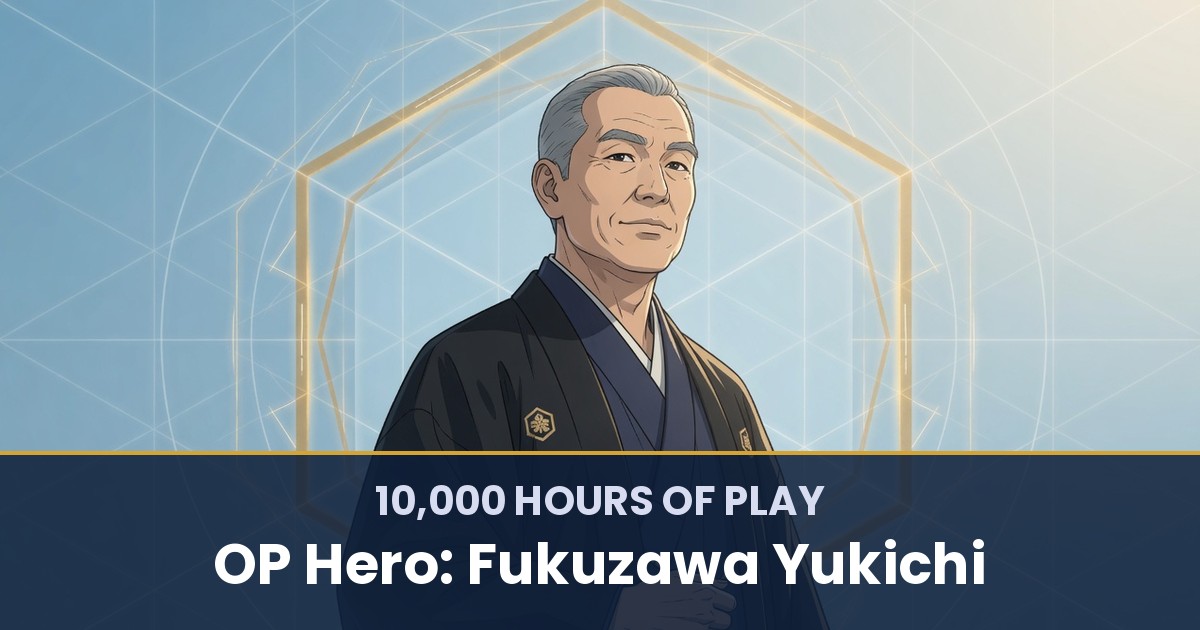


In 1859, a young translator walked into the newly opened port of Yokohama expecting to finally use the Dutch he had spent years mastering.
The signs on the merchant houses meant nothing to him. The foreigners doing business there spoke English, and years of grinding study had just been marked down in a single afternoon.
Fukuzawa Yukichi went home, got two Dutch-English dictionaries from a merchant house, and started over from page one.
That restart became the engine of one of the most consequential lives in modern Japan: three trips across the ocean, a school that became Keio University, a book so widely read that one estimate puts a copy in circulation for every 170 people in the country, and a face that spent forty years on the 10,000-yen note. The six Steps below map how he did it.
⚡ Speed Run Notes
- Fukuzawa Yukichi’s Game was converting foreign knowledge into independence, for Japan as a nation and for every individual reader he could reach.
- When Yokohama proved his Dutch useless in 1859, he restarted in English with two dictionaries. That single restart qualified him for the 1860 mission to America.
- His canon Skills: Ley Line Infusion (Mage), True Sight (Ranger), Reflect Damage (Paladin), Floral Blossom (Druid) and Loremaster (Druid).
- He declined government office and built his own platforms instead: Keio for teaching, mass-market books for ideas, and the Jiji Shimpo newspaper for daily debate.
- An Encouragement of Learning opened with “Heaven does not create one man above or below another man” and reached roughly 700,000 legitimate copies by 1880, by Fukuzawa’s own count.
Table of Contents
About Yu-kai Chou

Yu-kai Chou is the author of 10,000 Hours of Play — the book that treats your life as the most important game you’ll ever build a character in, and gives you the 6-Step framework (Game · Attributes · Role · Skills · Allies · Quests) to play it on purpose. He has spent two decades developing the system through which this post analyzes its OP Hero, and applies it to his own life and to the lives of the people he advises around the world.
Chou’s other framework, the Octalysis Framework, has been applied by LEGO, Microsoft, Porsche, Coca-Cola, Salesforce, and MrBeast, impacting over 1.5 Billion Users. He has taught the methodology at Harvard, Stanford, Yale, Tesla, Google, BCG, and IDEO, and has advised governments in eight nations including Ukraine, the United Kingdom, the Kingdom of Bahrain, Singapore, Taiwan, the Netherlands, Kazakhstan, and South Korea.
His work has been cited by Harvard, Stanford, MIT, Forbes, Wall Street Journal, Wired, US Department of Energy, NIST, NSF, NCBI, US Department of Education, ClinicalTrials.gov, and Google Scholar — with 3,700+ more academic publications. Explore his books here.

Fukuzawa belongs in this series because he shows what happens when a player refuses to let a sunk cost choose his build. If I could lift one move from his character sheet, it would be the Yokohama restart: he measured the gap between his skills and the actual game board, and he paid the full price of re-skilling without complaint.
Step 1: The Game — What Fukuzawa Was Actually Playing
Step 1 of the 10K HP framework asks what Game a player keeps returning to across decades, beneath the job titles.
Fukuzawa’s Game was converting knowledge into independence. Japan in his lifetime faced militarily and economically stronger Western powers, and his answer was to raise people who could think, work and judge for themselves before dependence hardened into subordination.
He never took the obvious route of government office, and he declined formal positions after the Meiji Restoration.
Instead he built his own board: a school to produce capable people, books to carry the ideas to everyone, and a newspaper to argue the case daily. Each piece scaled a different part of the same Game.
He stated the stakes himself in the opening line of his most famous book: “Heaven does not create one man above or below another man.” The sentences that follow argue that the real differences between people come from learning and conduct, which doubles as the mission statement for everything he built afterward.
Step 2: Attributes — The Innate Stats
Attributes are the stats a player brings to the table before any training. Fukuzawa’s were visible before he ever left his home domain.
He was born on 10 January 1835 in Osaka, at the storehouse residence of the Nakatsu domain, and grew up in Nakatsu in a samurai family of low rank.
The first attribute is resistance to inherited hierarchy. The rank system placed a ceiling over his family, and his reaction was to pursue learning outside the conventional path open to him. His later doctrine of independence reads like that early frustration turned into a philosophy.
The second attribute is a high tolerance for personal risk. He kept walking into environments where he held no advantage: Nagasaki for Dutch studies, then Edo, then an ocean crossing to San Francisco in 1860 when almost no Japanese had ever made the trip.
The third attribute is practical pattern recognition. Where other observers saw machines and guns, he kept asking what institutions actually did and how their moving parts fit together.
The fourth attribute is vision that runs on a horizon of decades. He treated teaching as the start of an institution meant to outlive him, and Keio did exactly that.
The OP Talent Triangle Method asks you to find the intersection of talents that sets your build apart. Fukuzawa’s edge sat where language ability crossed institutional curiosity, a pairing rare enough that the shogunate kept putting him on ships.
Step 3: Role(s) — The Character Class Across Chapters
Fukuzawa moved through five Roles, and each one widened the audience of the one before.
His first Role was the student of Dutch learning in the 1850s, grinding through the one language that gave Japan access to Western books.
His second Role was the interpreter and mission member. His English study qualified him for the shogunate’s 1860 voyage to the United States, the first Japanese embassy to Europe in 1862, and a second American trip in 1867.
His third Role was the teacher who turned a classroom into an institution. In 1858 he opened a school for Dutch studies at the Okudaira family’s residence in Tsukiji, Edo, and that modest classroom became the institutional seed of Keio.
His fourth Role was the public educator, turning what he had seen abroad into books ordinary readers could use.
His fifth Role was the journalist and institutional architect: from 1882 he ran a national newspaper while Keio grew into a university, adding its university-level departments in 1890 with Fukuzawa delivering the opening address.
The thread across all five is the same: get the knowledge first, then build a bigger pipe to move it through.
Step 4: Skills — The Real-Life Game Skills Fukuzawa Mastered
Skills are what a player trains on top of the starting stats. Each Real-Life Game Skill carries its Class in brackets, and five of them account for most of Fukuzawa’s run.
The first is Ley Line Infusion (Mage): absorbing a large body of knowledge in a subject quickly. He did it twice in sequence, first with Dutch and then with English, teaching himself the second language from two Dutch-English dictionaries after the Yokohama shock of 1859.
The second is True Sight (Ranger): observing the details others miss. On his missions he studied hospitals, banks, postal systems, schools and legislatures while colleagues catalogued hardware. The question he carried into every building was how the institution functioned and whether Japan could adapt it.
The third is Reflect Damage (Paladin): converting a setback into growth material. Yokohama told him years of Dutch study would not open the doors he wanted. He treated the loss as information about which language ran the new game board, and the pivot put him on a ship to America within a year.
The fourth is Floral Blossom (Druid): educating and mentoring at scale. Keio trained students in Western studies so well that other regions asked the school to send teachers, which multiplied one classroom into a national network.
The fifth is Loremaster (Druid): making difficult ideas land through accessible storytelling. His explanatory prose moved Western political and economic concepts into everyday Japanese, and An Encouragement of Learning reached roughly 700,000 legitimate copies by 1880, with about 100,000 more in pirated editions by his own estimate.
On the Skills Spectrum, Fukuzawa reads as a Master whose core craft was translation in the widest sense, with teaching, writing and publishing stacked on top of it.
Step 5: Allies — The People Who Multiplied Fukuzawa
Fukuzawa preached independence, and he built that independence on a dense web of Allies.
The first was the Okudaira family of Nakatsu. Their Tsukiji residence in Edo housed his Dutch-studies school in 1858, giving the future Keio its first roof.
The second was the shogunate’s foreign-mission apparatus. The 1860, 1862 and 1867 voyages gave him firsthand access to Western institutions that no amount of reading in Japan could substitute for, and much of his later writing runs on those observations.
The third group was Keio’s teachers and graduates. When other parts of Japan requested instructors, the school could send them, converting a personal classroom into a distributed educational system.
The fourth was the staff of the Jiji Shimpo, the newspaper he founded on 1 March 1882. A book is one argument, but a daily paper gave him a standing platform, and the people who ran it kept that platform alive while he wrote.
His career shows a cumulative team process underneath the independent-thinker brand. King Sejong the Great attacked the same distribution problem from a throne, with a new alphabet; Fukuzawa held no office, so every channel his ideas traveled through had to be built by the people in this section.
Step 6: Quests — The Milestones That Shaped the Saga
Fukuzawa’s Quests run from a domain school to a national institution, with the sharpest setback arriving early.
Quest 1 was escaping the limits of inherited status through learning, which carried him from Nakatsu through Nagasaki to Edo, where he opened his school for Dutch studies in 1858.
Quest 2 was the failure at Yokohama in 1859, when the open port revealed that the merchants’ working language was English and his Dutch could not even read the signage. He restarted his language training from zero.
Quest 3 was the reconnaissance arc: the 1860 mission to the United States, the 1862 embassy to Europe, and the 1867 return to America, which together gave him a comparative map of modern institutions.
Quest 4 was An Encouragement of Learning, published in seventeen installments from February 1872 to November 1876 and collected in 1880. One estimate puts its combined official and pirated circulation at a copy for every 170 people in Japan.
Quest 5 was the Jiji Shimpo, launched in 1882, which moved his arguments from occasional books into daily public debate. The 1880s also brought real strain, since Keio hit serious financial pressure in that decade and Fukuzawa had to solicit support and reorganize its finances to keep the school alive.
Quest 6 was the long contest of endurance and legacy. A major stroke in 1897 cut his public activity down, yet his autobiography was serialized in 1899, he died on 3 February 1901, and from 1984 to 2024 his portrait sat on the 10,000-yen note, the highest denomination in Japan.
What You Can Steal From Fukuzawa’s Build
First, re-test what you know against the game that is actually being played. One afternoon at Yokohama told Fukuzawa the market had switched languages, and starting over in English put him years ahead of everyone still polishing their Dutch.
Second, build your influence on platforms that you own outright. He declined office and instead ran a school, a publishing operation and a newspaper, which meant no patron could revoke his influence.
Third, deliver your best ideas in language the many can read. The opening line of An Encouragement of Learning was aimed at every reader in Japan, and the circulation numbers show what happens when a difficult idea gets delivered in plain language.
Where this framework comes from

Want the full system this profile is built on?
Every OP Hero piece runs through the same 6-Step framework from 10,000 Hours of Play: Unlock Your Real-Life Legendary Success. The book covers the full system, walks through Yu-kai’s own life run as the first applied case study, and gives you the worksheets to audit your own build.
Related Reading
- All OP Hero Profiles — the full hub
- 10,000 Hours of Play by OP Hero: King Sejong the Great
- 10,000 Hours of Play by OP Hero: Confucius
- 10,000 Hours of Play by OP Hero: Chiune Sugihara
- 10,000 Hours of Play by OP Hero: Morris Chang