
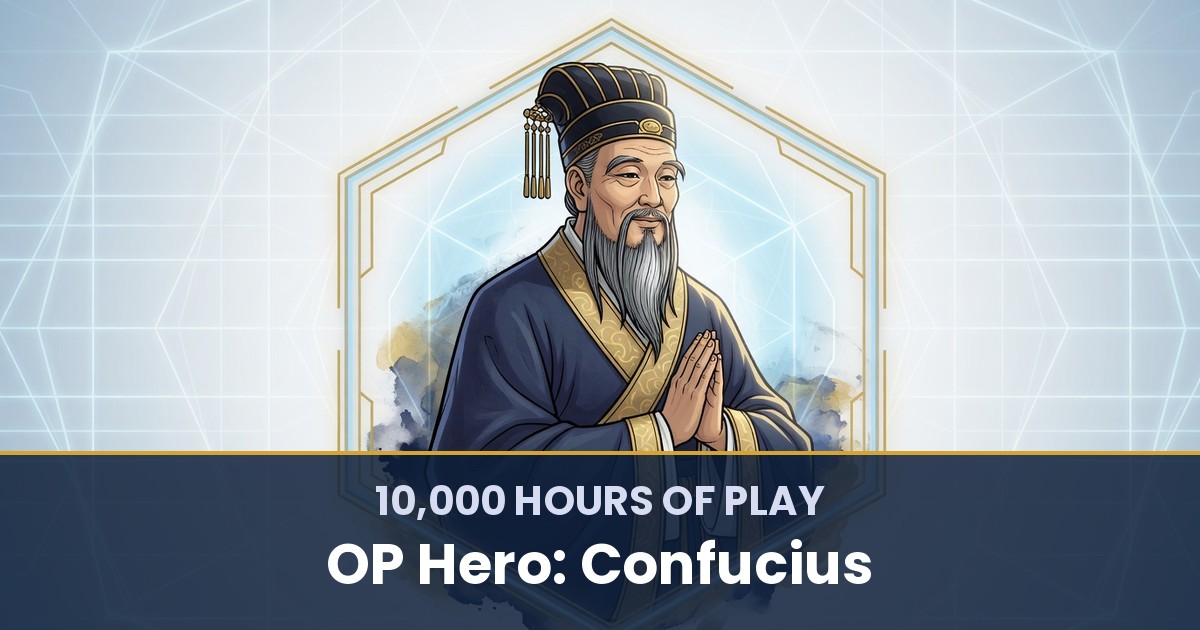


Confucius died in 479 BCE convinced he had failed. He had spent the last fourteen years of his working life traveling from one feudal court to the next, pitching rulers on a return to Zhou ritual order, and getting politely turned away every single time.
Two and a half millennia later, his name is on temples across East Asia, his sayings still anchor everyday argument across the Chinese-speaking world, and the civil-service exam system he indirectly inspired ran for some thirteen hundred years.
So what was actually happening inside that build? Strip away the marble statues and the imperial endorsements, run the life through the 10,000 Hours of Play framework, and score it as a character sheet: Game, Attributes, Role, Skills, Allies, Quests.
⚡ Speed Run Notes
- Confucius played a Game far bigger than philosophy: re-engineering an entire civilization from the inside out. Self, then family, then state, then “all under Heaven.”
- His core teaching move was calibration: he gave Zilu and Ran You opposite answers to the same question because one was reckless and the other was timid.
- From 497 to 484 BCE he wandered between courts looking for a ruler who would actually let him run the program. Every state passed. He kept going. Fourteen years of Aegis (Paladin).
- He died believing nothing took. The Han dynasty made his ideas state ideology three centuries later. Phoenix Rebirth (Paladin) at civilizational scale.
- You don’t need three thousand disciples to steal his build. You need a Game that scales from your own conduct outward, and the patience to keep teaching when the courts won’t listen.
Table of Contents
About Yu-kai Chou

Yu-kai Chou is the author of 10,000 Hours of Play — the book that treats your life as the most important game you’ll ever build a character in, and gives you the 6-Step framework (Game · Attributes · Role · Skills · Allies · Quests) to play it on purpose. He has spent two decades developing the system through which this post analyzes its OP Hero, and applies it to his own life and to the lives of the people he advises around the world.
Chou’s other framework, the Octalysis Framework, has been applied by LEGO, Microsoft, Porsche, Coca-Cola, Salesforce, and MrBeast, impacting over 1.5 Billion Users. He has taught the methodology at Harvard, Stanford, Yale, Tesla, Google, BCG, and IDEO, and has advised governments in eight nations including Ukraine, the United Kingdom, the Kingdom of Bahrain, Singapore, Taiwan, the Netherlands, Kazakhstan, and South Korea.
His work has been cited by Harvard, Stanford, MIT, Forbes, Wall Street Journal, Wired, US Department of Energy, NIST, NSF, NCBI, US Department of Education, ClinicalTrials.gov, and Google Scholar — with 3,700+ more academic publications. Explore his books here.

What stays with me about Confucius’ build is that its owner scored it a failure, and history overruled him. The lesson I would lift is the Step 3 one: when the role you trained for stays closed, the fallback role you run in the meantime can end up mattering more. His fallback, teacher, out-delivered the ministry he never got.
Step 1: The Game — What Confucius Was Actually Playing
If you ask a casual reader what Confucius’ Game was, they’ll say “Chinese philosophy.” That’s the surface read, and it understates what he was actually doing by an order of magnitude.
The Game Confucius played for his entire adult life was a civilizational re-engineering project: take a society sliding toward the chaos of the Warring States era, and rebuild it from the smallest unit outward.
Start with the individual’s conduct, compound it into family relationships, then into the state, then into tianxia, “all under Heaven.” Each level was supposed to be the training ground for the next.
He framed himself not as an innovator but as a transmitter. Analects 7.1: “I transmit rather than innovate; I trust and love the ancients.”
His reference model was the early Zhou dynasty, which he treated as a working example of what moral-ritual order looked like before it broke. The whole arc was less “invent a philosophy” and more “recover the operating manual.”
This is what the 10,000 Hours of Play framework means by your Game: the deep, repeated question your decades of output keep answering, which runs far past any job title or niche.
Confucius’ question was: what is the smallest unit of moral order, and how do you scale it without losing fidelity?
He answered it through his own conduct, through the personal correction of about three thousand students, through political service when he could get it, and through the editing of classical texts when he could not, holding the same Game from his first granary job into his seventies.
Step 2: Attributes — The Innate Stats
Attributes are the traits visible before you’ve had time to train anything. Sima Qian’s Shiji 47 and the Analects give us enough early-life material to see three stats rolling unusually high.
Compulsive ritual-pattern recognition. As a young child, Confucius was reportedly already arranging play-objects in ceremonial setups, miming sacrificial gestures with no one prompting him.
Analects 2.4: “At fifteen, I set my heart upon learning.” Read that line as a report of wiring already present, well before any training plan.
A kid who self-directs at fifteen toward something nobody else in his village finds interesting is showing you an Attribute.
High social perception. The Analects is full of moments where his replies to disciples are calibrated to that specific student’s character. The same question draws opposite answers depending on whether the reckless Zilu or the timid Ran You is asking it.
To do that consistently across hundreds of recorded episodes, you need an unusually fine-grained reader of people. That reading ability shows up too early and too uniformly to be trained technique.
Moral nerve. When his caravan got surrounded by hostile troops at Kuang (Analects 9.5), he turned to his disciples and said, in effect, the culture King Wen built is now in me; if Heaven wanted it destroyed, it would have done so already, so the people of Kuang are not going to be the ones who finish me.
He absorbed a death-level threat and reframed it as a Heaven-versus-history question in real time. Most people freeze.
If you want a cleaner way to audit your own Attribute stack, the OP Talent Triangle Method walks the same audit step by step.
Most people undercount the traits that come easiest to them, because they assume those traits come easy to everyone.
Confucius’ attunement to ritual and to people probably looked, to his neighbors, like a slightly odd kid being intense, and everything he built later ran on that early attunement.
Step 3: Role(s) — The Character Class Across Chapters
Classes are the working identity you put on at each life chapter. Confucius cycled through four.
Low-level administrator in Lu (young adult, c. 530s BCE). His first paid roles, per Shiji 47, were managing a state granary and overseeing public fields. He recorded that he focused on calculations being correct and being punctual.
The class: ritual-trained junior bureaucrat. It looks unromantic, and it was the training ground that gave him hands-on experience with how Zhou-style administration actually ran.
Independent teacher and school founder (c. 30s–50s). Confucius opened his own teaching practice, accepting students from any social class, paid in the symbolic gift of dried meat.
Analects 15.39: “In instruction, there is no class distinction.” Shiji 47 puts the total student count at three thousand, with seventy-odd reaching mastery in the classics.
He had no court patronage at this stage, just a teaching practice that compounded for two decades and produced the disciples who would write down everything we now read as the Analects.
State minister of Lu (early 50s, c. 501–497 BCE). Confucius briefly reached the political class he had been training for, serving as Sikou (often translated Minister of Justice). Shiji 47 credits him with reducing crime and tightening ritual conduct in the duchy of Lu.
The chapter is short because the political conditions were rotten: Duke Ding of Lu accepted a gift of female entertainers and horses from the rival state of Qi, neglected court for days, and Confucius resigned rather than serve a ruler who had stopped showing up to rule.
Wandering counselor and elder editor (497–479 BCE). For roughly fourteen years he traveled between the states of Wei, Song, Chen, Cai, and others, pitching his ritual-revival program to one ruler after another.
None hired him for serious office. He stayed on the road anyway. The class is “itinerant philosopher in his sixties refusing to retire.”
When he finally returned to Lu around 484 BCE, he gave the last few years of his life to editing the classics, the Shijing (Odes), the Shujing (Documents), and the Chunqiu (Spring and Autumn Annals), building the textbook he hoped a future ruler would use even after he was gone.
Step 4: Skills — The Real-Life Game Skills Confucius Mastered
Confucius’ character sheet leans on six canon Skills more than anything else.
Floral Blossom (Druid): educating and mentoring others. This is his defining Skill, the one he ran for forty years. His decision to teach anyone who showed up with the symbolic gift, regardless of birth, was structurally radical in a feudal society.
The teaching practice itself carried the whole build. No army, no throne, just a classroom that ran for decades and produced the seventy-plus students who would, after his death, turn his approach into a transmissible tradition.
Vision of the Wild (Druid): seeing things from multiple perspectives with empathy. The textbook case is Analects 11.22, where Zilu and Ran You ask the same question, should I immediately put what I’ve learned into practice, and Confucius gives them opposite answers.
Zilu was reckless, so the answer was wait. Ran You was timid, so the answer was act. When a third disciple asked why the inconsistency, Confucius explained that the goal was correcting each student in the direction that student actually needed.
The Skills Spectrum framing of specialist-versus-generalist is useful here, because Confucius read each student and dispensed a calibrated dose.
Loremaster (Druid): weaving compelling, portable stories and aphorisms. He compressed a whole ethical system into reusable formulations that ordinary people could carry around in their heads.
Analects 15.24: “Do not impose on others what you yourself do not desire,” the negative form of the Golden Rule, centuries before the Christian formulation.
The Loremaster move also covers his late-life editing of the Classics, turning inherited materials into a normative reading list that would be the spine of East Asian education for two millennia.
Cognitive Lens (Mage): zooming in on the micro and out to the macro fluidly. His program scaled across four nested levels, self, family, state, and tianxia, and he could move between them in the same conversation.
In the Analects, Book 2 alone moves from personal self-cultivation (2.4) to governing by virtue (2.1) without changing register. Most teachers can do one scale well. Confucius operated four at once and showed the linkages between them.
Aegis (Paladin): ignoring criticism and rejection while pushing the Quest. Fourteen wandering years supplied the proof. State after state passed on his proposals.
He was once described, in Analects 14.38, as “the one who knows the thing cannot be done, yet goes on doing it.” That quote came from somebody else mocking him. He almost certainly would have taken it as a compliment.
Running Aegis meant absorbing that public write-off and holding class again the next morning.
Phoenix Rebirth (Paladin): recovering from devastating failure stronger than before. By the standard of his own lifetime, Confucius did not recover. He died around 479 BCE in Lu, his favorite student Yan Hui already dead, his political program rejected by every court he had visited.
The Phoenix Rebirth ran posthumously. His students wrote down what he had said.
Mencius (4th century BCE) and Xunzi (3rd century BCE) systematized it. In 136 BCE the Han emperor Wu made Confucianism the official state ideology.
The civil-service exam that would dominate Chinese governance for thirteen centuries was built on his curriculum. He failed inside one lifetime and then won the next eighty generations.
That is the version of Phoenix Rebirth nobody markets, because nobody alive gets to enjoy it.
Step 5: Allies — The People Who Multiplied Confucius
Allies are where the Confucius build was decided. His teaching survived because specific students refused to let it die.
Yan Hui. The favorite student. Analects 6.11: “A single bamboo basket of food, a single gourd of drink, living in a mean alley; others could not have borne the hardship, yet it never disturbed his joy. What a fine person Hui was.”
Yan Hui was the living proof-of-concept for self-cultivation under poverty. When he died early, Confucius reportedly cried out, “Heaven is destroying me! Heaven is destroying me!” (Analects 11.9.)
He had lost his living proof-of-concept. He kept teaching anyway.
Zigong. The diplomat of the group. Politically connected, eloquent, and financially successful, he used his networks to keep the school’s reputation alive and to defend Confucius’ legacy after the master’s death.
The early canonization of Confucius as a sage owes a structural debt to Zigong’s advocacy.
Zilu. The bodyguard temperament, brave to the point of recklessness, and the exact disciple Confucius told to wait before acting in Analects 11.22.
Zilu’s role in the build was less about transmitting the philosophy and more about keeping the teacher alive during the wandering years.
Zengzi. The doctrinal transmitter, credited in tradition with passing the teaching to the next generation of compilers; the Classic of Filial Piety is traditionally associated with his lineage.
Through him, the school kept its chain of custody.
Mencius and Xunzi. Not direct students, but the next-generation philosophers (4th and 3rd century BCE) who picked up the program after Confucius and his original disciples were gone, and turned scattered Analects-style sayings into coherent, defendable schools.
Without them, the Han state never adopts Confucianism three centuries later, because there would have been no systematized doctrine left to adopt.
Step 6: Quests — The Milestones That Shaped the Saga
Here are the run’s pivotal Quests, including the ones that, by his own standard, ended in defeat.
c. 530s BCE: first administrative roles in Lu. Granary management, oversight of public fields. The unromantic level-grinding chapter every serious build needs. He learned how government actually moved.
c. 521 BCE onward: opens his teaching practice. Accepts students from any class, in exchange for the symbolic gift of dried meat. Analects 15.39 and 7.7. The practice ran for the rest of his life and outlasted every appointment he held or chased.
c. 501–497 BCE: serves as Sikou (Minister of Justice) of Lu under Duke Ding. The brief political peak. Credited in Shiji 47 with reducing crime and re-imposing ritual discipline. Resigned over Duke Ding’s neglect of court after a Qi-state gift of dancing women and horses pulled the duke away from his duties. Confucius walked rather than serve a compromised ruler.
497–484 BCE: the wandering years. Fourteen years between courts: Wei, Cao, Song, Chen, Cai, back to Wei. Threats to his life at Kuang and at Pu. Reported near-starvation in the wilderness between Chen and Cai.
No state took his program. The setback that defines the build. He kept teaching disciples on the road the whole time.
c. 484–479 BCE: return to Lu, edit the Classics. The final stretch. He poured his last years into the Shijing, the Shujing, and the Chunqiu. He was not paid to do this. He was building the textbook because no one else was going to.
Mencius 3B.9 records that “when Confucius completed the Spring and Autumn Annals, rebellious ministers and traitorous sons were afraid”: the moralized historical record outlived him as a standing indictment of bad rulers.
479 BCE: Confucius dies. 136 BCE: Han Wudi adopts Confucianism as state ideology. The gap between those two dates is three hundred forty-three years.
What You Can Steal From Confucius’ Build
The tempting takeaway from a Confucius profile is “be wise.” Here is the structural version instead.
Three concrete moves you can lift off his character sheet today.
First, scope your Game past your own job: pick one where your immediate work is the proof-of-concept for something much bigger. Confucius treated every job he held as one move inside a much larger project.
A single life only produces so much. Scoped to its students, the same life compounds for centuries.
Second, when the courts won’t hire you, teach anyway. Confucius did not get the political mandate he wanted. He kept running the school.
Most builds collapse during the wandering chapter because the obvious career path closed. Open a different one in parallel and train the people who will outlast you.
Third, accept that the validation may not arrive in your lifetime. The hardest part of Phoenix Rebirth, in his case, is that the rebirth happened three centuries after he was already dust.
Most of us are not playing on that timeframe, but the principle scales: the work is the work, and the recognition is somebody else’s problem.
Start with the smallest unit you control. Confucius started with how a fifteen-year-old studies.
Where this framework comes from

Want the full system this profile is built on?
Every OP Hero piece runs through the same 6-Step framework from 10,000 Hours of Play: Unlock Your Real-Life Legendary Success. The book covers the full system, walks through Yu-kai’s own life run as the first applied case study, and gives you the worksheets to audit your own build.
Related Reading
- All OP Hero Profiles: the full catalog of life-as-RPG breakdowns through the 10K HP framework.
- OP Hero: Marcus Aurelius, another teacher whose private system became civilizational canon.
- OP Hero: Viktor Frankl, meaning-making in the wilderness years.
- OP Hero: Lee Kuan Yew, a Singapore statesman who applied a Confucian operating manual at nation scale.
- OP Hero: Martin Luther King Jr., a teacher who scaled his Game from the individual to “all under Heaven.”
- 10,000 Hours of Play: 6 Steps to Gamify Your Real Life, the framework hub behind every profile in this series.