
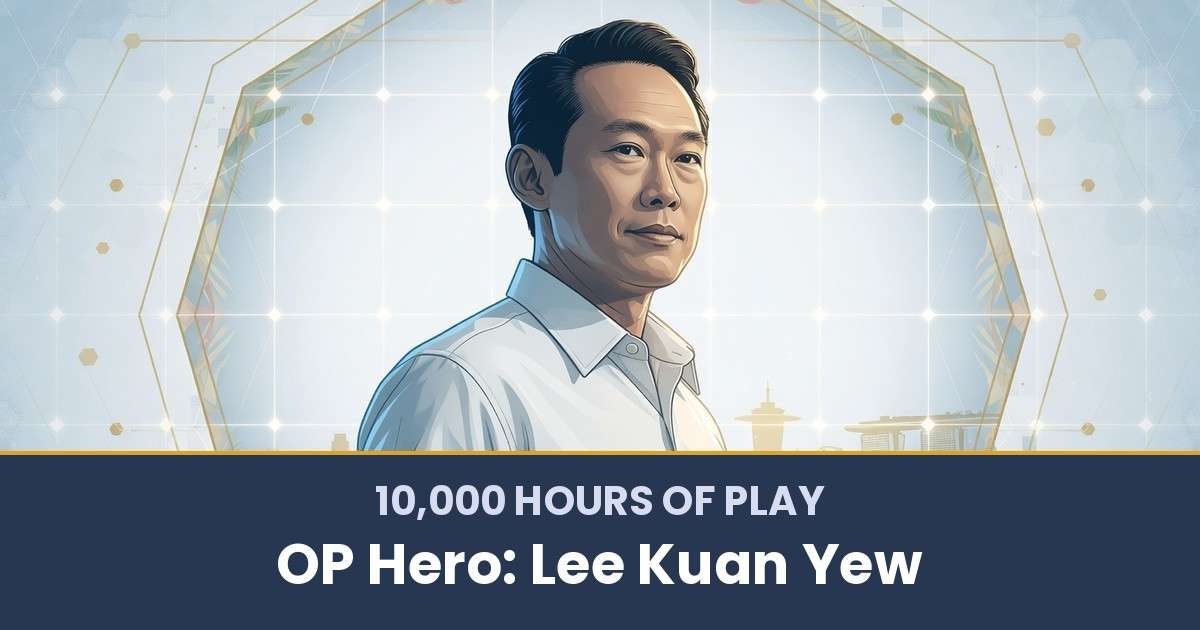


On the morning of 9 August 1965, the prime minister of a country that did not exist yet went on live television, choked up on camera, and told his people they had just been kicked out of Malaysia. No hinterland. No army worth the name. No oil, no farmland, no easy path forward. Two and a half million people stranded on an island the size of Lexington, Kentucky.
Then he stopped crying, went back to work, and spent the next 31 years building one of the most improbable success stories in modern history.
Most people learn the headline version of Lee Kuan Yew: third world to first, GDP per capita up roughly a hundredfold, Changi Airport, the squeaky-clean streets. What they miss is the build underneath. The specific attributes, roles, skills, allies, and quests that turned a humiliated lawyer into the closest thing the 20th century produced to a national-scale systems architect. Run his life through the 10,000 Hours of Play 6-Step framework and the pattern becomes much harder to dismiss as luck or geography.
⚡ Speed Run Notes
- Lee Kuan Yew’s core Game wasn’t “rule Singapore.” It was “make Singapore impossible to break.” That distinction explains every weird policy decision for 50 years.
- His standout innate Attributes were ferocious competitive drive, system-level pattern recognition, ice-cold emotional control, and a planning horizon measured in decades, not election cycles.
- He ran six character Classes in sequence: elite student, lawyer, anti-colonial organizer, head of government, nation-builder, and senior statesman. Each one fed the next.
- Key canon Skills he weaponized: Vision Manifestation (Warlock), Mastermind (Ranger), Tactical Command (Ranger), Loremaster (Druid), Aegis (Paladin), and Phoenix Rebirth (Paladin).
- His Allies were the multiplier. Goh Keng Swee, S. Rajaratnam, and Toh Chin Chye weren’t sidekicks — they ran whole subsystems of the country while Lee held the architecture.
- The biggest lesson for your own build: a 50-year quest beats a 50-month one, but only if your Attributes can carry the load that long.
Table of Contents
- Step 1: The Game — What Lee Kuan Yew Was Actually Playing
- Step 2: Attributes — The Innate Stats
- Step 3: Role(s) — The Character Class Across Chapters
- Step 4: Skills — The Real-Life Game Skills Lee Kuan Yew Mastered
- Step 5: Allies — The People Who Multiplied Lee Kuan Yew
- Step 6: Quests — The Milestones That Shaped the Saga
- What You Can Steal From Lee Kuan Yew’s Build
- Where this framework comes from
- Related Reading
About Yu-kai Chou

Yu-kai Chou is the author of 10,000 Hours of Play — the book that treats your life as the most important game you’ll ever build a character in, and gives you the 6-Step framework (Game · Attributes · Role · Skills · Allies · Quests) to play it on purpose. He has spent two decades developing the system through which this post analyzes its OP Hero, and applies it to his own life and to the lives of the people he advises around the world.
Chou’s other framework, the Octalysis Framework, has been applied by LEGO, Microsoft, Porsche, Coca-Cola, Salesforce, and MrBeast, impacting over 1.5 Billion Users. He has taught the methodology at Harvard, Stanford, Yale, Tesla, Google, BCG, and IDEO, and has advised governments in eight nations including Ukraine, the United Kingdom, the Kingdom of Bahrain, Singapore, Taiwan, the Netherlands, Kazakhstan, and South Korea.
His work has been cited by Harvard, Stanford, MIT, Forbes, Wall Street Journal, Wired, US Department of Energy, NIST, NSF, NCBI, US Department of Education, ClinicalTrials.gov, and Google Scholar — with 3,700+ more academic publications. Explore his books here.
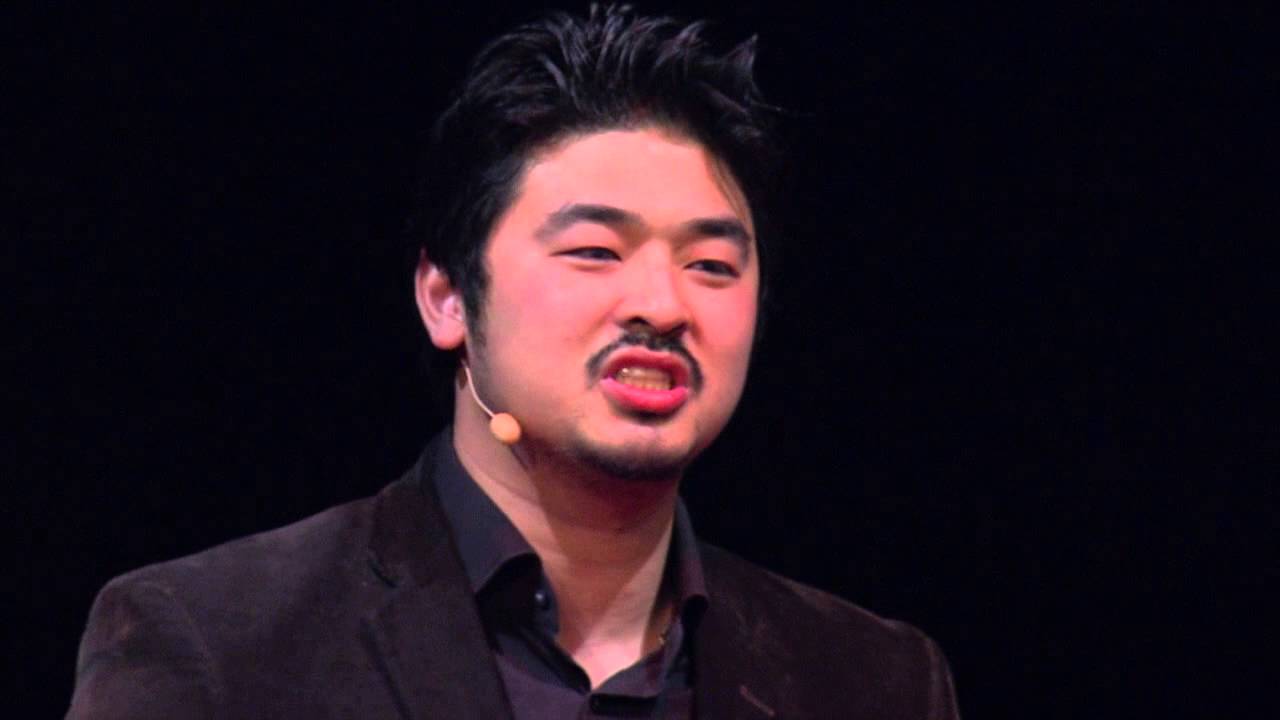
I read Lee Kuan Yew the same way I’d read a great game designer: through the systems, not the slogans. Singapore is one of the eight governments I’ve advised, so I’m not coming at this from an outside-observer seat. What I keep coming back to in Lee’s build is the planning horizon — most operators play for the next quarter, he played for the next half-century, and almost every “ruthless” choice he made looks different once you see the timescale he was scoring on. If you steal one thing from this profile, steal that.
Step 1: The Game — What Lee Kuan Yew Was Actually Playing
Most analyses of Lee Kuan Yew start with the wrong frame. They treat his Game as “modernize Singapore.” That’s the output, not the input.
The actual Game, as he described it in his memoir From Third World to First, was closer to this: make a small, multiracial, resource-poor island so economically valuable and so internally cohesive that no neighbor, no great power, and no internal faction can ever credibly threaten its survival. Every policy lever — housing, schools, language, defense, foreign investment — was a move on that single board.
That reframing matters because every Game in the 10,000 Hours of Play system has a hidden win condition underneath the obvious one. The obvious one is the headline metric. The hidden one is what the headline metric is in service of. If you only optimize the headline, you eventually do something stupid the day the headline and the hidden goal diverge.
Lee was almost monastic about not confusing the two. He would happily take an ugly political hit in year three if it bought structural resilience in year thirty. The 1965 separation from Malaysia is the cleanest example — he had spent years pushing for merger because merger was the obvious move for a city-state. When merger turned into a strategic threat instead of a strategic asset, he flipped, took the loss publicly, and rebuilt the Game around an independent Singapore inside 90 days. The headline changed. The hidden win condition never did.
The lesson for your own life run: write down your Game on one line. Then write the hidden win condition underneath it. If you cannot articulate the second line, your headline metric is going to lie to you.
Step 2: Attributes — The Innate Stats
Attributes are the stats you walked into the game with — the parts that don’t really upgrade past a certain point because they’re closer to wiring than to training. Lee Kuan Yew came pre-loaded with four that mattered.
The first was raw competitive drive. He was the top student of his year at Raffles Institution, and went on to take a double first in law at Cambridge despite his studies being interrupted by the Japanese occupation. People who grew up around him remarked on a refusal to come second at anything that could be ranked. That trait doesn’t predict success on its own, but it does pre-pay the price of admission for everything else.
The second was system-level pattern recognition. Where most politicians of his generation described problems in terms of ideology, Lee described them in terms of incentives and second-order effects. The Japanese occupation was a defining input — watching the British Empire collapse overnight taught him that institutions which look permanent are often shockingly thin, and that survival depends on what you build, not what you inherit.
The third was emotional control under crisis. The cliché is that he was cold; the more accurate read is that he could decouple decision-making from felt emotion in real time. He cried on television announcing the 1965 separation, then was back at his desk that afternoon redesigning ministries. That’s not absence of emotion. That’s an internal firewall.
The fourth was time-horizon length. Lee genuinely seemed to think in decades. Public housing policy was scoped to 30-year compounding effects. Bilingual education was scoped to the workforce of the 1990s, set up in the 1960s. This is the rarest Attribute on the list, and it ties directly into the OP Talent Triangle Method — when you stack natural Attributes that compound rather than substitute, your build pulls away from peers slowly at first, and then suddenly.
Step 3: Role(s) — The Character Class Across Chapters
Lee Kuan Yew didn’t play one character class. He played six in sequence, and the order was load-bearing.
Chapter one was Elite Student — Raffles, then Cambridge. The function of this class wasn’t the credential; it was the discipline of competing on rule-bound systems where outcomes were measurable. It gave him a baseline of “I can grind harder than the room” that he never lost.
Chapter two was Courtroom Lawyer. He practiced law after returning from Cambridge in 1950 and represented postal workers and trade unions in some of the era’s most visible labor disputes. Lawyering taught him three things that later became state-level operating principles: argue in cause and effect, write contracts that survive their authors, and never give a podium speech where a brief would do.
Chapter three was Anti-Colonial Organizer. The People’s Action Party was co-founded on 21 November 1954 with Goh Keng Swee, Toh Chin Chye, S. Rajaratnam and others. In this role he learned coalition-keeping under conditions where allies actively wanted to kill the project — the PAP’s internal split with the pro-communist left between 1957 and 1961 nearly ended his career before it started.
Chapter four was Head of Government. He became Singapore’s first prime minister on 5 June 1959 after PAP won 43 of 51 seats. The role’s function was execution at scale. He had to take the lawyer’s instinct for clean contracts and apply it to ministries that didn’t exist yet.
Chapter five — the most famous — was Nation-Builder. After 9 August 1965, the brief changed from “run a state inside a federation” to “build a state from scratch on a hostile board.” This is the chapter where his class abilities all stacked on the same encounter, and it’s the chapter the world remembers.
Chapter six was Senior Statesman. From his 1990 handover to Goh Chok Tong through his death in 2015, he played the role of long-cycle adviser — to his successors, to foreign heads of state from Deng Xiaoping to Henry Kissinger, and to the institutional memory of Singapore itself. The same arc you can study in Marcus Aurelius’s OP Hero profile — the philosopher-leader who turns from executor to teacher in the back half of the saga — shows up almost beat for beat in Lee’s final 25 years.
Step 4: Skills — The Real-Life Game Skills Lee Kuan Yew Mastered
Six canon Skills, each pinned to a moment you can point to.
Vision Manifestation (Warlock) — mental rehearsal vivid enough to shape reality. Lee would describe a finished Singapore — high-rise housing, mass transit, English-language fluency, a defense force large enough to deter — in his speeches well before any of those existed. The mental picture was specific enough that ministers and civil servants knew what they were building toward, and could course-correct without him in the room. That’s not motivational speaking; that’s a shared internal simulation.
Mastermind (Ranger) — creating, adapting, and executing complex plans. The Economic Development Board’s pitch to multinational corporations in the late 1960s and 1970s was a Mastermind play: bundle tax holidays, English-language workforce, political stability, and physical infrastructure into a single offer no individual country in the region could match. Texas Instruments arrived in 1968. Hewlett-Packard followed. The strategy compounded for two decades before the world noticed Singapore on the GDP-per-capita rankings.
Tactical Command (Ranger) — making people of very different talents work in formation. Goh Keng Swee on economics, S. Rajaratnam on foreign policy, Toh Chin Chye on party organization, Hon Sui Sen on finance — none of these men were obvious teammates, and several had vastly different temperaments from Lee. He gave each one a domain, defended their authority inside it, and intervened only at the seams. The same Skill type that shows up across the Skills Spectrum when a generalist learns to deploy specialists rather than out-specialize them.
Loremaster (Druid) — weaving compelling, inspiring stories. Lee’s national narrative was simple and repeated for 50 years: Singapore is small, surrounded, lucky to exist, and one wrong move from disappearing. That story functioned as social glue across ethnic groups that did not naturally see themselves as one nation. It’s the same Loremaster move Abraham Lincoln used to hold the Union together — fragile-but-precious framing instead of triumphalism.
Aegis (Paladin) — ignoring public criticism while pushing the Quest. Western press routinely accused Lee of authoritarianism, especially over press licensing and defamation suits. He absorbed it, answered when he felt like it, and kept building. Aegis isn’t thick skin; it’s the discipline to not let the loudest critic in the room redirect the next ten years of your work.
Phoenix Rebirth (Paladin) — recovering from devastating failure and coming back stronger. The 1965 expulsion was, by any normal political measure, a career-ending event. Lee turned it into the launchpad for everything else. The Skill isn’t optimism. It’s the ability to convert a structural defeat into a new starting position within days, before the loss calcifies into your identity.
Step 5: Allies — The People Who Multiplied Lee Kuan Yew
Solo runs make for bad biographies and worse outcomes. Lee Kuan Yew’s Ally roster is one of the more underrated stories in 20th-century politics, because Singapore’s success gets attributed to one man when at least four were doing the actual work.
Goh Keng Swee was the economic engine. As finance minister and later deputy prime minister, he architected the EDB-led industrial pivot, the Currency Board, and the early Singapore Armed Forces. Lee himself credited Goh as the most operationally indispensable colleague he had — without Goh, the economic-miracle half of the story doesn’t happen.
S. Rajaratnam ran foreign policy and national identity. He drafted the Singapore Pledge in 1966, the line every Singaporean schoolchild still recites, and led the country into ASEAN in 1967. His skill at framing Singapore externally bought the political room Lee needed to do unpopular things internally.
Toh Chin Chye was the party glue. As PAP chairman from the founding through 1981, he kept the organization functional through the leftist split, the merger years, and the post-separation rebuild. Lee got to be the front-of-house strategist partly because Toh ran the back-of-house.
The fourth-and-most-important Ally was his wife, Kwa Geok Choo. She topped him academically at Cambridge — quietly, in the same law tripos — and went on to run one of Singapore’s top law firms. She drafted significant parts of the documents underpinning the separation in 1965, and was, by his own account, the single person whose judgment he trusted without reservation for sixty-three years. The lesson on Allies from his story is brutal and clear: you cannot out-grind a missing co-founder. The Churchill OP Hero profile makes the same point from the wartime-leader angle — the cabinet of rivals is the multiplier, not the figurehead at the top.
Step 6: Quests — The Milestones That Shaped the Saga
Six Quests, in order, with the failure honestly in the middle.
Founding the PAP, 1954. A new party, a new tactical option, no money, no machine. The Quest’s reward wasn’t political power yet — it was the existence of a vehicle that could hold one. Without this move in 1954, nothing else lines up.
Winning the 1959 election. PAP took 43 of 51 seats with 54.1% of the popular vote. Lee was sworn in as Singapore’s first prime minister on 5 June 1959. The Quest reward was operational control of the island under internal self-government, with full foreign affairs and defense still controlled by London.
The leftist split and 1961 by-election defeats — the failure. PAP’s left wing, aligned with pro-communist trade unions, broke away after the Hong Lim by-election defeat on 29 April 1961 and the Anson defeat on 15 July 1961. Thirteen left-wing assemblymen were expelled on 20 July 1961 and formed the Barisan Sosialis. PAP’s working majority shrank from 43 to 26 seats. Most leaders would have been finished. Lee treated the split as a forced refactor: a smaller, ideologically coherent party that could actually be steered. By the 1963 election, PAP had clawed back to 37 of 51 seats. The setback didn’t just get survived; it got metabolized.
Merger and separation, 1963–1965. Singapore joined Malaysia on 16 September 1963. Two years of escalating racial and political conflict followed, including the 1964 race riots. On 9 August 1965, Malaysia expelled Singapore. Lee announced the separation in a televised press conference the same day and visibly broke down on camera. He was Prime Minister of a country with no army, no central bank worth the name, and no agreed-on plan for survival.
National Service and the SAF, 1967. The National Service (Amendment) Bill was passed on 14 March 1967 and came into force on 17 March 1967. Compulsory military service for male citizens transformed the SAF from a few thousand personnel into a credible defense force within a decade. The Quest reward was deterrence — Singapore stopped being a tempting target.
The 30-year economic and housing build-out, 1961–1990. EDB-driven foreign investment, HDB public housing that today houses roughly 80% of Singaporeans (with home-ownership rates above 90% of resident households), bilingual education, anti-corruption institutions, and a clean civil service. The headline payoff was GDP per capita growth from a few hundred US dollars in the early 1960s to among the highest in the world by the time Lee handed power to Goh Chok Tong in 1990. The Quest reward — the one Lee actually cared about — was that the small island had become impossible to break.
What You Can Steal From Lee Kuan Yew’s Build
You are not running a country. You are running a life. The transferable moves are still there, and they don’t require any of the powers a prime minister has.
Lengthen your planning horizon by one notch above whatever everyone around you is using. If your peers are scoping in quarters, scope in years. If they’re scoping in years, scope in decades. The unfair advantage is almost always in the timescale, not the speed.
Write down the hidden win condition under your headline Game. Headline-only operators eventually do something dumb when the metric and the goal diverge. The day you can articulate the second line is the day you stop optimizing for vanity.
Pick three to five Allies who own whole subsystems you don’t, defend their authority inside their domain, and intervene only at the seams. The cabinet of rivals beats the solo grind every time.
When you take a Phoenix Rebirth-grade hit — the kind that would normally calcify into your identity — use the first 90 days to refactor your Game, not to grieve. The split inside the PAP could have ended Lee Kuan Yew. He metabolized it into a tighter team within months. Most people take years and never finish the conversion.
If you want the entire 6-Step framework applied to a different OP Hero, the OP Hero Profiles hub has the rest of the catalog. Pick the one whose build matches the chapter of life you’re in right now.
Where this framework comes from

Want the full system this profile is built on?
Every OP Hero piece runs through the same 6-Step framework from 10,000 Hours of Play: Unlock Your Real-Life Legendary Success. The book covers the full system, walks through Yu-kai’s own life run as the first applied case study, and gives you the worksheets to audit your own build.
Related Reading
- All OP Hero Profiles — the full catalog of life-as-RPG breakdowns, updated as new heroes ship.
- 10,000 Hours of Play by OP Hero: Abraham Lincoln — the other great fragile-republic operator, with a near-identical Loremaster + institution-building build.
- 10,000 Hours of Play by OP Hero: Winston Churchill — wartime-leader parallel; the cabinet-of-rivals chapter is the same move.
- 10,000 Hours of Play by OP Hero: Marcus Aurelius — for the philosopher-leader senior statesman chapter Lee played for his final 25 years.
- The OP Talent Triangle Method — how to stack natural Attributes that compound rather than substitute, the way Lee stacked his.
- The 10,000 Hours of Play Framework Hub — the full 6-Step system you can apply to your own life run.