
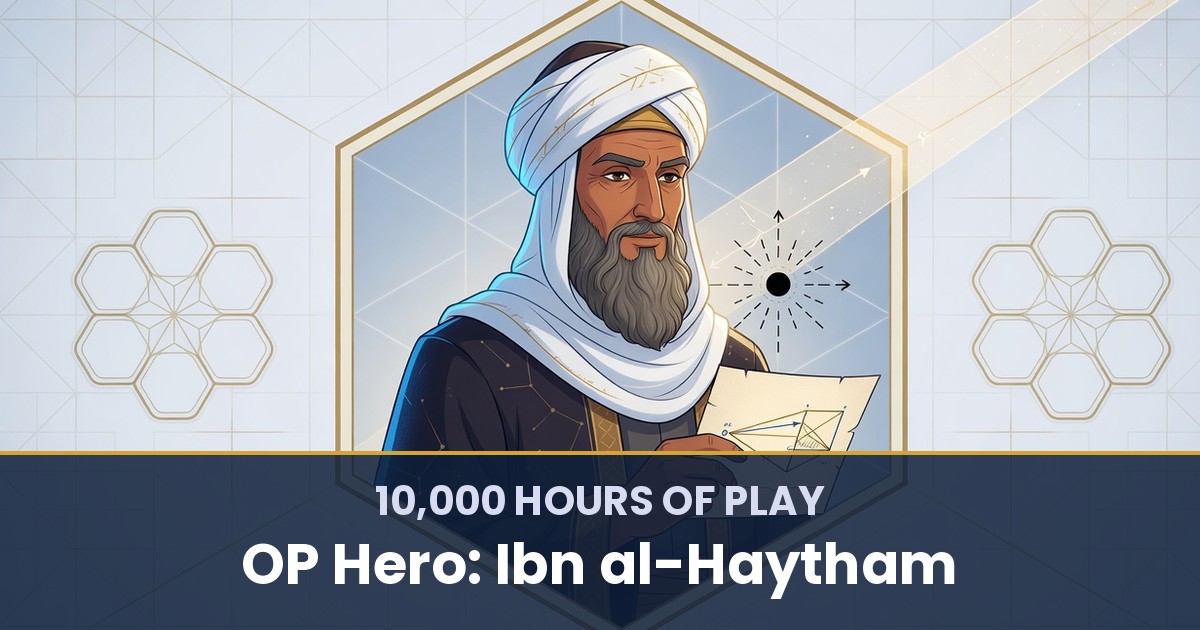


Sometime between 996 and 1021, a mathematician from Basra travelled up the Nile to the cataracts near Aswan to survey a Nile-regulation scheme he had boasted he could build for the Fatimid caliph, and came back to report that it could not be done.
The caliph was al-Ḥākim bi-Amr Allāh, a ruler whose reign ended with his disappearance in February 1021 and whose temper the medieval biographers treated as a mortal hazard.
The surveyor was Ibn al-Haytham, known to Latin Europe as Alhazen, and in the account the thirteenth-century biographer Ibn al-Qifṭī gives, the mathematician’s next move was to pretend he had lost his mind.
Writing in Cairo in the decades that followed, the same man produced the Kitāb al-Manāẕir, the Book of Optics: seven books that replaced the ancient theory of vision with one built on experiments you can still run today with a dark room and a few lamps.
Read through the six Steps, his life becomes a case study in one question: what does it take to trust evidence over authority when the authority in question can have you killed?
⚡ Speed Run Notes
- Ibn al-Haytham’s Game was to make truth answer to demonstration and experiment instead of the authority of the ancients, and the seven-book Book of Optics is the proof that he played it.
- His innate stats: a scepticism that by his own account doubted every sect in his youth, a geometric intuition that turned light into diagrams, and the independence to walk away from a government post in Basra.
- Canon Skills on the sheet: Feign Death (Rogue), True Sight (Ranger), Arcane Wisdom (Mage), Telekinesis (Mage) and Lich Grind (Warlock).
- His allies were mostly dead or unborn: Euclid, Ptolemy and Galen behind him, and al-Fārisī, Roger Bacon, Witelo and Kepler ahead of him, carrying the Optics forward for six centuries.
- The Quest log runs from the Nile project he judged impossible to the Book of Optics, the Doubts Concerning Ptolemy, and a copying trade that reportedly earned him 150 dinars a year.
Table of Contents
About Yu-kai Chou

Yu-kai Chou is the author of 10,000 Hours of Play — the book that treats your life as the most important game you’ll ever build a character in, and gives you the 6-Step framework (Game · Attributes · Role · Skills · Allies · Quests) to play it on purpose. He has spent two decades developing the system through which this post analyzes its OP Hero, and applies it to his own life and to the lives of the people he advises around the world.
Chou’s other framework, the Octalysis Framework, has been applied by LEGO, Microsoft, Porsche, Coca-Cola, Salesforce, and MrBeast, impacting over 1.5 Billion Users. He has taught the methodology at Harvard, Stanford, Yale, Tesla, Google, BCG, and IDEO, and has advised governments in eight nations including Ukraine, the United Kingdom, the Kingdom of Bahrain, Singapore, Taiwan, the Netherlands, Kazakhstan, and South Korea.
His work has been cited by Harvard, Stanford, MIT, Forbes, Wall Street Journal, Wired, US Department of Energy, NIST, NSF, NCBI, US Department of Education, ClinicalTrials.gov, and Google Scholar — with 3,700+ more academic publications. Explore his books here.

Ibn al-Haytham belongs in this series because he built a working method for checking reality in the eleventh century, and he did it with a dark room, a few lamps and a pinhole. If I could lift one move from his character sheet, it would be the habit he describes in the Doubts Concerning Ptolemy: treat the most respected source in your field as a claim to be tested, and then actually run the test.
Step 1: The Game — What Ibn al-Haytham Was Actually Playing
Ibn al-Haytham’s Game is easy to mistake for optics, because optics is where he won.
The clearer version sits in the autobiographical statement that Ibn Abī Uṣaybiʿa preserved in his thirteenth-century biographical dictionary: as a young man he examined the conflicting beliefs of the religious sects, concluded that truth is one, and resolved to look for it in doctrines grounded in sense perception and rational demonstration.
Everything else in this profile follows from that one resolution. He wanted knowledge that could be shown, and he wanted a method that let someone else check his work.
He stated the Game most plainly in al-Shukūk ʿalā Baṭlamyūs, the Doubts Concerning Ptolemy. In its preface, as the historian A. I. Sabra translates it, he argues that whoever seeks the truth must treat the writings of the ancients with suspicion, question everything taken from them, and submit only to argument and demonstration.
That was an expensive Game to play in eleventh-century Cairo. Ptolemy was the authority in both astronomy and optics, and Ibn al-Haytham used Ptolemy’s mathematics all his life while attacking the gap between models that merely reproduce appearances and models that describe how physical bodies can actually move.
He played the same Game on himself. In the Book of Optics he keeps a specific word, iʿtibār, for a test designed to decide between rival explanations, and the seven books run one loop over and over: state a physical hypothesis, derive its geometric consequences, build an arrangement that isolates the phenomenon, observe, and revise.
The question of how we see had been argued between the geometers’ camp and the philosophers’ camp for well over a thousand years. He answered it by putting lamps outside a dark room and looking at what landed on the wall.
Step 2: Attributes — The Innate Stats
Attributes are the stats a player carries in before any training, and for a man whose biography survives mainly through two later Arabic notices, the early evidence is thinner than usual.
He was born in Basra around 965, under Buyid rule in southern Iraq. The year is reconstructed from the autobiography, dated to the end of 417 AH (early 1027), and from Ibn Abī Uṣaybiʿa’s note that he was then sixty-three lunar years old.
The first attribute is scepticism toward received authority. By his own account the doubting started early, with the sects, long before it reached Euclid and Ptolemy.
The second attribute is geometric intuition, and it shows in everything he touched. Everything physical turned into a diagram in his hands: rays, mirrors, the apparent size of the Moon on the horizon, the height of the atmosphere, the shape of a paraboloid.
Nobody can prove that gift was visible in childhood, but he presents the turn toward mathematics as the defining choice of his youth, and he never turned back.
The third attribute is independence from institutions. A report preserved by Ibn Abī Uṣaybiʿa has him holding an administrative post in Basra, possibly a vizierial one, and giving it up because the work did not fit his purpose.
The fourth is a thoroughness that modern readers call obsessive. The Book of Optics treats light, perception, the anatomy of the eye, reflection, refraction, binocular vision and the errors of vision in separate, systematic books.
In the Talent Triangle Method, you get exactly one Edge Strength, the single attribute that hands you an unfair advantage in the right environment. His was geometric intuition, and he arranged his life so that one attribute did almost all the work.
Step 3: Role(s) — The Character Class Across Chapters
Ibn al-Haytham changed Roles more often than his reputation as a quiet theorist suggests.
The first Role was civil administrator in Basra. Its exact office and date are uncertain, but the report Ibn Abī Uṣaybiʿa preserves is clear about the exit: administration and inquiry pulled in different directions, and he chose inquiry.
The second Role was itinerant scholar, and it is the hardest chapter to date. His works show deep engagement with Greek science and with Arabic authors such as al-Kindī and Ibn Sahl, but the chronology of his movements before Egypt cannot be securely established from the sources.
The third Role was hydraulic engineer to a caliph, and it lasted exactly one site visit.
Ibn al-Qifṭī reports that Ibn al-Haytham remarked that, had he been in Egypt, he would have regulated the Nile so that its benefits could be had at every rise and fall. Al-Ḥākim heard of the remark, summoned him, and received him near Cairo at a place usually identified as al-Khandaq.
He travelled south toward the cataracts near Aswan, inspected the river and its terrain, and concluded that the project could not be executed with the means available. His reasoning, as reported, was that if it had been feasible the engineers of earlier ages would already have done it.
The caliph then gave him an administrative appointment instead, which brings us to the fourth Role: the madman.
In the traditional account he feigned insanity, his property was placed under sequestration, and he was confined until al-Ḥākim disappeared on 13 February 1021. He then recovered his property and lived in a domed structure, a qubba, near the gate of the al-Azhar mosque.
That story is disputed by the scholars who know the sources best. In a 1998 paper titled “One Ibn al-Haytham or Two?”, Sabra argued that the biographical tradition may have fused two men, al-Ḥasan ibn al-Haytham the optical theorist and a mathematician named Muḥammad ibn al-Haytham. Roshdi Rashed has defended a two-person reading; other historians reject it, and there is no settled consensus.
The fifth Role is the one that paid the bills: copyist for hire. Ibn al-Qifṭī reports that he produced one copy each of Euclid’s Elements, Ptolemy’s Almagest and the Mutawassiṭāt, the Intermediate Books, every year, and earned about 150 dinars annually from the trade.
The sixth Role, the one that lasted, was mathematical physicist. His near-contemporary Ibn Sina spent the same decades building a system that covered medicine and philosophy together; Ibn al-Haytham chose one narrow Role and stayed inside it.
Step 4: Skills — The Real-Life Game Skills Ibn al-Haytham Mastered
Five canon Real-Life Game Skills show up with evidence attached, and the first one rarely appears on a scientist’s character sheet.
Feign Death (Rogue) is the Skill of acting weak or incapable to escape a consequence you cannot fight. As the tradition tells it, Ibn al-Haytham used it on a caliph: after the Nile verdict he presented himself as insane and stayed that way until al-Ḥākim was gone in 1021.
True Sight (Ranger) is the Skill of noticing the detail everyone else looks past. He noticed that the Milky Way shows no detectable parallax, and used that to argue it lies far beyond the atmosphere, against the Aristotelian view.
The Moon looking larger on the horizon got the same treatment: he explained it as a judgment about perceived distance, with the eye taking cues from surrounding objects, which separates the angle the Moon fills at the eye from the size the mind reports.
And in the dark-room experiments he saw that several lamps placed outside a small aperture produce separate images inside, and that the images stay distinct. That observation carries the straight-line propagation of light and the whole case for vision as light entering the eye.
Arcane Wisdom (Mage) is the Skill of absorbing a wide field of information and synthesizing it into a clear output. Euclid and Ptolemy supplied the geometry, Galen the anatomy of the eye, al-Kindī and Ibn Sahl the Arabic work on rays and refraction, and he compressed all of it into one seven-book argument.
On the Skills Spectrum he sits at the master end of a single domain, and the Optics shows what that position buys: he could hold the mathematician’s, the physician’s and the philosopher’s accounts of vision in his head at once and find the seams where they contradicted each other.
Telekinesis (Mage) is the Skill of visualizing physical interactions in your head before they happen in the world. Book V of the Optics contains the problem later named for him: given a light source and an eye, find the point on a spherical mirror where the ray must reflect.
He attacked it with conic sections, the heaviest geometric tool available to him. In its general form the problem reduces to a quartic equation, and after Huygens and Isaac Barrow had both worked on it, the full algebraic solution waited until Jack Elkin published one in 1965.
The same Skill appears in his attempt to prove Euclid’s parallel postulate from a quadrilateral with three right angles, and in his use of the sum of fourth powers to compute the volume of a paraboloid of revolution.
Lich Grind (Warlock) is the Skill of intense, secluded work over long stretches. The Cairo decades after 1021 were exactly that: copying the Elements and the Almagest for income, and writing.
Ibn Abī Uṣaybiʿa’s list runs to more than ninety titles, the total attributed to him is often put near 200, and roughly fifty to fifty-five works survive, most of them produced by a man working largely alone, with only a handful of pupils reported by name.
Step 5: Allies — The People Who Multiplied Ibn al-Haytham
The medieval sources name only a handful of pupils: Ibn Abī Uṣaybiʿa says that al-Mubashshir ibn Fātik and Isḥāq ibn Yūnus studied the mathematical sciences with him in Egypt, and modern historians treat those reports with caution. If you build his Step 5 the way you would build it for a founder with a team, the section comes up nearly empty.
His alliance ran across time instead, in both directions.
Behind him stood Euclid, around 300 BCE, and Ptolemy, in the second century CE, who supplied the geometrical optics and the extramission theory he spent seven books dismantling. Galen gave him the anatomy of the eye. Al-Kindī, who died around 873, had already brought Greek optics into Arabic.
Closest of all was Ibn Sahl, active in the tenth century, who treated refraction geometrically before Ibn al-Haytham did. Any honest account of Arabic optics puts Ibn Sahl in the lineage, and Ibn al-Haytham worked from inside it.
Al-Ḥākim counts as an Ally of the dangerous kind. His reign brought Ibn al-Haytham to Cairo, and his Dār al-ʿIlm, the House of Knowledge founded in 1005, shows the Fatimid court investing in learning, though direct evidence that Ibn al-Haytham worked there is limited.
Ahead of him stood the transmitters who carried the text west. An anonymous translator working around 1200 produced the Latin De aspectibus. Roger Bacon, John Pecham and Witelo built on it across the thirteenth century, and Friedrich Risner printed the Latin text in Basel in 1572 as the Opticae thesaurus, bound together with Witelo’s Perspectiva.
From that edition Johannes Kepler worked out his own optics in the Ad Vitellionem Paralipomena of 1604, arguing with the Alhazen and Witelo tradition on nearly every page.
In the Persian world, Kamāl al-Dīn al-Fārisī wrote the Tanqīḥ al-Manāẕir, the Revision of the Optics, around 1300 to 1310, after his teacher Quṭb al-Dīn al-Shīrāzī pointed him to Ibn al-Haytham’s text. Using a glass sphere as a model droplet, al-Fārisī explained the primary rainbow through two refractions and one internal reflection.
Step 6: Quests — The Milestones That Shaped the Saga
Quest one was the Nile, and it failed. He went to the cataracts, read the terrain, and told the most powerful man in Egypt that the thing he had boasted about could not be done.
Modern readers tend to grade that as the low point of his life, but the evidence said no and he reported what the evidence said.
Quest two was the Book of Optics, seven books in all. Book I covers light and the mechanism of vision, Book II visual perception, Book III the errors of direct vision, Books IV through VI reflection, and Book VII refraction.
The date of its composition remains contested among historians. The older view places it during the alleged confinement between 1011 and 1021; Sabra argued for a later composition, roughly 1028 to 1038, after the autobiography and before his death around 1040.
Quest three was the Doubts Concerning Ptolemy, the critique of models that save appearances without describing physical motion. Nicolaus Copernicus would push that same dissatisfaction with Ptolemy to its conclusion five centuries later.
Quest four was the smaller treatises that filled the gaps: the Treatise on Light; On the Configuration of the World, which travelled into Latin and Castilian in the thirteenth century; On the Light of the Moon, arguing that sunlight proceeds from every illuminated point of the lunar surface; the Milky Way parallax argument; and a treatise On Place that challenged Aristotle’s definition.
Quest five was the catalogue of his own work. A list of his own works travelled with the autobiography of 1027, and the surviving lists are the reason anyone can count what he did.
The long tail of the Quest log runs past his death. A lunar crater carries the name Alhazen, as does asteroid 59239, and his portrait has appeared on Iraq’s 10,000-dinar banknote.
UNESCO’s International Year of Light in 2015 was tied to roughly a millennium since his optical work, and the “1001 Inventions and the World of Ibn al-Haytham” campaign launched at UNESCO headquarters in Paris in January 2015. Six years earlier, the physicist Jim Al-Khalili had made the case for his place in the history of science in a BBC article.
What You Can Steal From Ibn al-Haytham’s Build
Three moves transfer directly from his character sheet.
First, keep the hypothesis and the test in separate columns. Every geometric argument in the Optics is paired with an arrangement built to break it, and most strategy documents never reach that second column.
Second, treat an honest report of bad news as a completed Quest. The Nile verdict cost him his standing and, as the story goes, his freedom, and it shows how he actually played his Game when the stakes were highest.
Third, if you have no team, write for the one that will exist later. The Optics found its readers in Oxford, Persia and Prague over the next six hundred years, and every one of them came to it through the text alone, which is a slow alliance but a real one.
Where this framework comes from

Want the full system this profile is built on?
Every OP Hero piece runs through the same 6-Step framework from 10,000 Hours of Play: Unlock Your Real-Life Legendary Success. The book covers the full system, walks through Yu-kai’s own life run as the first applied case study, and gives you the worksheets to audit your own build.
Related Reading
- All OP Hero Profiles — the full hub
- 10,000 Hours of Play by OP Hero: Ibn Sina (Avicenna)
- 10,000 Hours of Play by OP Hero: Galileo Galilei
- 10,000 Hours of Play by OP Hero: Isaac Newton
- 10,000 Hours of Play by OP Hero: Johannes Kepler
- Real-Life Game Skills: The 96-Skill System Behind 10,000 Hours of Play