


On July 20, 1969, minutes above the lunar surface, the Apollo 11 guidance computer started flashing 1202 alarms.
The rendezvous radar was flooding it with more work than it could process. The software answered by discarding its lower-priority tasks, restarting what mattered, and keeping the landing-critical programs alive.
Neil Armstrong landed on a computer that stayed calm under overload, because the person who led its software had spent years imagining exactly this kind of moment.
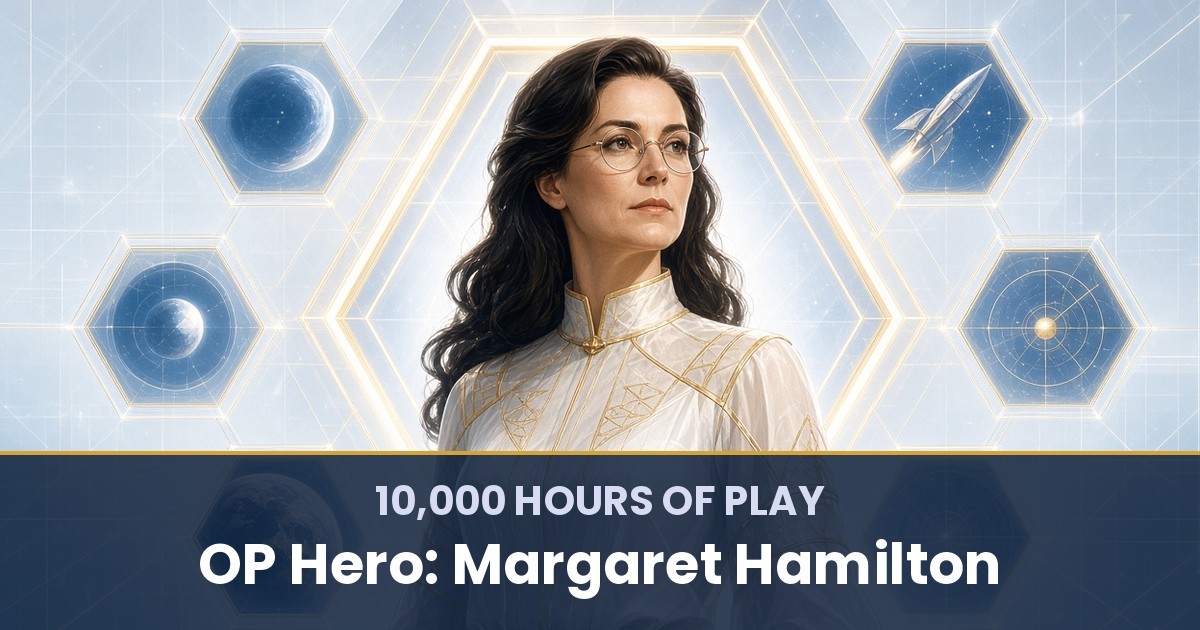
Her name is Margaret Hamilton, and when you run her life through the 6-Step framework from 10,000 Hours of Play, every Step lands on documented evidence: the Game, the stats, the class changes, the alliances, the quests.
⚡ Speed Run Notes
- Margaret Hamilton’s Game: make complex, safety-critical software reliable enough to survive the unexpected, then turn the lessons into reusable engineering methods.
- During the Apollo 11 descent, her team’s priority-scheduling design shed low-priority work under overload and kept the landing programs running through the 1202 alarms.
- Her standout Attributes: failure-oriented imagination, systems vision, pattern recognition, and the risk tolerance to lead a discipline that barely had a name.
- Skills cited: Astral Projection (Mage), Foresight (Ranger), Cosmic Alignment (Mage), Aegis (Paladin), Courageous Heart (Paladin).
- After Apollo, she co-founded Higher Order Software in 1976 to formalize error-prevention methods, and she helped popularize the term “software engineering” along the way.
Table of Contents
- Step 1: The Game Margaret Hamilton Was Actually Playing
- Step 2: Attributes, the Innate Stats
- Step 3: Role(s), the Character Class Across Chapters
- Step 4: The Real-Life Game Skills She Mastered
- Step 5: Allies, the People Who Multiplied Her
- Step 6: Quests, the Milestones That Shaped the Saga
- What You Can Steal From Margaret Hamilton’s Build
- Where this framework comes from
- Related Reading
About Yu-kai Chou

Yu-kai Chou is the author of 10,000 Hours of Play — the book that treats your life as the most important game you’ll ever build a character in, and gives you the 6-Step framework (Game · Attributes · Role · Skills · Allies · Quests) to play it on purpose. He has spent two decades developing the system through which this post analyzes its OP Hero, and applies it to his own life and to the lives of the people he advises around the world.
Chou’s other framework, the Octalysis Framework, has been applied by LEGO, Microsoft, Porsche, Coca-Cola, Salesforce, and MrBeast, impacting over 1.5 Billion Users. He has taught the methodology at Harvard, Stanford, Yale, Tesla, Google, BCG, and IDEO, and has advised governments in eight nations including Ukraine, the United Kingdom, the Kingdom of Bahrain, Singapore, Taiwan, the Netherlands, Kazakhstan, and South Korea.
His work has been cited by Harvard, Stanford, MIT, Forbes, Wall Street Journal, Wired, US Department of Energy, NIST, NSF, NCBI, US Department of Education, ClinicalTrials.gov, and Google Scholar — with 3,700+ more academic publications. Explore his books here.

What I find instructive about Margaret Hamilton’s build is how early she chose her Game: reliability itself, with Apollo simply the hardest version of that game available in her lifetime. If I could lift one thing from her character sheet, it would be the Mage-class habit of imagining every way a system can fail before it ships, because most of us only learn our failure modes after they have already cost us something.
Step 1: The Game — What Margaret Hamilton Was Actually Playing
Step 1 of the framework is Choose Your Game: the mission you keep returning to across decades, whatever costume it wears.
Hamilton’s Game was making complex, safety-critical systems reliable enough to survive the unexpected. Human mistakes, hardware faults, overload conditions, situations nobody planned for: her software was built to meet all of them and keep working.
You can trace the same mission through every chapter of her career. It shows up in weather-prediction software at MIT, in air-defense systems at Lincoln Laboratory, in the Apollo Command Module and Lunar Module code she led at the MIT Instrumentation Laboratory, and in the companies she founded afterward to formalize what she had learned.
She described the value of her Apollo work as going far beyond completing a mission. The point, in her words, was “designing it, developing it, evolving it, watching it perform and learning from it for future systems.”
Each system was a round of play, and the real score was the engineering method she carried into the next round.
Her Game also ran quietly. For most of her Apollo years, the public had no idea who she was.
A well-chosen Game pulls you forward even when nobody is watching, and hers kept pulling for more than five decades across four employers and two companies of her own.
Step 2: Attributes — The Innate Stats
Step 2 is Know Your Attributes: the innate stats you were dealt before any training happened. In the Talent Triangle Method, these are the raw materials you build your edge from.
Hamilton’s first and strangest stat was a failure-oriented imagination. She habitually asked what could go wrong, including failures and human actions that mission planners had not prioritized, and her Apollo work explicitly built in error detection and recovery.
Her instinct was to imagine the system breaking, in as many ways as possible. That instinct became the backbone of software that could save a Moon landing.
Her second stat was systems vision. She saw software, astronauts, procedures, sensors, computers, and mission objectives as one interacting system rather than isolated parts.
Third came pattern recognition. She noticed that seemingly unrelated faults could share a common cause, which pushed her toward mechanisms for prioritizing and recovering from whole classes of failure rather than patching symptoms one at a time.
And underneath all of it sat independent risk tolerance. She entered computing and software leadership when those roles were poorly defined, and she accepted responsibility for an unusually consequential, still-emerging discipline.
All four stats showed up in her choices long before the world handed her a title for them, which is exactly where Step 2 tells you to look in your own history.
Step 3: Role(s) — The Character Class Across Chapters
Step 3 is Select Your Role: the character class you play in each chapter, built on top of your Attributes.
Hamilton’s early chapters look like a classic Mage. She earned a mathematics degree from Earlham College in 1958, taught math and French, then moved into programming weather models at MIT around 1959, working on systems connected with the meteorologist Edward Lorenz.
Her next chapter raised the stakes. At MIT’s Lincoln Laboratory in the early 1960s she programmed SAGE, the Semi-Automatic Ground Environment air-defense system, one of the era’s largest real-time computing projects.
Then came the class change that defined her. Joining the MIT Instrumentation Laboratory in 1965, she rose to direct the Software Engineering Division responsible for Apollo’s onboard flight software, which means the Mage became a commander of Mages.
Leading specialists is its own Role, with its own skill tree. Grace Hopper’s OP Hero profile shows a strikingly similar arc: a mathematician who became most powerful when she started building the discipline other programmers would stand on.
Hamilton’s final Role was the methods entrepreneur. She co-founded Higher Order Software in 1976 and later Hamilton Technologies, turning her hard-won Apollo lessons into formal systems for preventing software errors.
She kept the same Attributes in every chapter, and she changed Roles each time the Game demanded it.
Step 4: Skills — The Real-Life Game Skills Margaret Hamilton Mastered
Step 4 is Enhance Your Skills: the learned abilities layered on top of innate stats. In 10K HP these are canon Real-Life Game Skills, each tied to one of seven Classes.
Skill selection shapes a build as much as Skill depth, because some Skills charge a recurring toll. The clearest documented case is the Lich Pact: two years on 3.5 hours of sleep a day, extra waking hours gained, and a physical price paid that the write-up itemizes.
Hold Hamilton’s five Skills against that benchmark and the difference jumps out: every one of them ran toll-free for decades, which is a large part of why her build compounded instead of burning down.
Astral Projection (Mage) — seeing all possible outcomes before they happen. Hamilton’s team designed Apollo software to detect abnormal conditions and keep executing its most important work instead of crashing, which required mentally walking through failure branches nobody had flown yet.
Foresight (Ranger) — projecting future risks and trends. The 1202 alarm response existed because her organization had anticipated overload as a category of event, so when the rendezvous radar swamped the computer during the Apollo 11 descent, the priority system already knew what to drop.
Cosmic Alignment (Mage) — optimizing how many moving parts come together. Apollo development meant maintaining software for multiple missions and vehicle systems at once, under strict memory limits, with configuration discipline that archival records still document today.
Aegis (Paladin) — pushing the Quest forward while ignoring the doubters. Software was widely treated as an improvised accessory to hardware, and Hamilton kept insisting it deserved the rigor of a real engineering discipline, helping popularize the very term “software engineering.”
Courageous Heart (Paladin) — charging into uncharted territory. There was no established career path for what she did; she walked into real-time programming, then flight software leadership, before either had a settled name.
To place these Skills on your own character sheet, the Skills Spectrum gives you the vocabulary: Hamilton played as a Master in a deliberately narrow lane, and the depth is what made her irreplaceable.
Step 5: Allies — The People Who Multiplied Margaret Hamilton
Step 5 is Build Your Alliance, and Hamilton’s story dismantles the lone-genius myth: every system she is celebrated for came out of a team she led, inside institutions she chose well.
Her core alliance was the MIT Instrumentation Laboratory team, later the Charles Stark Draper Laboratory. They converted Apollo’s guidance requirements into operational flight software for both the Command Module and the Lunar Module, and Hamilton led that software organization rather than producing the system alone.
NASA’s mission and flight-control organizations were allies of a different type. They supplied the requirements, operational constraints, and testing regime that made her fault-tolerance features consequential in the first place.
Even the astronauts functioned as allies inside her system model. Their actions were part of what the software had to anticipate, and the Apollo 11 landing proved the software could protect mission-critical functions when the unexpected arrived.
Earlier allies shaped her before Apollo did. Edward Lorenz and MIT’s meteorological computing colleagues gave her a first encounter with simulation, and Lincoln Laboratory colleagues on SAGE taught her what large real-time systems demand.
Katherine Johnson’s OP Hero profile shows another brilliant mind whose impact ran through NASA’s institutional machinery rather than around it.
Remove any one of those alliances and the story thins out quickly: the landing software needed Draper’s institutional depth, NASA’s testing regime, and astronauts willing to trust her team’s code.
Step 6: Quests — The Milestones That Shaped the Saga
Step 6 is Achieve Your Quests: the concrete milestones that turn a mission into a story.
Quest 1: Weather computing at MIT, around 1959. Her first major programming work, connected with Edward Lorenz, taught her the difference between a mathematical model and a working computational system.
Quest 2: SAGE air defense, early 1960s. Software that had to process continuous input and respond under operational constraints gave her the real-time instincts Apollo would later demand.
Quest 3: Apollo flight software, 1965 to 1972. She joined the Instrumentation Laboratory in 1965 and came to direct the division building onboard software for Apollo 8, 9, 10, 11 and the missions that followed, plus Skylab after that.
Quest 4: Apollo 8, December 1968. The first crewed mission to leave Earth orbit and return validated the software architecture at lunar distance, and Hamilton has discussed its errors and alarms candidly in oral-history material.
Quest 5: The Apollo 11 overload, July 20, 1969. The rendezvous radar swamped the computer during descent, the 1202 alarms fired, and the priority system shed less-important work while preserving the landing. Her failure-tolerant design philosophy had just passed its hardest exam in front of a live worldwide audience.
Quest 6: Higher Order Software, 1976 onward. Her setback lens matters here: Apollo had shown that testing and individual brilliance were never enough, so she built formal methods to control complexity before errors are born. Recognition followed across the decades, including the Presidential Medal of Freedom in 2016.
Margaret Hamilton died on September 30, 2026, at the age of 90, in Cambridge, Massachusetts, a short walk from the laboratories where she rewrote what software could be trusted to do.
What You Can Steal From Margaret Hamilton’s Build
Steal the failure-oriented imagination first. Before your next launch, project, or difficult conversation, spend twenty minutes listing the ways it breaks, then design your response to the top three while you are still calm.
Steal her relationship with unglamorous reps. The priority-scheduling code that saved Apollo 11 was written and tested years before anyone cheered for it.
Steal the class-change courage. When her Game demanded she stop being the strongest Mage in the room and start leading a division of them, she took the new Role instead of protecting the comfortable one.
And steal her endgame move: she turned her experience into methods other people could use, which is how one person’s 10,000 hours become an entire field’s foundation. The same conversion shows up again and again across the OP Hero profiles: the heroes whose influence outlives them are the ones who packaged personal mastery into systems others could run.
Your systems will get their own 1202 moment eventually. Build like someone who already expects it.
Where this framework comes from

Want the full system this profile is built on?
Every OP Hero piece runs through the same 6-Step framework from 10,000 Hours of Play: Unlock Your Real-Life Legendary Success. The book covers the full system, walks through Yu-kai’s own life run as the first applied case study, and gives you the worksheets to audit your own build.
Related Reading
- All OP Hero Profiles (the full catalog)
- 10,000 Hours of Play by OP Hero: Alan Turing
- 10,000 Hours of Play by OP Hero: Ada Lovelace
- 10,000 Hours of Play by OP Hero: Hedy Lamarr
- 10,000 Hours of Play by OP Hero: Dorothy Hodgkin
- The Skills Spectrum: Specialist, Dabbler, or Master?