
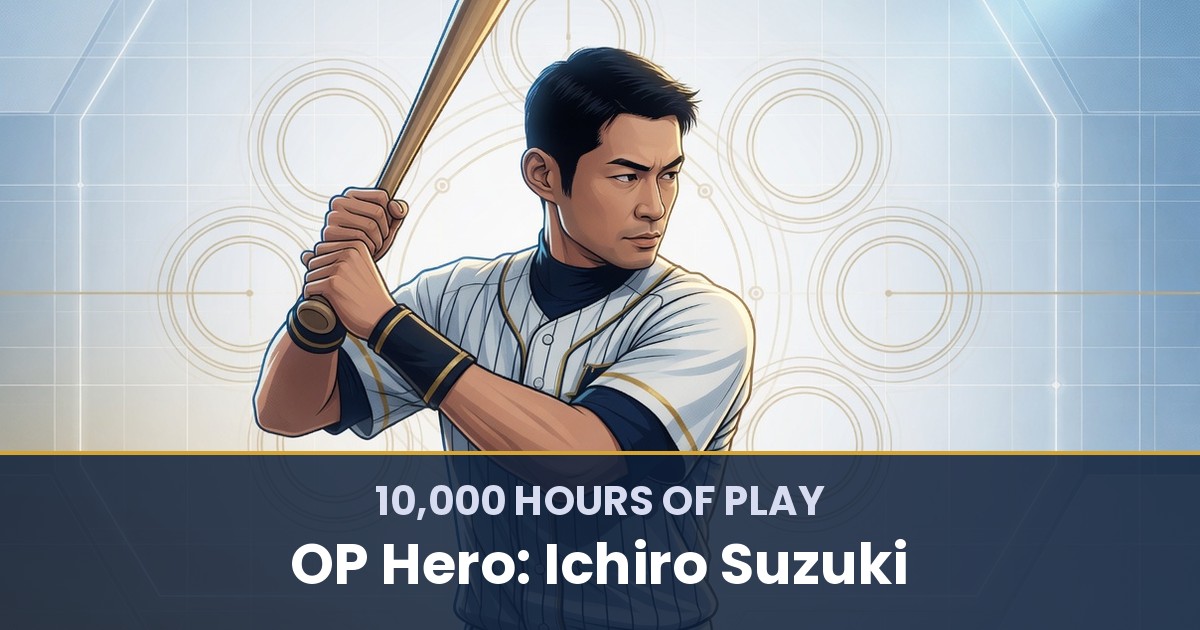


On August 7, 2016, at Coors Field in Denver, a 42-year-old outfielder for the Miami Marlins hit a triple. It was Ichiro Suzuki’s 3,000th hit in the major leagues.
He had not played his first major league game until he was 27. Before that he played for the Orix BlueWave in Japan from 1992 to 2000 and collected 1,278 hits there.
His first professional manager had refused to accept his swing. Ichiro kept it, and his hits from the two leagues add up to 4,367.
That run makes Ichiro a clean case for the 10K HP framework, because so much of his character build shows up in the numbers. The six Steps below read it in order, from the training sessions with his father to the Hall of Fame vote in 2025.
⚡ Speed Run Notes
- Ichiro’s Game held for almost three decades: make reliable contact every day, and show that a Japanese position player could star in the major leagues.
- His Attributes showed early: persistence, fine body control, a high tolerance for repetition, and a stubborn internal standard for how he should play.
- His Roles ran from fourth-round draft pick to MLB’s first Japanese position player, then veteran role player, Mariners special assistant and Hall of Famer.
- His canon Skills: Ninja Focus (Rogue), Aegis (Paladin), Courageous Heart (Paladin), and Revive (Paladin).
- His Allies included his father Nobuyuki, Orix manager Akira Ogi, and the Seattle Mariners, who gave him an everyday role in 2001.
Table of Contents
About Yu-kai Chou

Yu-kai Chou is the author of 10,000 Hours of Play — the book that treats your life as the most important game you’ll ever build a character in, and gives you the 6-Step framework (Game · Attributes · Role · Skills · Allies · Quests) to play it on purpose. He has spent two decades developing the system through which this post analyzes its OP Hero, and applies it to his own life and to the lives of the people he advises around the world.
Chou’s other framework, the Octalysis Framework, has been applied by LEGO, Microsoft, Porsche, Coca-Cola, Salesforce, and MrBeast, impacting over 1.5 Billion Users. He has taught the methodology at Harvard, Stanford, Yale, Tesla, Google, BCG, and IDEO, and has advised governments in eight nations including Ukraine, the United Kingdom, the Kingdom of Bahrain, Singapore, Taiwan, the Netherlands, Kazakhstan, and South Korea.
His work has been cited by Harvard, Stanford, MIT, Forbes, Wall Street Journal, Wired, US Department of Energy, NIST, NSF, NCBI, US Department of Education, ClinicalTrials.gov, and Google Scholar — with 3,700+ more academic publications. Explore his books here.
Ichiro belongs in this series because his build shows what daily repetition can do with a modest physical starting kit over three decades. If I could lift one move from his character sheet, it would be the way he kept a swing his first manager rejected until the results settled the question.
Step 1: The Game — What Ichiro Suzuki Was Actually Playing
Ichiro’s results describe one Game played the same way for almost thirty years: put the ball in play, use his speed, and make the next at-bat as repeatable as the last.
He built that Game around contact and speed. He reached base through bat control and by running hard out of the box, and his major league career included 509 stolen bases.
The second layer of the Game was bigger than his own box score. In 2001 he became the first Japanese position player in Major League Baseball, and every season after that tested whether a hitter trained in Japan could hold his place at the top level.
The answer came in totals: ten straight seasons of at least 200 hits from 2001 to 2010, a major league record, and a single-season record of 262 hits in 2004.
Compare his Game with that of Shohei Ohtani, who arrived in the major leagues in 2018. Ohtani’s Game is to do two jobs at once as a pitcher and a hitter, while Ichiro spent his career refining a single job, contact hitting, until it produced 200 hits a season for a decade.
A clear Game makes the hundreds of small daily choices easier to settle, because each one either serves the next hit or it does not.
Step 2: Attributes — The Innate Stats
Attributes are the stats a player brings before any training. Four of Ichiro’s show up from childhood onward.
The first Attribute is persistence, and it showed up in childhood: as a boy he asked his father to help him become a better player, and the two of them settled into a demanding training regimen that they repeated day after day.
The second is fine body control, since his style depended on balance, bat speed, contact point and running speed working together, which mattered for a player the Hall of Fame describes as overlooked early partly because of his small stature.
The third is a tolerance for repetition. Batting practice, throwing, route running and baserunning were small tasks he performed at high volume for decades, and the steadiness of his hit totals reflects that volume.
The fourth is a self-directed standard for how he should play. When his first manager at Orix rejected his unorthodox swing, he kept it, and that trait reappears as a Skill in Step 4.
The OP Talent Triangle Method is built to surface your Edge Strength, the strength that feels so normal you stop noticing it. Ichiro’s looks like the ability to repeat the same fine motor action at high volume, season after season.
Step 3: Role(s) — The Character Class Across Chapters
Ichiro’s Role changed at least six times, and each change put the same contact skill in a new setting.
His first class was the apprentice, training under his father, Nobuyuki Suzuki, from elementary school, long before any scout knew his name.
In the 1991 draft, Orix took him in the fourth round. That made him an unorthodox prospect, and in 1992 and 1993 he spent much of his time in the farm system because manager Shōzō Doi did not accept his swing.
From 1994 to 2000 he was the precision star of the Pacific League. He won seven straight batting titles in that stretch, starting with a 210-hit season in 1994.
In 2001 he respecced into the trans-Pacific proof point for the Seattle Mariners, winning the American League Rookie of the Year and Most Valuable Player awards in the same season.
The New York Yankees acquired him in July 2012, and the Miami Marlins signed him for 2015. In those chapters he played the veteran adapter, moving from franchise centerpiece to a role player who kept adding to his totals.
He returned to Seattle in 2018, became special assistant to the Mariners chairman that May, and ended his playing career in Tokyo in March 2019. His later class is the elder and ambassador, and a Hall of Famer whose number 51 the club retired on August 9, 2025.
Step 4: Skills — The Real-Life Game Skills Ichiro Suzuki Mastered
Attributes are the starting stats, and Skills are what a player grinds. Four canon Skills explain most of Ichiro’s run.
The first is Ninja Focus (Rogue): sustained discipline and focus on a task. Ichiro’s evidence is the training he began as a boy with his father and the daily preparation that kept him productive across 19 major league seasons.
Ten consecutive 200-hit seasons are what Ninja Focus looks like on a stat sheet, because each of those years asked for the same output again from a body that was getting older.
The second is Aegis (Paladin): ignoring critics and naysayers while pushing the Quest. Doi’s refusal to accept the swing kept Ichiro in the farm system for much of two seasons.
He kept the swing anyway, and once Akira Ogi took over as manager and moved him to the top of the lineup, the same swing produced 210 hits in 1994.
The third is Courageous Heart (Paladin): charging into uncharted territory. When he moved to Seattle for 2001, no Japanese position player had played in the major leagues, so he had no route map for how his game would translate.
He answered with 242 hits and a .350 batting average in his first season.
The fourth is Revive (Paladin): recovering from failure and taking new action toward the next Quest. At the 2009 World Baseball Classic he struggled at the plate for much of the tournament, then won the final against South Korea with a two-run single in the 10th inning.
On the Skills Spectrum, Ichiro sits on the Master track: one primary Skill, Ninja Focus, with the other three protecting and extending it.
Step 5: Allies — The People Who Multiplied Ichiro Suzuki
Ichiro’s Allies supplied three things at the right moments: training, trust and a stage.
His father, Nobuyuki Suzuki, was the first Ally, coaching him in daily practice sessions after school from his elementary school years onward.
Akira Ogi was the second, hired as Orix manager after the 1993 season. He moved Ichiro to the top of the lineup, and the 1994 season that followed set what was then the Japanese single-season hits record.
Shōzō Doi belongs in the story as the opposite of an Ally. His resistance cost Ichiro much of two seasons, and it shows how much a single gatekeeper can decide when a young player has nobody in his corner.
The Seattle Mariners provided the stage in 2001, with an everyday role in his first major league season.
Japan’s national team gave him a second stage at the 2009 World Baseball Classic, where the final against South Korea was decided by his at-bat in the 10th inning.
After Seattle, the Yankees and then the Marlins kept him in the major leagues through his late 30s and early 40s, and the at-bats they gave him carried his total past 3,000 hits.
Step 6: Quests — The Milestones That Shaped the Saga
Ichiro’s six Quests run in order from his first professional seasons to the Hall of Fame vote.
Quest 1 was surviving the Orix system between 1991 and 1994. Ichiro spent much of 1992 and 1993 in the farm system, then collected 210 hits in 1994 with a .385 average.
Quest 2 was proving himself in Seattle in 2001. His first major league season produced 242 hits, a .350 average and 56 stolen bases, along with both the Rookie of the Year and MVP awards.
Quest 3 was breaking an 84-year-old record in 2004. His 262 hits passed George Sisler’s 257 from 1920, which had stood as the major league single-season record.
Quest 4 was the loss of the streak in 2011 and 2012. The run of 200-hit seasons ended in 2011 at 184 hits, and in July 2012 the Mariners traded him to the Yankees.
This was the setback Quest, and he answered it by playing on until 2019 and adding hundreds more hits to his total.
Quest 5 was reaching 3,000 major league hits in 2016. The triple at Coors Field on August 7, 2016 came in his 16th major league season.
Quest 6 closed the loop between 2019 and 2025. He retired at the Tokyo Dome on March 21, 2019, and on January 21, 2025 he was elected to the Hall of Fame with 393 of 394 votes.
What You Can Steal From Ichiro Suzuki’s Build
First, pick one action you can repeat daily and protect it the way Ichiro protected his preparation. Ten seasons of 200 hits came from a routine that held whether the previous day went well or badly.
Second, treat a new arena as a Quest you can prepare for. Ichiro had no Japanese position player ahead of him in the major leagues, so his preparation had to stand in for a map.
Third, plan for the slump inside a longer run. His 2009 World Baseball Classic began badly and ended with the winning hit in the final.
Fourth, measure your build over decades, the way Ichiro’s 4,367 combined hits accumulated one at-bat at a time across 28 professional seasons.
Where this framework comes from

Want the full system this profile is built on?
Every OP Hero piece runs through the same 6-Step framework from 10,000 Hours of Play: Unlock Your Real-Life Legendary Success. The book covers the full system, walks through Yu-kai’s own life run as the first applied case study, and gives you the worksheets to audit your own build.
Related Reading
- All OP Hero Profiles — the full hub
- 10,000 Hours of Play by OP Hero: Shohei Ohtani
- 10,000 Hours of Play by OP Hero: Michael Jordan
- 10,000 Hours of Play by OP Hero: Roger Federer
- 10,000 Hours of Play by OP Hero: Eliud Kipchoge