
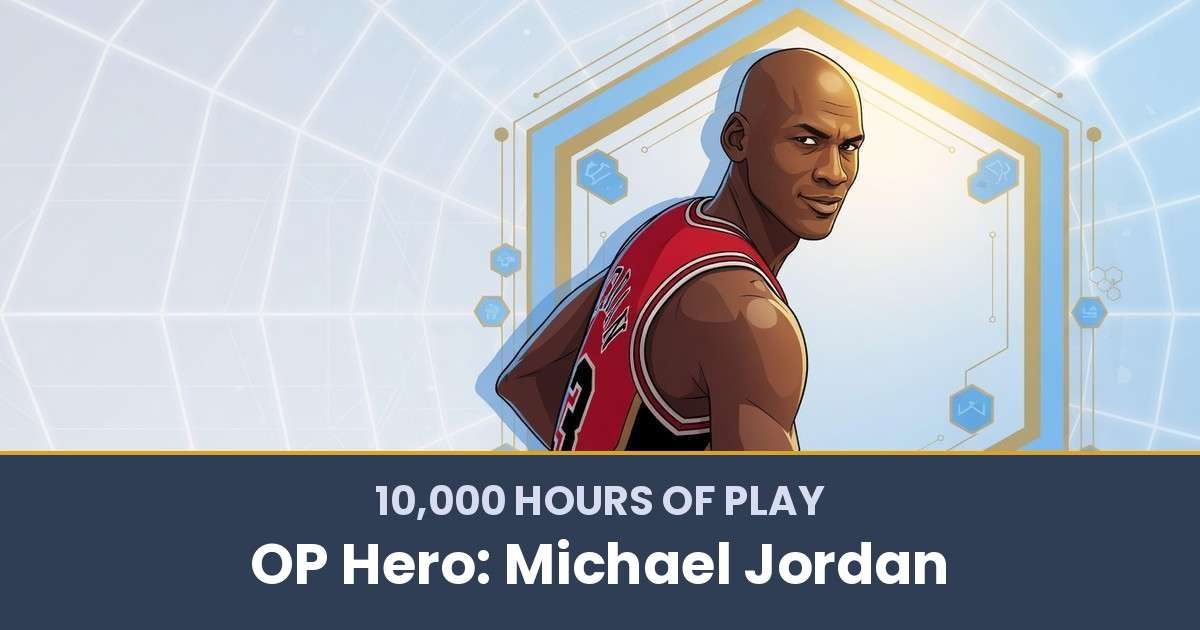


Most kids who get cut from the high school varsity team go home, lick the wound for a week, and quietly decide they were never going to be that good anyway. Michael Jordan went home, taped the roster to his bedroom wall, and started using the rejection as a daily ignition system for the next 35 years of his life.
That single rejection didn’t make him the greatest basketball player ever. The way he metabolized it did.
If you’ve watched The Last Dance, you already know Jordan turns nearly every slight, real or invented, into fuel. What’s less obvious is that this isn’t a quirky personality trait. It’s a deliberate operating system. He kept seeking arenas that would punish him, kept manufacturing internal stakes when the external ones got too small, and kept rebuilding his game from scratch every time the league started to catch up. Six championships, ten scoring titles, two retirements, one baseball detour, and a $7 billion brand later, that loop is still the most copyable thing about him — if you’re willing to look at the design instead of the highlights.
This profile runs his life through the 10,000 Hours of Play framework, the same six-step system I use on every OP Hero piece. You’ll see a build that almost any reader can borrow from: not his vertical or his jumper, but his Game, his Attributes, the Roles he rotated through, the Skills he layered on top, the Allies who amplified him, and the Quests that compounded into a legend.
⚡ Speed Run Notes
- Jordan’s Game wasn’t basketball. It was an escalating difficulty ladder — high school cut, NCAA title, NBA, Olympics, Pistons wall, baseball, comeback, ownership. He kept inventing harder tests so his motivation never died.
- His base stats were rare but they weren’t magic: extreme competitive drive, pain tolerance, fast pattern recognition, explosive athleticism, and a chip-on-shoulder that he could manufacture on demand.
- He rotated through eight character classes across his life — and he didn’t try to be the same Jordan in every chapter. The 1988 dunk-contest Jordan and the 1997 post-up-fadeaway Jordan are almost different players.
- The Skills that actually unlocked the rings weren’t athleticism — they were Vision Manifestation, Ninja Focus, Lich Grind, Reflect Damage, Heroic Strike, and Phoenix Rebirth.
- His Allies multiplied him: Phil Jackson contained the ego, Tex Winter contained the playbook, Scottie Pippen contained the floor, and his father James Jordan contained the meaning.
- The Quest line: Laney varsity cut (1979), 1982 NCAA winner over Georgetown, 1984 draft, Pistons wall (1988-90), three-peat (1991-93), baseball pivot (1994), second three-peat (1996-98), Wizards stint, owner — failure threaded through every chapter.
Table of Contents
- Step 1: The Game — What Michael Jordan Was Actually Playing
- Step 2: Attributes — The Innate Stats
- Step 3: Role(s) — The Character Class Across Chapters
- Step 4: Skills — The Real-Life Game Skills Jordan Mastered
- Step 5: Allies — The People Who Multiplied Jordan
- Step 6: Quests — The Milestones That Shaped the Saga
- What You Can Steal From Jordan’s Build
- The 10K HP Frame — Michael Jordan Through the 6 Steps Lens
- Which Octalysis Core Drives Michael Jordan’s Arc Activated
- Modern Echo — Who’s Playing This Game Today
- Frequently Asked Questions
- Where this framework comes from
- Related Reading
About Yu-kai Chou

Yu-kai Chou is the author of 10,000 Hours of Play — the book that treats your life as the most important game you’ll ever build a character in, and gives you the 6-Step framework (Game · Attributes · Role · Skills · Allies · Quests) to play it on purpose. He has spent two decades developing the system through which this post analyzes its OP Hero, and applies it to his own life and to the lives of the people he advises around the world.
Chou’s other framework, the Octalysis Framework, has been applied by LEGO, Microsoft, Porsche, Coca-Cola, Salesforce, and MrBeast, impacting over 1.5 Billion Users. He has taught the methodology at Harvard, Stanford, Yale, Tesla, Google, BCG, and IDEO, and has advised governments in eight nations including Ukraine, the United Kingdom, the Kingdom of Bahrain, Singapore, Taiwan, the Netherlands, Kazakhstan, and South Korea.
His work has been cited by Harvard, Stanford, MIT, Forbes, Wall Street Journal, Wired, US Department of Energy, NIST, NSF, NCBI, US Department of Education, ClinicalTrials.gov, and Google Scholar — with 3,700+ more academic publications. Explore his books here.
Of every OP Hero I’ve profiled, Jordan’s build is the one I most want my younger readers to study, because his greatest move was psychological, not athletic. He didn’t outwork his rivals on a stopwatch alone — he kept re-arming his own motivation by manufacturing new reasons to be hungry. If you only borrow one thing from his sheet, borrow the loop: pick a Game whose difficulty escalates faster than your boredom does, and use every setback as an Attribute upgrade rather than a verdict.
Step 1: The Game — What Michael Jordan Was Actually Playing
If you ask most fans what Jordan’s life mission was, you’ll get some version of “he wanted to be the GOAT.” That’s true but lazy. The deeper mission was structural.
Jordan kept choosing arenas that were designed to humiliate him, then rebuilding himself to dominate them. High school varsity. NCAA title game against a heavily favored Georgetown with Patrick Ewing. The NBA’s “Bad Boy” Pistons. Major League pitching. The 1995 NBA he came back to, with younger, faster players. The Charlotte Bobcats — a franchise nobody believed could win.
His own words land cleanly on this: “I play to win, whether during practice or a real game.” It sounds like a slogan until you notice he applied the same standard to a Tuesday shoot-around as to a Finals Game 7. That’s not a personality. That’s a Game definition — one where every interaction is a scored event.
What makes this useful for you is that Jordan’s Game wasn’t basketball. Basketball was the arena. The Game was “escalate the difficulty ladder until something stops me.” The reason this matters is that most people pick a Game that runs out of difficulty before their motivation does. They beat the level, get bored, and quit. Jordan never beat his level because he kept choosing harder ones — which is exactly how the life-as-a-game framing keeps your runway long enough to actually compound.
Step 2: Attributes — The Innate Stats
Attributes are the base stats you were born with or developed so early they may as well be innate. Jordan’s sheet had a clear top five.
Dominance orientation. His own framing across The Last Dance is the same: he was wired to fight his older brother Larry for their father’s attention, and losing to Larry made him fight harder, not sulk. That’s not a champion’s adult posture, that’s a 10-year-old’s nervous system. James Jordan put it more usefully — telling Michael he couldn’t do something was the most reliable way to get him to go do it. A father who understood his son’s motivational wiring is itself a rare advantage.
Pain tolerance. The 1997 “Flu Game” — 101°F fever, 38 points, Game 5 of the NBA Finals — is the famous example. The less-famous one is that he played all 82 games in nine different seasons. Body composition matters here, but the willingness to play through minor injuries was a stat he ran hot for two decades.
Pattern recognition. Dean Smith, his college coach, said Jordan as a freshman had the ability to see things a step ahead. Opponents (including Isiah Thomas) described it as Jordan seeming to know what was coming. This is the basketball-court version of what the Talent Triangle Method calls innate processing speed in your chosen arena — the thing you can sharpen but can’t manufacture from zero.
Explosive athleticism. 40+ inch vertical, freakish first step, hang time that became its own marketing category. This is the only Attribute on his sheet that most readers can’t borrow. Don’t try.
Manufactured-grievance engine. The chip on his shoulder wasn’t a side effect — it was a renewable energy source. He could invent slights when none existed. The Last Dance documents him fabricating disrespect from opponents who’d barely spoken to him, then using the manufactured insult to power a 40-point game. This is the Attribute most readers underrate, and the one most worth examining.
Step 3: Role(s) — The Character Class Across Chapters
One of the things people miss about Jordan is that he wasn’t the same player twice. He changed his character class at least eight times across his life, and each one had different optimal Skills.
Chapter 1: High school late bloomer (1979-81). Cut from Laney High’s varsity as a 5’10” sophomore. Spent that year averaging 25+ points on JV. By senior year he was a McDonald’s All-American.
Chapter 2: System wing at UNC (1981-84). Under Dean Smith, a disciplined two-way player inside a team structure. Hit the go-ahead 16-footer against Georgetown to win the 1982 NCAA Championship as a freshman. ACC Player of the Year in 1983 and 1984. Naismith and Wooden Awards in 1984.
Chapter 3: Rookie supernova (1984-86). Drafted No. 3 overall in 1984. Rookie season: 28.2 ppg, 6.5 rpg, 5.9 apg. Bulls attendance more than doubled.
Chapter 4: Scoring champion who couldn’t win it all (1986-90). Ten scoring titles eventually, the first in 1986-87 at 37.1 ppg. Defensive Player of the Year in 1987-88. But the Pistons kept ending his playoff runs.
Chapter 5: Triangle-offense closer (1990-93). Three straight rings. The class change was massive — same body, totally different style of play.
Chapter 6: Baseball novice (1993-94). Retired from the NBA in October 1993, signed with the White Sox organization, hit .202 with the Birmingham Barons. Most observers laughed. The discipline he absorbed under Terry Francona’s coaching showed up in his post-up game two years later.
Chapter 7: Mid-range assassin (1995-98). Came back, won three more rings, rebuilt his game around footwork and the fadeaway. This is the Jordan most current players actually study, and the same class-change discipline you see in Serena Williams’s late-career evolution.
Chapter 8: Owner-executive (2010-23). Bought majority stake in the Charlotte Bobcats in 2010, sold majority in 2023. Less successful competitively, but the Role change taught him what it costs to build a franchise from the front office instead of the floor.
Step 4: Skills — The Real-Life Game Skills Jordan Mastered
The Skills below are from the canon list in 10,000 Hours of Play, the same vocabulary I use for every OP Hero profile and for my own students. If you want the full taxonomy of how Skills sort across Warrior, Ranger, Mage, Rogue, Druid, Paladin, and Warlock classes, the Skills Spectrum piece is the right home base.
Vision Manifestation (Warlock). Jordan would describe in interviews how he had already seen the shot before he took it — the 1989 series-winning shot over Craig Ehlo, the 1998 last shot in Salt Lake City. He rehearsed crucial moments so vividly in his head that the live moment felt like a replay, not a first take. Same Skill we saw in Shigeru Miyamoto’s design process — picture the experience down to the user’s smile, then go build the thing.
Ninja Focus (Rogue). The training intensity is documented in Tim Grover’s Relentless: Jordan would do the second workout of the day at 5 AM while teammates were sleeping off the first. Sustained discipline on the boring stuff — footwork drills, free throws, conditioning — for decades. The same Skill that anchors Kobe Bryant’s Mamba Mentality, which Kobe consciously inherited from watching Jordan.
Reflect Damage (Paladin). This is the Skill of using negative feedback as a growth loop. Jordan didn’t just absorb the varsity cut — he came back the next morning and used it as a daily ignition. The Pistons “Jordan Rules” didn’t break him. They forced him into the weight room and into the post-up game. Every Reflect Damage moment was him asking, “What does this make me need to become?”
Lich Grind (Warlock). The summer of 1994 in the Birmingham minors and the summer of 1995 after the second-round loss to Orlando were Lich Grind seasons — intense, secluded work periods where he disappeared from the public eye and rebuilt his game’s component parts. The fadeaway he came back with in 1995-96 was not present in his 1993 highlights. Pure Lich Grind output.
Heroic Strike (Warrior). The bold, public binary moments. Give me the ball, get out of the way. The flu game. The shrug game (six threes in the first half against Portland, 1992 Finals, then a literal shoulder shrug at the bench). Saying it before doing it, then doing it, is a Warrior move — it puts the binary outcome on the table and forces the result.
Phoenix Rebirth (Paladin). Came back from the varsity cut. Came back from the Pistons. Came back from his father’s death and the baseball detour that followed. The 1995 second-round exit and the two-year layoff at age 38 for the Wizards each fed the same loop. The pattern was so consistent it became a brand.
Step 5: Allies — The People Who Multiplied Jordan
Phil Jackson contained the ego. Before Jackson, Jordan was a brilliant scorer who lost in the playoffs. After Jackson, Jordan was a champion. The Zen Master’s contribution wasn’t motivation — Jordan had plenty — it was channel discipline. Jackson made the team-based triangle offense survivable for a player whose every instinct was to dominate possessions.
Tex Winter contained the playbook. The triangle offense Winter brought from Kansas State and refined in Chicago gave Jordan a structured way to involve teammates without losing his closing role. Jordan, famously, hated the triangle at first. He bought in because the math of titles required it.
Scottie Pippen contained the floor. A 6’8″ point-forward who could guard 1-through-4 freed Jordan from the defensive load of stopping the league’s best perimeter scorer every night. Without Pippen’s defensive versatility, Jordan’s body doesn’t survive 82 games and four playoff rounds at the level he played.
Dean Smith contained the foundation. The system discipline Jordan learned at UNC — defense, ball movement, deference to teammates — was the floor under everything that came after.
James Jordan contained the meaning. His father was the emotional anchor for the entire competitive engine. James’s murder in July 1993 broke something in Jordan that the baseball detour was, in part, a grief process for. The second three-peat is unimaginable without the year he spent reconstructing his “why.”
Tim Grover contained the body. Personal trainer from 1989 onward. Designed the workouts that kept Jordan’s vertical and durability intact into his late thirties.
Step 6: Quests — The Milestones That Shaped the Saga
Quest 1: The Laney varsity cut (1979). Sophomore year. He doesn’t make the team. He spends the year on JV, then comes back the next season at 6’3″ and dominates. The defeat is the ignition.
Quest 2: The 1982 NCAA Championship. March 29, 1982. UNC trailing Georgetown by one with 32 seconds left. Coach Smith calls for the freshman to take the shot. He sinks the 16-footer with 15 seconds on the clock. The narrative shift inside Jordan from “freshman” to “closer” happens in that single possession.
Quest 3: The Pistons wall (1988-90). Three straight years, the Bad Boys end the Bulls’ season. The “Jordan Rules” — punishing every drive, denying him the lane — are designed specifically to break him. This is a failure Quest, and the most important one on his sheet. He responds by hitting the weight room with Tim Grover for the first time and rebuilding his body for the next decade.
Quest 4: The first three-peat (1991-93). Bulls beat the Lakers, Trail Blazers, and Suns in consecutive Finals. Jordan wins Finals MVP all three years. He has, by 30, won everything basketball can give him at the team level.
Quest 5: The baseball detour (1993-94). James Jordan is murdered in July 1993. Michael retires that October. He plays for the Birmingham Barons in 1994 and hits .202. The press calls it a midlife crisis. Jordan calls it a promise to his father. Both are partly true. The thing he absorbs from the year — humility in front of a new craft, patience for repetition, willingness to be terrible in public — shows up in his second-act NBA game.
Quest 6: The second three-peat (1996-98). Three more rings. A 72-win regular season in 1995-96. The flu game in 1997. The last shot over Bryon Russell in 1998. He retires the second time as the same player nobody can quite explain.
Quest 7: The Wizards comeback (2001-03). Returns at 38, averages 22.9 ppg his first year back, 20.0 his second. The Wizards don’t make the playoffs. The Quest is technically a competitive failure. But it tells you something useful: he was so addicted to the Game that 20 ppg as a 40-year-old felt like a worthwhile use of his last competitive years.
What You Can Steal From Jordan’s Build
Most of Jordan’s build is uncopyable. You don’t have his vertical, his hand size, or his pattern recognition. That’s fine. The copyable parts are the design choices, not the gifts.
First: pick a Game whose difficulty ladder escalates faster than your boredom does. If your Game runs out of levels, you quit. Jordan kept inventing new levels (Olympics, baseball, ownership) so the Game outlasted him.
Second: build a Reflect Damage habit before you need one. Every setback becomes raw material if you have a frame for converting it. The varsity cut was just a cut until Jordan decided what it meant.
Third: change your character class on schedule. The 1988 Jordan would’ve been embarrassing in 1997, and vice versa. Most professionals stay in one Role too long because the Skills got them rewarded once. Jordan kept upgrading the Role and rebuilding the Skill stack underneath.
Fourth: stack Allies who contain different parts of you. Jackson for the ego. Pippen for the floor. Grover for the body. Smith for the foundation. James for the meaning. Different functions, no overlap. Most people stack Allies who duplicate each other and wonder why they still have gaps.
If you want to see how this same six-step lens reads on other OP Heroes — athletes, scientists, founders, reformers — the full library lives on the OP Hero Profiles hub. Different builds, same questions: what was the Game, what were the Attributes, where did the Skills come from, and which Allies did the multiplying.
The 10K HP Frame — Michael Jordan Through the 6 Steps Lens
Run the full 35-year arc back through the six Steps in one pass and Jordan’s character sheet gets surprisingly legible. The chassis is Warlock: Compete and Crush, control the arena, feed on supremacy.
The armor is Warrior plate. And the line almost nobody names out loud is the Paladin recovery loop running underneath both, the set of Skills that turned every collapse into a louder second act.
Look at where his six documented Skills actually sort. Vision Manifestation and Lich Grind are Warlock. Heroic Strike is Warrior. Ninja Focus is Rogue. But Reflect Damage and Phoenix Rebirth are both Tier III Paladin, and those two carried the varsity cut, the Pistons wall, the baseball detour, and the Wizards years.
The public remembers the predator. The build says the comebacks were the rarer engineering.
He kept purchasing harder arenas with the winnings from the last one.
Three more canon Skills belong on his sheet, and each one has a documented moment attached.
Berserk Mode (Warrior). The canon description is five minutes of extreme motivation summoned through cognitive reappraisal, and Jordan ran the technique so well he could skip the real trigger entirely. In 1993, after LaBradford Smith scored 37 on him, Jordan told teammates that Smith had taunted him with a mocking compliment. The next night he hung 36 points on Washington by halftime. Years later he admitted the taunt never happened. He needed the rage state, so he wrote the script himself.
Bat Signaling (Ranger). Building a reputation and brand over time, deliberately, layer by layer. The Air Jordan launch in 1984 started as a shoe deal that Nike executives considered a gamble on a rookie. Jordan and Nike turned every controversy into brand sediment, including the league’s threats to fine his early shoe colors, and compounded it patiently for four decades into the multi-billion-dollar Jumpman empire the intro mentioned. The dunks aged. The signal kept broadcasting.
Guardian Restraint (Paladin). The ego check. Jordan openly hated Tex Winter’s triangle offense, and he was the greatest scorer alive being told to give up the ball. He channeled the pride down anyway because the math of titles demanded it. Two seasons of swallowed ego bought six rings. Restraint is the least cinematic Skill on this sheet and it may have been the highest-paid.
Heroic Strike also has a family tree worth naming. Muhammad Ali was calling his rounds two decades before Jordan shrugged at Portland, and both men understood the same mechanic: announcing the outcome first converts a performance into a wager the audience cannot look away from.
So the synthesis reads like this. A Warlock core defined the Game, Warrior Skills fought it in public, Rogue discipline kept the machine oiled in private, and a Paladin substrate resurrected the whole build every time the story tried to end.
Which Octalysis Core Drives Michael Jordan’s Arc Activated
The 10K HP frame explains what Jordan built. My Octalysis Framework, covered in the bio above and in its own definitive guide, explains what powered the building, and his arc runs on four Core Drives with unusual clarity.
Core Drive 2: Development & Accomplishment is the loudest one. Ten scoring titles, six Finals MVPs, and a self-imposed rule that a Tuesday shootaround counts as a scored event.
Jordan built his life so that progress was always measurable and the next rung was always visible. That is CD2 in its purest athletic form, and it explains why he kept generating fresh ladders (Olympics, baseball, ownership) the moment an old one ran out of rungs.
Core Drive 5: Social Influence & Relatedness is the furnace under the furnace. The engine started as a boy fighting his brother Larry for their father’s attention, and it never stopped needing an audience and a rival.
Trash talk, practice wars, the manufactured insults from the Berserk Mode story above: all of it is social comparison converted into fuel. When no rival showed up, he fabricated one, which tells you CD5 sat so deep in the build that he ran synthetic versions rather than play a single night without it.
A manufactured insult burns as hot as a real one, if the furnace is built right.
Core Drive 8: Loss & Avoidance took over the late game. By the second three-peat, teammates and cameras caught something the box scores hid: winning had started paying out as relief instead of joy.
The Flu Game is a CD8 artifact. A man with a 101-degree fever plays 44 minutes in the Finals because the alternative, sitting out a loss, costs more than the suffering. The same drive explains why the Pistons beatings produced a weight room habit rather than a retirement, and why he collapsed in tears clutching the game ball after the 1996 title rather than celebrating on his feet.
Core Drive 1: Epic Meaning & Calling arrived last, and it arrived through grief. After James Jordan’s murder in July 1993, the baseball detour became a son keeping a promise, because baseball had been his father’s first dream for him.
That 1996 championship was clinched on Father’s Day, and Jordan’s reaction on the locker room floor is one of the most famous displays of meaning outrunning achievement in sports history. The scoreboard stopped being the point. He was playing for someone who could no longer watch.
Here’s the framework observation worth carrying to your own build: CD2 and CD5 made Jordan great, but they are scoreboard-dependent drives, and scoreboards eventually run out. CD8 extended the run past the joy, and CD1 was the only drive still standing when the game itself had nothing left to pay him. The heroes who finish well are usually the ones whose deepest drive was never on the scoreboard at all.
Modern Echo — Who’s Playing This Game Today
The Jordan pattern (choose an arena built to humiliate you, convert the damage into raw material, come back as a different class) has two clear heirs competing right now.
Simone Biles ran the fullest Reflect Damage cycle in modern sport. The 2021 “twisties” forced her out of most of her Tokyo events while much of the internet called it quitting.
She named the damage publicly, rebuilt through therapy she talks about openly, and titled her return the “redemption tour.” Paris 2024 paid the wager: gold in the team final, the all-around, and the vault, plus a floor silver she lost by 0.033 points. Eleven Olympic medals now, the most decorated American gymnast in Olympic history, and the comeback chapter is the one that made her legend permanent.
Victor Wembanyama is playing the difficulty-ladder game itself. Leading the league at 3.8 blocks a game in February 2025, he lost the rest of his season to deep vein thrombosis in his right shoulder, the kind of diagnosis that makes a franchise hold its breath.
Cleared in July 2025, he spent ten days that summer training with monks at a Shaolin temple in Zhengzhou, China, because normal offseasons apparently run out of rungs when you are 21. That is a young man deliberately purchasing a harder arena with his recovery, which is the most Jordan-shaped move in today’s NBA.
The cut list is still the most productive document in sports.
Since the Last Time We Told This Story
The profile above ends the saga at the 2023 sale of the Hornets. Two chapters have opened since.
On October 21, 2025, Jordan debuted as a special contributor for NBC’s returning NBA coverage. His interview series “MJ: Insights to Excellence,” filmed with Mike Tirico, premiered at halftime of the Thunder-Rockets season opener and has run in segments across the 2025-26 season on NBC and Peacock, a Bat Signaling chapter conducted entirely in a chair.
The sharper chapter came in a courtroom. His 23XI Racing team and Front Row Motorsports spent over a year in a federal antitrust fight against NASCAR itself, and Jordan sat front row when the trial opened on December 1, 2025.
After eight days of testimony, NASCAR settled on December 11: the teams’ six charters restored for 2026, and charters made permanent across the sport. Jordan’s verdict from his courtroom seat was vintage CD8 economy: “Today’s a good day.” At 62 he had picked one more arena with real stakes, against the house, and left with the win.
Frequently Asked Questions
Was Michael Jordan really cut from his high school basketball team?
Sort of, and the nuance matters. As a 5’10” sophomore at Laney High he was assigned to junior varsity while his taller classmate Leroy Smith got the final varsity roster spot. Jordan experienced the decision as a cut, taped the memory to his motivation system, and spent decades citing it as fuel. The paperwork says reassignment. His nervous system said rejection, and that reading built the career.
How many championships did Michael Jordan win?
Six NBA championships with the Chicago Bulls (1991, 1992, 1993, 1996, 1997, 1998), with Finals MVP in all six. Add the 1982 NCAA title at North Carolina and Olympic gold medals in 1984 and 1992, and every level of basketball he entered ended with him holding its top prize.
Why did Michael Jordan play baseball?
His father James was murdered in July 1993, and baseball had been James’s first dream for his son. Michael retired from the NBA that October, joined the Birmingham Barons in 1994, and hit .202 while grieving in public. The year functioned as both a promise kept and a reset: the humility and repetition he absorbed in the minors showed up in the rebuilt post-up game of his second three-peat.
What is Michael Jordan doing now in 2026?
Two active chapters. He is a special contributor for NBC’s NBA coverage, where his interview series MJ: Insights to Excellence has aired through the 2025-26 season. He also co-owns 23XI Racing, which along with Front Row Motorsports settled its federal antitrust lawsuit against NASCAR in December 2025 after eight days of trial, restoring the teams’ six charters for 2026 and making charters permanent across the sport.
What made Michael Jordan so competitive?
The engine assembled early: a boyhood rivalry with his brother Larry for their father’s attention wired him to treat every contest as a referendum. He then engineered the trait into a system, defining his Game so that every interaction scored, manufacturing insults when real ones ran out, and choosing arenas specifically because they could beat him. The competitiveness looks innate. The maintenance of it was designed.
Where this framework comes from

Want the full system this profile is built on?
Every OP Hero piece runs through the same 6-Step framework from 10,000 Hours of Play: Unlock Your Real-Life Legendary Success. The book covers the full system, walks through Yu-kai’s own life run as the first applied case study, and gives you the worksheets to audit your own build.
Related Reading
- All OP Hero Profiles — the full library of life-as-RPG builds, updated every fire.
- 10,000 Hours of Play by OP Hero: Kobe Bryant — the player who consciously inherited Jordan’s loop, then re-tooled it.
- 10,000 Hours of Play by OP Hero: Serena Williams — another athlete who survived by changing character class mid-career.
- 10,000 Hours of Play by OP Hero: Phil Knight — the builder who put Jordan’s brand on the global map.
- The OP Talent Triangle Method — the diagnostic for figuring out which of your stats are Attributes versus Skills.
- The 10,000 Hours of Play framework hub — the full 6-Step system this profile is built on.