
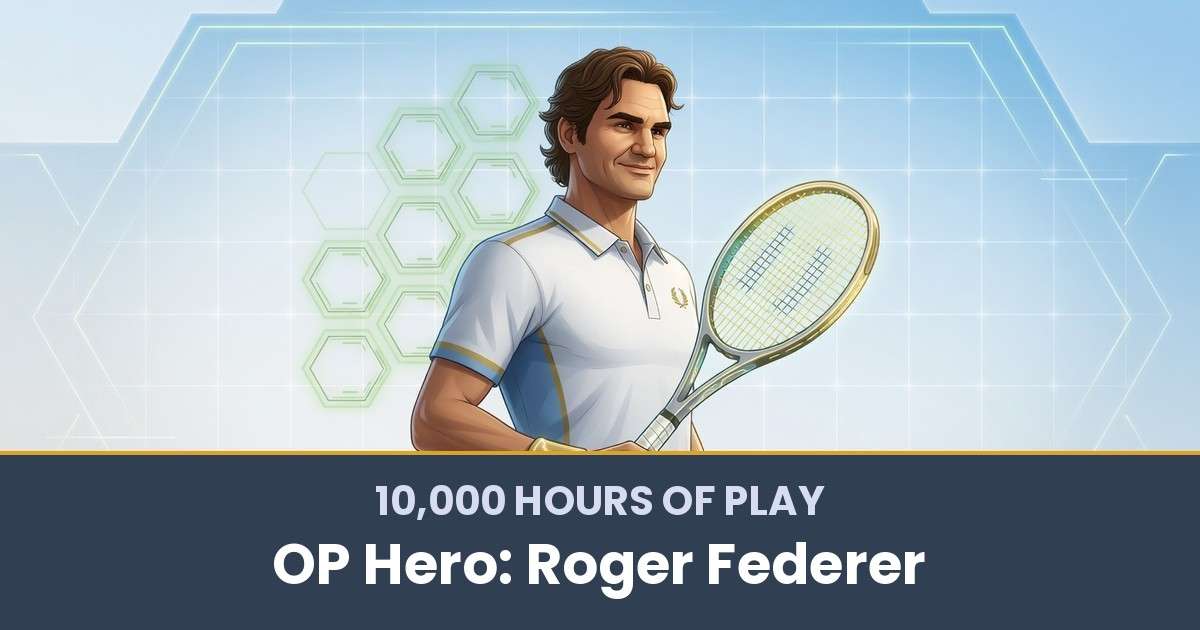


By the time Roger Federer was 19, the tennis world had two opinions on him: the most talented player anyone had seen in a decade, and a kid who threw his racket so often that his junior coaches kept losing their patience with him.
Twenty-four years later, he walked off the court at the 2022 Laver Cup with 20 Grand Slams, 310 weeks at world No. 1, and the kind of late-career reverence that almost no athlete earns in any sport. The talent was always there. What he built around that talent is the actual story.
That gap, between raw gift and durable legendary career, is what the 10,000 Hours of Play framework is built to expose. Federer is a textbook case. He didn’t grind harder than everyone else; he built a smarter character sheet around a body that, on paper, peaks at 24.
⚡ Speed Run Notes
- Federer’s talent was obvious at 14. The career-defining build wasn’t talent; it was a long-horizon mindset and a refusal to play the season the way every other top-10 played it.
- The 2003 Wimbledon breakthrough wasn’t a forehand upgrade. It was a temperament upgrade: the on-court tantrum kid finally locked his emotional reset on big points.
- His 2016 knee surgery should have ended him at 35. He came back at the 2017 Australian Open and beat Rafa Nadal in five sets. That comeback is the single cleanest Phoenix Rebirth in modern sport.
- The hidden Skill behind his longevity isn’t a stroke. It’s schedule curation: picking which tournaments to skip so he could peak at the four that mattered.
- His allies (Peter Carter, Severin Lüthi, Pierre Paganini, Mirka) are not background characters. They are the multipliers without which the Federer build collapses.
Table of Contents
- Step 1: The Game — What Federer Was Actually Playing
- Step 2: Attributes — The Innate Stats
- Step 3: Role(s) — The Character Class Across Chapters
- Step 4: Skills — The Real-Life Game Skills Federer Mastered
- Step 5: Allies — The People Who Multiplied Federer
- Step 6: Quests — The Milestones That Shaped the Saga
- What You Can Steal From Federer’s Build
- Where this framework comes from
- Related Reading
About Yu-kai Chou

Yu-kai Chou is the author of 10,000 Hours of Play — the book that treats your life as the most important game you’ll ever build a character in, and gives you the 6-Step framework (Game · Attributes · Role · Skills · Allies · Quests) to play it on purpose. He has spent two decades developing the system through which this post analyzes its OP Hero, and applies it to his own life and to the lives of the people he advises around the world.
Chou’s other framework, the Octalysis Framework, has been applied by LEGO, Microsoft, Porsche, Coca-Cola, Salesforce, and MrBeast, impacting over 1.5 Billion Users. He has taught the methodology at Harvard, Stanford, Yale, Tesla, Google, BCG, and IDEO, and has advised governments in eight nations including Ukraine, the United Kingdom, the Kingdom of Bahrain, Singapore, Taiwan, the Netherlands, Kazakhstan, and South Korea.
His work has been cited by Harvard, Stanford, MIT, Forbes, Wall Street Journal, Wired, US Department of Energy, NIST, NSF, NCBI, US Department of Education, ClinicalTrials.gov, and Google Scholar — with 3,700+ more academic publications. Explore his books here.
What I keep coming back to with Federer is how cleanly his build separates the raw gift from the system that protected it. Tennis is a brutal physical sport and the men’s tour is full of players who burned out at 27. Federer’s lesson, the one I’d hand a 19-year-old: pick the right four boss fights a year, win those, skip the rest, and your career lasts twice as long.
Step 1: The Game — What Federer Was Actually Playing
Most pundits talk about Federer’s career as a chase for Grand Slam titles. That’s true at the surface. But it’s the wrong frame.
The real game Federer was playing, and you can hear it explicitly in his 2024 Dartmouth commencement speech, was the long-arc version of staying great — keep being able to play at the top, not just be great once. His career mission split into two halves the moment he became No. 1: he kept the Slam-chasing alive, but he was also playing a longevity meta-game that very few peers even noticed they were in.
Pete Sampras retired at 31. Andre Agassi retired at 36. Federer played his last competitive doubles match at 41. That delta isn’t motivation, and it isn’t medicine. It’s the difference between optimizing the season and optimizing the decade.
The book treats this distinction as Step 1 of the 6-Step framework for a reason: until you can name the game you’re actually playing, every Skill, every Ally, every Quest is just busywork around a goal you never picked clearly. Federer picked. He picked early. He picked twice, once at the start, once when the body started to fight him in his late 20s.
That’s why studying his build matters more than studying his backhand.
Step 2: Attributes — The Innate Stats
Attributes are the traits you walk into the game already carrying, not the techniques you learn later. Federer’s standout stats, visible by 14:
Pattern recognition. Watch any 1998 footage of him as a junior and you’ll see a kid reading the rally one shot before everyone else. He didn’t out-power opponents; he was already at the ball when they were still recovering. That’s an anticipation engine you cannot teach to a 25-year-old.
Long-horizon ambition. Most junior champions chase the next title. Federer was on record from childhood saying he wanted to be world No. 1, and as a teenager he was already telling people around him that he wanted a career that would last, not a peak that would flash. That posture sounds throwaway until you realize 90% of his peers were thinking in seasons and he was already thinking in decades.
Volatile temperament. This is the one nobody romanticizes, but it’s an Attribute. The young Federer threw rackets, swore at himself, broke down in matches he should have won. That fire was real, and the same engine that fueled his belief almost wrecked his early career. Step 4 is where he learns to convert it.
Aesthetic kinaesthesia. His body moved through space differently. He had a sense for shot creativity that came from somewhere deeper than coaching, the kind of touch sports writers later described as making tennis look like a form of art. You can refine that, but the raw signal is innate.
The Talent Triangle Method is the right tool to apply here, because Federer’s Attributes don’t form one clean weapon. They form a triangle: anticipation, long-horizon thinking, aesthetic touch. Each one alone makes you a top-100 player. Stack the three on the same character sheet and you get a 20-Slam build.
Step 3: Role(s) — The Character Class Across Chapters
Federer’s “class” in 10K HP terms isn’t a single role. His career runs through four distinct character chapters, each one a different role he had to grow into.
Chapter 1, The Junior Prodigy (1996–2000). Wimbledon boys’ singles title at 16 in 1998. World No. 1 junior. The role was pure potential: a Rogue archetype trading on creativity and shot-making rather than power.
Chapter 2, The Apprentice Closer (2001–2002). The 2001 Wimbledon win over a four-time defending champion Sampras was the audition. The next 18 months were the role where Federer had to convert “talented teenager” into “guy who actually finishes matches.” He failed that role often, including at the 2002 French Open where the temperament problem cost him.
Chapter 3, The Standard-Bearer (2003–2010). 2003 Wimbledon was the moment the Rogue evolved into a Paladin: confident, composed, attracting both opponents and audiences toward his way of playing. 237 consecutive weeks at No. 1. Three Grand Slams in 2004, 2006, and 2007. The 2009 French Open completed his career Slam.
Chapter 4, The Veteran Tactician (2014–2022). The body slowed. The competition didn’t. This is the role he had to invent from scratch: a Ranger class focused on opportunity selection, schedule curation, and a one-handed backhand he rebuilt at age 33 specifically to handle Nadal’s topspin. The 2017 Australian Open belongs to this chapter, and so does every late-career match where he beat a younger man through positioning instead of pace.
Tennis fans treat these chapters as one story. The 10K HP frame insists they’re four roles, each one a build pivot the player had to commit to.
Step 4: Skills — The Real-Life Game Skills Federer Mastered
Six canon Real-Life Game Skills carry Federer’s saga. Each one has a moment you can point to.
Vision Manifestation (Warlock) — visualize success so vividly it shapes reality. Federer was telling Swiss tennis coaches at 14 that he was going to be world No. 1. That isn’t bravado; it’s a long-running mental rehearsal that pre-loaded his nervous system for the moments when the rehearsal had to become real. The 2003 Wimbledon final wasn’t the first time he had played that point in his head. It was the first time the ball was actually there.
Aegis (Paladin) — ignore public criticism and naysayers while pushing the Quest. After his 2008 Wimbledon final loss to Nadal, every commentator declared Federer’s peak over. He won the 2009 French Open and the 2009 Wimbledon. The Aegis Skill isn’t pretending the criticism isn’t there. It’s protecting the work from people whose job it is to comment on the work, not do it.
Ninja Focus (Rogue) — sustained discipline and focus on tasks across long stretches. Federer’s training blocks in his late 20s and early 30s were not louder than other players’. They were longer-arc. He’d rebuild a stroke over six months, not six weeks, and stay locked in long after the initial novelty of the change had worn off. The same Skill underwrites the Skills Spectrum idea: you don’t get to master rank on any stroke without the multi-year burn.
Mastermind (Ranger) — create, adapt, and execute complex plans. The clearest case is his 2017 calendar. After the 2016 knee surgery, his team’s plan was to skip clay season entirely, peak twice (Australian Open and Wimbledon), and let everything else go. He won both. That is not luck. It is a planning Skill applied with the kind of selectivity that almost no peer was willing to commit to.
Cognitive Lens (Mage) — zoom in on details and zoom out for strategy. Federer’s anticipation engine is the zoom-in. His longevity meta-game is the zoom-out. The Skill is being able to flip between them inside a single point, inside a single tournament, inside a 20-year career.
Phoenix Rebirth (Paladin) — recover from devastating failure and come back stronger. February 2016: torn meniscus, surgery, a full six-month layoff at age 34. The conventional wisdom was that he was done. January 2017: he beats Nadal in five sets at the Australian Open final, his first Slam in nearly five years. Same year: he wins Wimbledon without dropping a set. The Phoenix Rebirth Skill is what lets a hero treat a career-ending injury as a checkpoint, not a game-over screen.
Step 5: Allies — The People Who Multiplied Federer
The Federer build is unusual in how stable the Ally roster was. Most pros cycle coaches every few years. Federer kept the same core team for most of his career, and that continuity is itself a multiplier.
Peter Carter — his early Australian coach in Switzerland, the man who shaped his fundamentals and, more importantly, made the kid believe he could be world-class. Carter died in a car accident in 2002. Federer has said the loss reset his approach to the sport: he stopped being the tantruming kid and started honoring what Carter had built. The grief became fuel.
Severin Lüthi — coach and Swiss Davis Cup captain. With Federer through the prime years and beyond. The unflashy continuity hire; the Ally who keeps the build coherent across decades while higher-profile names rotate through.
Pierre Paganini — fitness trainer since the early 2000s. Paganini is the reason Federer’s body lasted as long as it did. His program emphasized footwork, reaction, and recovery over brute strength. The longevity meta-game from Step 1 is half Federer’s selectivity and half Paganini’s biomechanics.
Mirka Federer — wife, former WTA player, the steadiest line on the chart. Public, often-traveled, present at the matches. The Ally who makes the rest of the build possible because the home life isn’t a battleground.
Stefan Edberg and Ivan Ljubicic — late-career coaches who pushed the strategic pivots that produced the 2017 comeback, including the more aggressive return game and the larger racket head. Allies you bring in specifically to crack a level you can’t crack alone.
Compare this to peers like Serena Williams, whose roster was equally stable, or Tiger Woods, whose roster turned over violently: the pattern matters. Long-arc Ally stability lets a hero compound across the chapters Step 3 names.
Step 6: Quests — The Milestones That Shaped the Saga
Six Quests carry the saga. Five are wins. One is a loss, and it might matter more than any of the wins.
1998 Wimbledon Boys’ Singles. The first proof that the Junior Prodigy role was real. Without this title the next chapter never happens; with it, the Swiss tennis system invests in him at a different level entirely.
2001 Wimbledon, defeat of Pete Sampras in five sets. Not a final. A fourth-round match. But this is the inflection point: the moment a 19-year-old beat the player whose career he was supposed to inherit. The role shift from apprentice to standard-bearer begins here, two years before the trophy.
2003 Wimbledon men’s singles title. First Grand Slam. Validation of every Attribute and every Skill discussed above, all at once, on grass, against a fully-formed adult field.
2008 Wimbledon final loss to Nadal. The Quest that should have ended him. Five sets, fading light, a result that most commentators read as the end of the Federer era. The Phoenix Rebirth Skill from Step 4 is named correctly because of how he answered this loss, not next month, but across the next 14 years.
2009 French Open title. The Slam everyone said he couldn’t win. Career Grand Slam completed. The Cognitive Lens Skill paid out: he had spent years adjusting the clay-court patterns specifically to crack Roland Garros.
2017 Australian Open final over Nadal. The Quest that made the post-2016 comeback real. Six months out of tennis at 34. Five-set win against the man who had beaten him at four previous Slam finals. This is the line in the saga where the longevity meta-game stops being theoretical and becomes the actual story.
You can read the full hub of OP Hero profiles for what other character builds look like when their Quest log gets stress-tested by setbacks, but Federer’s 2008–2017 arc is one of the cleanest “the loss made the win possible” stories in modern sport.
What You Can Steal From Federer’s Build
The Federer build is uncopyable in one obvious way: most readers aren’t going to suddenly develop the hand-eye coordination of a generational tennis talent. That’s fine. The Attributes are the part you can’t lift.
What you can lift are the moves in Steps 1, 4, and 5.
From Step 1, lift the longevity meta-game. Whatever your craft is, the question worth asking is not “how do I peak this year?” It’s “how do I still be in the room ten years from now?” That’s a different game with different Skill picks, and most people never name it.
From Step 4, lift the selective-tournament pattern. You don’t have to show up to every fight to win the ones that matter. Federer skipped clay seasons. You can skip meetings, side projects, and prestige conferences that drain the Mastermind Skill you need for the work that actually moves you. Selectivity is the Skill peers undervalue most.
From Step 5, lift the stable Ally roster. Pick a small number of multipliers and keep them around for a decade. Rotating coaches, mentors, and partners every two years is a tax most ambitious people pay without noticing. Federer’s bench changed slowly and the build compounded.
And from the whole arc, lift the Phoenix Rebirth posture. The 2016 knee surgery is the single best argument that a career-ending event can become a career-clarifying one. The hero who treats a setback as a checkpoint plays a different game than the hero who treats it as the end.
Where this framework comes from

Want the full system this profile is built on?
Every OP Hero piece runs through the same 6-Step framework from 10,000 Hours of Play: Unlock Your Real-Life Legendary Success. The book covers the full system, walks through Yu-kai’s own life run as the first applied case study, and gives you the worksheets to audit your own build.
Related Reading
- All OP Hero Profiles — the full hub
- Serena Williams: OP Hero — Tennis’s other 20-year longevity case
- Tiger Woods: OP Hero — The grind, the surgery, the 2019 Masters
- Kobe Bryant: OP Hero — Mamba Mentality and the late-career pivot
- Marcus Aurelius: OP Hero — Composure as a trainable Skill
- The 10,000 Hours of Play framework hub