
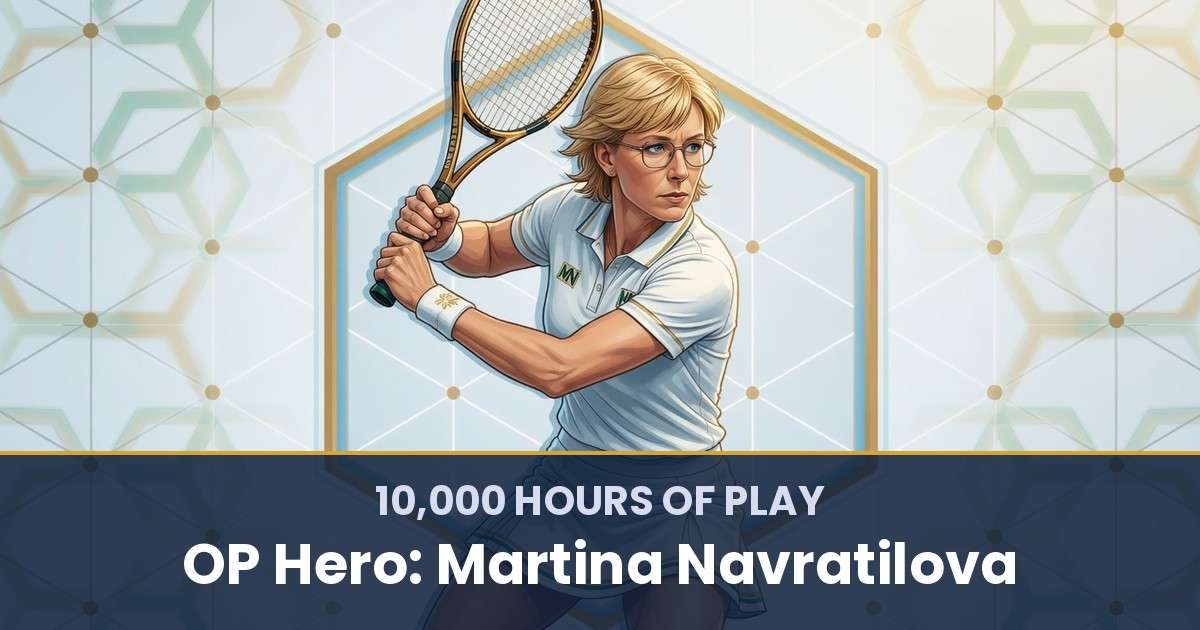


On September 6, 1975, fresh off a US Open semifinal loss to Chris Evert, an 18-year-old from Prague walked into an immigration office in New York City and asked to defect from communist Czechoslovakia.
She signed the papers late that night, after an FBI interview. The bill arrived immediately: she would not see her mother for four years, or her father and sister for five.
The teenager who paid that price became the player with 18 Grand Slam singles titles, 31 more in women’s doubles, and a 1983 season the WTA still calls the most dominant of the Open Era.
Run Martina Navratilova’s life through the 10,000 Hours of Play framework and the defection stops looking like an escape. It was the opening move of a build she kept extending for the next three decades, and the rest of her saga follows from it. The character sheet below traces that build step by step.
⚡ Speed Run Notes
- Navratilova’s Game had two win conditions running at once: find the ceiling of tennis performance, and live openly no matter what it cost her.
- Her Attributes showed early: risk tolerance strong enough to leave a country at 18, an attacking instinct built for the net, and a stubborn honesty she never switched off.
- Five canon Skills carry the build: Courageous Heart, Batcave Crafting, Siphoning, Aegis, and Summon.
- The years when critics mocked her fitness produced Team Navratilova, the sport-science overhaul behind an 86–1 season in 1983 and a 74-match winning streak in 1984.
- Her last Grand Slam title came at the 2006 US Open, weeks before her 50th birthday. The build was designed for the longest possible playthrough.
Table of Contents
- About Yu-kai Chou
- Step 1: The Game Martina Navratilova Was Actually Playing
- Step 2: Attributes, the Innate Stats
- Step 3: Role(s) Across Chapters
- Step 4: The Real-Life Game Skills She Mastered
- Step 5: The Allies Who Multiplied Her
- Step 6: The Quests That Shaped the Saga
- What You Can Steal From Navratilova’s Build
- Where this framework comes from
About Yu-kai Chou

Yu-kai Chou is the author of 10,000 Hours of Play — the book that treats your life as the most important game you’ll ever build a character in, and gives you the 6-Step framework (Game · Attributes · Role · Skills · Allies · Quests) to play it on purpose. He has spent two decades developing the system through which this post analyzes its OP Hero, and applies it to his own life and to the lives of the people he advises around the world.
Chou’s other framework, the Octalysis Framework, has been applied by LEGO, Microsoft, Porsche, Coca-Cola, Salesforce, and MrBeast, impacting over 1.5 Billion Users. He has taught the methodology at Harvard, Stanford, Yale, Tesla, Google, BCG, and IDEO, and has advised governments in eight nations including Ukraine, the United Kingdom, the Kingdom of Bahrain, Singapore, Taiwan, the Netherlands, Kazakhstan, and South Korea.
His work has been cited by Harvard, Stanford, MIT, Forbes, Wall Street Journal, Wired, US Department of Energy, NIST, NSF, NCBI, US Department of Education, ClinicalTrials.gov, and Google Scholar — with 3,700+ more academic publications. Explore his books here.
Why Navratilova earns a seat in this series: her career shows what happens when a player stops relying on talent and starts engineering everything around it. Everyone talks about her trophies; underneath them sat a support structure none of her rivals had yet matched, and the nerve to make an irreversible move at 18. The pairing I would lift from her sheet is Courageous Heart plus Batcave Crafting: commit early to the Game you actually want, then rebuild your surroundings until they match it.
Step 1: The Game Martina Navratilova Was Actually Playing
Plenty of players chase trophies. Navratilova’s Game was stranger and harder: find the absolute ceiling of what a tennis player can be, while refusing to hide who she was.
Both win conditions ran simultaneously, from the 1975 defection to the 2006 farewell title, and her refusal to drop either one shaped every chapter in between.
The performance half is easy to see in the numbers. Her 1983 season finished 86–1, a .989 winning percentage that the WTA describes as the most dominant of the Open Era.
The integrity half is easy to hear in her own words. “I’ve always tried to do the right thing rather than the popular thing,” she told the Guardian in 2022, and the record backs the sentence: defecting at 18, then coming out as gay in 1981, at the height of her career, when it carried real commercial risk.
Half her hardest bosses had nothing to do with a tennis ball.
Step 2: Attributes, the Innate Stats
Attributes are the stats you spawn with, and hers were visible long before the trophies.
Risk tolerance at the edge of recklessness. Born Martina Šubertová in Prague on October 18, 1956, she grew up inside a state sports system that owned her schedule and her passport. At 18 she traded all of it, family included, for a defection that could never be taken back.
An attacking instinct. Her serve-and-volley game ran on speed, reflexes, and the urge to take time away from opponents at the net. You can coach technique onto that engine, but the engine itself, the pull toward the aggressive play, showed up with her.
A competitive furnace that never banked down. Twelve Wimbledon singles finals. Nine titles. She kept showing up for finals across eras, surfaces, and generations of rivals.
Directness she never learned to suppress. The same bluntness that made her defection possible made her an outspoken voice on politics and fairness for the rest of her public life.
Notice that two of these four stats created her early problems. The risk appetite made her a target of the Czechoslovak sports bureaucracy, and the bluntness cost her endorsements.
None of those four traits guaranteed anything until she landed in the one Game that priced all of them correctly. If you want to run the same audit on your own raw traits, the Talent Triangle Method is the worksheet for exactly that: matching what you were born with to the Game that pays for it.
Step 3: Role(s) Across Chapters
A Role is the character class you equip for a chapter. Navratilova ran five.
State-system prodigy (1960s to 1975). A Czechoslovak junior climbing the national ladder, already reaching major finals by 1975, and already chafing against a regime that decided when and where she could play.
Defector-challenger (1975 to 1981). The green card came fast; the crown did not. Chris Evert beat her in the 1975 French Open final and the US Open semifinal that preceded the defection, and critics mocked her fitness. Those years supplied the loss data she would spend the next chapter fixing.
Overlord (1982 to 1987). Six consecutive Wimbledon singles titles. The player others built their games around beating, and mostly failed to.
Elder specialist (1990s to 2006). After stepping back from singles, she re-classed into a doubles and mixed doubles craftsman, winning Wimbledon mixed doubles in 2003 at age 46 and her final major in 2006.
Advocate (retirement onward). The platform built by the first four Roles now funds the fifth: equal rights work and AIDS research advocacy.
Readers who know the Arthur Ashe profile will recognize that final re-class, because Ashe ran the same conversion of court authority into moral authority a generation earlier.
What sets her sequence apart is the middle: almost nobody holds the Overlord class for six straight years, and almost nobody re-classes out of it gracefully. She managed both, with a clean handoff into the doubles chapter.
Step 4: The Real-Life Game Skills She Mastered
Skills are the other half of the sheet: earned through grinding rather than granted at spawn. Five canon Skills from the 10,000 Hours of Play system show up all over this saga.
Courageous Heart (Paladin) — charging into hostile, uncharted territory. The defection is this Skill at maximum rank: an 18-year-old walking into a foreign government office, alone, to trade everything familiar for the right to play her own Game.
Batcave Crafting (Ranger) — redesigning the environment around the player. Stung by the fitness criticism of her late-1970s years, she assembled what became known as Team Navratilova: dedicated conditioning, nutrition, and tactical support, adopted earlier and more completely than her contemporaries adopted theirs. The 86–1 season that followed was the measurable payoff.
Siphoning (Warlock) — extracting skills and knowledge rapidly from others. Basketball star Nancy Lieberman drove her conditioning transformation in the early 1980s. Coach Mike Estep sharpened the tactics behind the dominant seasons. Late in her singles career, she brought in Billie Jean King, whom she credits with re-engineering her footwork for a faster generation of opponents. If you want to place your own version of that habit on the dabbler-to-master scale, the Skills Spectrum maps where cross-discipline borrowing starts paying off.
Aegis (Paladin) — pushing the Quest forward while ignoring public criticism. She came out in 1981 with her prime still ahead of her, absorbed the scrutiny that followed, and then won six straight Wimbledons anyway.
Summon (Druid) — calling the right Ally for the current Quest. Pam Shriver for the doubles dynasty. King for the late-career rebuild. Bob Bryan for one last title run at 49.
Five Skills, four classes. OP builds are rarely single-class.
Step 5: The Allies Who Multiplied Her
No solo player wins 31 Grand Slam doubles titles. Her Alliance did specific, measurable work.
Pam Shriver, the doubles partner. Together they won 20 Grand Slam women’s doubles titles between 1981 and 1989, ran a 109-match doubles winning streak from April 1983 to July 1985, and completed the calendar-year doubles Grand Slam in 1984.
Nancy Lieberman, the standards-raiser. A basketball player, imported from outside tennis, who pushed her through the off-court training that answered the fitness critics and powered the long stretch at world No. 1.
Mike Estep, the tactician. The coach who worked the strategic side during the phase that produced her most dominant seasons, turning raw aggression into structured, repeatable patterns.
Billie Jean King, the late-game mentor. When the tour got faster and younger, King rebuilt her movement patterns for the modern game, helping extend her effectiveness into her forties. The full story of that mentor sits in the Billie Jean King profile.
Chris Evert, the rival who functioned as an Ally. They met 80 times, and Navratilova finished ahead 43–37. Each spent a decade forcing the other to patch weaknesses, which means her greatest opponent did more for her build than most friends could have, serving as the benchmark every upgrade was tested against.
Step 6: The Quests That Shaped the Saga
The defection (September 6, 1975). The origin Quest. She filed for asylum in New York City the same week she lost to Evert at the US Open, accepting years of family separation as the price.
First Wimbledon crown (1978). She beat Evert 2–6, 6–4, 7–5 in the final for her first major singles title at 21, flipping the script of a rivalry Evert had owned.
The rebuild (late 1970s to 1983). The failure years came first: the mocked fitness, the near-misses, the sense that talent alone had hit its ceiling. Team Navratilova was the answer, and 1983 was the payoff: 86–1, with three major titles that season.
The 1984 peak. A 74-match winning streak from February 20 to December 6, 13 singles titles including the French Open, Wimbledon, and the US Open, while she and Shriver swept all four women’s doubles majors in the same calendar year.
The boss fights she lost. The 1994 Wimbledon final, at 37, went to Conchita Martínez, ending the chase for a tenth singles crown. In February 2010 came a breast cancer diagnosis, DCIS, met with a lumpectomy, radiation, and a public return to full health.
The 2006 US Open (final Quest). Mixed doubles with Bob Bryan, won 6–2, 6–3, weeks before her 50th birthday. It came 31 years after she signed the asylum papers.
Put the six Quests in a row and the dependency chain becomes visible. The defection opened the door to 1978, and the rebuild carried her from 1983 all the way to that last trophy at 49.
What You Can Steal From Navratilova’s Build
Pay relocation costs early. The defection hurt most at 18 and kept paying returns for the rest of her career. If a move is both painful and clearly right, price it by the decades it unlocks, and make it while those decades are still ahead of you.
When effort plateaus, overhaul the inputs. Her answer to the fitness critics was new conditioning, new nutrition, and a new tactical bench. The 86–1 season arrived after that overhaul.
Import expertise from outside your field. A basketball player transformed her conditioning. Ask what the equivalent cross-discipline import would be for your own build, then go get it.
Let rivals do free coaching. Eighty matches against Evert doubled as eighty scouting reports on her own weaknesses. Study whoever beats you regularly, because they have already located the gaps you cannot see from inside.
To compare her sheet against other legendary builds run through the same 6-Step audit, browse the rest of the OP Hero profiles.
So steal her opening move: name the one honest decision you keep postponing, and give it a date.
Where this framework comes from

Want the full system this profile is built on?
Every OP Hero piece runs through the same 6-Step framework from 10,000 Hours of Play: Unlock Your Real-Life Legendary Success. The book covers the full system, walks through Yu-kai’s own life run as the first applied case study, and gives you the worksheets to audit your own build.
Related Reading
- All OP Hero Profiles: the full hub of legendary builds analyzed through the 10,000 Hours of Play framework.
- 10,000 Hours of Play by OP Hero: Billie Jean King: the mentor in this story, and the player who rebuilt the economics of the entire women’s game.
- 10,000 Hours of Play by OP Hero: Arthur Ashe: tennis mastery converted into moral authority, one deliberate chapter at a time.
- 10,000 Hours of Play by OP Hero: Novak Djokovic: another build that treated the body as an engineering project and stretched dominance across eras.
- 10,000 Hours of Play by OP Hero: Eliud Kipchoge: the purest modern case of environment design and disciplined systems beating raw talent.