
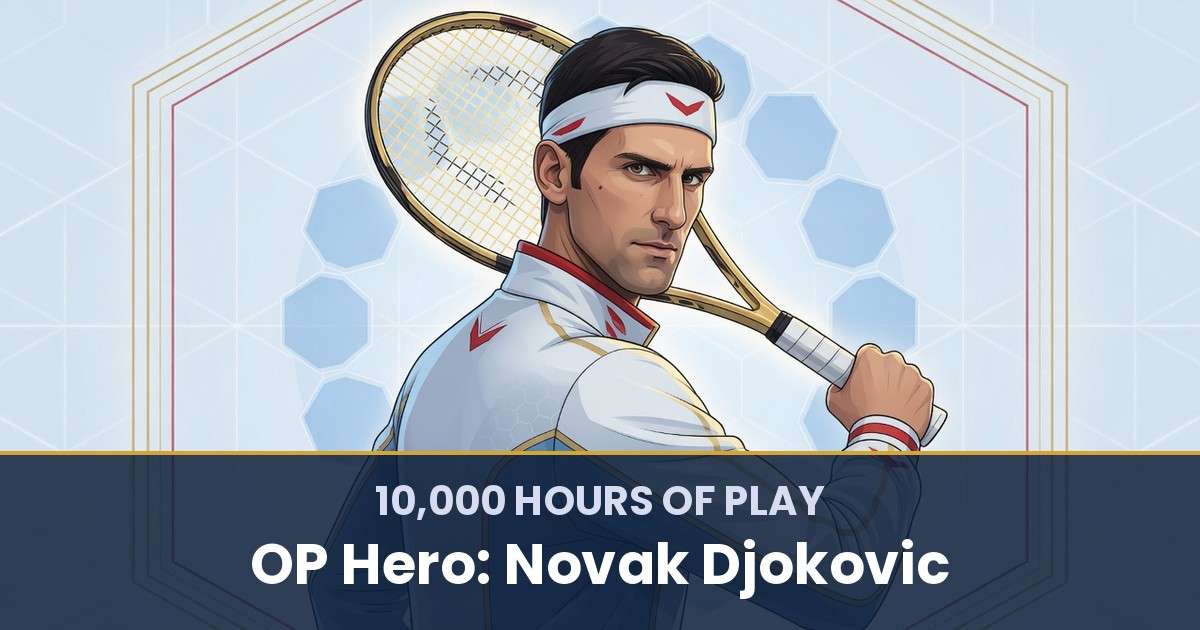


In 1999, a twelve-year-old boy was hitting tennis balls on a cracked court in Belgrade while NATO bombs fell on the city at night. His family would find bombed-out craters and set up nets inside them, because the theory went that a target already hit was the safest place to stand. That boy grew up to win 24 Grand Slam singles titles, more than any man in the history of the sport.
Most people watch Novak Djokovic bend backward into a full split to return a serve and assume the story is about talent. It isn’t. It is about a build.
Djokovic spent more than 420 weeks ranked world No. 1, the most of any man ever, and he did it while starting behind two of the greatest players who ever lived. He was the third wheel to Roger Federer and Rafael Nadal for years before he found the one adjustment that flipped his whole career. Here is how his character was assembled, and what you can copy from it.
⚡ Speed Run Notes
- Djokovic’s real game was never “win tennis matches.” It was survival turned into supremacy: a kid from a war economy who decided that being the best on earth was the only acceptable outcome.
- His career-defining move wasn’t a shot. In 2010 a doctor found he was gluten-intolerant, he rebuilt his diet, and the guy who used to collapse mid-match became the fittest player on tour.
- He was stuck behind Federer and Nadal with one major to his name. Then he won three of the four Grand Slams in a single 2011 season and never looked back.
- An elbow that ended his 2017 and forced surgery. A deportation from Australia in 2022. He turned both into comebacks that produced more titles.
- Element of the build to steal: he treats a hostile crowd chanting a rival’s name as fuel, not friction. That reframe is a trainable skill, not a personality trait.
Table of Contents
- Step 1: The Game — What Djokovic Was Actually Playing
- Step 2: Attributes — The Innate Stats
- Step 3: Role(s) — The Character Class Across Chapters
- Step 4: Skills — The Real-Life Game Skills Djokovic Mastered
- Step 5: Allies — The People Who Multiplied Djokovic
- Step 6: Quests — The Milestones That Shaped the Saga
- What You Can Steal From Djokovic’s Build
- Where this framework comes from
- Related Reading
About Yu-kai Chou

Yu-kai Chou is the author of 10,000 Hours of Play — the book that treats your life as the most important game you’ll ever build a character in, and gives you the 6-Step framework (Game · Attributes · Role · Skills · Allies · Quests) to play it on purpose. He has spent two decades developing the system through which this post analyzes its OP Hero, and applies it to his own life and to the lives of the people he advises around the world.
Chou’s other framework, the Octalysis Framework, has been applied by LEGO, Microsoft, Porsche, Coca-Cola, Salesforce, and MrBeast, impacting over 1.5 Billion Users. He has taught the methodology at Harvard, Stanford, Yale, Tesla, Google, BCG, and IDEO, and has advised governments in eight nations including Ukraine, the United Kingdom, the Kingdom of Bahrain, Singapore, Taiwan, the Netherlands, Kazakhstan, and South Korea.
His work has been cited by Harvard, Stanford, MIT, Forbes, Wall Street Journal, Wired, US Department of Energy, NIST, NSF, NCBI, US Department of Education, ClinicalTrials.gov, and Google Scholar — with 3,700+ more academic publications. Explore his books here.
I keep coming back to Djokovic because his biggest breakthrough came from listening to his own body instead of pushing harder against it. Everyone else in his position would have trained more. He found out why he kept breaking down, changed the input, and the results reorganized themselves around him. The lesson I’d lift from his build is that when you keep hitting the same wall, the answer is often a hidden variable in your own system, not a lack of effort. Diagnose before you grind.
Step 1: The Game — What Djokovic Was Actually Playing
Most people file Djokovic under “great tennis player” and stop there. The game he was actually playing was much larger, and it started before he ever held a trophy.
His father once held up roughly ten Deutsche marks and told the family that was all they had. For a household of five in a collapsing economy, tennis wasn’t a hobby to be enjoyed. It was the way out, and young Novak internalized the stakes early: being good was not enough, because good doesn’t rescue a family. Only the best does.
So the real game became “convert survival pressure into total dominance, then use the platform for something bigger.” On the court that meant No. 1 and Wimbledon and the record book. Off it, that meant founding the Novak Djokovic Foundation in 2007 to fund early childhood education for kids growing up the way he did.
This is the shift at the center of treating your life as a game you can study and level up: the winners usually aren’t the most gifted people in the room. They’re the ones who correctly identify what game they’re really in and then commit to that one without apology. Djokovic’s game was never “enjoy tennis.” It was “make being the best the only survivable outcome, and then keep the promise.”
Step 2: Attributes — The Innate Stats
Attributes are the stats you show up with, the ones visible early and hard to teach. Djokovic’s were unusual, and they showed before any coach could have installed them.
The first was an obsessive drive under scarcity. Growing up through war and financial fear, he didn’t wilt; he converted the instability into a compulsion to succeed. Coaches noticed a six-year-old who talked about becoming the best player in the world and meant it.
The second was emotional openness under pressure. A kid practicing during a bombing campaign could have shut down. Instead he found joy and focus in the game while the city shook, and that capacity to stay loose in hostile conditions became the foundation of his on-court personality.
The third was extraordinary anticipation and coordination: the ability to read a ball’s flight and get his body to impossible positions in time. His later reputation as the best returner in the sport is built on that native wiring. If you want a structured way to read your own innate stats the way we’re reading his, the Talent Triangle Method is the tool for it.
Running under all of it was a fourth stat: relentless curiosity. He was drawn to languages, nutrition, breathing, and psychology long before any of it was fashionable in tennis, and that openness is what let him find the fix that everyone else missed.
Step 3: Role(s) — The Character Class Across Chapters
Djokovic’s saga runs through several distinct character classes, each stacking on the last.
He started as the Scarcity-Forged Apprentice: a Serbian kid learning under Jelena Gencic, then shipped off to a German academy to get the training his war-battered country couldn’t provide. The next class was the Trickster Contender, roughly 2007 to 2010, when he broke through for his first major but mostly played comic third wheel to the Federer-Nadal duopoly, famous as much for impersonating other players as for beating them.
Then came the class that defined him: the Relentless Optimizer, from 2011 on. This is the chapter where he fixed his body, sharpened his mind, and turned “promising” into “nearly unbeatable.” The rivalry that sharpened him is the same kind of iron-on-iron dynamic you see in how Rafael Nadal weaponized relentless intensity across their two decades of matches.
His latest class is the Elder Champion and Advocate: still winning majors into his late thirties, while pushing hard on player rights, scheduling, and governance. Same core stats each chapter, heavier armor each time.
Step 4: Skills — The Real-Life Game Skills Djokovic Mastered
In the 10K HP system, Skills are the learned, repeatable techniques behind a hero’s breakthroughs. Djokovic’s set is unusually clear.
The one that changed everything was Limit Awareness (Warrior) — interoception, the discipline of listening to your body’s signals instead of overriding them. For years he suffered mid-match collapses and breathing trouble that got blamed on weak fitness or nerves. In 2010, during Davis Cup duty in Croatia, he met Dr. Igor Cetojevic, who identified a gluten and dairy sensitivity. Djokovic rebuilt his diet, the collapses stopped, and he went from breaking down in the late rounds to being the fittest man on tour. Where any technique sits on the range from dabbler to mastery is its own question, and the Skills Spectrum is a clean way to map it.
Paired with it was True Sight (Ranger) — observing the keen detail others miss. His return of serve, widely considered the greatest in men’s tennis, is really a reading skill: he picks up tiny cues in a server’s toss and stance and starts moving before the ball is struck. That is why elite servers who ace everyone else get broken by him.
Then there is Mood Hacking (Rogue), arousal control through deliberate ritual. Djokovic uses breathing work, meditation, and visualization to change his state on command, and he has described mentally converting a crowd chanting a rival’s name into support, hearing “Novak” where they shout “Roger.” That reframe kept him composed through the most pressure-soaked matches of his life.
Underneath the highlights sits the least glamorous Skill of all: Locked Heart (Warlock), pain contrasting, measuring today’s discomfort against a much harder past. A man who practiced in bomb craters does not find a fifth-set tiebreak frightening, and that comparison is a renewable source of calm.
Step 5: Allies — The People Who Multiplied Djokovic
No OP Hero levels up alone, and Djokovic’s first multiplier was his first coach, Jelena Gencic.
She spotted him at around age six on Mount Kopaonik, where his family ran a small restaurant, and immediately told his parents she had found a golden child. Gencic fed him more than technique. She gave him classical music, poetry, and languages, treating the whole person as the project, and when his talent outgrew what Serbia could offer she sent him to Nikola Pilic’s academy in Germany to keep climbing.
His longest professional partnership was with coach Marian Vajda, who guided him from 2006 through 2017 and then returned in 2018 to help engineer his comeback. Vajda was in his corner for the transformational 2011 season and for the resurrection that followed the elbow injury. The way a steady long-term coach can anchor a career echoes the mentor dynamic in how Roger Federer built and rebuilt his own team across a twenty-year run.
Later came former Wimbledon champion Goran Ivanisevic, who joined the team in 2019 and coached him through more Slam titles, and his wife Jelena, who runs the foundation and grounds the operation off the court. Different allies for different chapters, each one built into the machinery of a specific win.
Step 6: Quests — The Milestones That Shaped the Saga
Djokovic’s quest log has clean, dated entries, and, crucially, real losses in it.
The opening quest was his first major at the 2008 Australian Open, plus a bronze at the Beijing Olympics that same year. The breakout quest was 2011: he opened the season on a 41-match winning streak and won three of the four Grand Slams, seizing the No. 1 ranking for the first time. The endurance quest was the 2012 Australian Open final against Nadal, five hours and fifty-three minutes of attrition, still the longest Grand Slam final ever played, which he won. The completion quest came in 2016, when a French Open title finally gave him all four majors and the Career Grand Slam.
But the log is honest about defeats. In 2017 an elbow injury wrecked his season and forced surgery in early 2018, dropping him out of the top tier and into a genuine crisis of form. In 2021 he came within one match of the first calendar Grand Slam in over half a century, winning the year’s first three majors before losing the US Open final to Daniil Medvedev. And in 2022 he was detained and deported from Australia over his COVID-19 vaccination status, barred from defending his title in a very public humiliation.
He answered each one. The elbow gave way to a Wimbledon title in 2018. The deportation was followed by a 2023 that carried him to his 24th major, and in 2024 he finally won the one prize that had eluded him, Olympic singles gold in Paris. If you want more builds like this, heroes who turned rejection into fuel, the full roster lives on the OP Hero profiles hub.
What You Can Steal From Djokovic’s Build
You are not going to win 24 Grand Slams this year. But three moves from Djokovic’s build port directly onto your own.
First: diagnose the hidden variable before you grind harder. Djokovic’s ceiling wasn’t lifted by more training. It was lifted by finding out that gluten was quietly wrecking him. When you keep hitting the same wall, look for the input nobody has checked before you assume the problem is willpower.
Second: turn the crowd against you into a battery. Most people leak energy when they feel unwanted, booed, doubted, or overlooked. Djokovic built a deliberate practice of converting that hostility into fuel. The reframe is a skill you can rehearse, and it is available to you in your next hard room.
Third: let the losses stay in the log and keep swinging. The elbow surgery, the deportation, the lost US Open final one match from history, none of it ended him. That is Phoenix Rebirth (Paladin) in its plainest form, recovering from a devastating setback and coming back to work instead of nursing the wound. The same refusal to quit shows up across the roster, from Viktor Frankl finding meaning inside the worst circumstances imaginable onward. Play the long game, treat every wall as a puzzle with a hidden piece, and keep your name in the fight.
Where this framework comes from

Want the full system this profile is built on?
Every OP Hero piece runs through the same 6-Step framework from 10,000 Hours of Play: Unlock Your Real-Life Legendary Success. The book covers the full system, walks through Yu-kai’s own life run as the first applied case study, and gives you the worksheets to audit your own build.
Related Reading
- The OP Hero Profiles Hub: every hero run through the 10K HP framework, in one place.
- The 10,000 Hours of Play Framework: the 6 Steps (Game, Attributes, Role, Skills, Allies, Quests) explained in full.
- OP Hero: Rafael Nadal: the rival whose intensity forged Djokovic across two decades.
- OP Hero: Roger Federer: the benchmark Djokovic chased and eventually passed.
- OP Hero: Billie Jean King: a champion who turned the court into a platform for change.
- The Skills Spectrum: how to tell where any skill sits from dabbler to master.