
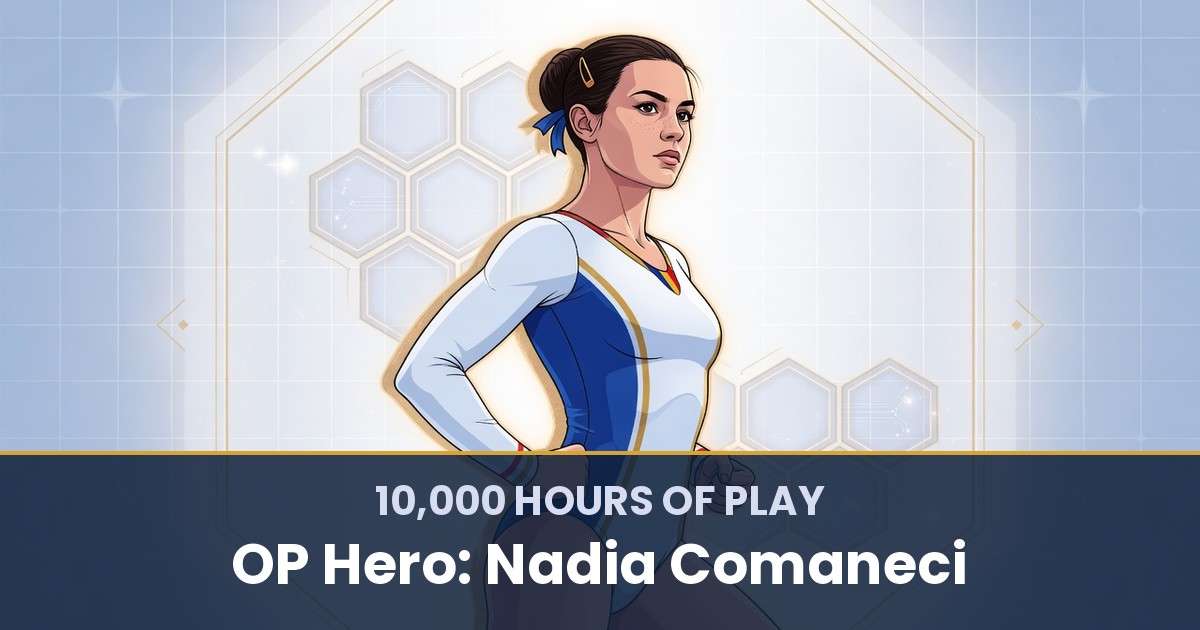


On 18 July 1976, at the Montreal Olympics, a 14-year-old from a small Romanian town finished her uneven bars routine and the scoreboard broke. It flashed 1.00. The machine had been built by engineers who had been assured that a perfect 10.00 in Olympic gymnastics was impossible, so they never programmed four digits.
Nadia Comăneci had just made it necessary. Over the next few days she scored seven perfect 10s and walked away with three gold medals, and the display kept lying because reality had outrun the equipment.
Here is the part most people miss. The perfect 10 was not the peak of her story. It was the opening boss. What she did afterward, under a surveillance state that owned her image, and then across a border she crossed on foot in the dark, is the real reason her life reads like a character build worth studying move by move.
⚡ Speed Run Notes
- Nadia’s “game” was perfection under constraint: push the ceiling of what a human body can score, then keep excelling while a regime controlled everything about her.
- Her breakout stat was fearless coordination. Béla Károlyi scouted her out of a kindergarten yard, and by 14 she was doing beam elements no one had landed in competition.
- The seven perfect 10s at Montreal 1976 came from relentless secluded training plus a composure most adults never develop, let alone a teenager at her first Games.
- Her hardest quest was not a routine. In November 1989 she crossed the Romanian border at night to escape Ceaușescu’s Romania, then had to rebuild from a con man who exploited her in America.
- She converted a legendary run into a second act: coach, academy owner with husband Bart Conner, and a voice at the United Nations, becoming a US citizen in 2001.
Table of Contents
About Yu-kai Chou

Yu-kai Chou is the author of 10,000 Hours of Play — the book that treats your life as the most important game you’ll ever build a character in, and gives you the 6-Step framework (Game · Attributes · Role · Skills · Allies · Quests) to play it on purpose. He has spent two decades developing the system through which this post analyzes its OP Hero, and applies it to his own life and to the lives of the people he advises around the world.
Chou’s other framework, the Octalysis Framework, has been applied by LEGO, Microsoft, Porsche, Coca-Cola, Salesforce, and MrBeast, impacting over 1.5 Billion Users. He has taught the methodology at Harvard, Stanford, Yale, Tesla, Google, BCG, and IDEO, and has advised governments in eight nations including Ukraine, the United Kingdom, the Kingdom of Bahrain, Singapore, Taiwan, the Netherlands, Kazakhstan, and South Korea.
His work has been cited by Harvard, Stanford, MIT, Forbes, Wall Street Journal, Wired, US Department of Energy, NIST, NSF, NCBI, US Department of Education, ClinicalTrials.gov, and Google Scholar — with 3,700+ more academic publications. Explore his books here.
What pulls me back to Nadia’s build is the gap between her Role and her freedom. For most of her career the state owned her name, her travel, and her image, and she still kept raising the technical ceiling of her sport from inside that cage. The lesson I’d lift from her run is that constraint does not have to cap your Skills. You can compound a talent to a world-defining edge even when almost none of the external variables are under your control, and that compounded Skill becomes the asset nobody can confiscate when you finally get the chance to walk free.
Step 1: The Game — What Nadia Comăneci Was Actually Playing
Most champions play to win the next competition. Nadia played to redraw the boundary of what a score could even be.
Her real game was perfection under constraint. She kept chasing the cleanest possible execution of a routine, the version with zero visible error, and she did it inside a system that controlled her food, her travel, and her public story. Two pressures stacked on top of each other: the pressure to be flawless on the apparatus, and the pressure of being a state asset off it.
This is exactly why she is such a sharp case study for treating your own life as a game you build on purpose rather than a series of contests you react to. Nadia was not optimizing for a single medal. She was optimizing the standard itself, and once she moved the standard, every gymnast who came after her inherited the new floor she had set.
The engine underneath that game was Lich Grind (Warlock), the skill of intense, secluded work. She trained under a centralized, high-intensity regimen at the national center in Onești, hour after hour of the same elements, long before Montreal made her famous. When your game is the standard and not the scoreboard, the private grind is where the whole thing is actually won.
Step 2: Attributes — The Innate Stats
Attributes are the traits you show up with before any coach touches you. Nadia’s stat sheet was visible absurdly early.
Her top stat was fearless physical coordination. She was hooked on gymnastics by age six, and Béla Károlyi famously spotted her doing cartwheels in a schoolyard and recruited her into his program. Children who move like that under pressure are not made in a gym. They arrive that way, and the gym refines them.
Her second stat was composure under load. At her first national junior championship in 1969, at age seven, she placed 13th. One year later she won the same competition. Reproducing exacting routines while the whole arena watches, at 14, at a first Olympics, is a nerve stat almost no one rolls.
The third was a quiet, internal drive rather than showy charisma. Accounts from the 1970s describe a reserved kid locked onto training, indifferent to the noise around her. That interior focus is what let her keep functioning when the surveillance and the fame arrived.
If you want to pull your own innate stats out of the pile of things you merely learned, the Talent Triangle Method is the tool built for exactly that sorting job.
Step 3: Role(s) — The Character Class Across Chapters
Nadia’s Role changed more violently than most, and the gap between what she did and what she was allowed to be is the whole drama of her build.
In her first chapter she was the Prodigy Apprentice, a child trainee under Béla and Márta Károlyi at Onești from around 1969, stacking national junior titles and early international wins.
In her second chapter she became the Perfect Champion and National Icon. From her dominant 1975 European Championships (four golds and a floor silver) through Montreal 1976, she was the best gymnast alive, and the Romanian state promptly turned her into a propaganda symbol it could parade.
Her third chapter is the cruel one: the Constrained Emissary. Through the 1980s she was a sports ambassador whose every move was monitored, her foreign travel heavily restricted, her image managed by people who were not her. Like Wilma Rudolph, who converted a childhood of physical adversity into Olympic gold, Nadia spent years performing at the top of the world while carrying a weight the audience never saw.
Her fourth chapter was the Defector, and her fifth the Coach-Patron: academy owner, sport promoter, and advocate, rebuilding an identity that finally belonged to her.
Step 4: Skills — The Real-Life Game Skills Nadia Mastered
Nadia’s breakthroughs trace to a small set of Real-Life Game Skills she sharpened to an extreme edge.
The first is Ninja Focus (Rogue), sustained discipline and focus on a single track of work. Her climb from 13th to national champion in a year, and later the reproduction of seven perfect 10s across multiple apparatuses at one Games, both run on the same engine: an unusual tolerance for repeating the same motion thousands of times until the error rate hits zero. If you want to see where a skill like this sits on the road from dabbler to master, Yu-kai’s Skills Spectrum maps that exact climb.
The second is Elemental Ensemble (Mage), the ability to visualize a complex composition in the mind and then execute it with precision. On balance beam she was the first gymnast to compete an aerial walkover and an aerial cartwheel to back handspring flight series, plus a difficult double-twist dismount. On floor she debuted a double back salto. These were not lucky attempts. They were choreographed compositions executed to the millimeter, and they helped her take beam gold at the 1978 World Championships.
The third is Courageous Heart (Paladin), the skill of charging into uncharted and hostile territory. She used it twice, in two completely different arenas. First when she landed elements no one had done in Olympic competition, accepting the real physical risk of being the first. Then, unforgettably, when she used it off the mat entirely. A gymnast who innovated under a rigid scoring code the way Simone Biles later would is impressive; a person who points that same nerve at an international border in the dark is operating on another level.
Step 5: Allies — The People Who Multiplied Nadia
No OP Hero levels alone, and Nadia’s allies cut both ways, which is part of what makes her story honest.
Béla and Márta Károlyi were her first great multipliers. Béla discovered her as a small child and, with Márta, built the intense centralized training system at Onești that turned a coordinated kid into the gymnast who scored the first perfect 10 in Olympic history in 1976. Whatever the later controversies around their methods, the coaching engine that produced Montreal was theirs.
Bart Conner was the ally who arrived early and mattered late. They first met at the American Cup in March 1976, months before he competed for the United States at the 1976 Montreal Olympics. Years after her defection they married, in 1996, in Bucharest, and together they built the Bart Conner Gymnastics Academy, which gave Nadia a professional platform to re-enter the sport on her own terms rather than a state’s.
Not every ally is a gift. In November 1989 the man who organized her escape, Constantin Panait, led her and a small group across the border to freedom, and then in America reportedly exploited her finances and her image before she broke free of him. The lesson is worth stealing whole: the same person can be the key that unlocks your cage and a threat you later have to escape a second time. Vet the people who hold your exits.
Step 6: Quests — The Milestones That Shaped the Saga
Nadia’s saga is a chain of specific quests, and the two biggest ones sit at opposite ends of her life.
The 1975 European Championships in Skien, Norway, were her call to the frontier: a teenager dominating the continent and announcing herself before the Olympics. Then came the boss fight. At Montreal 1976 she recorded seven perfect 10.00 scores and won three gold medals, in the all-around, uneven bars, and balance beam, plus a team silver and a bronze on floor. The scoreboard that could not show her score is now the most famous glitch in sports.
Her setback quest is the one people forget. At the 1979 World Championships in Fort Worth, Texas, she arrived fighting an infection, no longer the untouchable machine of 1976, and had to compete through the psychological weight of being expected to stay perfect forever. She still contributed and still medaled at the 1980 Moscow Olympics with two golds, on beam and floor, but the aura of inevitability was gone. Growing up in public, under a standard she herself had set, was its own kind of boss.
The final quest was the escape. In November 1989, weeks before Ceaușescu fell, she crossed the border on foot at night and eventually reached the United States. Rebuilding from there, through an exploitative handler and a foreign country, and ending up a US citizen in 2001 and a speaker at the United Nations, is the truest OP Hero arc she ran. You can trace this same pattern of rebuilding after a catastrophic reset across the whole OP Hero profiles library.
What You Can Steal From Nadia’s Build
The most portable Skill in Nadia’s kit is Phoenix Rebirth (Paladin), the ability to recover from a devastating reset and come back building rather than mourning. She lost her country, her structure, and very nearly her savings, and she treated all of it as a new chapter instead of a game over. The gymnast became the coach, the academy owner, and the advocate. Like Novak Djokovic, who rebuilt his body and game after early collapses, she proved that a reset is a respawn if you refuse to read it as a verdict.
Here is the practical version for your own build. First, compound one Skill to a world-defining edge even while your external conditions are locked down, because that Skill is the asset no regime, employer, or bad actor can confiscate. Second, separate your Role from your freedom: play the class fully even when the world is managing your image, and keep the receipts of your own excellence. Third, when the escape window opens, and it usually opens fast, use Courageous Heart and go, then be ready for the messy rebuild on the other side.
The perfect 10 made Nadia Comăneci a legend at 14. What she did with the four decades after it, escaping, rebuilding, and handing the sport forward, is why she is worth studying as a build and not just remembering as a highlight.
Where this framework comes from

Want the full system this profile is built on?
Every OP Hero piece runs through the same 6-Step framework from 10,000 Hours of Play: Unlock Your Real-Life Legendary Success. The book covers the full system, walks through Yu-kai’s own life run as the first applied case study, and gives you the worksheets to audit your own build.
Related Reading
- The OP Hero Profiles Hub: the full library of legendary lives run through the 6-Step framework.
- 10,000 Hours of Play by OP Hero: Simone Biles: another gymnast who rewrote the ceiling of her sport under a rigid scoring code.
- 10,000 Hours of Play by OP Hero: Wilma Rudolph: an athlete who turned early adversity into Olympic gold.
- 10,000 Hours of Play by OP Hero: Novak Djokovic: a champion whose story is really about rebuilding after collapse.
- 10,000 Hours of Play by OP Hero: Usain Bolt: raw physical attributes compounded into a standard no one has matched.
- The 10,000 Hours of Play Framework: the 6 Steps for turning your own life into a game you play on purpose.