
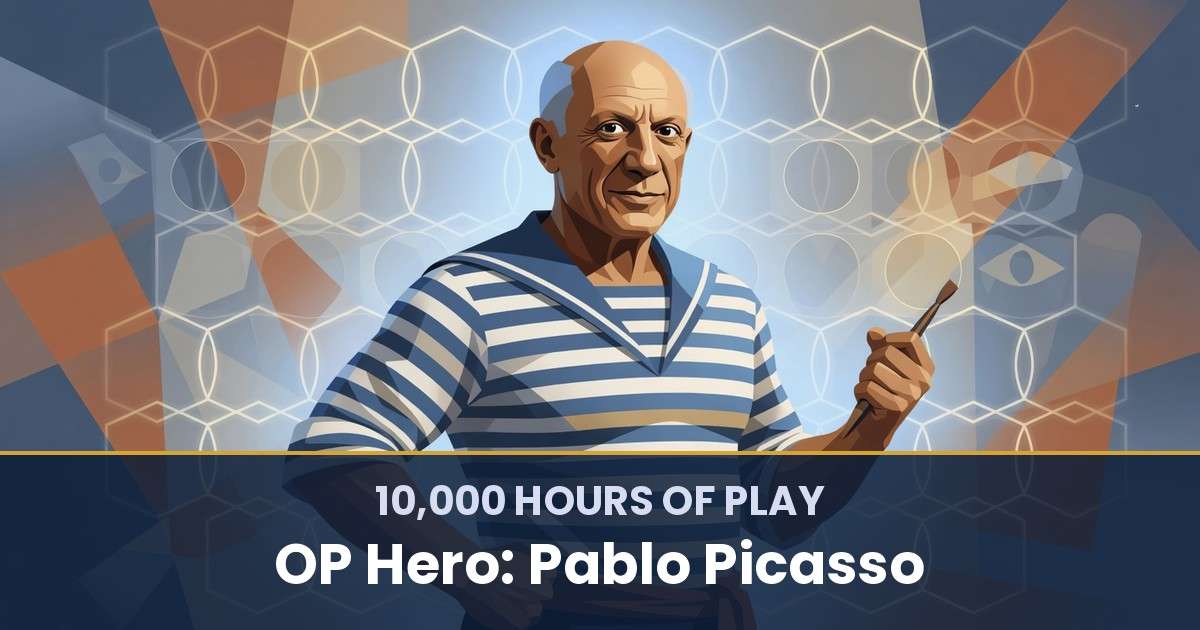


TL;DR
- One decision in his late teens, leaving the academic track his father had built for him, set the direction for everything up to 1973.
- Over 20,000 works across seven media, produced in bursts: Les Demoiselles d’Avignon within a year of encountering the masks, Guernica in five weeks.
- Braque co-built Cubism with him, Kahnweiler financed its unsaleable years, and Gertrude Stein put the work in front of the people who mattered.
- Two living artists, Refik Anadol and Beeple, each carry one half of his build in the 2020s: the reinvention of seeing, and the daily volume.
On the night of 17 February 1901, in a café in Paris, a 21-year-old Spanish painter named Carles Casagemas tried to shoot the woman who had rejected him, missed, and turned the gun on himself. Casagemas was Pablo Picasso’s closest friend from their Barcelona art-school years. Picasso was not in the café that night. He was in Madrid.
What Picasso did with that loss shows a single human treating personal catastrophe as material. Inside roughly a year, the bright Toulouse-Lautrec colors he had been painting in went monochrome. The figures elongated. In the Blue Period (1901-1904), a young painter ran the worst thing in his life through the only working machine he had, which was paint.
If you read Picasso’s seventy working years as a life-as-game framework, the surprise is how still the center stays underneath all that volume. The main quest never moved. He kept asking the same question, how else can reality be drawn, and every chapter is a different answer.
⚡ Speed Run Notes
- Picasso’s main quest never changed: rewrite how reality can be seen. Across seven decades he kept respeccing his style tree while keeping his technical level cap.
- His estimated lifetime output is over 20,000 works across painting, sculpture, prints, drawings, ceramics, and theater design.
- The Blue Period was a grief response to the suicide of his best friend Carles Casagemas in February 1901. Loss became his first distinctive style.
- Les Demoiselles d’Avignon (July 1907) used African-mask geometry to break Western perspective. Even his avant-garde peers were appalled. He did not exhibit it publicly until 1916.
- Guernica was painted between 1 May and 4 June 1937 for the Spanish Pavilion at the Paris World’s Fair. Five weeks of work produced the antiwar image that then toured for years raising funds for Spanish refugees.
Table of Contents
- Step 1: The Game Picasso Was Actually Playing
- Step 2: Attributes (The Innate Stats)
- Step 3: Role(s) Across Chapters
- Step 4: Skills Picasso Mastered
- Step 5: Allies Who Multiplied Picasso
- Step 6: Quests That Shaped the Saga
- What You Can Steal From Pablo Picasso’s Build
- Where this framework comes from
- Related Reading
About Yu-kai Chou

Yu-kai Chou is the author of 10,000 Hours of Play — the book that treats your life as the most important game you’ll ever build a character in, and gives you the 6-Step framework (Game · Attributes · Role · Skills · Allies · Quests) to play it on purpose. He has spent two decades developing the system through which this post analyzes its OP Hero, and applies it to his own life and to the lives of the people he advises around the world.
Chou’s other framework, the Octalysis Framework, has been applied by LEGO, Microsoft, Porsche, Coca-Cola, Salesforce, and MrBeast, impacting over 1.5 Billion Users. He has taught the methodology at Harvard, Stanford, Yale, Tesla, Google, BCG, and IDEO, and has advised governments in eight nations including Ukraine, the United Kingdom, the Kingdom of Bahrain, Singapore, Taiwan, the Netherlands, Kazakhstan, and South Korea.
His work has been cited by Harvard, Stanford, MIT, Forbes, Wall Street Journal, Wired, US Department of Energy, NIST, NSF, NCBI, US Department of Education, ClinicalTrials.gov, and Google Scholar — with 3,700+ more academic publications. Explore his books here.
What I keep coming back to with Picasso’s build is how he refused to retire any single style as his identity. Most artists at his level brand themselves around the one breakthrough that made them famous and then defend it for fifty years. He treated every breakthrough as a tool he was about to outgrow. If you read only one Role lesson off his sheet, read that one. The hero who is willing to respec their character class after a win has a longer game than the hero who is not.
Step 1: The Game — What Pablo Picasso Was Actually Playing
Picasso’s career looks like at least seven different careers from the outside: Blue Period painter, Cubist co-inventor, classical revivalist, Surrealist-adjacent draftsman, political muralist, late-career ceramicist, lithographer. From the inside it was one continuous project.
The Metropolitan Museum of Art summarizes it cleanly. His styles “transcend realism and abstraction, Cubism, Neoclassicism, Surrealism, and Expressionism.” Every label in it is a phase he entered, exhausted, and left for the next phase, while keeping the technical level he had earned in the previous one.
You can also see the rules in his metric. His estimated lifetime output is over 20,000 works across painting, drawing, prints, sculpture, ceramics, theater design, and costume. A man defending a brand does not produce at that rate. He was running constant experiments, and the experiments were the point. Each canvas is a probe testing a question, not a product defending a position.
The win condition stayed simple. Did he move the visual language somewhere it had not been? If yes, ship and move on. If no, change tools, change subject, change studio. By the end he had cycled through enough phases that critics who hated his late work were on the third generation of critics who had hated his work for different reasons. The game held up against all of them because the game was not their approval.
Step 2: Attributes — The Innate Stats
Attributes are the stats a hero shows before they have time to “learn” anything. Picasso’s stats were visible in his early teens.
Extreme visual-processing talent. His father, José Ruiz y Blasco, was a drawing teacher. He recognized his son’s skill very early and pushed him into formal academic training. By his teens, Picasso was producing technically adept academic work and won a place at La Llotja in Barcelona. The early studies show command of anatomy, light, and composition far beyond his years. The Talent Triangle would have flagged him at thirteen.
Compulsive productivity. 20,000+ works across a single lifetime reads less like discipline and more like metabolism. Accounts of his early Barcelona and Paris years describe constant sketching, rapid series of canvases, and impatience with any single solved problem. He could not stop making images, the way some athletes cannot stop training. That stat carried him through every chapter that followed.
High deviance tolerance. In his early twenties he walked away from the academic style that could have given him a stable, respectable career. He went into the melancholic Blue Period that nobody was buying, and then into Cubism, which baffled the public. Co-founding Cubism in 1907-1909 was a deliberate choice to alienate a large part of the market in exchange for solving a more interesting problem.
Structural pattern recognition. Cubism requires seeing objects as systems of planes from multiple viewpoints at once. That is a cognitive style as much as an artistic method. His earlier work already shows the same instinct: a tendency to strip figures to essential structural shapes while still retaining likeness. He was wired to see the scaffolding behind the surface.
Charismatic social intelligence. The minute he hit Paris, he embedded himself at the center of the avant-garde and pulled in poets, dealers, and rival painters as durable allies. People wanted to be inside his orbit and stayed, the way a high Charisma roll plays out at any table.
Step 3: Role(s) — The Character Class Across Chapters
Same player, six character classes:
Prodigy Draftsman (c. 1891-1900). Born in Málaga in 1881. Trained by his father from childhood. Admitted to La Llotja in Barcelona. Around 1899 he made the decision to abandon academic art school against his family’s wishes and commit to the avant-garde. Class: High-INT Academic Realist, maxed drawing stats, ready to respec.
Bohemian Symbolist (1901-1906). The Blue Period (1901-1904) and Rose Period (c. 1904-1906). Elongated melancholic figures, then warmer harlequins and circus performers. He was painting his way through the loss of Casagemas and through real poverty in Montmartre. Class: Melancholic Storyteller, low charisma roll with the buying public, high signal with future collectors.
Cubist Co-Founder (1907-1914). With Georges Braque he co-invented Cubism, fracturing form into geometric planes and multiple viewpoints. The starting move was Les Demoiselles d’Avignon in July 1907. The system was developed across 1909-1912 in close collaboration with Braque. Class: Systems Hacker, rewriting the visual engine of Western art.
Multi-Class Polymath (1915-1936). Post-Cubism he cycled through Neoclassicism, Synthetic Cubism, and Surrealist-inflected distortion, while expanding seriously into sculpture, printmaking, theater design, and the early collage work. The 1932 retrospective at Galeries Georges Petit collected around 225 works he had selected himself. Class: Painter-Sculptor-Designer hybrid, refusing to specialize.
Political Muralist (1937-1945). Spanish Civil War commission from the Republican government. Guernica painted between 1 May and 4 June 1937 for the Spanish Pavilion at the Paris World’s Fair. He stayed in occupied Paris through the war, and on 5 October 1944, weeks after liberation, he joined the French Communist Party. Class: Moral Chronicler, channeling national catastrophe into a single canvas the size of a wall.
Late-Style Experimenter (1946-1973). Moved to the south of France. Started serious ceramics at the Madoura pottery in Vallauris around summer 1947. Lithograph “Dove” chosen as the poster image for the 1949 Paris Peace Congress. Married Jacqueline Roque in 1961 and produced hundreds of late portraits of her. Class: High-Level Archmage, running ceramics, lithography, and portraiture in parallel.
Step 4: Skills — The Real-Life Game Skills Pablo Picasso Mastered
These are the canon 10K HP Skills with concrete evidence in Picasso’s record. The Skills Spectrum shows why this works: legendary builds usually look like two or three Specialist-depth skills plus a stack of Dabbler-range adapters around them.
Vision Manifestation (Warlock) is mental rehearsal so vivid it shapes real action. Cubism shows this skill at full strength. Before Picasso and Braque painted in faceted multi-viewpoint planes, no one had seen the world that way on a canvas. They had to picture the broken geometry in their heads first, then translate it onto a flat surface. Every Analytic Cubist canvas from 1909 to 1912 is a Vision Manifestation roll that succeeded.
Cognitive Lens (Mage) is zooming in on detail and zooming out for structure at the same time. A Cubist face shows the eye in profile and the nose head-on inside one composition. You cannot paint that without holding the micro and macro views simultaneously. He used the same skill on the preparatory drawings for Guernica, where he ran dozens of zoom-in studies of single figures (the screaming horse, the dead child, the broken sword) before locking in the macro composition.
Lich Grind (Warlock) is intense secluded work periods. Guernica is the textbook case: a wall-sized canvas painted in his studio at 7 rue des Grands-Augustins between 1 May and 4 June 1937. Five weeks. The Vollard Suite is the longer-cycle version: 100 etchings commissioned by Ambroise Vollard and worked across 1930-1937 with experimental aquatint and sugar-lift technique. Across his life the same skill produced the 20,000+ work total.
Siphoning (Warlock) is rapidly extracting skills or knowledge from others and folding them into your own toolkit. Les Demoiselles d’Avignon (July 1907) is the canonical move. He saw African masks and Iberian sculpture in Paris ethnographic collections and inside a year had translated their geometry into a new painting vocabulary that broke Western academic perspective. The same skill ran in reverse on his classical training: he Siphoned everything his father and the academies could teach him, then abandoned the surface style while keeping the structural control. Without the classical base, the Cubist moves would have read as incompetence instead of invention.
Phoenix Rebirth (Paladin) is recovery from devastating failure that comes back stronger. The first instance is the Blue Period. Casagemas’s suicide on 17 February 1901 was a personal catastrophe. The behavioral response was three years of paintings about poverty, loss, and isolation that became his first fully distinctive style. The lesson has nothing to do with grief being useful. He refused to treat a loss as the end of a campaign, and that refusal is the copyable part. He rolled it into the next chapter and walked out with a body of work that art historians still teach.
Bind Fate (Warlock) is leveraging someone else’s brand or resource to grow your own. Picasso stacked allies deliberately (see Step 5). He used Apollinaire’s critical voice, Stein’s salon, Vollard’s dealership, Kahnweiler’s exclusive contracts, and Olga Khokhlova’s connection to the Ballets Russes. Each ally added a multiplier to whatever stage he was in. Without that stack, Cubism is a private experiment instead of a movement.
Step 5: Allies — The People Who Multiplied Picasso
Picasso’s alliance stack is unusually large because his career was unusually long. The professional layer is the one to study if you are mapping this onto your own build.
Georges Braque was the artistic co-inventor. From roughly 1909 to 1912 he and Picasso worked so closely on Analytic Cubism that historians often cannot reliably attribute individual canvases. They were the lab partners who built the new visual language together. Without Braque, Cubism is Picasso alone and probably never escapes a private studio.
Guillaume Apollinaire, the poet and critic, was the intellectual amplifier. He championed Cubism in print in the years before the First World War and gave the movement its theoretical vocabulary in the public mind. Apollinaire turned a painter’s experiments into a labeled, defensible avant-garde position.
Gertrude Stein was the salon-and-collector multiplier. She bought Picasso’s work early, displayed it in her Paris salon, and put him in the same rooms as the writers and artists who would carry his reputation through the early modernist decades. She made him visible.
Ambroise Vollard was the dealer-publisher who unlocked his late-career printmaking. He commissioned the Vollard Suite, 100 etchings worked across 1930-1937, providing both the framework and the technical opportunity for his largest print project.
Daniel-Henry Kahnweiler was the dealer who carried Cubism financially in its earliest, least-saleable years. By taking on the Cubist work as a primary commercial mission, Kahnweiler let Picasso and Braque keep experimenting without being forced back into a more saleable style.
Henri Matisse was the rival-peer. Their decades-long rivalry sharpened both of them. Matisse was the high-level competition that kept Picasso from ever becoming complacent about color or composition, the way a great rival keeps a great athlete from coasting.
Olga Khokhlova, his first wife, was a ballet dancer with Sergei Diaghilev’s Ballets Russes. Her network is what pulled Picasso into the theater-and-stage-design chapter and gave him entry into a more formally dressed European cultural establishment after the war.
Marie-Thérèse Walter, Dora Maar, Françoise Gilot, and Jacqueline Roque were each, in turn, the central romantic partner of a different chapter, and the work of each chapter is unintelligible without them. Walter (met in late 1927 outside the Galeries Lafayette) is the curvilinear sensual style that culminates in the 1932 portrait series and pushes him back to sculpture after a 14-year hiatus. Maar (1936-1943) photographed the step-by-step painting of Guernica and is the face of the political-period portraits. Gilot (together with him through most of the 1940s and into the early 1950s, mother of Claude (b. 1947) and Paloma (b. 1949)) later wrote Life with Picasso in 1964 and became a critical voice on his life. Roque (married 1961 until his death in 1973) is the late-period muse who appears in hundreds of his last works.
Step 6: Quests — The Milestones That Shaped the Saga
Six dated quests anchor the saga. Each one is a discrete objective with a measurable outcome, including the setback chapter that almost never gets credited as one.
Quest 1, The Blue Period after Casagemas (1901-1904). Casagemas’s suicide on 17 February 1901 in Paris. The Blue Period dates from that year through 1904. Outcome: Picasso’s first fully recognizable style and the body of work that established him as a serious painter to take seriously, even though it sold poorly during the period itself.
Quest 2, Les Demoiselles d’Avignon (1907). The large canvas was completed in his studio at 33 rue des Grands-Augustins in Paris in July 1907. Outcome includes the setback: when first shown privately to his avant-garde peers, the work was met with shock and hostility. Picasso did not publicly exhibit Les Demoiselles d’Avignon until 1916, nine years after he finished it. It is now treated as a foundational work of Cubism and a decisive break from traditional representation, but it had to wait.
Quest 3, The 1932 retrospective at Galeries Georges Petit, Paris. Opened 16 June 1932. Around 225 works spanning his career, selected and arranged by Picasso himself, including the new Marie-Thérèse paintings shown alongside his earlier Cubist work. Outcome: it consolidated his standing as the leading modern painter in France and tied his current erotic portrait series back to the structural innovations that had built his reputation.
Quest 4, Guernica and the Spanish Pavilion (1937). Commission from the Spanish Republican government in early 1937. Painted between 1 May and 4 June 1937 for the Spanish Pavilion at the Exposition Internationale des Arts et Techniques dans la Vie Moderne in Paris, which opened on 25 May 1937. Outcome: a monumental canvas that became an international anti-war symbol, toured for years to raise funds for Spanish refugees, and confirmed Picasso’s role as a politically engaged artist whose work could affect events as well as describe them.
Quest 5, “Picasso: Forty Years of His Art” at MoMA (1939-1940). The Museum of Modern Art retrospective ran from 15 November 1939 to 7 January 1940 in New York. Outcome: the first major American retrospective of his work. It planted his reputation firmly inside the U.S. institutional canon at exactly the moment the war was disrupting his European market, and secured his standing on the other side of the Atlantic.
Quest 6, Ceramics and the Vallauris chapter (1947-1973). He began serious ceramic work at the Madoura pottery in Vallauris around summer 1947 and expanded into the Fournas workshops in 1949. The Communist Party affiliation from 5 October 1944 fed directly into the 1949 “Dove” lithograph, chosen as the image of the Paris Peace Congress. Outcome: a late-career chapter that produced hundreds of ceramic works, raised ceramics into the modern-art conversation as a serious medium, and ran in parallel with the Jacqueline portraits up to his death in 1973.
What You Can Steal From Pablo Picasso’s Build
Picasso never let a single breakthrough become his permanent address. After Les Demoiselles d’Avignon in 1907 he could have spent the rest of his career as the Cubism guy. After Guernica in 1937 he could have spent the rest of his career as the political-painter guy. He did neither. Each win became equipment for the next campaign, and the next phase was always the result of being willing to put the old tool down. That is the Role lesson that matters: your identity is the question you keep asking, not the answer you got the last time you asked it.
The second lesson is the alliance stack. Cubism without Braque stays in the studio, and the Vollard Suite without Vollard stays a folder of unfinished etchings. Even Guernica without Dora Maar’s photographs of the process would have a much thinner historical record.
When a chapter ends with a win, audit the inventory instead of defending the win. The skills that made the last win possible are usually the skills the next chapter is going to ask you to spend on a problem you do not yet know how to solve.
The 10K HP Frame — Pablo Picasso Through the 6 Steps Lens
What the chronology hides is how tightly the six Steps fed each other.
The Game he chose in 1899 was only playable because the Attributes were already in place. A painter without his processing speed or his metabolism for output could have asked the same question and gotten through three style periods instead of seven.
The Role respecs, in turn, were financed by the Alliances. Kahnweiler’s contracts paid for the least saleable experiments, which means the famous willingness to walk away from a winning style was never pure courage. It was courage with a dealer underneath it.
The Skill mix explains the shape of the Quests. A sheet built on extraction and seclusion produces milestone works in concentrated bursts, and the record shows exactly that: the Demoiselles within a year of encountering the masks, Guernica in five weeks, the Vollard Suite in pulses across seven years.
The practical read for your own sheet: pick the two Skills on his list that are trainable this year. Cognitive Lens responds to deliberate practice, since alternating between detail work and structure review inside one session is a drill anyone can run. Lich Grind responds to calendar design, and a protected five-week block modeled on the Guernica sprint is a reasonable first test of your own capacity.
Which Octalysis Core Drives Picasso’s Arc Activated
The Octalysis Framework names the eight Core Drives behind human motivation. Picasso’s arc ran hot on four of them, and naming which four explains choices that otherwise look like pure temperament.
CD1: Epic Meaning & Calling. Epic Meaning & Calling is the drive of serving something larger than yourself. Guernica is its clearest firing: in five weeks of 1937 he turned a bombed Basque town into a canvas that toured the world for Spanish refugee relief, because he believed a painting could carry a nation’s catastrophe further than a newspaper could. The commission paid almost nothing against what the canvas cost him.
CD3: Empowerment of Creativity & Feedback. Empowerment of Creativity & Feedback is the drive of expressing yourself through experiments and seeing the results. Every canvas tested a move, every finished work came back as feedback, and seventy years of that loop added up to the 20,000-work total.
The late ceramics chapter proves CD3 never depended on prestige. At Vallauris he spent his final decades experimenting in a medium the art market considered minor, producing hundreds of works because the feedback loop itself rewarded him.
CD5: Social Influence & Relatedness. Social Influence & Relatedness covers mentorship, rivalry, and the pull of the people around you. Picasso built his career inside it: the Braque partnership that co-invented Cubism, the Stein salon that made him visible, and the Matisse rivalry that kept him sharp for forty years all fed the same drive.
CD7: Unpredictability & Curiosity. Unpredictability & Curiosity is the drive of needing to know what happens next. The same curiosity that chose his Game drove the style changes that frustrated his dealers, with CD7 overruling CD4’s urge to defend owned territory.
The drive he conspicuously resisted was CD8, Loss & Avoidance, in its defensive form. After the Demoiselles was met with hostility in 1907 he held the painting back from public exhibition for nine years, yet he kept building Cubism on its foundations the entire time, so fear delayed the reveal without redirecting the work.
Modern Echo — Who’s Playing This Game Today
Picasso’s build has two living heirs in the 2020s, and they split his stats between them.
Refik Anadol inherited the question. His medium is machine intelligence and data, and his standing project is teaching machines to show us what reality looks like from inside a dataset. On 20 June 2026 he opened DATALAND at The Grand LA in downtown Los Angeles, presented as the world’s first museum of AI arts, with the exhibition Machine Dreams: Rainforest built from his work with the Yawanawá community in the Amazon. That is a Demoiselles-scale bet: a new visual vocabulary, given a building before the broader art world has agreed it counts.
DATALAND opened inside Frank Gehry’s Grand LA complex before the critics had settled whether machine dreams belong in a museum.
Mike Winkelmann, better known as Beeple, inherited the volume stat. He has posted a finished artwork every day since 1 May 2007, a daily run that crossed eighteen years in 2025 with a single missed day in 2022, and he was still posting daily when interviewed in mid-2025.
Neither heir has shown Picasso’s willingness to abandon a winning medium entirely. Anadol has stayed inside data visualization since his breakthrough, and Beeple’s streak is itself a format he cannot leave without ending the thing that defines him, so Picasso’s habit of retiring a victorious style at full strength still has no reliable modern heir.
Frequently Asked Questions
How many artworks did Pablo Picasso create?
Estimates put his lifetime output at over 20,000 works across painting, drawing, sculpture, prints, ceramics, and theater design. The volume came from roughly seventy working years of near-daily production rather than from any single prolific decade.
Why did Picasso keep changing styles?
Each period solved a problem he had set himself. The Blue Period processed grief, Cubism broke single-point perspective, and the ceramics chapter tested a medium the market dismissed, and none of the moves cost him the craft underneath.
What can I copy from Picasso’s build without his talent?
Two of his moves transfer to any build. Commit to a goal that can absorb decades of attempts, and recruit allies early: Braque supplied the lab partnership and Kahnweiler the financing that carried Cubism through its least saleable years.
Who is the modern equivalent of Picasso?
No single figure carries the whole build. Refik Anadol carries the reinvention-of-seeing question into AI and data art, while Beeple carries the daily-volume discipline with an Everydays streak running since 2007.
Where this framework comes from

Want the full system this profile is built on?
Every OP Hero piece runs through the same 6-Step framework from 10,000 Hours of Play: Unlock Your Real-Life Legendary Success. The book covers the full system, walks through Yu-kai’s own life run as the first applied case study, and gives you the worksheets to audit your own build.
Related Reading
- All OP Hero Profiles: the 10K HP hub
- Vincent van Gogh: the cautionary version of the prolific-artist build, with comparable talent and fewer durable allies
- David Bowie: the same serial-reinvention build run through five decades of music personas
- Miles Davis: the closest twentieth-century parallel, retiring winning styles from bebop through fusion
- Michelangelo Buonarroti: the other multi-decade visual-arts run that refused to specialize
- Frida Kahlo: a Spanish-language artist who turned personal catastrophe into a signature visual language
- The 10K HP framework hub: the 6 Steps explained in full
- The OP Talent Triangle Method: how to audit your own attributes