
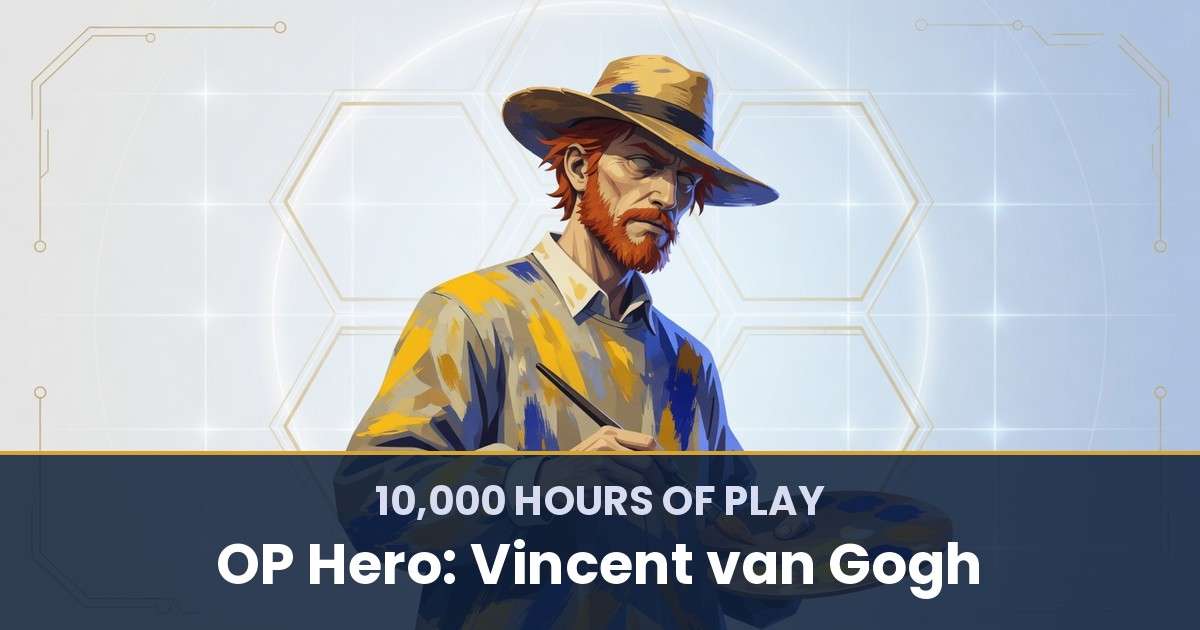


Vincent van Gogh started painting at twenty-seven. He died at thirty-seven. In the ten years between those two dates he produced roughly 2,100 artworks, about 860 of them oil paintings, and most of the canvases that hang in the world’s great museums were made in the final twenty-four months of his life.
He sold almost nothing while alive. He was financially dependent on his younger brother Theo for a decade. He cut off part of his own ear after a fight, voluntarily committed himself to an asylum, and died from a self-inflicted gunshot in a wheat field at thirty-seven.
And yet the build worked. A century later Portrait of Dr. Gachet sold for $82.5 million at auction. The letters he wrote to Theo are studied in graduate programs. Every middle-school art class in the world has heard of Starry Night. He produced more in ten years than most of his contemporaries did in fifty, and almost none of them can be named today.
This is the rare 10,000 Hours of Play run where the meta-game pays out entirely after the player has left the table. The lessons in it are the most useful ones in the framework.
Speed Run Notes
- Van Gogh’s Game was never “be a famous painter.” It was “turn inner conviction into images that serve ordinary people.” That is what stayed steady when every Role collapsed.
- His innate Attributes (religious-moral intensity, extreme empathy for the poor, obsessive monomania, high emotional sensitivity, visual-symbolic imagination) were all visible by his early twenties.
- He took four full Role swaps before painting (art-dealer apprentice, teacher, lay preacher, peasant draftsman) and three more after (Paris colourist, Arles sun-mage, asylum visionary). One Game, seven Roles.
- The Skills that decided his legacy were Vision Manifestation, Siphoning, Lich Grind, Phoenix Rebirth, Reflect Damage, and Spirit of Nature. Read in order they map exactly onto the chapter shifts.
- Without Theo (the 17,500 francs over ten years and 900 letters) and Jo van Gogh-Bonger (the widow who actually built the legend after the brothers were both dead), the world never sees the work. Allies do not just multiply heroes; sometimes they entirely replace the hero who is no longer alive.
- The Quest list is six lines. The lesson is the order they are in.
Table of Contents
- About Yu-kai Chou
- Step 1: The Game (What Van Gogh Was Actually Playing)
- Step 2: Attributes (The Innate Stats)
- Step 3: Role(s) (The Character Class Across Chapters)
- Step 4: Skills (The Real-Life Game Skills Van Gogh Mastered)
- Step 5: Allies (The People Who Multiplied Van Gogh)
- Step 6: Quests (The Milestones That Shaped the Saga)
- What You Can Steal From Van Gogh’s Build
- Where this framework comes from
- Related Reading
About Yu-kai Chou

Yu-kai Chou is the author of 10,000 Hours of Play — the book that treats your life as the most important game you’ll ever build a character in, and gives you the 6-Step framework (Game · Attributes · Role · Skills · Allies · Quests) to play it on purpose. He has spent two decades developing the system through which this post analyzes its OP Hero, and applies it to his own life and to the lives of the people he advises around the world.
Chou’s other framework, the Octalysis Framework, has been applied by LEGO, Microsoft, Porsche, Coca-Cola, Salesforce, and MrBeast, impacting over 1.5 Billion Users. He has taught the methodology at Harvard, Stanford, Yale, Tesla, Google, BCG, and IDEO, and has advised governments in eight nations including Ukraine, the United Kingdom, the Kingdom of Bahrain, Singapore, Taiwan, the Netherlands, Kazakhstan, and South Korea.
His work has been cited by Harvard, Stanford, MIT, Forbes, Wall Street Journal, Wired, US Department of Energy, NIST, NSF, NCBI, US Department of Education, ClinicalTrials.gov, and Google Scholar — with 3,700+ more academic publications. Explore his books here.

What I want to lift from Van Gogh’s build is the relationship between conviction and validation. He chose his Game at twenty-seven with zero market signal that it would ever pay. He held the Game across a decade of poverty, ridicule, and breakdown. The market discovered him only after he was dead. If you are building toward something the world has not yet decided to reward, his build is the one to study. The lesson is that the Game has to be worth playing whether anyone validates it or not. Pick it for what it does to your days, not for what it might do to your reputation.
Step 1: The Game — What Van Gogh Was Actually Playing
Most people read Van Gogh as a tragic artist. That is reading him at Step 4 and skipping the most important question.
Step 1 in the 10,000 Hours of Play framework is the meta-game your life is in service of, the one mission your smaller missions all answer to. Van Gogh’s was unusually clean for a man whose biography looks like chaos: turn his inner spiritual and emotional conviction into images that serve ordinary people. He spent his twenties trying to do that as a preacher. When the church rejected him, he did not change the Game. He changed the Role. He picked up a charcoal pencil and tried to do the same Game through pictures.
Read his letters to Theo and that frame stays consistent for the rest of his life. He paints peasants because he wants to honour peasant life. He paints the night sky over Saint-Rémy because he wants to make visible something he experienced as real but invisible. He paints sunflowers because he wants to fill a friend’s bedroom with warmth before the friend arrives. The output is staggering in technical range, but the meta-game underneath it is a single sentence held over thirty years.
This is the part most aspiring artists skip. They install a Role first (“be a working painter”) and then try to reverse-engineer a meaning that justifies it. Van Gogh did the opposite. He installed the meaning at twenty-one in a London boarding house reading the Bible and never released it. The Role he used to deliver on it changed five times. The Game stayed steady. That is why he kept producing through every collapse: when you have not confused your identity with your Role, losing the Role does not break you. You just pick up a different Role.
Step 2: Attributes — The Innate Stats
Attributes are the part of your character sheet you walked in with. Yu-kai’s Talent Triangle Method argues that your highest payoff comes from finding work that sits at the intersection of three innate stats, not from grinding the weakest one up to average. Van Gogh’s three core stats line up unusually neatly.
The first stat was religious-moral intensity. In his early twenties his letters to Theo were filled with Bible quotations and sermon notes. In the Borinage, where he served as a lay preacher among Belgian coal miners, he gave away his possessions, slept on the floor, and lived among the people he was preaching to so completely that the miners nicknamed him “The Christ of the Coal Mine.” This is not learnable. You either have a relationship with absolute commitments by twenty-one or you do not.
The second was extreme empathy for the poor and marginal. Before he ever picked up a brush he had volunteered as an unpaid assistant teacher in Ramsgate, worked in a Dordrecht bookshop while studying theology, and chosen the most desperate parish in Belgium for his preaching work. When he became a painter, the first major work he was proud of was The Potato Eaters (April 1885), a deliberate attempt to dignify peasants by painting them honestly. The empathy is the through-line; the medium changed.
The third was obsessive monomania. When he committed to theology, he studied in Amsterdam until he burned out. When he committed to painting, he produced roughly 2,100 works in ten years, with the bulk arriving in the final two. The monomania attribute does not pick its target. It just locks on. Lock it on something that compounds and you get Van Gogh. Lock it on something that does not and you get a person who burns out quietly.
The fourth was visual-symbolic imagination. Even before he called himself an artist, his letters contained small sketches of what he saw, which Theo recognised as significant and pushed him to develop. This is the stat he could not have manufactured. Mauve taught him oil technique; he could have learned that from many teachers. The imagination that turned a wheat field into a moral statement was already there.
The fifth — and the one that complicates the build — was high emotional sensitivity. The same nervous system that made him capable of Starry Night also made him capable of cutting off his ear. You cannot pick which way an Attribute leans before you press it. Van Gogh’s sensitivity was the soil that everything grew in, both the masterpieces and the breakdowns.
Step 3: Role(s) — The Character Class Across Chapters
The Role count is the part that shocks people who only know Van Gogh as “the painter.” He played seven different classes across thirty-seven years, and only the last three were artistic.
From sixteen to twenty-three he was the art-dealer apprentice: 1869 he joined the firm Goupil & Cie in The Hague, transferred to London, then Paris, until he was fired in 1876. This Role was where he absorbed his entire database of European and Japanese art before he had drawn a single sketch.
From twenty-three to twenty-five he was the teacher: unpaid assistant in Ramsgate, then salaried at Isleworth where he was also preaching, then a bookshop in Dordrecht while studying for theology exams in Amsterdam.
From twenty-five to twenty-six he was the lay preacher: the Borinage years, the “Christ of the Coal Mine,” the contract that was not renewed and the public failure that broke his religious career.
From twenty-seven to thirty-two he was the self-taught peasant draftsman: October 1880 in Brussels copying drawing manuals, late 1881 in The Hague learning oil from Anton Mauve, 1883 to 1885 in Nuenen producing The Potato Eaters.
From thirty-two to thirty-four he was the Paris colourist: March 1886 to February 1888, living with Theo, meeting Pissarro, Bernard, Toulouse-Lautrec, absorbing Impressionist and Neo-Impressionist colour theory, encountering Japanese woodblock prints, and shifting his palette from dark Dutch tones to bright unmixed colour.
From thirty-four to thirty-six he was the Arles sun-mage: February 1888 to May 1889, the highest-output period of his life, sunflowers and night cafés and the Yellow House, sometimes finishing a canvas in a single day.
And from thirty-six to thirty-seven he was the asylum visionary: Saint-Rémy from May 1889, then Auvers under Dr. Gachet from 20 May 1890. Starry Night was painted in this Role, in June 1889, looking out through a barred window.
The lesson is the Skills Spectrum playing out at the Role level across an entire life. Van Gogh was not a specialist locked into one identity. He picked up a new class when the chapter demanded it, but every class drew on the same five Attributes. Each Role was funded by stats he already had. That is the part most people get wrong when they “reinvent themselves.” They reach for a Role that requires Attributes they do not have, because the Role looks shiny. Van Gogh only ever picked Roles his existing stats could fund.
Step 4: Skills — The Real-Life Game Skills Van Gogh Mastered
The Skills below are canon entries from the 10K HP system. I am picking the six the historical record shows him using, not the full kit.
Vision Manifestation (Warlock) was the foundation. The 10K HP definition is mental rehearsal so vivid it shapes reality. Van Gogh’s version was unusual: he had no market validation at any point in his painting career, so the vision had to do all the work of holding him to the bench. His letters to Theo from 1882 onward describe in concrete sensory detail what he wanted to paint, why it would matter, who it would serve, and what feeling it should produce in the viewer. He had no proof any of it would land. He held the picture in his head anyway and worked toward it every day for ten years. That is what the Skill looks like on hard mode.
Siphoning (Warlock) was the Skill that built the Paris years. The 10K HP definition is rapid extraction of skills and knowledge from others. Between March 1886 and February 1888 Van Gogh extracted, in roughly twenty-three months, the complete colour theory and brushwork vocabulary of three different schools (Impressionism, Neo-Impressionism, and the Japanese woodblock tradition) from Pissarro, Bernard, Toulouse-Lautrec, his collection of ukiyo-e prints, and the open studios of Montmartre. He arrived in Paris painting in dark Dutch tones and left it painting in the chromatic vocabulary that would carry the Arles period. That is the Skill compressing five years of curriculum into two.
Lich Grind (Warlock) was the Skill that produced the volume. The 10K HP definition is intense, secluded work periods, and the Lich Pact post shows what extreme versions look like. Van Gogh’s Arles output is the textbook example: he sometimes completed an entire oil canvas in a single day, painting from sunrise into the heat of the afternoon, returning to the Yellow House to write a letter about what he had made, then starting another. The roughly 860 oil paintings of his lifetime, with the majority produced in the last twenty-four months, is what Lich Grind looks like sustained for two years.
Phoenix Rebirth (Paladin) was the Skill that converted the Borinage failure. The 10K HP definition is recovering from devastating failure and coming back stronger. By 1879 his preaching career was over, his church had refused to renew him, his family thought he was lost, and he was twenty-six with nothing to show. In October 1880 he picked up a charcoal pencil in Brussels and started again at zero with a different medium that served the same Game. Without that rebirth there is no Vincent van Gogh the artist. There is only Vincent the failed preacher who died in obscurity. The same Skill saved Viktor Frankl, on different inputs.
Reflect Damage (Paladin) was the Skill that built the asylum period. The 10K HP definition is using negative feedback and setbacks as opportunities for growth. After the December 1888 breakdown and the ear-cutting incident, most artists would have stopped. Van Gogh checked himself into the Saint-Rémy asylum in May 1889 and turned the locked ward into a studio. Starry Night was painted in June 1889, looking out through a barred bedroom window in a mental institution, and is probably the single most reproduced image in Western art. He converted his breakdown into the production conditions for his most famous work. The same Skill, in a healthier version, runs through Frida Kahlo‘s build.
Spirit of Nature (Druid) is the Skill that explains why the build held together across the breakdowns. The 10K HP definition is meaning-making under stress, turning suffering into a value-driven mission. Van Gogh’s letters from Saint-Rémy and Auvers do something unusual for a man in extreme distress: they treat the suffering as part of the Game. He framed his episodes as the price of producing the images, and the images as a service to the people who would one day look at them. Without that frame, the suffering would have stopped him. With it, the suffering became fuel.
Step 5: Allies — The People Who Multiplied Van Gogh
The Lone Genius story is almost always wrong, and in Van Gogh’s case it is wrong twice. He had two Allies whose contributions are so large that without them there is no Van Gogh legacy at all.
Theo van Gogh, his younger brother, was the financial and emotional spine. Scholars working from Theo’s account book estimate he sent Vincent roughly 17,500 francs over ten years, about 100 to 150 francs a month, which is around 14.5% of Theo’s own annual income at an art dealership. From June 1882 onward the money arrived three times a month. They exchanged just over 900 letters in their lives, the bulk written by Vincent. The Van Gogh Museum’s official position is that without Theo, Vincent is unlikely to have become an artist at all. The Allies discussion in 10K HP is built on cases like this: not advisors, not mentors, but a single person whose subsidy makes the run possible.
Anton Mauve, his cousin by marriage and a respected Hague School painter, taught Vincent oil painting in late 1881 and early 1882. Mauve lent him a studio, helped him acquire materials, and gave him his first structured instruction in watercolours and oils. Without Mauve the Brussels-to-Hague transition is much rougher, and the technical floor that The Potato Eaters is built on does not arrive on time.
Camille Pissarro, Émile Bernard, and Henri de Toulouse-Lautrec were the Paris circle that made Siphoning possible. Pissarro was the senior mentor, encouraging Vincent to study Seurat and Signac and pushing him toward a brighter palette. Bernard debated artistic theory with him in letters that survive and influenced his thinking on Cloisonnism and Symbolism. Toulouse-Lautrec moved in the same Montmartre circles and exhibited beside him in 1887. The colour vocabulary of Arles was assembled in those twenty-three Paris months from those three relationships.
Paul Gauguin is the most famous of the Allies and also a cautionary case. Gauguin lived with Vincent at the Yellow House in Arles from 23 October to 23 December 1888, the closest thing to the “Studio of the South” Vincent had been imagining for years. The two of them painted each other’s portraits, debated theory, and produced some of Vincent’s strongest work. The cohabitation also ended on 23 December 1888 with the famous row that triggered the ear-cutting incident. The lesson is the asymmetry of Ally relationships: the same person can be a multiplier on the upside and a breaking point on the downside. Pick your Allies for the Game, not the Role.
Dr. Paul Gachet was the Auvers physician under whose care Vincent lived from 20 May 1890 until his death two months later. Gachet sat for two versions of the Portrait of Dr. Gachet, one of which sold at Christie’s New York on 15 May 1990 for $82.5 million. That sale, a century later, was the moment the market finally caught up to the Game.
And then there is Jo van Gogh-Bonger, who is the most important Ally in the story and almost never appears in popular tellings. Jo was Theo’s wife. Theo died in January 1891, six months after Vincent. Jo inherited the entire body of work, plus the letters. She was twenty-eight, widowed, with an infant son named Vincent, and she had every reason to liquidate the inheritance and move on. Instead she spent the next three decades placing paintings strategically into museums, organising exhibitions across the Netherlands and Germany, and editing the letters for publication. The first substantial Dutch edition of Vincent’s letters appeared in 1914 because she made it happen. The Van Gogh Foundation in 1962 and the Van Gogh Museum opening in Amsterdam in 1973 trace their existence to her stewardship. The lesson is the one most ambitious people miss: sometimes the most important Ally is the one who arrives after you are dead.
Step 6: Quests — The Milestones That Shaped the Saga
Quests in 10K HP terms are the concrete, datable projects that move the meta-game forward. Van Gogh’s main line had six.
Quest 1: The Borinage failure (1878 to 1879). Lay preacher among the Belgian coal miners, contract not renewed, religious career ended at twenty-six. This is the failure the framework demands we name, because the next Quest only makes sense in light of it. Without the Borinage there is no October 1880, and without October 1880 there is no painter.
Quest 2: The Potato Eaters (April 1885). Five years of self-taught drawing, copying manuals zealously, learning oils from Mauve, and finally his first canvas he considered a masterpiece. The peasant Role peaks here. This is the Quest that proves to him the Game can be played through paint.
Quest 3: Paris with Theo (March 1886 to February 1888). Twenty-three months of Siphoning. He arrived in Paris a dark-toned Dutch realist and left it a colourist with a vocabulary the Arles period would explode.
Quest 4: The Yellow House and the Studio of the South (February 1888 to December 1888). Arles. Sunflowers. Night cafés. The plan to make Arles a community of avant-garde painters with Gauguin at the centre. The plan ended on 23 December 1888 with a row and a razor. The Quest still counts as a success because the painting it produced is what the world ended up reading the period through.
Quest 5: Saint-Rémy and Starry Night (May 1889 to May 1890). Voluntary commitment to an asylum, twelve months of supervised production, and a single canvas painted in June 1889 that became one of the most reproduced images in Western art. The Reflect Damage Quest. He turned the locked ward into a studio.
Quest 6: Auvers and the unfinished saga (20 May 1890 to 29 July 1890). Two months under Dr. Gachet’s care, an enormous burst of canvases, a self-inflicted gunshot in a wheat field on 27 July, death two days later on 29 July. The Quest that ended the run also began the posthumous Quest that Jo van Gogh-Bonger would carry alone for the next thirty years.
What You Can Steal From Van Gogh’s Build
Four lifts.
First, pick a Game that is worth playing without the market’s permission. Van Gogh sold almost nothing in his lifetime. The Van Gogh Museum is careful to note that the popular “only one painting sold” claim is not strictly accurate — he made other small sales and trades — but the picture is roughly right: the financial validation of his work arrived after he was dead. He kept going because the Game itself was valuable to him on a daily basis. If your Game collapses the day the market stops applauding, you picked a Role and called it a Game.
Second, build the rebirth Skill before you need it. Most ambitious people will have at least one Borinage in their life: a public failure of the Role they had bet their identity on. Phoenix Rebirth (Paladin) is what lets you swap the Role and keep the Game. Van Gogh did it once at twenty-six. Almost everyone else who matters in this Profiles series did it at least once too. Socrates did it at the trial. Maya Angelou did it after the silent years. The Skill is the most important one in the kit.
Third, treat your Allies as a deliberate build, not a side cast. Theo subsidised Vincent for ten years. Jo carried the work for thirty more after Theo was gone. Mauve gave him oils. Gauguin gave him two months of intense exchange and one breakdown. The Allies were not accidents. They were chosen, cultivated, and (in Gauguin’s case) survived. If your Ally list is shorter than your Skill list, you are running the framework underweighted on what matters most.
Fourth, do not confuse the Role with the Game. He played seven Roles in thirty-seven years. The Game stayed steady from twenty-one to thirty-seven. If your identity dissolves every time your job title changes, you do not have a Game yet. You have a job title cosplaying as one.
You can study Van Gogh as a painter all day and still miss the build. The reason his name outlasted every dealer who refused to show his work, every editor who panned him, and every contemporary critic who dismissed him is not in the canvases. It is in the sentence he wrote at twenty-one and refused to release. If you want to look at other heroes who picked a Game early and held it through Role swaps that should have broken them, the rest of the OP Hero Profiles hub is the next stop.
Where this framework comes from

Want the full system this profile is built on?
Every OP Hero piece runs through the same 6-Step framework from 10,000 Hours of Play: Unlock Your Real-Life Legendary Success. The book covers the full system, walks through Yu-kai’s own life run as the first applied case study, and gives you the worksheets to audit your own build.
Related Reading
- All OP Hero Profiles — the hub for every 10K HP hero breakdown.
- The 10K HP Framework: 6 Steps to Gamify Your Life — the system this profile is built on.
- Frida Kahlo: OP Hero 10K HP — another painter who turned physical and emotional pain into the material of the work.
- Viktor Frankl: OP Hero 10K HP — the master class on meaning-making under conditions that should break a person.
- Stephen King: OP Hero 10K HP — another monomanic obsessive whose volume defines the legacy.
- The Talent Triangle Method — how to identify the innate Attributes that should anchor your build.