
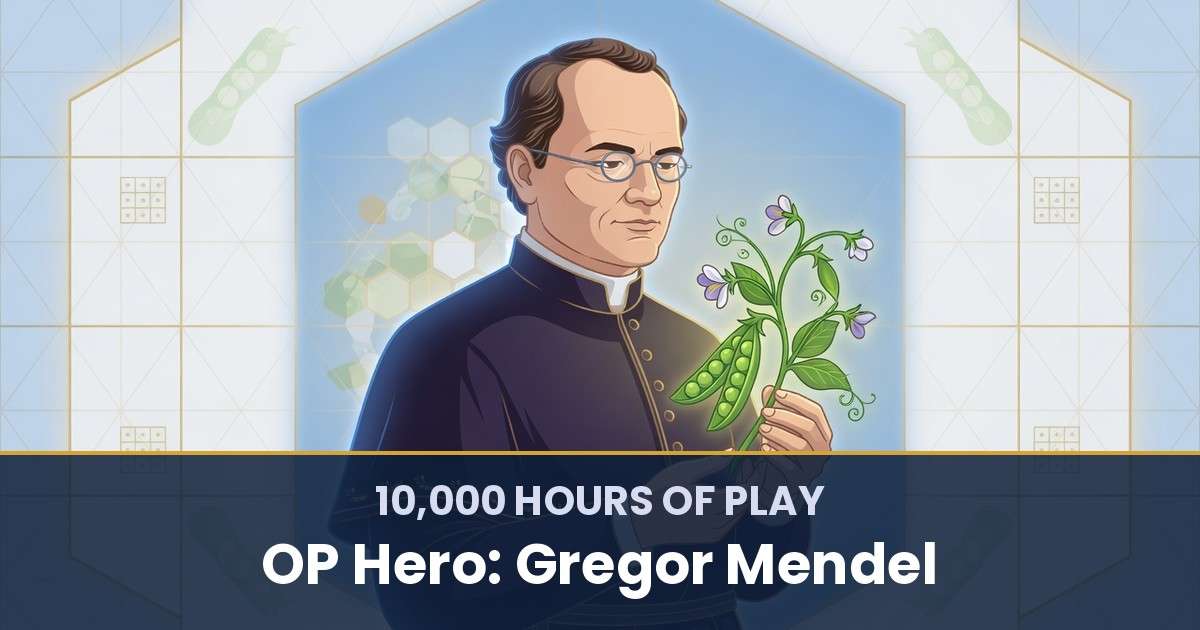


In 1866 a monk in what is now the Czech city of Brno published the rules of heredity, and almost nobody noticed for thirty-four years. The paper sat in the proceedings of a small regional science society, quietly correct, while the rest of biology argued in circles about how traits pass from parent to child.
His name was Gregor Mendel. He had grown nearly 28,000 pea plants by hand to get there. He died in 1884 still effectively unknown for the work, and was only vindicated in 1900, sixteen years after his death, when three separate scientists rediscovered what he had already proven.
That is one of the strangest win conditions in the history of science: be right, be ignored, and let time settle the score. Run Mendel’s life through the 6 Steps of 10,000 Hours of Play and the shape of it stops looking like luck and starts looking like a deliberate build.
⚡ Speed Run Notes
- Mendel’s “game” was singular: pull simple, countable laws out of messy living nature, and prove heredity obeys math the way physics does.
- His edge was not credentials. He twice failed the state teacher exam. His edge was counting tens of thousands of plants when rivals trusted impressions.
- The breakthrough came from ruthless setup: he spent two years pre-testing 34 pea varieties for true breeding before the real experiment even began.
- His big setback was self-inflicted by bad advice: a famous botanist steered him to hawkweed, a plant whose odd reproduction broke his ratios and discouraged him.
- Becoming abbot in 1868 bought him power and cost him his research time. The recognition arrived in 1900, long after he could enjoy it.
Table of Contents
About Yu-kai Chou

Yu-kai Chou is the author of 10,000 Hours of Play — the book that treats your life as the most important game you’ll ever build a character in, and gives you the 6-Step framework (Game · Attributes · Role · Skills · Allies · Quests) to play it on purpose. He has spent two decades developing the system through which this post analyzes its OP Hero, and applies it to his own life and to the lives of the people he advises around the world.
Chou’s other framework, the Octalysis Framework, has been applied by LEGO, Microsoft, Porsche, Coca-Cola, Salesforce, and MrBeast, impacting over 1.5 Billion Users. He has taught the methodology at Harvard, Stanford, Yale, Tesla, Google, BCG, and IDEO, and has advised governments in eight nations including Ukraine, the United Kingdom, the Kingdom of Bahrain, Singapore, Taiwan, the Netherlands, Kazakhstan, and South Korea.
His work has been cited by Harvard, Stanford, MIT, Forbes, Wall Street Journal, Wired, US Department of Energy, NIST, NSF, NCBI, US Department of Education, ClinicalTrials.gov, and Google Scholar — with 3,700+ more academic publications. Explore his books here.

What I take from Mendel’s build is that patience and rigor can beat status every time, if you are willing to wait longer than is comfortable. He had no chair at a great university and no powerful network, so he did the one thing those things cannot buy: he counted. The lesson I would lift is that a single well-chosen skill, practiced past the point most people quit, can outlast every credential in the room.
Step 1: The Game — What Mendel Was Actually Playing
Most naturalists of the mid-1800s were playing a game called “describe and classify.” Collect specimens, name them, sort them into a grand catalog of life. It was respectable, endless, and mostly about observation.
Mendel opted out of that game and started a harder one. His objective was to pull simple, countable laws out of the chaos of living things, to show that heredity could be predicted with the same clean math that governs falling objects. He wanted rules, not descriptions.
That single goal explains everything that followed. When you decide your real subject is the hidden rule rather than the visible plant, you start designing experiments instead of just admiring nature. This is exactly the kind of long, self-chosen game that the 6-Step framework exists to surface: the question a person keeps answering for decades, regardless of whether anyone is paying attention.
It helps to see how quiet his game was compared with the loud one running next door. His contemporary Charles Darwin was reshaping all of biology with a sweeping public theory of how species change. Mendel was in a monastery garden counting wrinkled and round peas. The two halves of modern genetics were being written at the same time, and only one of the authors knew he was famous.
Step 2: Attributes — The Innate Stats
Several of Mendel’s core stats showed up long before he had a laboratory to point them at.
The first was numerical pattern recognition. Even as a boy on a poor farm he was drawn to measure, count, and compare, and he later spotted clean ratios where trained scientists saw only hybrid mess. The ability to feel a simple number hiding inside noisy data is not something a curriculum installs in you.
The second was an unusual tolerance for delayed payoff. He spent eight years on a single pea experiment with no guarantee anyone would ever care, then kept defending the results for years against near-total silence. Most people need feedback to keep going. Mendel apparently did not.
The third was conceptual independence. He rejected the dominant “blending” view of heredity, where parental traits supposedly mix like paint, and insisted instead on discrete, particle-like factors that stay intact across generations. That looked naive to his contemporaries. He was right and they were wrong.
Stack those traits and you get his natural Talent Triangle: a mind that counts, a temperament that waits, and the nerve to hold an unpopular idea. None of the three guaranteed a discovery. Together they made one possible.
Step 3: Role(s) — The Character Class Across Chapters
Mendel did not begin as “Mendel the father of genetics.” He moved through several distinct classes, and each one handed the next the tool it needed.
He started as a peasant-farmer’s son, breeding and grafting fruit trees on the family land as a teenager. That early hands-on tinkering taught him that you can deliberately steer what a plant becomes, the seed of every later experiment.
Money forced his next move. Unable to afford university on his own, he entered St. Thomas’s Abbey in Brno in 1843, where the monastery became his unlikely scholarship: room, board, books, and a culture that valued science. He became the novice monk who was really a student in disguise.
From 1851 to 1853 he leveled up again into a formal science student at the University of Vienna, training in physics and mathematics under serious teachers. This was the chapter that fused his farm-boy instincts with quantitative method. Back in Brno he then became the monastery teacher and experimental biologist, the role in which the actual breakthrough happened.
His final class change, in 1868, was the costly one. Elected abbot of the monastery, he gained real institutional power and lost the thing that mattered most to his work: time. Administration, finances, and a dispute with the government over taxes swallowed the years he might have spent on the next experiment.
Step 4: Skills — The Real-Life Game Skills Mendel Mastered
Strip away the legend of the lonely genius and Mendel’s success traces back to a handful of repeatable skills, each of which maps onto a canon Real-Life Game Skill.
The foundation was Lich Grind (Warlock), the skill of long, secluded, obsessive work periods. From 1856 to 1863 he cultivated and scored roughly 28,000 pea plants inside the monastery garden, season after season, tracking each trait across generations. No audience, no funding pressure, just years of quiet repetition that almost no one else would have tolerated.
What made the grind pay off was Devour (Warlock), the discipline of stripping a problem down until only the essential parts remain. Before the real experiment began, Mendel spent two years testing 34 pea varieties to find ones that bred true, then narrowed his study to seven clean either-or traits like tall versus short and yellow versus green seed. By refusing complexity at the setup stage, he made sure the signal could not get buried.
Then came Arcane Metrics (Mage), harnessing data to measure what others only guessed at. Where earlier hybridizers worked from impressions, Mendel pushed his numbers into the thousands until stable ratios snapped into focus: roughly three-to-one in one generation, and the famous nine-to-three-to-three-to-one when he tracked two traits at once. The math was the discovery.
Underneath all of it ran True Sight (Ranger), the knack of seeing keen detail others miss. Plenty of people had crossed pea plants before. Mendel was the one who looked at the resulting jumble and saw a law. That choice to go deep on one tightly controlled system rather than wide across many plants is the specialist’s bet mapped out in the Skills Spectrum, and it is the whole reason his peas gave a clean answer when grander surveys gave none.
Step 5: Allies — The People Who Multiplied Mendel
For a man working in near-total obscurity, Mendel was carried at key moments by a small handful of people.
The most important was Abbot Cyrill Napp, the head of the monastery. Napp was the patron who made the whole build possible: he welcomed Mendel into a scientifically curious community, paid to send him to Vienna for formal training, and let him turn part of the monastery grounds into an experimental garden. Without Napp’s backing there is no pea experiment at all.
His Vienna professors were the next multipliers. Studying physics under Christian Doppler, of the Doppler-effect, and mathematics and natural science under Andreas von Ettingshausen and the botanist Franz Unger, Mendel absorbed the quantitative, experimental habits of mind that he would later aim at heredity. They handed him the method; he supplied the target.
Closer to home, the Brno physicist and teacher Friedrich Franz and the local Natural History Society gave him a venue and a peer group, the small stage on which he first presented his results in 1865.
And then there was the ally who accidentally became the obstacle. The eminent botanist Carl Nägeli corresponded with Mendel from 1866 to 1873 and was the one major scientist who engaged with his work, which mattered enormously. But Nägeli also steered him toward a plant that would break him, which is where the saga turns.
Step 6: Quests — The Milestones That Shaped the Saga
Mendel’s life reads like a quest log where the hardest fight comes from following good advice into bad terrain.
The early quests built steadily. He pre-tested his 34 pea lines from 1854 to 1856, ran the main hybridization experiments from 1856 to 1863, and then presented his findings in two lectures to the Natural History Society of Brno on 8 February and 8 March 1865. In 1866 he published them as “Versuche über Pflanzen-Hybriden,” or “Experiments on Plant Hybridization,” the paper that quietly contained the laws of inheritance.
Then the response: almost nothing. The paper landed with a thud. The science world was not ready to read heredity as math, and the work drifted into the citation wilderness for decades.
The real setback was the hawkweed detour. Encouraged by Nägeli to confirm his theory on the genus Hieracium, Mendel spent precious years on a plant that, unknown to anyone then, often reproduces without normal fertilization. His clean pea ratios refused to appear. The repeated failures made his own theory look weaker than it was and helped drain his confidence, right before the abbot election in 1868 pulled him away from research for good. He died in 1884 with the work still unrecognized.
The final quest he never saw. In 1900, sixteen years after his death, three scientists, Hugo de Vries, Carl Correns, and Erich von Tschermak, independently arrived at his conclusions and found his buried paper waiting for them. William Bateson then championed the work across the English-speaking world, and Mendel went from forgotten monk to founder of a field. This delayed, posthumous vindication is one of the recurring patterns across the OP Hero profiles: being early is often indistinguishable from being ignored, until suddenly it isn’t.
What You Can Steal From Mendel’s Build
You are not going to rediscover the laws of inheritance. That is not the point. The point is that Mendel’s build is made of moves you can actually copy.
Count what others only eyeball. Mendel’s entire advantage was that he gathered real data at a scale his rivals dismissed as tedious. In almost any field, the person willing to measure carefully while everyone else trusts their gut is holding a quiet superpower.
Simplify the setup before you chase the result. The two years he spent finding true-breeding plants and narrowing to seven traits look like delay, but that discipline is exactly what let the answer emerge clean. Most failures are not effort problems; they are messy-setup problems.
And make peace with a long clock. Mendel’s recognition arrived in 1900, far too late for him to enjoy, yet the work was right the whole time. The same pattern of being ahead of the room runs through fellow OP Heroes like Srinivasa Ramanujan and Galileo Galilei, both of whom were doubted in their day and proven right by history. If your work is sound, the scoreboard can be slow without being wrong.
Where This Framework Comes From

Want the full system this profile is built on?
Every OP Hero piece runs through the same 6-Step framework from 10,000 Hours of Play: Unlock Your Real-Life Legendary Success. The book covers the full system, walks through Yu-kai’s own life run as the first applied case study, and gives you the worksheets to audit your own build.
Related Reading
- All OP Hero Profiles: the full roster of legendary real-life builds, analyzed through the 6 Steps.
- The 10,000 Hours of Play Framework: the 6-Step system behind every OP Hero profile.
- Charles Darwin, OP Hero: the contemporary who wrote the other half of modern genetics out loud.
- Srinivasa Ramanujan, OP Hero: another self-taught mind whose work outran the recognition of his time.
- Galileo Galilei, OP Hero: doubted in his day, vindicated by history.
- The Skills Spectrum: when to go deep like a specialist versus wide like a dabbler.