
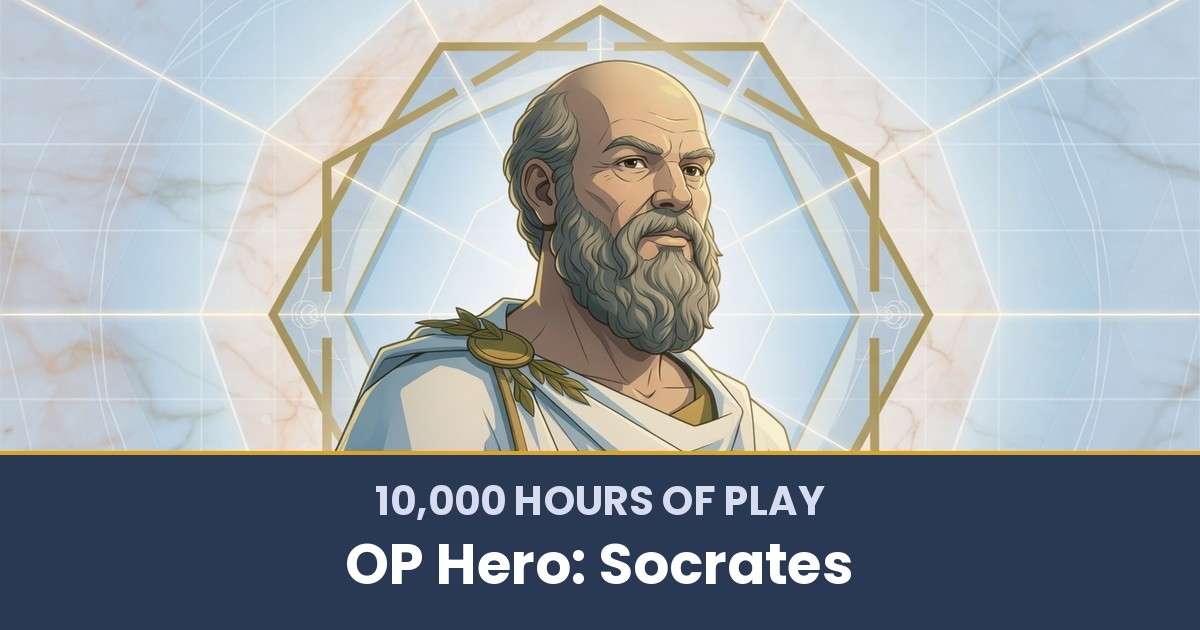


A 70-year-old man in Athens drinks a cup of poisoned hemlock in 399 BCE rather than stop asking awkward questions in public. He has written exactly nothing during his life. He has founded no school. He charges no fees. And 2,400 years later we are still building philosophy on top of the moves he made in the agora.
Most modern profiles of Socrates lead with “the unexamined life is not worth living” and call it a day. That sentence is the souvenir, not the engine. The engine was a stonemason’s son who decided early that other people’s confident opinions deserved to be tested in public, and who refused to flinch when the testing cost him his standing, his political safety, and finally his life.
Run him through the 10,000 Hours of Play framework and the build clicks into focus. The Attributes show up in battle reports from his 30s. The Roles change every twenty years. The Skills are a small handful of moves repeated thousands of times. And the Game never moves an inch from the day Chaerephon comes back from Delphi.
⚡ Speed Run Notes
- Socrates’ life Game wasn’t “doing philosophy.” It was a divine assignment to test reputed wisdom in public until people cared more about their souls than their careers. Plato’s Apology states it plainly.
- His Attributes were visible before philosophy existed as a profession: hoplite-grade courage at Potidaea and Delium, freakish self-mastery, an indifference to wealth that put off even his admirers.
- The elenchus, his question-and-answer method, was a tool, not a hobby. He used it the way a surgeon uses a scalpel: cut through one belief at a time, leave the patient in productive aporia, walk away without prescribing.
- His most underrated move was political, not philosophical. He stood alone twice: at the Arginusae trial in 406 BCE and against the Thirty Tyrants in 404. He lost both times. The losses became the basis for his moral authority.
- He failed publicly: 399 BCE, condemned 280–220, executed. He treated the loss as the final exam of the same Game he had been playing his whole life, and his refusal to escape turned the death into the curriculum.
- The takeaway for your build is uncomfortable: a mission that can’t get you killed probably can’t get you remembered either.
Table of Contents
- Step 1: The Game — What Socrates Was Actually Playing
- Step 2: Attributes — The Innate Stats
- Step 3: Role(s) — The Character Class Across Chapters
- Step 4: Skills — The Real-Life Game Skills Socrates Mastered
- Step 5: Allies — The People Who Multiplied Socrates
- Step 6: Quests — The Milestones That Shaped the Saga
- What You Can Steal From Socrates’ Build
- Where this framework comes from
- Related Reading
About Yu-kai Chou

Yu-kai Chou is the author of 10,000 Hours of Play — the book that treats your life as the most important game you’ll ever build a character in, and gives you the 6-Step framework (Game · Attributes · Role · Skills · Allies · Quests) to play it on purpose. He has spent two decades developing the system through which this post analyzes its OP Hero, and applies it to his own life and to the lives of the people he advises around the world.
Chou’s other framework, the Octalysis Framework, has been applied by LEGO, Microsoft, Porsche, Coca-Cola, Salesforce, and MrBeast, impacting over 1.5 Billion Users. He has taught the methodology at Harvard, Stanford, Yale, Tesla, Google, BCG, and IDEO, and has advised governments in eight nations including Ukraine, the United Kingdom, the Kingdom of Bahrain, Singapore, Taiwan, the Netherlands, Kazakhstan, and South Korea.
His work has been cited by Harvard, Stanford, MIT, Forbes, Wall Street Journal, Wired, US Department of Energy, NIST, NSF, NCBI, US Department of Education, ClinicalTrials.gov, and Google Scholar — with 3,700+ more academic publications. Explore his books here.
What I keep coming back to with Socrates is the idea of mission-as-public-stake. He didn’t journal his way into legend; he stood in the agora and let his beliefs get tested in real time, by anyone with a counter-argument. The lesson I’d lift for your own build: pick a Game whose moves only count when other people can see them. Private convictions don’t compound. Public ones, defended openly over decades, do.
Step 1: The Game — What Socrates Was Actually Playing
Strip away the dialogues and the marble busts and Socrates’ Game has a single objective line: test reputed wisdom in public until people care more about the state of their soul than about their reputation, wealth, or career. The clearest source is his own self-description in Plato’s Apology, the speech he gives at his trial in 399 BCE. He tells the jury, in plain language, that he will keep philosophizing “as long as I breathe” because the god has assigned him this work.
The trigger event for the Game is well-attested. His friend Chaerephon goes to the oracle at Delphi sometime before 431 BCE and asks the Pythia whether anyone is wiser than Socrates. The oracle says no one is. Socrates, who at this point already has a reputation for awkward questions, treats the answer as a riddle rather than a compliment. He goes hunting for people wiser than himself in order to disprove the god, and finds instead a city full of confident experts who can’t defend their own definitions.
That hunt becomes his life Game. Not “build a school.” Not “publish a treatise.” Hunt the false wisdom of his city, in public, every day, until the city either fixes itself or kicks him out. He is the only one of the major Greek philosophers who writes nothing. The medium IS the public conversation, and writing would freeze it.
Notice how narrow this Game is. It rejects the sophist’s option of charging fees. It rejects the natural-philosopher’s option of speculating about cosmology. It rejects the political option of running for office. He had decades to drift into easier games, and he never did. The Game stayed precisely the size it was when Chaerephon came back from Delphi.
Step 2: Attributes — The Innate Stats
The Attributes Socrates runs on aren’t the ones his marble busts suggest. The Roman-era bust most people picture (bald, beard, snub nose, slightly mocking) is real. The Attributes underneath it are far stranger, and they show up in primary sources written by men who knew him personally. His Talent Triangle stacked four stats unusually high, and none of them looked like “intellect” in the modern sense.
Hoplite-grade courage, both moral and physical. Alcibiades’ drunken speech in Plato’s Symposium (219e–221b) is the gold-standard witness here, because Alcibiades has no incentive to flatter him. He testifies that Socrates fought as a hoplite at Potidaea (432–429 BCE), Delium (424 BCE), and Amphipolis (422 BCE), and that at Potidaea Socrates personally saved his life and refused the citation that would have made the rescue famous. The same courage shows up four decades later when Socrates refuses to flee Athens before the trial.
Extraordinary stamina and self-mastery. Same passage, same witness: Alcibiades reports Socrates standing motionless for an entire day and night during the Potidaea campaign, lost in thought, ignoring cold, hunger, and the soldiers gathering to gawk. He drank more than anyone at symposia and was never seen drunk. The body did what the mind told it.
Indifference to wealth and status. Xenophon’s Memorabilia (1.2.1–1.2.8) and Plato’s Apology (23b–c, 31b–32a) agree on this from independent angles: Socrates lived in real poverty by choice. He never charged for his teaching, which set him visibly apart from the well-paid sophists. He wore the same cheap cloak winter and summer. The poverty wasn’t asceticism for show. It was a structural cost of the Game, since taking money would have changed the conversations.
Relentless, almost compulsive inquiry. Aristophanes parodies him in Clouds (423 BCE) as a man who can’t stop investigating anything, including absurdities. The caricature is unflattering, but it confirms that the obsession was visible to ordinary Athenians a quarter-century before his trial. The questioning wasn’t a technique he picked up. It was a temperament.
Step 3: Role(s) — The Character Class Across Chapters
Socrates cycled through four Roles across his roughly 70 years, and the Class shifted with each. He started as a Druid, became a Warrior, settled into Rogue, and ended as a Paladin. He is the only OP Hero in this catalog whose final role was the one that actually killed him.
From his teens through his late 20s he played the young stonemason and citizen apprentice. His father Sophroniscus was a sculptor or stonemason, and Diogenes Laertius reports that Socrates worked the trade for a time. The role is the unglamorous Druid setup: learn the city, learn the workshops, learn the rhythms of ordinary Athenian life that he would later draw on when questioning craftsmen about whether they knew what they thought they knew.
From roughly 432 BCE through 422 BCE he played the citizen-soldier hoplite. Three campaigns, all front-line. This is the Warrior chapter where the moral courage of his later years gets battle-tested before anyone is recording his words. Plato’s Laches uses his Delium service explicitly as an exemplar of bravery, told by an actual general.
From the 420s through 404 BCE he played the gadfly of Athens. This is the long Rogue chapter. He calls himself a gadfly stinging a sluggish horse (Athens) in Apology 30e, and the metaphor is precise. He doesn’t take a teaching post. He doesn’t write. He moves through the agora, the gymnasia, the workshops, picking up conversations and ending them in productive aporia. Most OP Heroes accumulate institutions; he refused them on principle.
From 404 BCE through his death in 399 BCE he became the defendant and martyr-philosopher. The Paladin chapter. After the Thirty Tyrants fall and the democracy returns, the political climate sharpens. Aristophanes’ old caricature is dusted off, his association with disgraced students (Alcibiades, Critias) is held against him, and Meletus, Anytus, and Lycon bring the indictment. He could have escaped. He didn’t. The Role becomes the message.
Step 4: Skills — The Real-Life Game Skills Socrates Mastered
If you read his life through the canon skill set, five moves keep appearing. They map cleanly to the same Real-Life Game Skills the Skills Spectrum uses to grade every OP Hero on this site.
Elemental Transposition (Mage). The elenchus is the textbook example. Socrates would take a familiar concept (courage, piety, justice) and treat it as a puzzle whose pieces the interlocutor hadn’t actually examined. The Euthyphro opens with a man on his way to prosecute his own father for impiety, and Socrates reframes the whole interaction as: “before you do this, can you tell me what piety actually is?” Every interrogation followed that same move: turn a confident statement into a solvable problem and make the other person solve it.
Self Mastery (Rogue). Alcibiades’ speech in the Symposium is a 1,500-word case study of this Skill. Standing all day and night thinking in the snow. Outdrinking the room without showing it. Walking through Potidaea barefoot in winter while the other soldiers froze. Self Mastery in the canon list is high self-awareness applied to state control, and Socrates ran it at superhuman levels. It’s the same self-discipline trait that Marcus Aurelius built five centuries later by reading him.
Floral Blossom (Druid). His self-described role as a midwife of ideas, laid out in Plato’s Theaetetus (149a–151d), is Floral Blossom executed without a school, a textbook, or a fee structure. He didn’t pour knowledge into students; he helped them deliver the ideas that were already in them, then tested whether each idea was real or a stillborn imitation. Plato learned the move so well that he wrote thirty-five dialogues across the next fifty years using it.
Divine Shield (Paladin). The Skill is “say no, regardless of how persuasive others are.” Socrates ran it twice in real politics, on the record, at increasing personal cost. In 406 BCE, as the lot-chosen epistates of the prytaneis, he refused to put the illegal mass trial of the Arginusae generals to a vote even though the Assembly was screaming for it. In 404 BCE, under the Thirty Tyrants, he refused the order to arrest Leon of Salamis and simply went home, knowing the consequence if the regime held. Both times the no was lonely; both times the no defined him.
Phoenix Rebirth (Paladin). The 399 BCE trial is the Skill in its most extreme form. Condemned by a jury of 501 Athenians by a vote of roughly 280–220, he could have suggested a soft counter-penalty (a fine, exile) that the jury would likely have accepted instead of death. He suggested free meals in the Prytaneum as if he were an Olympic victor. The vote for execution then came in larger than the conviction vote. When Crito later visits the prison and lays out a fully funded escape plan, Socrates refuses again. The death becomes the proof that the Game was real. Martin Luther King Jr. ran a structurally identical Paladin move more than two thousand years later, with the same understanding that some Games only finish in martyrdom.
Step 5: Allies — The People Who Multiplied Socrates
For a man who wrote nothing, Socrates’ Alliance is the entire reason we are still reading him. Take away the four or five people who chose to remember him, and the historical Socrates evaporates into a footnote in Athenian court records.
Plato was the most consequential student in human history measured by output-per-teacher. He turned roughly thirty years of conversations into thirty-five dialogues that became the source code for the entire Western philosophical tradition. Whitehead’s line that all of European philosophy is footnotes to Plato is really a line about Socrates working through Plato as his medium. Without Plato, no Apology, no Phaedo, no Republic, no Socrates.
Xenophon was the cross-check. A pragmatic general and historian rather than a metaphysician, he wrote the Memorabilia and his own Apology to defend Socrates against the charges from a very different angle than Plato’s. The fact that two such different students remembered overlapping material is one of the strongest pieces of evidence we have that Socrates actually existed as a coherent person rather than as Plato’s mouthpiece.
Chaerephon was the early multiplier. He took the trip to Delphi, asked the question, and brought back the oracle that gave Socrates his Game. Without that one act of friendship, Socrates likely lives and dies as a thoughtful Athenian craftsman.
Crito was the loyal logistical Ally. Plato’s Crito records him offering to bankroll Socrates’ escape from prison, complete with the bribes, the boat, and the destination. Socrates refused, but the offer itself shows the depth of the Alliance: a man wealthy enough to do this for a friend who never charged a fee.
Alcibiades was the Ally who damaged him most. A brilliant, charismatic, treasonous student whose later defection to Sparta turned Socrates’ association with him into political ammunition at the 399 trial. The same Alliance pattern that multiplied him also helped kill him. The 10K HP lesson is that Allies are not all upside.
Step 6: Quests — The Milestones That Shaped the Saga
Six Quests bracket the run. Three are battles, two are political stands, and one is the trial. The arc is unusually clean for a life this long.
Before 431 BCE: Chaerephon’s oracle at Delphi. The trigger event. The Pythia tells Chaerephon that no one is wiser than Socrates. He returns to Athens and Socrates spends the next three decades trying to disprove the oracle by finding someone wiser. The investigation becomes the life Game (Apology 20e–23b).
432–422 BCE: three campaigns as a hoplite (Potidaea, Delium, Amphipolis). The Attributes get tested in combat. He saves Alcibiades’ life at Potidaea, holds the line at Delium during one of Athens’ worst defeats, and serves at Amphipolis. The physical courage that the later trial would showcase was field-verified two decades earlier.
406 BCE: the Arginusae stand. As epistates of the prytaneis, Socrates alone refuses to put the illegal mass trial of the victorious generals to a vote. The Assembly overrules him after his term ends and executes the generals anyway. He fails to save them. He succeeds in establishing, on the public record, that he will not obey the multitude when the law says otherwise. He cites the stand later in the Apology as proof that his philosophical principles weren’t theoretical.
404 BCE: the Leon of Salamis refusal. The Thirty Tyrants order Socrates and four others to arrest Leon of Salamis as part of a campaign to extract wealth and implicate citizens in the regime’s crimes. The other four obey. Socrates simply walks home. He survives only because the Thirty fall before they can punish him. The episode becomes the second public-record example of Divine Shield.
399 BCE: the trial and the Apology. Meletus, Anytus, and Lycon bring charges of impiety and corrupting the youth. Socrates delivers what we now read as Plato’s Apology, not an apology in the modern sense but a defense that doubles down on the life Game. He refuses to plead, refuses to weep, refuses to bring his family before the jury. Convicted roughly 280–220. The counter-penalty proposal (free meals in the Prytaneum) ensures the execution vote.
399 BCE: the cell, Crito, and the hemlock. Crito visits with a fully funded escape plan. Socrates refuses on the grounds that fleeing would invalidate everything the trial had been about, and works through the argument out loud (Crito). A month later, after the sacred ship returns from Delos, he drinks the hemlock surrounded by friends, walks until his legs go numb, and dies (Phaedo). The OP Hero hub has profiles of other builders who chose finality over comfort. What unites them is that none of them flinched at the cost.
What You Can Steal From Socrates’ Build
The temptation with a Socrates profile is to walk away preaching “examine your life.” That’s the souvenir again. The Game is harder to copy than the slogan.
The first lesson is that a Game worth playing has to be visible. Socrates’ insight wasn’t private reflection. He took every important conversation into the public square, where a stranger could puncture it. Most of us run our examined-life work in a journal nobody else sees. That isn’t the Game. The Game is the conversation that costs you something to have.
The second lesson is that your Skills need to be repeatable enough to outlive you. Socrates wrote nothing because the elenchus was a method, not a content. The method survived because it was simple enough that Plato could rebuild it from memory thirty years later and execute it in dialogue after dialogue. If your craft requires you to be present to transmit it, the Game ends with you. Build the move, not the artifact.
The third lesson is the uncomfortable one. A mission that can’t get you killed probably can’t get you remembered either. That doesn’t mean you should pick fights with executioners. It means a Game small enough to fit inside your comfort zone has a ceiling that most builders hit by their mid-thirties. Socrates picked a Game whose endgame was death and played it for fifty years anyway. The fact that 2,400 years later we are still reading him is downstream of that one choice.
Most of us write missions that approve everything. He wrote one that disqualified silence, retreat, fee-taking, and finally his own life. If that level of constraint feels excessive, the more useful question is: what is the smallest version of it that I could actually run starting Monday?
Where this framework comes from

Want the full system this profile is built on?
Every OP Hero piece runs through the same 6-Step framework from 10,000 Hours of Play: Unlock Your Real-Life Legendary Success. The book covers the full system, walks through Yu-kai’s own life run as the first applied case study, and gives you the worksheets to audit your own build.
Related Reading
- All OP Hero Profiles: the full catalog of life-as-RPG breakdowns, organized by Class and Skill.
- 10,000 Hours of Play by OP Hero: Marcus Aurelius: the philosopher-emperor who ran a private version of the Socratic examined life from inside an empire.
- 10,000 Hours of Play by OP Hero: Confucius: Socrates’ contemporary half a world away, with a parallel student-as-multiplier model.
- 10,000 Hours of Play by OP Hero: Viktor Frankl: the modern Paladin who tested the examined life against the worst possible conditions.
- 10,000 Hours of Play by OP Hero: Martin Luther King Jr.: the same Divine Shield + Phoenix Rebirth pairing in twentieth-century America.
- The 10,000 Hours of Play framework: the hub for the full system.