
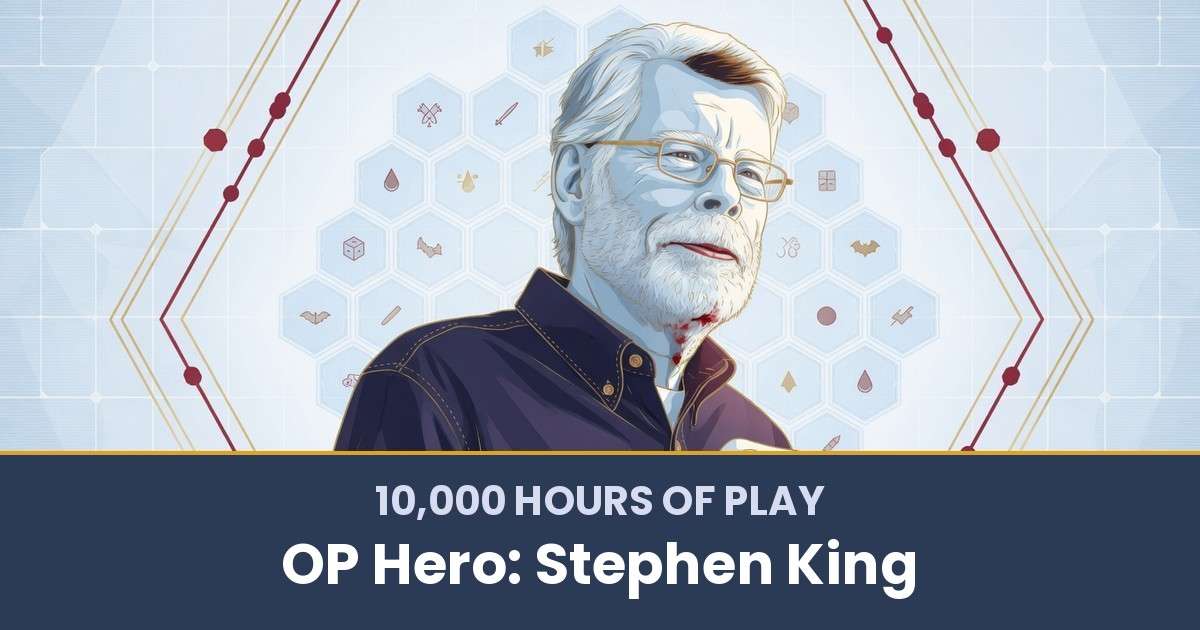


Stephen King kept his rejection slips on a nail. By the time he was a teenager, the nail had so many slips spiked through it that the weight pulled the nail straight out of the wall. He replaced it with a spike.
That spike is the most useful piece of writing advice he ever gave the world, and he gave it without saying a word. The man who would go on to publish more than sixty novels and sell over 400 million copies didn’t start as a phenom. He started as a kid who refused to stop submitting stories to magazines that kept saying no.
So what was actually going on inside that build? Strip away the brand and the bestsellers, and what does Stephen King’s life look like when you score it as a character sheet — Game, Attributes, Role, Skills, Allies, Quests?
Here’s the breakdown.
⚡ Speed Run Notes
- Stephen King’s Game wasn’t horror — it was proving that genre fiction could be both commercially dominant and emotionally serious. The horror was the vehicle, not the destination.
- His most under-copied move is the daily 2,000-word quota, run every day including Christmas, birthdays, and the 4th of July. The output is the moat.
- The first draft of Carrie ended up in a wastebasket. Tabitha King pulled it back out and told him to keep going. One ally’s belief restarted a career.
- The 1999 van accident shattered his right side and almost killed him. He was back at the page within weeks, dictating from a chair. That’s Phoenix Rebirth in real time.
- You don’t need to write horror to steal his build. You need a Game worth chasing, a Lich Grind that compounds daily, and one Ally willing to fish your draft out of the trash.
Table of Contents
- About Yu-kai Chou
- Step 1: The Game — What Stephen King Was Actually Playing
- Step 2: Attributes — The Innate Stats
- Step 3: Role(s) — The Character Class Across Chapters
- Step 4: Skills — The Real-Life Game Skills Stephen King Mastered
- Step 5: Allies — The People Who Multiplied Stephen King
- Step 6: Quests — The Milestones That Shaped the Saga
- What You Can Steal From Stephen King’s Build
- Where this framework comes from
- Related Reading
About Yu-kai Chou

Yu-kai Chou is the author of 10,000 Hours of Play — the book that treats your life as the most important game you’ll ever build a character in, and gives you the 6-Step framework (Game · Attributes · Role · Skills · Allies · Quests) to play it on purpose. He has spent two decades developing the system through which this post analyzes its OP Hero, and applies it to his own life and to the lives of the people he advises around the world.
Chou’s other framework, the Octalysis Framework, has been applied by LEGO, Microsoft, Porsche, Coca-Cola, Salesforce, and MrBeast, impacting over 1.5 Billion Users. He has taught the methodology at Harvard, Stanford, Yale, Tesla, Google, BCG, and IDEO, and has advised governments in eight nations including Ukraine, the United Kingdom, the Kingdom of Bahrain, Singapore, Taiwan, the Netherlands, Kazakhstan, and South Korea.
His work has been cited by Harvard, Stanford, MIT, Forbes, Wall Street Journal, Wired, US Department of Energy, NIST, NSF, NCBI, US Department of Education, ClinicalTrials.gov, and Google Scholar — with 3,700+ more academic publications. Explore his books here.
What I personally find instructive about Stephen King’s build is how unglamorous the load-bearing skill is. The thing he’s most famous for — terrifying you — is a downstream effect. The actual move is showing up at the desk every day for fifty years and treating writing as honest work. If you take only one lesson from his character sheet, take the daily grind. The reputation is what compounds on top of it.
Step 1: The Game — What Stephen King Was Actually Playing
If you ask the average reader what Stephen King’s Game is, they’ll say “writing horror.” That’s the surface read. It’s also wrong.
The Game King has been playing since he was a teenager is something more interesting: prove that genre fiction — the stuff the literary establishment dismissed as pulp — can be both massively popular and emotionally serious. He picked horror as his vehicle, but the actual quest was to drag a so-called low form into the room with the so-called high one and make people stop pretending there was a difference.
Look at the through-line. Carrie (1974) is a horror novel that’s really about bullying, religious abuse, and what poverty does to a teenage girl. The Shining (1977) is a haunted-hotel story that’s really about alcoholism and what it does to a family. Misery (1987) is a captivity thriller that’s really about the strange contract between artist and superfan. The supernatural sits on top of the human; the human is what does the work.
This is what the 10,000 Hours of Play framework means by your Game. Not your job title. Not your genre. The deep, repeated question that your output keeps answering across decades. King answered it in Danse Macabre (1981) more directly than most novelists ever do — he wrote a whole book of nonfiction defending horror as serious literature. The 2003 National Book Foundation Medal for Distinguished Contribution to American Letters was, in a real sense, the literary establishment finally conceding the point.
That’s a forty-year quest. Most people don’t have one.
Step 2: Attributes — The Innate Stats
Attributes are the traits that showed up early — the stuff you can see in someone’s life before they had any training. King’s character sheet rolled unusually high on four.
Compulsive narrative generator. As a child, King made his own comic books based on movies he’d seen, then sold them to classmates for a few cents each until a teacher made him stop. He once described stories as “found things” — he wasn’t inventing them so much as digging them up. That’s not a skill you learn. That’s an attribute.
Risk and rejection tolerance. The nail-on-the-wall story. He was a teenager submitting to Alfred Hitchcock’s Mystery Magazine and Ellery Queen’s Mystery Magazine, getting rejected over and over, and the response was to keep mailing stories. Most teenagers don’t have the tolerance for that level of negative feedback. King apparently never noticed it was supposed to bother him.
Vivid involuntary visualization. When he saw Earth vs. the Flying Saucers as a kid, the images didn’t fade — they replayed. EC horror comics colonized his head. He didn’t avoid the feeling of being scared; he treated it as raw material. That’s not a craft choice — that’s a sensory wiring he was born with.
Empathy for the working-class everyman. His father walked out when he was about two. He grew up poor, often in single-parent setups, in small-town Maine. His protagonists are almost never elites. Bookstore clerks. Schoolteachers. Recovering alcoholics. Kids in rural towns. That perspective wasn’t a marketing decision — it was the only world he actually knew from the inside.
If you want to see how to think about your own Attribute stack honestly, the OP Talent Triangle Method is the cleanest tool for it. Most people undercount their Attributes because they assume that whatever comes easy to them must come easy to everyone. King’s compulsive storytelling, in his own family, just looked like Steve being Steve. It was, in fact, his rarest stat.
Step 3: Role(s) — The Character Class Across Chapters
Classes are the working identity you put on at each life stage. King’s class shifted four times.
Apprentice pulp writer (late 1950s through early 1970s). Teenager-grinding-the-market mode. Short stories to fanzines and men’s magazines. His first professional sale was “The Glass Floor” to Startling Mystery Stories in 1967 for $35. Low-level Bard farming side quests in the markets nobody else wanted.
Working-class teacher and night-writer (1971–1973). English teacher at Hampden Academy in Maine by day. Laundry worker between teaching gigs. Writing fiction at night in a trailer, with two small children and a wife working to keep the family afloat. This is the chapter where most aspiring writers tap out. King didn’t. He treated the day job as a debuff to push through, not a reason to stop.
Breakout horror bestseller (mid-1970s through the 1980s). The class flip happened almost overnight. In 1973, NAL bought the paperback rights to Carrie for $400,000 — King’s cut was $200,000, which was generational money for a school-teacher family. The 1974 hardcover from Doubleday followed. Then a run of cultural sledgehammers: ‘Salem’s Lot, The Shining, The Stand, Firestarter, Cujo, Christine. By the mid-1980s, “Stephen King” was a verb publishers used.
World-builder and elder statesman of horror (late 1980s onward). The Dark Tower epic. Cross-linked universes where characters from one book wandered into another. Nonfiction (On Writing, 2000) where he showed the work behind the work. Adaptations everywhere. By the 2010s he was doing the things a class evolves into when it can’t grow up any further — mentoring, defending the field (his 2022 antitrust testimony against the Penguin Random House / Simon & Schuster merger was a writer using his weight on behalf of writers who don’t have his weight), and showing up for a younger generation of horror authors who all grew up reading him.
Step 4: Skills — The Real-Life Game Skills Stephen King Mastered
King’s character sheet leans on six canon Skills more than anything else.
Loremaster (Druid) — his master Skill. Loremaster is the ability to weave compelling, inspiring stories around real-world material. King’s gift isn’t inventing scary monsters; it’s that the monsters live inside character work so detailed you’d recognize his small-town Maine residents in a grocery store. The Stand is 1,100 pages and you remember the people, not the plague. That’s Loremaster maxed out. (The Skills Spectrum has a useful framing for the difference between a Loremaster who specializes and one who dabbles — King is the textbook specialist, and the Skills Spectrum guide walks through why.)
Vision Manifestation (Warlock) — mental rehearsal so vivid it shapes reality. King has said for years that he doesn’t outline. He sees the situation — a writer chained to a bed in Misery’s house, a clown rising out of a storm drain in It, a man in a cell-phone-zombified Boston in Cell — and then he lives inside the scene until he can transcribe what happens. Most writers plot. King hallucinates on schedule.
Lich Grind (Warlock) — intense, secluded daily work. The famous 2,000-words-a-day rule, every single day, including birthdays and Christmas. He treats writing as labor, not inspiration. The output isn’t an accident of talent; it’s the cumulative result of forty years of unbroken daily grinding. This is the same Warlock-class compounding muscle behind the Lich Pact (sleep-as-leverage) — different surface, same underlying class signature: trade something most people guard, get back outsized output.
Astral Projection (Mage) — seeing all possible outcomes. King describes his story-generation as collisions of “What if?” — what if a teenage girl had telekinesis and a religious-fanatic mother? What if a sober writer relapsed in a snowed-in hotel? The Mage move is to take a premise and then walk every branch, picking the one where the human emotion lands hardest. Most plot ideas die because the writer can only see one path through them; King sees twelve and picks the one with the most pressure.
Phoenix Rebirth (Paladin) — coming back from devastating failure stronger than before. King has run this Skill twice in serious mode. First in 1987–1988, when his family staged an intervention over his cocaine and alcohol addiction. He has been sober since. Second in 1999, when Bryan Smith’s minivan hit him while he was walking in Maine on June 19. Five surgeries. Right leg almost lost. He was back at writing within weeks, dictating early sections of On Writing from a chair because sitting at a desk was too painful. That book — the one half-written before the crash and finished afterward — is now the bestselling craft manual for writers in the English language.
Aegis (Paladin) — ignoring public criticism while pushing the Quest. For decades the literary establishment dismissed King as a hack who got lucky with horror. He kept publishing horror. He kept defending the genre in Danse Macabre and in interviews. He stopped engaging with the critics on their terms and just kept producing. The 2003 National Book Foundation Medal and the 2014 National Medal of Arts from President Obama are what Aegis looks like after thirty years of compounding — you outlast the gatekeepers until they have to name a category for you.
Step 5: Allies — The People Who Multiplied Stephen King
Nobody plays this Game solo. King’s Allies stack is small and load-bearing.
Tabitha King. The most important Ally in the entire build, full stop. King has told the story in On Writing and in countless interviews: he threw the first draft of Carrie in the trash because he didn’t believe in it. Tabitha fished it out, read it, told him it was good, and pushed him to finish. That single act of belief restarted a career that had been gathering rejection slips for fifteen years. She also held the family together — emotionally and financially — through the addiction years and the recovery. Whatever the Stephen King brand is, half of it is Tabitha. The pattern (one believing reader unblocking a stuck creator) shows up in other OP-Hero builds too — see how a partner’s confidence shaped J.K. Rowling’s early Harry Potter chapters.
Bill Thompson. The Doubleday editor who actually bought Carrie after it had been bouncing around. Thompson was the first major editor to take King seriously and gave him the foothold into hardcover publishing. Without that single editorial yes, the paperback windfall never happens.
Chuck Verrill. King’s editor at Viking through the breakout years, and his longtime literary agent (Darhansoff & Verrill) thereafter. Editors at this level don’t just fix sentences — they protect the writer’s working conditions, manage the publisher relationships, and act as the second pair of eyes that keep an author honest with himself. Verrill was that for King for decades.
Owen King and Joe Hill. His sons. Both became serious novelists in their own right (Joe Hill’s Heart-Shaped Box, Locke & Key; Owen King’s co-authored Sleeping Beauties, written with his father). They’re not just family — they’re members of his working creative network. A house where everyone takes writing seriously is its own form of leverage.
His brother David. Part of the formative family environment where the original storytelling habit took root. King has credited David repeatedly in On Writing as part of the earliest creative chapter, when the two of them were running a hectograph-printed neighborhood newsletter called Dave’s Rag.
Step 6: Quests — The Milestones That Shaped the Saga
Here are the run’s pivotal Quests, including the ones that almost ended it.
1967 — “The Glass Floor” sells to Startling Mystery Stories. First professional sale. $35. Small money, huge level-up. The moment a hobby crossed into a profession on paper.
1973 — Tabitha pulls Carrie out of the trash. The hinge. Without this single domestic moment, no Stephen King brand exists. The lesson here isn’t about Tabitha; it’s about being the kind of partner who reads someone’s discarded work seriously enough to tell them they’re wrong about it.
1974 — Carrie hardcover from Doubleday; paperback rights sell for $400,000. The breakout. King quit teaching and went full-time on fiction. The Working-Class Teacher class was retired forever.
1985 — the Richard Bachman pseudonym is unmasked. King had been publishing as Bachman to test whether his success was about craft or about brand. The experiment ended when a Washington bookstore clerk named Steve Brown noticed the prose style. The five Bachman books had sold modestly — proof, in a way, that brand was doing real work. Useful self-audit data most authors never collect.
1987–1988 — addiction intervention; sobriety. The setback most fans don’t think about. King has said he barely remembers writing Cujo. His family — Tabitha leading — confronted him with the evidence and gave him an ultimatum. He chose the work and the marriage over the substances. He has been sober since 1988. This is Phoenix Rebirth at the family-systems level.
June 19, 1999 — hit by a minivan in Maine. Walking on Route 5, struck by Bryan Smith’s distracted driving. Five surgeries. Almost lost his right leg. Came within an inch of dying. Returned to writing within weeks — propped up, in pain, on a lap desk — to finish On Writing. The book has since become the modern craft bible for a generation of novelists. The recovery proves that the daily Lich Grind wasn’t a young man’s discipline; it was a temperament.
2003 — National Book Foundation Medal for Distinguished Contribution to American Letters. 2014 — National Medal of Arts from President Obama. The literary establishment that spent the 1970s and 1980s dismissing King as a popular hack handed him both of its highest honors. Aegis paid out. (For more profiles of OP Heroes who outlasted their gatekeepers, the OP Hero hub has the full catalog.)
What You Can Steal From Stephen King’s Build
Most readers will walk away from a Stephen King profile thinking the lesson is “be talented.” That’s the wrong takeaway. The lesson is much more boring, and much more useful: pick a Game worth chasing for forty years, then show up at the desk every day with no exceptions.
Three concrete moves you can lift off his character sheet today.
First, install a daily Lich Grind. Pick a unit of work — 500 words, one client call, one hour of practice — and run it every single day, including the days you don’t feel like it. King’s 2,000 words a day is the version that suits a novelist; yours will look different. The discipline isn’t the number, it’s the no-exception clause.
Second, recruit one Tabitha. Find the one person in your life who will read your draft seriously enough to disagree with you when you’ve given up on it. Most people don’t have this Ally because they never explicitly asked for it. Ask.
Third, when the van hits, get back to the desk. Phoenix Rebirth isn’t a heroic moment — it’s a habit you only get to use when something has gone genuinely wrong. King’s response to nearly dying was to dictate a book about how to write. Whatever your version of that is, the lesson is the same: don’t let the setback become the new Game.
The build is repeatable. That’s the entire point of a framework.
Where this framework comes from

Want the full system this profile is built on?
Every OP Hero piece runs through the same 6-Step framework from 10,000 Hours of Play: Unlock Your Real-Life Legendary Success. The book covers the full system, walks through Yu-kai’s own life run as the first applied case study, and gives you the worksheets to audit your own build.
Related Reading
- All OP Hero Profiles — the full catalog of life-as-RPG breakdowns through the 10K HP framework.
- OP Hero: J.K. Rowling — another writer who fished her own draft out of long odds.
- OP Hero: Stan Lee — Loremaster maxed out in a different medium.
- OP Hero: Maya Angelou — writing as identity recovery after trauma.
- OP Hero: Viktor Frankl — a different kind of horror, the same Phoenix Rebirth.
- Why Play Beats Practice — the philosophy underneath the 6-Step framework.