
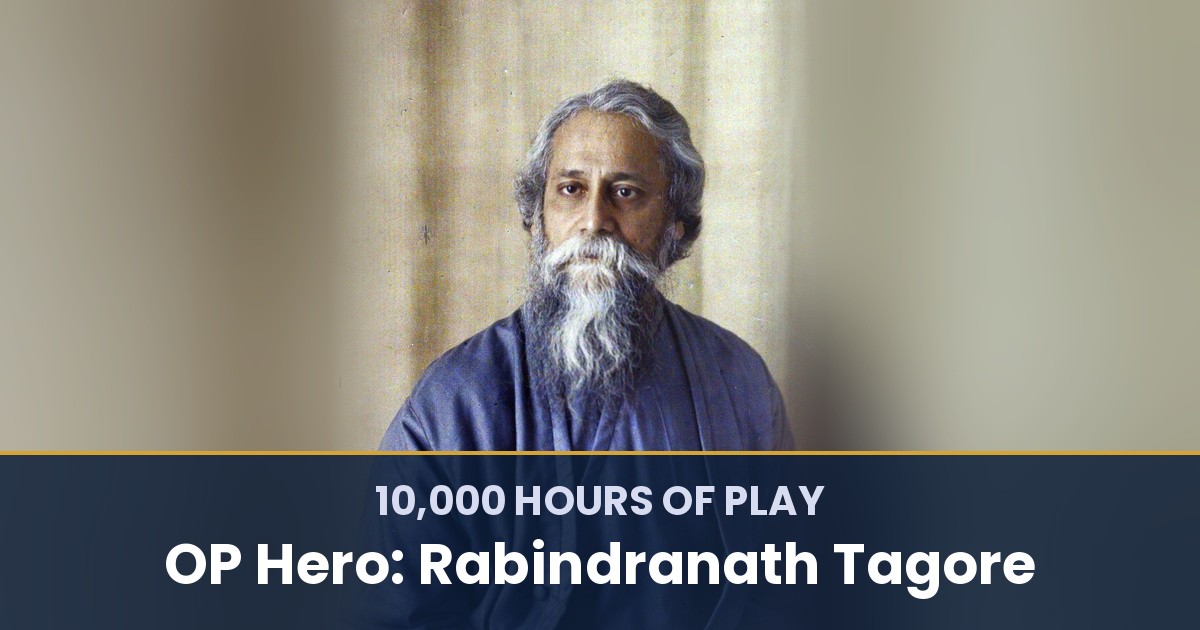


On 31 May 1919, Rabindranath Tagore wrote a letter to the Viceroy of India and handed back the knighthood that King George V had conferred on him four years earlier.
The letter came seven weeks after troops fired on a crowd at Jallianwala Bagh in Amritsar on 13 April 1919. “The time has come when badges of honour make our shame glaring in the incongruous context of humiliation,” he wrote, and The Statesman published the letter on 3 June 1919.
By then Tagore was already the first non-European winner of the Nobel Prize in Literature, awarded in 1913. He was also running a small school in the countryside at Santiniketan, and he had deposited the prize money in an agricultural bank for the tenant farmers on his family’s estate.
That school, and the question of what education and a country are actually for, occupied him for the next forty years.
The six Steps below follow his run from the youngest child of a Calcutta mansion to the writer whose songs became the national anthems of two nations.
⚡ Speed Run Notes
- Tagore’s Game was building forms of human freedom: a school without walls, a world university, a village reconstruction program, and a body of songs people still sing.
- His signature move was converting private creativity into public institutions, from the 1901 Santiniketan school to Visva-Bharati in 1921 and Sriniketan in 1922.
- His canon Skills: Loremaster (Druid), Batcave Crafting (Ranger), Concord of Elements (Druid), Heroic Strike (Warrior) and Courageous Heart (Paladin).
- His Allies ran from his father, whose Santiniketan ashram became the school’s home, to W. B. Yeats, who carried the English Gitanjali into London literary circles in 1912.
- His setbacks were heavy ones: his wife died in 1902, a daughter in 1903 and a son in 1907, and his schools ran short of money for decades while he lectured to keep them alive.
Table of Contents
About Yu-kai Chou

Yu-kai Chou is the author of 10,000 Hours of Play — the book that treats your life as the most important game you’ll ever build a character in, and gives you the 6-Step framework (Game · Attributes · Role · Skills · Allies · Quests) to play it on purpose. He has spent two decades developing the system through which this post analyzes its OP Hero, and applies it to his own life and to the lives of the people he advises around the world.
Chou’s other framework, the Octalysis Framework, has been applied by LEGO, Microsoft, Porsche, Coca-Cola, Salesforce, and MrBeast, impacting over 1.5 Billion Users. He has taught the methodology at Harvard, Stanford, Yale, Tesla, Google, BCG, and IDEO, and has advised governments in eight nations including Ukraine, the United Kingdom, the Kingdom of Bahrain, Singapore, Taiwan, the Netherlands, Kazakhstan, and South Korea.
His work has been cited by Harvard, Stanford, MIT, Forbes, Wall Street Journal, Wired, US Department of Energy, NIST, NSF, NCBI, US Department of Education, ClinicalTrials.gov, and Google Scholar — with 3,700+ more academic publications. Explore his books here.

Rabindranath Tagore belongs in this series because he played as a poet, a school founder and a political dissenter in the same run. If I could lift one move from his character sheet, it would be the 1919 letter: he handed back a royal honour in public, seven weeks after Amritsar, and let that single act carry his whole argument.
Step 1: The Game — What Rabindranath Tagore Was Actually Playing
Tagore’s Game was freedom, and he chased it by building institutions that could hold it.
He had hated the classroom as a boy, and in 1901 he founded a school at Santiniketan built on the opposite pattern: classes in the open air, close contact with nature, and a far less authoritarian relationship between teacher and student.
Twenty years later he raised the stakes. Visva-Bharati, formally founded in December 1921, was designed as a meeting place for Indian and world cultures, and its Sanskrit motto is rendered in English as “Where the world makes a home in a single nest.”
The following year he added Sriniketan, an Institute of Rural Reconstruction that applied education, cooperative organization and agricultural improvement to the villages near the campus.
The same Game shaped what he refused to play. In lectures delivered in Japan and the United States in 1916 and 1917, he attacked aggressive state-centered nationalism, arguing that it turned the nation into an impersonal machine.
Indian nationalists criticized those lectures sharply, and he kept giving them anyway before renouncing his knighthood in 1919 when British troops massacred civilians at Amritsar.
Step 2: Attributes — The Innate Stats
Attributes are the stats a player shows before any training, and Tagore’s were visible in childhood.
He was born on 7 May 1861 at the Jorasanko mansion in Calcutta, the youngest of thirteen surviving children in a family that ran its own ongoing festival of music, theatre and literature.
The first attribute was imaginative output, and it showed up long before anyone paid him for it. He wrote verse as a child and published poems in a medieval Bengali style under the pseudonym Bhanusimha while still young, inventing a fictional poet to hide inside.
The second was independence from conventional pathways. He disliked formal schooling, left the standard educational track, and never completed the legal career his family had in mind for him.
The third was pattern recognition across domains. Throughout his life he kept connecting systems other people treated as separate: poems became songs, songs became plays, schooling merged with nature, and agriculture merged with education.
The fourth was empathic attention to ordinary lives. Managing the family estates in East Bengal in the 1890s put him in sustained contact with cultivators and village communities, and that experience fed his short fiction and, decades later, his rural reconstruction program.
The OP Talent Triangle Method asks you to find the edge strength that sets your build apart.
For Tagore that edge was integrative imagination, the habit of turning poems into songs and schooling into village economics described above.
Step 3: Role(s) — The Character Class Across Chapters
Tagore changed Roles roughly once a decade, and each new class kept the experience points of the one before it, which is the pattern behind what actually transfers in any career change.
His first Role was the child poet and literary experimenter, formed inside the Jorasanko household’s crowded workshop of writers and musicians.
His second Role was the estate manager. In the 1890s he administered the family’s holdings in East Bengal, learning about tenancy, debt and village institutions from the inside.
His third Role was the school founder. From 1901 he ran the Santiniketan school as a living experiment, developing its practices through use instead of waiting for a finished theory.
His fourth Role was the international cultural ambassador. After the English Gitanjali appeared in November 1912 and the Nobel Prize followed in 1913, he traveled and lectured across continents.
His fifth Role was the institution builder, recruiting teachers, artists, scholars and technical specialists for Visva-Bharati and Sriniketan in 1921 and 1922.
His final Role was the painter, a class he unlocked in his late sixties and played until the end.
Step 4: Skills — The Real-Life Game Skills Rabindranath Tagore Mastered
Skills are what a player trains on top of the starting stats. Each Real-Life Game Skill carries its Class in brackets, and five of them explain most of Tagore’s run.
The first is Loremaster (Druid): weaving compelling, inspiring stories. Tagore composed roughly 2,000 songs, now known as Rabindra Sangeet, alongside poems, plays, novels and short stories, and two of those songs became the national anthems of India and Bangladesh.
The second is Batcave Crafting (Ranger): redesigning the environment itself. The Santiniketan school was an engineered learning space, with open-air classes under trees replacing the walls and benches he had hated as a student.
The third is Concord of Elements (Druid): bringing parties with different interests together. Visva-Bharati’s whole design was that meeting, an institution where Indian, Asian and Western scholars worked in one place, which is what its motto about the world making a home in a single nest promises.
The fourth is Heroic Strike (Warrior): a bold statement that forces a choice. The 31 May 1919 letter returning his knighthood was exactly that, a public move that tied his name and his honour directly to Amritsar.
The fifth is Courageous Heart (Paladin): charging into territory where you hold no credential. He founded a school with no teaching degree, built a university with no academic post, and took up painting in his late sixties, with a first major exhibition at the Galerie Pigalle in Paris in May 1930.
On the Skills Spectrum, Tagore reads as a Master of verse and song, with roughly 2,000 songs behind that rating, who kept adding adjacent crafts to the same tree for seven decades.
Step 5: Allies — The People Who Multiplied Rabindranath Tagore
Tagore’s Allies supplied land, London contacts and agricultural expertise.
The first was his father, Debendranath Tagore. He established the Santiniketan retreat that later became the physical and spiritual foundation of his son’s school, and his Brahmo religious universalism shaped the son’s lifelong suspicion of sectarian walls.
The second was the Jorasanko family circle itself. The household functioned as a working laboratory of music, theatre and reform, and Tagore’s artistic formation happened inside it rather than inside any school.
The third was W. B. Yeats. Yeats championed the English Gitanjali in London, wrote the introduction dated September 1912 for the India Society edition, and materially increased the book’s visibility in the year before the Nobel committee made its decision.
The fourth was C. F. Andrews, the English clergyman who became a close collaborator in education and international advocacy at Santiniketan, connecting the institution with networks far beyond Bengal.
The fifth was Leonard K. Elmhirst, the English agricultural economist who became the principal organizer of Sriniketan in 1922 and turned Tagore’s rural ideals into organized experiments in village reconstruction.
Step 6: Quests — The Milestones That Shaped the Saga
Tagore’s Quests stretch across six decades, and several of them are built around losses.
Quest 1 was running the family estates in East Bengal. The 1890s there were his field apprenticeship, a learning quest carried out by doing the work, and the decade turned a Calcutta poet into someone who understood village debt and tenancy firsthand.
Quest 2 was the school, founded at Santiniketan in 1901, and it overlapped with the hardest stretch of his life. His wife Mrinalini died on 23 November 1902, his daughter Renuka in 1903, his father in 1905 and his youngest son Samindranath in 1907.
Quest 3 was the book that made him known worldwide, Gitanjali. The Bengali collection of 157 poems appeared in 1910, he translated a selection into English during his 1912 voyage to England, and the Nobel Prize was announced on 13 November 1913. He deposited the prize money in the Patisar agricultural bank he had set up for farmers on the family estate.
Quest 4 was the refusal of a royal honour. The 1915 knighthood became unbearable after Amritsar, and the 1919 letter to Lord Chelmsford returned the royal honour in protest at the killings.
Quest 5 was the double founding: Visva-Bharati founded in December 1921 and Sriniketan in 1922. The finances stayed precarious for the rest of his life, and he kept lecturing, publishing and appealing for funds to hold the institutions together.
Quest 6 was a late-life turn toward painting. He began painting seriously in the late 1920s, produced roughly 2,500 works, and exhibited in Paris in May 1930. His health declined from 1937, and he died at Jorasanko on 7 August 1941, in the house where he was born.
What You Can Steal From Rabindranath Tagore’s Build
First, convert your creative wins into infrastructure. Tagore put his Nobel money into a farmers’ bank and decades of royalties and lecture fees into schools that kept running after the applause stopped.
Second, treat your apprenticeships seriously even when they look like detours. The estate years of the 1890s looked like a career pause and became the foundation for Sriniketan thirty years later.
Third, recruit Allies for the domains you will never master. Tagore let Yeats handle London, Andrews handle networks and Elmhirst handle agriculture.
Fourth, keep opening skill trees late in the run. Tagore started painting in his late sixties and had a solo exhibition in Paris by 1930, which tells you the character sheet does not lock at any age.
Where this framework comes from

Want the full system this profile is built on?
Every OP Hero piece runs through the same 6-Step framework from 10,000 Hours of Play: Unlock Your Real-Life Legendary Success. The book covers the full system, walks through Yu-kai’s own life run as the first applied case study, and gives you the worksheets to audit your own build.
Related Reading
- All OP Hero Profiles — the full hub
- 10,000 Hours of Play by OP Hero: Leo Tolstoy
- 10,000 Hours of Play by OP Hero: Confucius
- 10,000 Hours of Play by OP Hero: Hayao Miyazaki
- 10,000 Hours of Play by OP Hero: Michel de Montaigne