
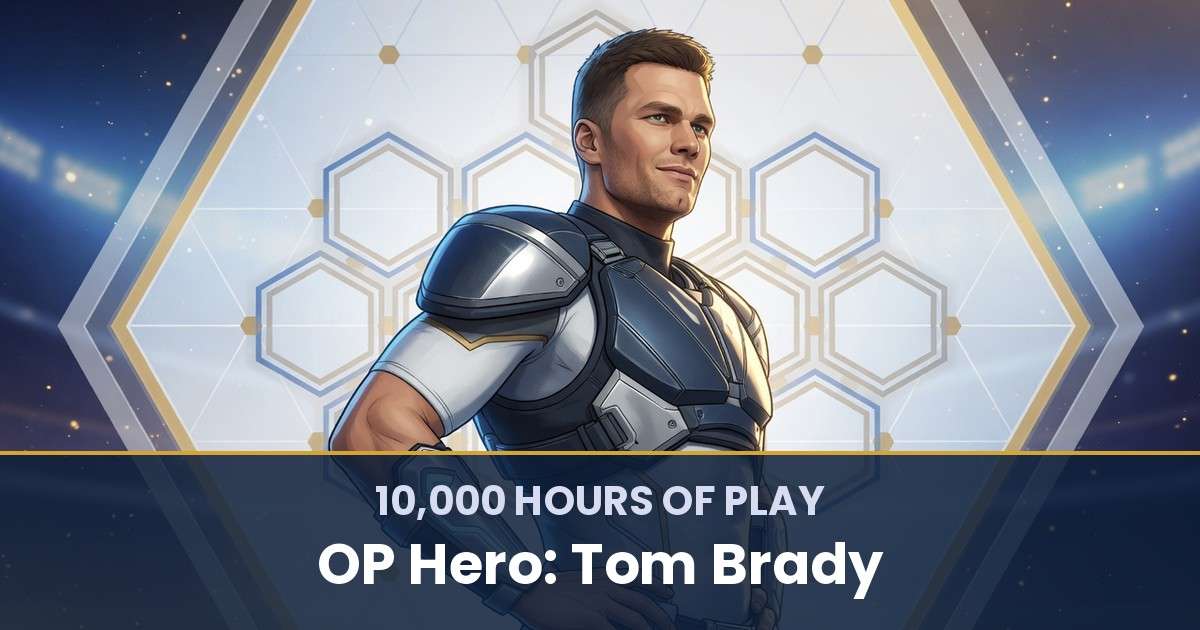


On 28 April 2000, six quarterbacks heard their names called in the NFL Draft before Tom Brady did. He went 199th overall, in the sixth round, to the New England Patriots, with scouting reports that called him slow and physically limited.
Twenty-three seasons later he retired as the all-time leader in wins, passing yards, and passing touchdowns, with seven Super Bowl rings. No quarterback in history has been to ten Super Bowls. He is the only one who has.
The gap between that draft slot and that record is the whole story. Brady was almost never the most gifted athlete on the field. He won because he treated his own career as a system to be studied, drilled, and optimized while everyone faster and stronger coasted on talent.
That is exactly the move at the center of 10,000 Hours of Play. Here is his character sheet.
⚡ Speed Run Notes
- Brady’s win condition never moved: be the most durable, winning quarterback in NFL history, and hold that edge as long as a human body allows.
- The 199th pick was not a tragedy he overcame. It was the fuel he ran on for two decades, and he never let go of it.
- His real edge was preparation, not arm strength. As a fourth-string rookie he already practiced like a starter, years before he got the job.
- He turned setbacks into launch pads. The Deflategate suspension fed straight into the 28-3 comeback, the largest in Super Bowl history.
- At 43 he left the only franchise he had known, joined Tampa Bay, and won a title in year one, proving the build was portable, not borrowed.
Table of Contents
About Yu-kai Chou

Yu-kai Chou is the author of 10,000 Hours of Play — the book that treats your life as the most important game you’ll ever build a character in, and gives you the 6-Step framework (Game · Attributes · Role · Skills · Allies · Quests) to play it on purpose. He has spent two decades developing the system through which this post analyzes its OP Hero, and applies it to his own life and to the lives of the people he advises around the world.
Chou’s other framework, the Octalysis Framework, has been applied by LEGO, Microsoft, Porsche, Coca-Cola, Salesforce, and MrBeast, impacting over 1.5 Billion Users. He has taught the methodology at Harvard, Stanford, Yale, Tesla, Google, BCG, and IDEO, and has advised governments in eight nations including Ukraine, the United Kingdom, the Kingdom of Bahrain, Singapore, Taiwan, the Netherlands, Kazakhstan, and South Korea.
His work has been cited by Harvard, Stanford, MIT, Forbes, Wall Street Journal, Wired, US Department of Energy, NIST, NSF, NCBI, US Department of Education, ClinicalTrials.gov, and Google Scholar — with 3,700+ more academic publications. Explore his books here.
I keep coming back to Brady because he is the loudest proof I know that the draft slot is not the character build. He was the consolation pick six quarterbacks deep, and he turned that into the highest score the game has ever recorded. If you only steal one thing from his build, steal this: the chip on your shoulder is not something to get over, it is a resource to spend, as long as you point it at preparation instead of resentment.
Step 1: The Game — What Brady Was Actually Playing
Most people think Brady’s game was winning Super Bowls. That is the scoreboard, not the game.
His actual quest line was narrower and stranger: become the most durable winning quarterback in history, and then refuse to stop while the body still worked. He did not retire after his fourth ring, or his sixth, or after proving he could win without the only coach he had ever played for. He kept stacking win conditions long past the point where most stars cash out.
You can see it in the shape of the career. He played 23 seasons, from 2000 to 2022, and finished as the all-time leader in wins, passing yards, and passing touchdowns, with 7 championships from 10 Super Bowl trips. Then, at 45, instead of coasting on legend, he threw for 4,694 yards and 25 touchdowns at a Pro Bowl level.
This is the part of 10,000 Hours of Play where you name the game before you grind it. Brady picked a goal big enough to organize an entire adult life, then let every smaller decision serve it. If you have never defined your own version of that, the 6-Step framework for turning your life into a game is the place to start, because a vague game produces a vague character.
Step 2: Attributes — The Innate Stats
Attributes are the stats you walk in with. Brady’s were not the ones scouts measure.
The loudest was a competitive drive that ran on grievance. Sliding to the 199th pick, behind six other quarterbacks, gave him a permanent chip he never set down. He referenced being overlooked for the rest of his career, and he turned it into fuel rather than bitterness.
The second was psychological durability. At Michigan he climbed from seventh on the depth chart to starter, then had to hold the job against a celebrated recruit. In the pros he absorbed shock after shock, a late-round draft, lost Super Bowls, a suspension, and kept returning to form. That is mental toughness more than physical gift.
The third was a strange calm when the stakes spiked. He was trusted early to run fast two-minute drills, and his profile is built on clear decisions in the final minutes when the noise is loudest.
The fourth was long-horizon thinking. While other stars maximized the next contract, Brady repeatedly took below-market deals and reinvested in the roster and in his own longevity. If you want a structured way to find which of your own attributes deserve your biggest bets, the Talent Triangle Method is the tool for that audit.
Step 3: Role(s) — The Character Class Across Chapters
Brady multi-classed harder than almost any athlete of his era. The role kept changing while the quest stayed fixed.
In the 1990s he was the Undervalued Apprentice. Two years as a Michigan backup, then a starter who led the 1999 Orange Bowl win over Alabama, all of it under a coach who made him earn every rep instead of handing him the job.
From 2001 he became the Upstart, the second-year quarterback who took over an injured starter and won a title nobody predicted. By the mid-2000s the class evolved again into the Franchise Centerpiece, the fixed point a dynasty was built around for nearly two decades.
Then came the reinvention that proved it was him and not just his surroundings. At 43 he left for Tampa Bay and played the Portable Veteran, walking into a new locker room and lifting it to a championship immediately. After football he changed class one more time, trading the huddle for the broadcast booth and an ownership stake. That refusal to stay in one lane shows up in other greats who kept re-classing, like Michael Jordan, who walked away at his peak and rebuilt himself more than once. The role is supposed to change as the quest evolves.
Step 4: Skills — The Real-Life Game Skills Brady Mastered
This is where Brady separates from stronger, faster, higher-drafted quarterbacks. His edges were learnable, and he ground them on purpose.
The foundational one was Lich Grind (Warlock), the skill of intense, secluded work long before anyone is watching. As the Patriots’ fourth-string rookie in 2000, with almost no chance of playing, he already prepared like a starter. The reps were invisible and unrewarded for a full season. They are the reason he was ready the moment the job opened.
On the field that preparation became Astral Projection (Mage), the skill of seeing all the possible outcomes at once. Brady’s calm in two-minute drills was not nerve, it was processing. He read the whole field fast enough to find the right outcome before the pocket collapsed, which is why his late-game decisions looked slow and inevitable while everyone around him sped up.
Sustaining a 23-year career took Self Mastery (Rogue), high self-awareness about his own body and limits. The TB12 training and recovery system he built with his body coach was an attempt to engineer longevity instead of hoping for it, and it is a large part of why he was still elite at 45. Skills like these are not fixed gifts. They sit on a spectrum you can climb, which is the whole idea behind the Skills Spectrum from dabbler to master.
And when he changed teams, Tactical Command (Ranger) carried over, the skill of making people of different talents pull in one direction. He walked into Tampa Bay in 2020 and reset the standard so fast that a roster of strangers won a Super Bowl in his first season there.
Step 5: Allies — The People Who Multiplied Brady
The GOAT story is told as a solo legend. It was a roster of multipliers.
The defining partnership was with head coach Bill Belichick, alongside whom Brady won six titles in New England, the longest and most decorated coach-quarterback run the modern game has seen. Owner Robert Kraft backed him as the long-term starter and gave the dynasty its stability. None of the rings happen without that trio holding.
His weapons were elite and loyal. Rob Gronkowski became his most dangerous target and trusted him enough to follow him out of New England to Tampa Bay. Coordinator Josh McDaniels built the schemes around his strengths, and Bruce Arians gave him the system that won in Florida.
The quieter allies shaped the foundation. His private coach Tom Martinez, whom Brady credited with teaching him how to throw, worked on his mechanics from college into the pros. A Michigan sports psychologist helped him build the resilience that the depth-chart battles demanded. His body coach engineered the recovery program that bought him extra seasons. The same multiplier logic shows up in John Wooden, whose legend rests on the people he developed rather than any single feat of his own.
Step 6: Quests — The Milestones That Shaped the Saga
Brady’s career reads like a quest log with one giant boss fight after each setback.
The opening quest arrived by accident. On 23 September 2001, starter Drew Bledsoe was injured against the Jets, and Brady took the job and never gave it back. That February he led the underdog Patriots to a 20-17 win over the Rams in Super Bowl XXXVI, engineering a final drive to set up the game-winning field goal and taking home the MVP in his first title.
Then comes the setback that proves he was beatable. In 2007 his Patriots went 16-0 in the regular season behind a then-record 50 touchdown passes, only to lose 17-14 to the Giants in the Super Bowl, one win short of a perfect 19-0. By his own standard, that was a failure that stung for years.
The redemption arc is almost too neat. After serving a four-game suspension to open the 2016 season over the Deflategate dispute, he came back, went 14-2, and reached Super Bowl LI. Trailing the Falcons 28-3 late in the third quarter, he led the largest comeback in Super Bowl history, forced the first overtime the game had ever seen, and won 34-28.
The final proof came in a new uniform. He left New England in 2020, joined Tampa Bay, and won Super Bowl LV in his first season there, a seventh ring that settled the question of how much was him and how much was the dynasty around him. You can trace the same pattern of setback-then-summit across the other OP Hero profiles on this site.
What You Can Steal From Brady’s Build
You will probably never take a snap. The build still transfers.
Brady’s edge was almost never the talent the scouts grade. It was preparation done when it was invisible, a grievance pointed at work instead of complaint, and a refusal to treat any setback as the end of the save file. He out-prepared faster men for twenty years and let them call it intangibles.
So find the chip you have been trying to get over, and spend it on reps instead. Do the unglamorous work while no one is watching and the stakes are zero. Build the recovery habits that let you keep playing long after your peers quit. Then, when the moment finally comes, be the one who already knows the ending.
Where this framework comes from

Want the full system this profile is built on?
Every OP Hero piece runs through the same 6-Step framework from 10,000 Hours of Play: Unlock Your Real-Life Legendary Success. The book covers the full system, walks through Yu-kai’s own life run as the first applied case study, and gives you the worksheets to audit your own build.
Related Reading
- All OP Hero Profiles: the full roster of legendary lives run through the 10,000 Hours of Play framework.
- OP Hero: Michael Jordan, competitive drive turned into a repeatable winning machine.
- OP Hero: Kobe Bryant, the Mamba Mentality version of preparation as an edge.
- OP Hero: John Wooden, greatness built on developing the people around you.
- The 10K HP Framework: 6 Steps to Gamify Your Life: the system behind every profile here.
- The Skills Spectrum: how to climb from dabbler to master at any skill.