
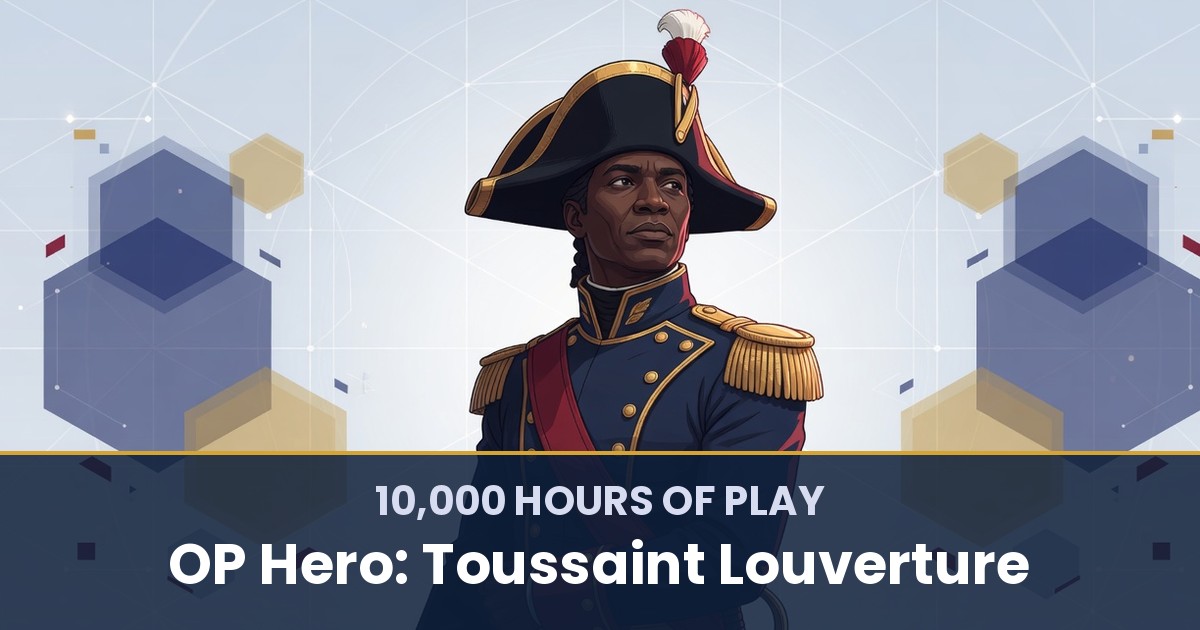


On June 7, 1802, French troops at Ennery arrested the man who governed the entire island of Hispaniola, after inviting him to a meeting under terms he had negotiated in good faith.
They put him on a ship to France and locked him in a mountain fortress called Fort de Joux, where he died on April 7, 1803.
By any scoreboard that ends at his death, Toussaint Louverture lost. Yet the revolution he built declared Haitian independence on January 1, 1804, barely nine months later, and slavery never returned to the island he had governed.
A man born enslaved around 1743, who did not hold a military command until his late forties, finished his run as governor-general of an entire island. The sections below take the six Steps in order: Game, Attributes, Role, Skills, Allies, Quests. His twelve revolutionary years give every one of them a concrete test.
⚡ Speed Run Notes
- Toussaint Louverture entered the Haitian Revolution in 1791 as a 48-year-old former coachman with no command. Twelve years later he governed the whole island of Hispaniola.
- His signature move was alliance switching anchored to one fixed objective: whichever power protected emancipation earned his army, first Spain, then republican France.
- He converted battlefield wins into institutions: the 1801 constitution he promulgated banned slavery in law and made him governor-general for life, while stopping short of declaring independence.
- His endgame carries the warning: he accepted a negotiated retirement in 1802, was arrested anyway, and died at Fort de Joux before Haiti won in 1804.
- Steal the build by picking your mission before you pick your faction, and by treating every role change as a move inside the same long game.
Table of Contents
About Yu-kai Chou

Yu-kai Chou is the author of 10,000 Hours of Play — the book that treats your life as the most important game you’ll ever build a character in, and gives you the 6-Step framework (Game · Attributes · Role · Skills · Allies · Quests) to play it on purpose. He has spent two decades developing the system through which this post analyzes its OP Hero, and applies it to his own life and to the lives of the people he advises around the world.
Chou’s other framework, the Octalysis Framework, has been applied by LEGO, Microsoft, Porsche, Coca-Cola, Salesforce, and MrBeast, impacting over 1.5 Billion Users. He has taught the methodology at Harvard, Stanford, Yale, Tesla, Google, BCG, and IDEO, and has advised governments in eight nations including Ukraine, the United Kingdom, the Kingdom of Bahrain, Singapore, Taiwan, the Netherlands, Kazakhstan, and South Korea.
His work has been cited by Harvard, Stanford, MIT, Forbes, Wall Street Journal, Wired, US Department of Energy, NIST, NSF, NCBI, US Department of Education, ClinicalTrials.gov, and Google Scholar — with 3,700+ more academic publications. Explore his books here.

Toussaint Louverture is the OP Hero I point to when someone tells me they started too late: he trained in obscurity for four decades, then compounded all of it in his final twelve years. The attribute work you do before anyone is watching still counts at full value, and his life is the proof I reach for.
Step 1: The Game — What Toussaint Louverture Was Actually Playing
Strip away the battles and the titles, and Toussaint’s Game stays the same from 1791 through 1803: make emancipation permanent in Saint-Domingue, and make formerly enslaved people the decisive military and political power that enforces it.
Everything else about his career stayed negotiable in service of that outcome: he fought for Spain when Spain armed the insurgency, then joined republican France in May 1794, months after the National Convention abolished slavery that February 4.
Contemporaries who tracked his uniform called him inconsistent, while anyone tracking his objective would have seen a straight line.
The sophistication shows in what he refused to simplify. Saint-Domingue’s economy ran on export agriculture, so he tried to keep the plantations producing through coercive labor regulations while refusing any return to slavery itself, holding two goals in tension that most revolutionaries would have collapsed into one.
By 1801 the end-state he had been playing toward was visible on paper: a self-governing colony, nominally French, with himself as governor-general for life and slavery abolished in its founding law.
Step 2: Attributes — The Innate Stats
Four innate stats show up across his record, and each of them was visible before 1791.
Strategic adaptability sat at the top of the sheet: the same man served Spain, then France, then effectively himself, evaluating each allegiance against the emancipation objective the way a portfolio manager evaluates positions.
Coalition intelligence let him manage Black, mixed-race, and white constituencies at the same time, while negotiating with three empires that all wanted him gone. He ran that stakeholder map with no ministry, no treasury, and no formal mandate behind him.
Institutional vision showed in what he built after each victory: where other commanders saw winning as the enemy leaving, he worked toward a constitution, a labor code, and an administration that could survive the next war.
Risk tolerance rounded out the sheet with the stat that made the others usable: marching into Spanish Santo Domingo in early 1801 unified the island and directly provoked Napoleon, and he did it anyway.
None of these attributes required the revolution to exist. As an enslaved coachman and later a commandeur at the Bréda plantation, he was already running logistics, reading people, and managing production systems.
The OP Talent Triangle Method calls this finding the overlap between what you are naturally wired for and what your arena rewards. In Toussaint’s case the arena arrived late: the attributes he had been sharpening since the 1750s only found their full market after 1791.
Step 3: Role(s) — The Character Class Across Chapters
Toussaint respec’d his character five times across five distinct life chapters, and every respec served the same Game.
Chapter one cast him as a plantation worker and coachman at Bréda, where he learned transport, animals, and how the colony’s labor system actually functioned from the inside.
Chapter two made him a freedman and a small planter: he obtained his freedom around 1776, in his early thirties, and later leased a coffee plantation, which means he understood the economics of the system he would eventually rewrite.
Chapter three recast him as an insurgent organizer when the northern plains rose in August 1791: the 48-year-old joined under Georges Biassou and, by most accounts, handled paperwork and negotiations before he ever held formal command.
Chapter four put him in a general’s uniform, first as a Spanish-allied commander and then as a French republican one, rising to brigadier general on July 23, 1795 and divisional general on August 17, 1796.
Chapter five crowned the run with the ruler and state-builder class, as governor-general of a unified Hispaniola by 1801.
A generation later, Simón Bolívar ran the same respec sequence across South America, moving from aristocrat to exile to general to head of state as his campaign demanded it.
Across all five chapters he never took a role that required abandoning the mission, and when France finally demanded exactly that, he fought rather than respec one more time.
Step 4: Skills — The Real-Life Game Skills Toussaint Louverture Mastered
Toussaint’s build drew on canon Real-Life Game Skills from four of the seven Classes, and each one is a named, trainable technique rather than a vague virtue.
Mastermind (Ranger) is the ability to create, adapt, and execute complex plans, and it was his core rotation. The 1798 to 1801 consolidation stands as the proof: he pushed the British into a negotiated evacuation in 1798, won the War of Knives against André Rigaud across 1799 and 1800, and occupied Santo Domingo in early 1801, three campaigns sequenced so each victory funded the next.
Adaptive Foraging (Ranger), finding the right resources for the challenge, showed earliest. As a Spanish-allied officer he negotiated weapons and provisions directly from Spanish authorities, converting leadership into supply lines when his side owned no arsenal.
Ley Line Infusion (Mage), the rapid absorption of a large body of knowledge, explains the paperwork behind the legend. He learned to read and write without formal schooling, and while archival summaries describe his writing as imperfect, his letters show a working command of French politics and law, the same command he had used when negotiating arms and supplies from Spanish officials.
Concord of Elements (Druid), the craft of bringing parties with different interests together, held his coalition of formerly enslaved soldiers, mixed-race officers, and white planters in one governable colony for years.
Terraform (Warlock) — changing the terrain by rewriting its rules — was the capstone. The constitution of 1801 turned his battlefield position into standing law.
On the Skills Spectrum, Toussaint reads as a master in the Ranger line who deliberately cross-trained into Druid and Warlock Skills, because governing demanded what winning battles never would.
Step 5: Allies — The People Who Multiplied Toussaint Louverture
Toussaint’s alliance map had two layers: a command structure he built from scratch, and imperial patrons he effectively rented.
The inner layer was his command structure. Georges Biassou gave him his first seat near power, an apprenticeship where he handled strategy and supply negotiations before holding rank.
Jean-Jacques Dessalines and Henri Christophe became the senior generals who made his army scale beyond what one commander could personally lead. Dessalines mattered most of all, because after Toussaint’s capture he broke with the French and carried the revolution through to independence on January 1, 1804.
The Allies lesson sits in that sequence: Toussaint’s mission survived his own arrest because he had built lieutenants who owned the mission rather than merely obeying him.
The outer layer was imperial patrons, and he treated them as rentable rather than permanent. Spain supplied arms and legitimacy in the early years, then republican France supplied legal emancipation and formal rank after 1794.
Both patrons believed they were using him, and both discovered too late that the dependency ran the other way.
The same map holds the failure that ended his run. When Napoleon sent General Leclerc’s expedition in 1802, parts of the coalition bent toward the invaders, and the trust Toussaint extended in negotiation became the opening his enemies used to arrest him.
An alliance built on a shared mission had multiplied him for ten years, and a negotiation that rested on nothing firmer than an enemy’s promise undid it in one afternoon.
Step 6: Quests — The Milestones That Shaped the Saga
Quest 1 was joining the 1791 uprising at all. When the northern enslaved population revolted in August 1791, the 48-year-old freedman chose the insurgency and started near the bottom of its org chart, in staff roles under Biassou. His earliest appearances in the surviving records involve negotiations rather than battles.
Quest 2 was the volte-face of 1794. After France abolished slavery on February 4, 1794, he moved his forces and territory to the republican side that May, a single decision that realigned the entire war around emancipation.
Quest 3 was consolidating the island between 1798 and 1801. The British evacuation of 1798, victory over Rigaud in the War of Knives of 1799 to 1800, and the occupation of Santo Domingo in early 1801 brought all of Hispaniola under one administration.
Quest 4 was the constitution of 1801. It abolished slavery in law, named him governor-general for life, and dared France to object, while still never declaring independence — broad autonomy under nominal French sovereignty.
Quest 5 was the endgame he could not win. Leclerc’s expedition arrived in early 1802 with overwhelming force. Toussaint accepted a negotiated retirement in May, was arrested at Ennery on June 7, 1802 in violation of those terms, and died at Fort de Joux on April 7, 1803.
He is widely reported to have said, as the ship carried him away, that in overthrowing him France had cut down only the trunk of the tree of liberty, and that it would spring back from the roots, which were many and deep.
The attribution rests on later histories rather than a shipboard transcript, but the forecast itself proved exact within two years. Dessalines declared Haitian independence on January 1, 1804, twenty-one months after Toussaint’s death.
What You Can Steal From Toussaint Louverture’s Build
First, fix the mission before you pick the faction. Toussaint switched employers the way modern professionals switch companies, and history reads him as consistent because the objective never moved.
Second, convert wins into institutions while you still hold the advantage. A victory that lives only in momentum evaporates; the 1801 constitution outlasted its author because he wrote his position into law.
Third, build allies who own the mission rather than allies who obey you. Dessalines finished the revolution after Toussaint’s death because the alliance carried the mission itself, and it kept functioning without its founder.
Fourth, respect how asymmetric endgames are compared to every move before them. One trusting negotiation with an opponent who held all the leverage undid a decade of patient positioning, so guard your final moves more carefully than your opening ones.
Your arena is almost certainly gentler than revolutionary Saint-Domingue, and the build transfers to it anyway. Start with a Game measured in years rather than weeks, because once that choice holds, the other five Steps finally have somewhere to compound.
Where this framework comes from

Want the full system this profile is built on?
Every OP Hero piece runs through the same 6-Step framework from 10,000 Hours of Play: Unlock Your Real-Life Legendary Success. The book covers the full system, walks through Yu-kai’s own life run as the first applied case study, and gives you the worksheets to audit your own build.
Related Reading
- All OP Hero Profiles: the full 10,000 Hours of Play hero catalog
- 10,000 Hours of Play by OP Hero: Frederick Douglass
- 10,000 Hours of Play by OP Hero: Harriet Tubman
- 10,000 Hours of Play by OP Hero: José Rizal
- The 10K HP Framework: 6 Steps to Gamify Your Life