
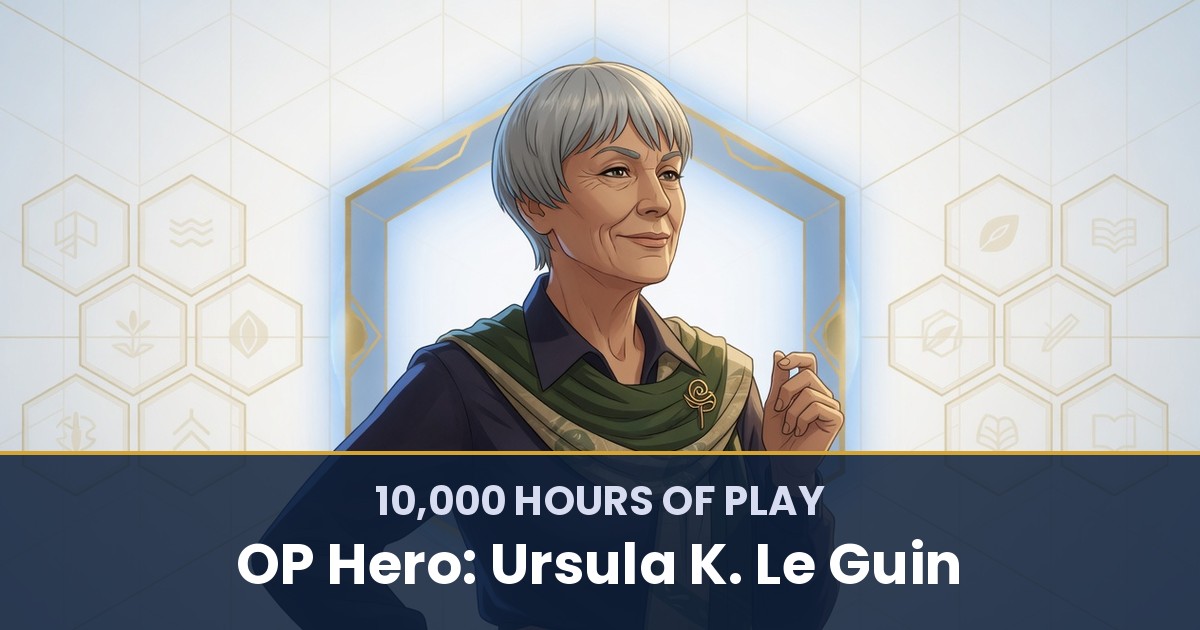


On November 19, 2014, an 85-year-old fantasy writer stood on the National Book Awards stage and told the assembled publishing industry that its ruling logic would not last forever: “We live in capitalism, its power seems inescapable — but then, so did the divine right of kings.”
The room she said it to belonged to an establishment that had spent decades treating her genre as a lesser shelf. She had spent those same decades collecting six Nebula Awards and five Hugo Awards while building invented worlds that put gender, property, and power under the microscope.
And the run almost didn’t happen. Between 1951 and 1961, Ursula K. Le Guin wrote five complete novels, and publishers rejected every single one of them.
She kept playing anyway. This profile maps her life through the 6-Step framework for gamifying your real life: the Game she chose, the Attributes she was dealt, the Roles she selected, the Skills she trained, the Allies who multiplied her, and the Quests that made her legendary.
⚡ Speed Run Notes
- Le Guin wrote five novels between 1951 and 1961 and sold none of them. Her first published novel, Rocannon’s World, arrived in 1966. The rejected decade is where the writer got built.
- The Left Hand of Darkness (1969) and The Dispossessed (1974) each won both the Hugo and the Nebula Award. Across her career she collected six Nebulas and five Hugos.
- Her signature move was the thought experiment: change one rule of a society (gender, property, dreaming) and run the world forward to see what breaks.
- Her build runs on five canon Real-Life Game Skills: Loremaster, Arcane Wisdom, Astral Projection, Iron Skin, and Aegis.
- Raised by an anthropologist and a writer, she turned a childhood of watching human systems into the raw material for Earthsea, Gethen, and Anarres.
Table of Contents
About Yu-kai Chou

Yu-kai Chou is the author of 10,000 Hours of Play — the book that treats your life as the most important game you’ll ever build a character in, and gives you the 6-Step framework (Game · Attributes · Role · Skills · Allies · Quests) to play it on purpose. He has spent two decades developing the system through which this post analyzes its OP Hero, and applies it to his own life and to the lives of the people he advises around the world.
Chou’s other framework, the Octalysis Framework, has been applied by LEGO, Microsoft, Porsche, Coca-Cola, Salesforce, and MrBeast, impacting over 1.5 Billion Users. He has taught the methodology at Harvard, Stanford, Yale, Tesla, Google, BCG, and IDEO, and has advised governments in eight nations including Ukraine, the United Kingdom, the Kingdom of Bahrain, Singapore, Taiwan, the Netherlands, Kazakhstan, and South Korea.
His work has been cited by Harvard, Stanford, MIT, Forbes, Wall Street Journal, Wired, US Department of Energy, NIST, NSF, NCBI, US Department of Education, ClinicalTrials.gov, and Google Scholar — with 3,700+ more academic publications. Explore his books here.

Le Guin ran Step 4 discipline on a Step 1 timescale: one Game chosen in her early twenties, ten years of rejection absorbed without a course change, and a single trained skill (the thought experiment) carrying five decades of output. From her run I’d lift one rule for yours: pick the Game first, and let rejections inform your timing while the mission stays fixed.
Step 1: The Game — What Le Guin Was Actually Playing
Most readers file Le Guin under escapism. Her actual Game ran in the opposite direction: she built other worlds to make this one easier to see.
Across six decades of novels, essays, and poetry, she kept chasing the same objective: expand the range of imaginable human lives. Can people live without domination? What does gender do to power? Which kinds of knowledge get excluded when institutions decide what counts as rational?
Those questions sound like a philosophy seminar. She smuggled them into bookstores inside dragons and spaceships, and readers worked through them without ever feeling lectured.
The Game stayed fixed while the genres rotated. Science fiction, fantasy, children’s books, criticism, translation: every format was another board to play the same match on.
Step 2: Attributes — The Innate Stats
Le Guin rolled an unusual starting character sheet. Her father was the anthropologist Alfred L. Kroeber, and her mother was the writer Theodora Kroeber, which meant she grew up inside a household where human cultures were the standing topic of conversation.
Her first attribute was pattern recognition. She saw societies as systems of kinship, language, ritual, and economics rather than as backdrops, and that systems-eye is visible in everything she wrote.
Second came empathy across difference. Her fiction keeps entering radically unfamiliar perspectives, and understanding in her stories develops through translation and trust rather than conquest.
Third was her tolerance for ambiguity. She preserved contradictions (freedom versus community, technology versus wisdom) as live questions instead of resolving them for applause.
Fourth, and most load-bearing: independence from prestige systems. She worked for decades in genres the literary establishment dismissed, and the dismissal never redirected her output.
In the Talent Triangle Method terms, her edge strength was that systems-eye: the analytical talent sat underneath the artistic one, and the overlap is where Earthsea and Anarres came from.
Step 3: Role(s) — The Character Class Across Chapters
Le Guin’s Role evolved in clean chapters, and each chapter compounded the previous one.
As a child she played the observer, absorbing how her parents’ anthropological world examined custom and culture. At Radcliffe and then in graduate work at Columbia, she became the scholar, training on literature and language.
Through the 1950s and early 1960s she ran a double Role that would exhaust most players: parent of three young children and apprentice novelist, drafting books in the hours a household left over.
Then came the Role she is remembered for: world-builder. From the mid-1960s onward she operated as a social experimentalist who happened to publish her laboratory results as novels.
Her later chapters added essayist, critic, and finally elder stateswoman of American letters, the Role she was playing on that 2014 awards stage.
Step 4: Skills — The Real-Life Game Skills Le Guin Mastered
Mapped against the canon catalog, Le Guin’s build centers on five trained Skills, and each one has a documented moment where it cracked a result open.
Loremaster (Druid) — weaving compelling, inspiring stories. This is the visible Skill. In A Wizard of Earthsea (1968) she used mythic structure while refusing the easy good-versus-evil payoff: Ged’s enemy is his own divided self, and mastery arrives through recognition rather than conquest.
Arcane Wisdom (Mage): absorbing wide information and synthesizing it into clear output. A childhood of anthropology became usable craft: kinship structures, naming customs, and economic arrangements all got converted into the texture of invented societies.
Astral Projection (Mage) — seeing the possible outcomes before they happen. Her thought experiments changed exactly one rule and ran the consequences honestly. The Left Hand of Darkness (1969) removed fixed gender and watched politics transform; The Dispossessed (1974) removed property and refused to pretend the resulting society had no problems.
Iron Skin (Warrior): staying unaffected by rejection after proactive outreach. Five novels written between 1951 and 1961, every one rejected, and she kept submitting until Rocannon’s World sold in 1966. A fifteen-year apprenticeship with no external validation is this Skill at grandmaster level.
Aegis (Paladin) — ignoring naysayers while pushing the Quest. The literary world called her genre a ghetto for most of her career. She answered by writing essays defending imaginative fiction as serious thought, and by 2014 the same establishment was handing her its Medal for Distinguished Contribution to American Letters.
All five are trainable Real-Life Game Skills rather than fixed talents. Where she sat on the Skills Spectrum is instructive too: a Master profile, one deep stack of storytelling-plus-systems skills applied across many formats rather than many shallow ones.
Step 5: Allies — The People Who Multiplied Le Guin
Le Guin’s alliance started at birth. Alfred Kroeber gave her the comparative lens on culture that her world-building ran on for six decades.
Theodora Kroeber modeled the writing life itself, and her book Ishi in Two Worlds (1961) demonstrated at the family dinner table that cultural encounter could be written about with rigor and care.
Her husband Charles Le Guin was the durable infrastructure ally. She acknowledged across interviews and autobiographical writing that their partnership is what made a five-decade writing career compatible with raising three children.
The children were allies too, in an unexpected direction: parenting shaped her schedule and fed directly into her children’s books, including the Catwings series.
And her editors and publishers, once they finally arrived, converted a rejected decade of manuscripts into a publishing run. The alliance lesson is structural: nobody in her corner wrote a sentence for her, yet without the household and professional scaffolding the sentences would have had nowhere to land.
Step 6: Quests — The Milestones That Shaped the Saga
Quest one was surviving the rejection decade. Five finished novels between 1951 and 1961, zero sales, and the response that defines her build: keep writing until Rocannon’s World broke through in 1966.
Quest two, A Wizard of Earthsea in 1968, opened the Earthsea saga, the series she would keep returning to for the next three decades.
The same era delivered a telling setback: when Playboy published her story “Nine Lives” in 1968, it ran under the byline “U.K. Le Guin.” The industry would take the fiction before it would take the name.
Quest three was The Left Hand of Darkness in 1969, which won both the Nebula and the Hugo Award and forced the field to treat a gender thought experiment as a landmark.
Quest four, The Dispossessed (1974), repeated the double win and proved the first one was no accident. Alongside them, The Farthest Shore took the National Book Award for Children’s Books in 1973.
The endgame Quest came on November 19, 2014: the National Book Foundation’s Medal for Distinguished Contribution to American Letters, and the acceptance speech where she defended art against the market’s claim to permanence.
What You Can Steal From Le Guin’s Build
First, choose a Game you can state in one sentence. Le Guin could: make other ways of living imaginable. Every project for sixty years cashed out that sentence.
Second, train Iron Skin before you need it. Ten years of rejection would end most careers in year two; she treated the pile as tuition.
Third, steal her Astral Projection protocol. Take a system you live inside, change exactly one rule, and think the consequences through without cheating. That exercise works on product strategy and career design as well as it works on novels.
Fourth, audit your alliance for infrastructure. Her multipliers were a household and a heritage rather than a mastermind group, and they compounded for decades.
Le Guin’s scoreboard lagged her skill curve by roughly twenty years, and she won anyway.
Where this framework comes from

Want the full system this profile is built on?
Every OP Hero piece runs through the same 6-Step framework from 10,000 Hours of Play: Unlock Your Real-Life Legendary Success. The book covers the full system, walks through Yu-kai’s own life run as the first applied case study, and gives you the worksheets to audit your own build.
Related Reading
- OP Hero Profiles: 100+ Legendary Lives as RPG Builds
- 10,000 Hours of Play by OP Hero: Hans Christian Andersen
- 10,000 Hours of Play by OP Hero: Gabriel García Márquez
- 10,000 Hours of Play by OP Hero: Toni Morrison
- Real-Life Game Skills: 96 Skills, 7 Classes, Real Builds