
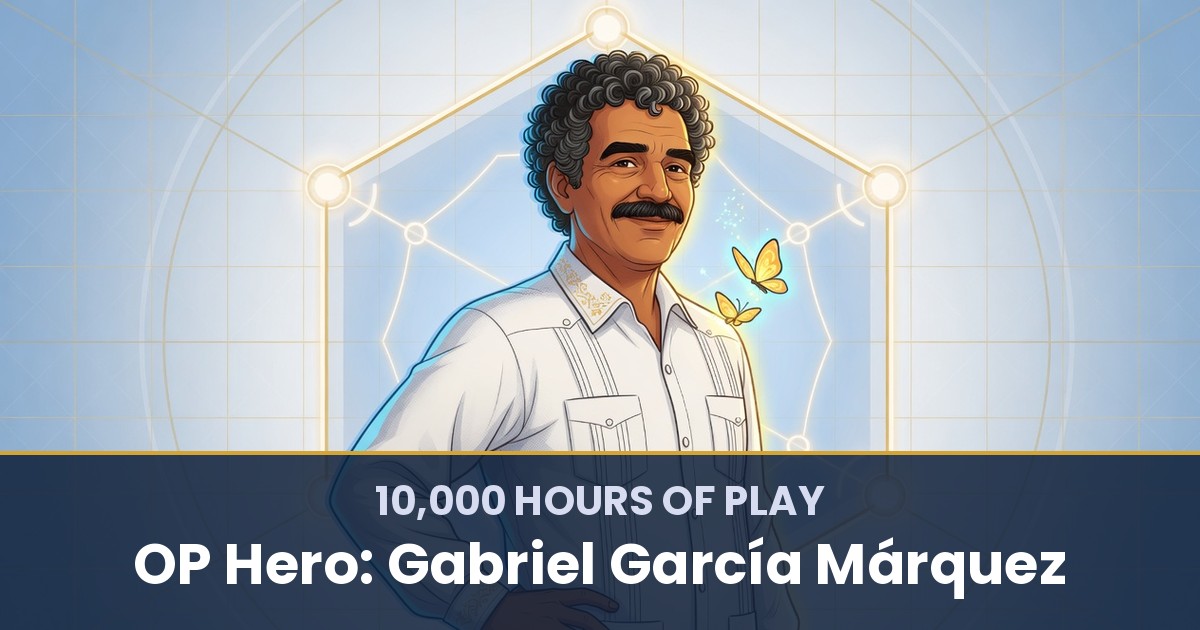


In August 1966, a writer and his wife stood at a post office counter holding the manuscript of One Hundred Years of Solitude, and they could not afford to mail it.
Postage to the publisher in Buenos Aires came to 82 pesos. The family had been living on credit for eighteen months while Gabriel García Márquez wrote, so they sent the portion they could pay for, pawned more of their belongings, and mailed the rest.
The book in that package sold 8,000 copies in its first week in Argentina. Fifteen years later, the Swedish Academy called his name for the 1982 Nobel Prize in Literature.
Run his life through the 10,000 Hours of Play framework and the story reads as a build: a Game chosen in childhood, Attributes sharpened into a reporter’s toolkit, and one all-in Quest that bet everything the family owned on a single story. Let’s walk the six Steps of that build, because almost every one of them is stealable.
⚡ Speed Run Notes
- García Márquez played one Game his whole career: converting Latin America’s lived reality (family memory, political violence, superstition) into fiction read across the whole world.
- His breakout Skill was a reporter’s True Sight: a fourteen-part 1955 shipwreck investigation taught him to make the incredible sound documented.
- The eighteen-month Lich Grind that produced One Hundred Years of Solitude ran on Sacrificial Cycle: every household asset the couple had, down to the pawnshop, went into finishing the book.
- Allies multiplied him at every chapter: Mercedes Barcha ran the household, the Barranquilla Group rebuilt his reading list, and agent Carmen Balcells turned one novel into a global career.
- His biggest setback, exile after exposing a naval scandal in 1955, became the pivot that turned a reporter into a novelist and his clearest use of Phoenix Rebirth.
Table of Contents
About Yu-kai Chou

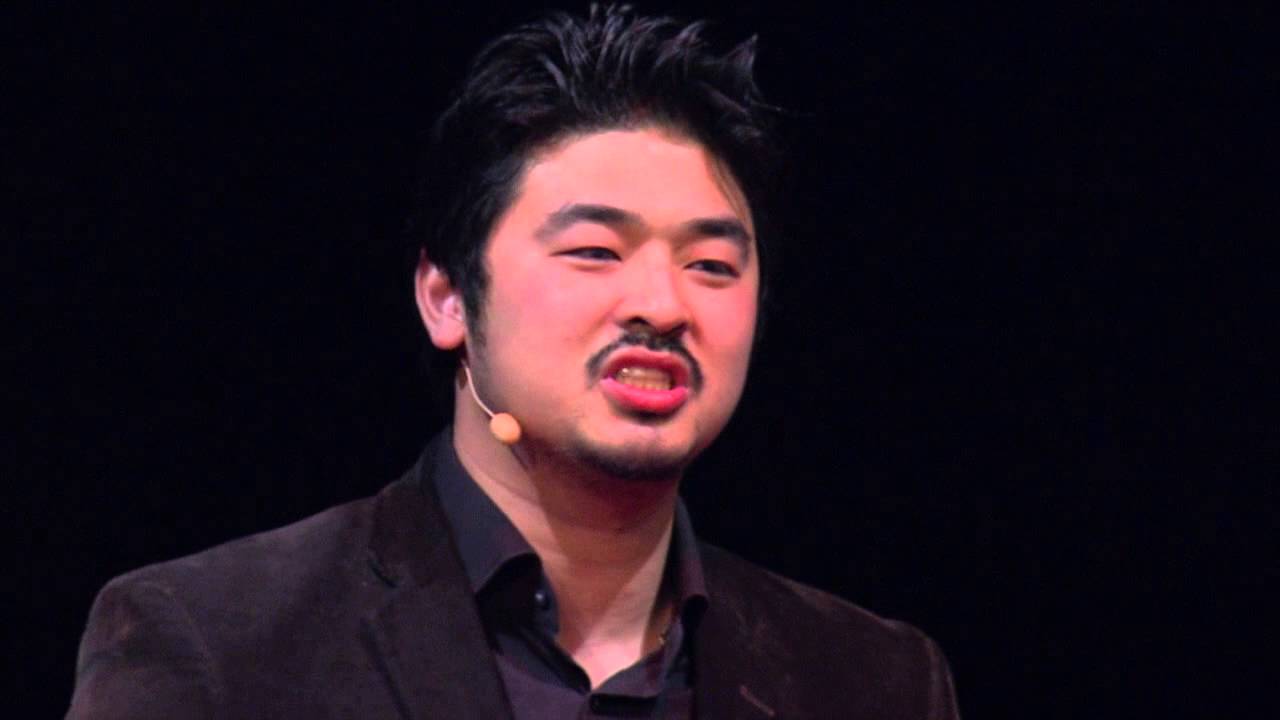
Yu-kai Chou is the author of 10,000 Hours of Play — the book that treats your life as the most important game you’ll ever build a character in, and gives you the 6-Step framework (Game · Attributes · Role · Skills · Allies · Quests) to play it on purpose. He has spent two decades developing the system through which this post analyzes its OP Hero, and applies it to his own life and to the lives of the people he advises around the world.
Chou’s other framework, the Octalysis Framework, has been applied by LEGO, Microsoft, Porsche, Coca-Cola, Salesforce, and MrBeast, impacting over 1.5 Billion Users. He has taught the methodology at Harvard, Stanford, Yale, Tesla, Google, BCG, and IDEO, and has advised governments in eight nations including Ukraine, the United Kingdom, the Kingdom of Bahrain, Singapore, Taiwan, the Netherlands, Kazakhstan, and South Korea.
His work has been cited by Harvard, Stanford, MIT, Forbes, Wall Street Journal, Wired, US Department of Energy, NIST, NSF, NCBI, US Department of Education, ClinicalTrials.gov, and Google Scholar — with 3,700+ more academic publications. Explore his books here.
What draws me to García Márquez’s build is its patience. He spent decades collecting the material of Macondo before he locked the door to write it, and the lesson I’d lift for your own run is the sequencing: a storyteller’s craft only became legendary after a journalist’s eye had fed it years of concrete, verifiable detail. Master the boring version of your Skill first. The magical version is built on top of it.
Step 1: The Game — What García Márquez Was Actually Playing
Gabriel García Márquez grew up in Aracataca, a small Colombian town, raised largely by his maternal grandparents in a house thick with family stories, ghosts, omens, and the living aftermath of the Banana Massacre.
That childhood handed him his Game before he could name it: preserve and transform memory through storytelling.
Everything that looks like a career pivot in his life is actually the same mission wearing a different uniform. He abandoned law school for journalism, a profession built around observing and recording reality.
His fiction then converted that recorded reality into universal form. One Hundred Years of Solitude compresses roughly a century of family and national history into the rise and disappearance of a single town, Macondo.
And when he finally stood at the Nobel podium on December 8, 1982, his lecture made the mission explicit: Latin America’s seemingly fantastic realities are not inventions. They are historical facts the outside world had failed to recognize.
Written as a game objective, his life reads in three moves: convert memory into narrative, convert narrative into recognition, and convert recognition into cultural agency for an entire continent.
Step 2: Attributes — The Innate Stats
Attributes are the stats you spawn with. You don’t earn them; you discover them, and the OP Talent Triangle Method exists precisely to help you find yours faster than García Márquez found his.
His character sheet shows at least four stats rolled high from the start.
Pattern recognition. He noticed structural links among apparently unrelated things: family legends, recurring names, cycles of political catastrophe. That instinct later became the formal architecture of One Hundred Years of Solitude, where repeated names and repeated mistakes carry the novel’s whole argument about history.
Memory orientation. He retained sensory and verbal detail across decades and reused it on demand. His memoir Living to Tell the Tale makes memory itself the organizing subject of his life.
Imaginative tolerance for the improbable. Raised by relatives who treated omens as ordinary facts, he never learned to separate the supernatural from the political and the everyday.
Risk tolerance. He left law for poorly paid journalism, lived abroad through political and economic uncertainty, and later let his family run on credit for a year and a half while he wrote.
Step 3: Role(s) — The Character Class Across Chapters
A Role is the class you play in a given chapter, and García Márquez changed his on purpose, several times.
Childhood cast him as the memory-gatherer: a child absorbing several generations of family narrative at once.
His twenties made him a literary apprentice publishing early stories, then a journalist and foreign correspondent. Reporting trained him in investigation, scene construction, dialogue, and documentary detail.
The 1950s pushed him into a harder class: the exile. Political pressure after a story he broke sent him to Geneva and Rome, and later chapters of his life ran through Paris, New York, Barcelona, and Mexico. Working abroad gave him a longer view of the country he kept writing about.
Then 1967 arrived, and he respec’d into the class the world knows: the novelist. Later chapters added public intellectual and institution-builder, roles that spent the authority the novels had earned.
Mark Twain ran the same class sequence a century earlier, a reporter who turned a journalist’s eye into fiction that outlived every newspaper he wrote for.
Step 4: Skills — The Real-Life Game Skills García Márquez Mastered
Attributes are rolled; Skills are trained. Where your practice sits on the Skills Spectrum decides whether a talent ever becomes a weapon. Here is the stack García Márquez trained to mastery.
True Sight (Ranger) — the ability to observe keen details others miss. His reporting years built it deliberately: constructing narrative from observable physical detail, chronology, and testimony. You can watch the Skill firing in The Story of a Shipwrecked Sailor and Chronicle of a Death Foretold, where every extraordinary event stands on documented specifics.
Loremaster (Druid) — weaving compelling, inspiring stories. His version adapted oral storytelling to prose: anecdote, refrain, delayed revelation, the cadence of a narrator recounting events everyone already knows. Leo Tolstoy ground the same Skill toward moral clarity; García Márquez ground it toward myth.
The fusion of those two Skills produced his famous method: present the fantastic in a plain, reportorial register. The technique that critics named magical realism is, mechanically, True Sight feeding Loremaster.
Lich Grind (Warlock): intense, secluded work periods. From January 1965 to August 1966 he disappeared into the novel, roughly eighteen months of concentrated work while the world outside the study was held together by his wife.
Sacrificial Cycle (Warlock): reinvesting all resources back into the project. The family lived on credit and pawned belongings to finish and mail the manuscript.
Step 5: Allies — The People Who Multiplied García Márquez
No solo run produces One Hundred Years of Solitude. Every phase of his life shows a deliberate Summon (Druid): calling the right Ally into the current Quest.
Mercedes Barcha, his wife, sustained the entire household through the eighteen-month writing grind. When the finished manuscript needed 82 pesos of postage they didn’t have, the two of them solved it together at the pawnshop. Without her the eighteen-month grind could not have kept going.
The Barranquilla Group rebuilt his literary operating system in his twenties. The Catalan bookseller Ramón Vinyes, whom he later wrote into One Hundred Years of Solitude as “the Catalan bookseller,” pointed him at the modern experimental fiction that conventional Colombian realism never would have shown him. Senior members like Alfonso Fuenmayor and Álvaro Cepeda Samudio sharpened him through argument.
Carmen Balcells, his literary agent, converted one breakout novel into a durable global career by managing the international rights to his work.
Editorial Sudamericana, the Buenos Aires publisher, gave the book its launchpad: first edition on May 30, 1967, and 8,000 copies sold in the first week in Argentina.
His alliance filled four distinct slots: a stabilizer at home, a challenger circle for craft, a dealmaker for reach, and an institution for distribution.
Step 6: Quests — The Milestones That Shaped the Saga
Quest 1: The shipwreck investigation (1955). Beginning April 5, 1955, he published a fourteen-part series in El Espectador on sailor Luis Alejandro Velasco, who survived the wreck of the destroyer Caldas. The reporting showed the ship had been carrying contraband, contradicting the government’s official account. The fallout pushed him out of Colombia, first to Geneva, then Rome.
That first major Quest ended in exile, and the exile was also the making of him. The displacement forced the correspondent years, the European vantage point, and the long apprenticeship that fed the novels. Phoenix Rebirth (Paladin) — recovering from devastating failure and coming back stronger — is the defining move of his mid-game, the same recovery Fyodor Dostoevsky had to make when his own career detoured through a Siberian prison.
Quest 2: The novel (1965–1967). Eighteen months of seclusion, a family in debt, a manuscript mailed in two installments, and then publication on May 30, 1967. The breakout was immediate.
Quest 3: The Nobel (1982). The Swedish Academy announced him on October 21, 1982, citing work in which “the fantastic and the realistic are combined.” His December lecture turned the personal award into an argument on behalf of a continent.
Quest 4: Giving the Skill tree away (1994–2002). He co-founded the Fundación Nuevo Periodismo Iberoamericano in 1994 with his brother Jaime and journalist Jaime Abello Banfi to train the next generation of reporters. He published News of a Kidnapping in 1996, was diagnosed with lymphoma in 1999, and answered the diagnosis by publishing his memoir Living to Tell the Tale in 2002, a memory-keeper getting his memories down while there was time.
What You Can Steal From García Márquez’s Build
Let your day job feed your art. He was a working reporter long before he was a novelist, and the novels are built from what the reporting years handed him. If your current Role feels beneath your ambition, ask what Skill it’s secretly leveling.
Recruit a full alliance. Stabilizer, challengers, dealmaker, distributor. Write the four slots down, name who fills each one for you, then recruit for the empty ones.
Treat your worst setback as a respec. When a door slams, check which class it just unlocked.
Your move: pick the one Step above where your build is weakest, and spend this week playing it on purpose.
Where this framework comes from

Want the full system this profile is built on?
Every OP Hero piece runs through the same 6-Step framework from 10,000 Hours of Play: Unlock Your Real-Life Legendary Success. The book covers the full system, walks through Yu-kai’s own life run as the first applied case study, and gives you the worksheets to audit your own build.
Related Reading
- All OP Hero Profiles: the full 10,000 Hours of Play roster
- 10,000 Hours of Play by OP Hero: Eiichiro Oda
- 10,000 Hours of Play by OP Hero: Agatha Christie
- 10,000 Hours of Play by OP Hero: J.R.R. Tolkien
- 10,000 Hours of Play by OP Hero: Confucius